
Compare UK restaurant SEO services from £300 to £2,000/month. Learn what's included, red flags to avoid, and when DIY is enough.
You've just finished Saturday service when you remember: you were supposed to sort out SEO this week. Again. With 74% of diners searching online, you need help. But every restaurant SEO services agency sounds identical. They promise "First page in 90 days!" Yet you're still not sure what they actually do for £500 monthly.
Restaurant SEO services help restaurants rank higher in local search results. They optimise Google Business Profiles, build citations, manage reviews, and improve website performance. These services range from full-service agency retainers costing over one thousand pounds monthly to more affordable packages for independent restaurants.
Yet many restaurant owners avoid professional restaurant SEO services. They don't understand what they're buying. You've probably been cold-called by agencies promising first-page rankings.
But ask yourself: do you know what restaurant SEO services should include? Many owners sign up without clarity. That makes them targets for overpriced packages that deliver glossy reports instead of customers. You pay an agency £500 monthly. Six months later you're still not ranking. But they'll have plenty of charts showing why results are "coming soon."
This guide to restaurant SEO services breaks down what they deliver, what they cost in the UK, and whether professional SEO services are worth the investment.
Related: Restaurant SEO
What You'll Learn
- What legitimate agencies should deliver for your restaurant
- Typical UK pricing and what you should expect at each level
- Red flags that signal an agency to avoid
- When DIY SEO makes more sense than hiring help
Contents:
- What Do Restaurant SEO Services Include?
- How Much Do Restaurant SEO Services Cost?
- What Makes Restaurant SEO Different?
- How to Evaluate an SEO Agency
- DIY vs Agency
- Minimum Viable Plan
What Do Restaurant SEO Services Include?
So what exactly should you expect from restaurant SEO services? Legitimate SEO agencies typically cover four core areas for restaurants: Google Business Profile optimisation, local citation building, review management, and website optimisation. Many good services also include regular reporting so you can see what's actually happening with your rankings.
So what does that actually look like in practice?
Google Business Profile Optimisation
Your Google Business Profile is typically one of the most critical foundations for restaurant SEO. According to Whitespark's local search ranking factors research, GBP signals typically account for approximately 32% of local pack ranking factors.
A good SEO service should:
- Claim and verify your profile if not already done
- Select appropriate business categories for your restaurant type
- Upload photos on a regular schedule
- Keep hours and contact information updated
- Post weekly updates to keep your profile active
For example, a pizza restaurant in Bristol might work with an agency to add high-quality photos of their wood-fired oven, update their menu with seasonal specials, and ensure their delivery radius is accurately marked.
Local Citation Building
Citations are mentions of your restaurant's name, address, and phone number across the web. Consistency matters more than quantity. So where should an agency focus? Here are the key UK citation sources worth optimising:
Key UK citation sources an agency should target:
- TripAdvisor
- Yell.com
- OpenTable
- The Good Food Guide
- Time Out
- Local business directories
Related: Restaurant Citations
If you focus only on citations and skip Google Business Profile updates, competitors who manage both will typically outrank you. Now let's look at the third pillar that often gets overlooked.
Review Management
Reviews are where customer sentiment becomes visible to both Google and future diners.
Reviews typically influence both rankings and customer decisions. According to industry research, nearly 98% of consumers read online reviews before visiting local businesses (ReviewTrackers, 2025).
SEO services should include:
- Setting up a system to request reviews from customers
- Monitoring reviews across platforms
- Drafting professional responses to both positive and negative feedback
- Flagging fake or policy-violating reviews for removal
Finally, there's the technical side that many restaurant owners find most intimidating.
Website SEO
Beyond Google Business Profile and reviews, your actual website also needs optimisation for both search engines and diners.
For restaurants with their own website, technical SEO services typically include:
- Mobile optimisation (critical for restaurant searches)
- Page speed improvements
- Menu page optimisation with relevant keywords
- Local schema markup implementation
- Blog content strategy for longer-term traffic
How Much Do Restaurant SEO Services Cost in the UK?
Now for the question most restaurant owners ask first: what will this actually cost?
UK restaurant SEO services typically range from around two hundred pounds per month for basic packages to over two thousand pounds monthly for comprehensive agency retainers. The right investment depends on your local competition and current visibility.
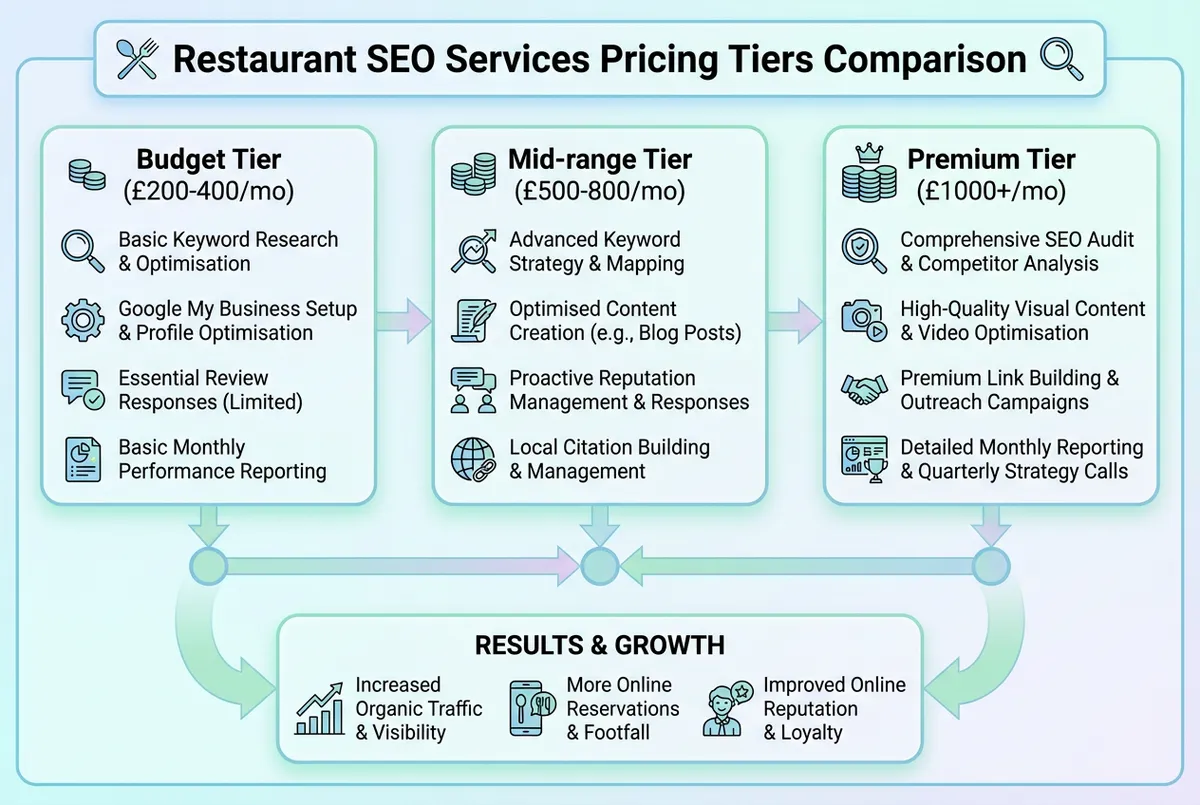
UK restaurant SEO services pricing comparison
Here's what you typically get at each price point for restaurant SEO services:
| Tier | Monthly Cost | What's Included | Often Best For |
|---|---|---|---|
| Budget | £200-400 | Basic GBP management, citation cleanup, monthly reports, limited optimisation | Single-location restaurants in moderate competition areas |
| Mid-Range | £500-800 | Budget services + review campaigns, basic website SEO, 1-2 blog posts/month, strategy calls | Urban restaurants or second location builds |
| Premium | £1,000+ | Comprehensive strategy, ongoing content, technical audits, multi-location support, dedicated manager, ROI tracking | Restaurant groups, franchises, or competitive central London locations |
Note: This pricing comparison reflects typical UK market rates as of 2026. Individual restaurant SEO services may vary based on location competition and specific needs.
Budget Tier: Around Two to Four Hundred Pounds Monthly
At this level, expect:
- Basic Google Business Profile management
- Citation auditing and cleanup
- Monthly reporting
- Limited ongoing optimisation
Often best for: Single-location restaurants in areas with moderate competition. If you're the only Thai restaurant in a small town, budget restaurant SEO services might be sufficient.
For instance, a village gastropub might hire an agency at this level to clean up inconsistent business listings and get their Google Business Profile properly optimised.
Mid-Range: Five to Eight Hundred Pounds Monthly
At this level, services typically include:
- Budget tier services
- Active review generation campaigns
- Basic website SEO
- Content creation (1-2 blog posts monthly)
- More detailed reporting and strategy calls
Often best for: Restaurants in competitive urban areas or those building a second location.
Premium: Over One Thousand Pounds Monthly
At this level, professional services include:
- Comprehensive local SEO strategy
- Ongoing content marketing
- Technical website audits
- Multi-location management
- Dedicated account manager
- Detailed analytics and ROI tracking
Often best for: Restaurant groups, franchises, or ambitious independents in highly competitive markets like central London.
For many independent UK restaurants, the mid-range tier typically offers a good balance of results and affordability. If you're only looking at the cheapest option available you'll typically lose ground to competitors investing in proper SEO.
Understanding pricing is only half the picture. Here's why restaurant SEO requires a different approach than general SEO.
What Makes Restaurant SEO Different from General SEO?
Understanding these pricing tiers is important, but there's something else you need to know. Restaurant SEO focuses heavily on local search signals because diners search with location intent. Unlike e-commerce sites competing nationally, restaurants compete within a specific radius.
This typically means:
- Google Business Profile often matters more than your website for local searches
- Reviews typically have greater importance compared to many other industries
- "Near me" searches frequently dominate the customer discovery journey
- Mobile optimisation is usually critical since most restaurant searches happen on mobile devices
An agency that specialises in restaurants understands these nuances. A generalist SEO agency might focus too heavily on traditional website metrics that often matter less for local restaurant visibility.
Related: Restaurant Local SEO
If you're reading this thinking "I've been paying an agency and I'm not sure what they're actually doing", that's usually a sign something needs addressing. Legitimate agencies should be able to show you exactly what work they've completed and how it connects to your visibility.
So how do you separate the good agencies from the bad?
How to Evaluate a Restaurant SEO Agency
So you've decided hiring an SEO agency might be worth exploring. But here's the challenge: how do you tell the difference between legitimate agencies and one that takes your money and delivers nothing useful?
Before signing any contract, you need answers to these core questions.
Questions to Ask
If you're only skimming agency proposals and signing without understanding what you're buying, competitors who ask these questions will typically outrank you. Here are the core questions to ask before signing any contract:
Can you show me case studies from other restaurants? Legitimate agencies have examples of results they've achieved for similar businesses.
What specific work will you do each month? Vague answers like "optimisation" or "link building" often signal a problem. You want specifics.
How will you report on progress? Monthly reports should typically include rankings for specific keywords, Google Business Profile insights, and review metrics, not just generic traffic numbers.
What's your approach to reviews? Any agency suggesting they'll write fake reviews or use review exchange schemes is a red flag and should typically be avoided.
What happens if I want to cancel? Avoid long lock-in contracts. Quarterly agreements are reasonable; annual contracts with penalty clauses are not.
Pro Tip: Ask for a sample monthly report from another client (anonymised). This shows you exactly what you'll receive and how detailed their work actually is.
Red Flags to Watch For
- Guaranteed rankings - If an agency promises first-page rankings, be cautious. Very few legitimate agencies can guarantee specific positions on Google: this is typically a warning sign
- Secret techniques - SEO fundamentals are well documented; secrecy often suggests black-hat tactics
- Ownership of your listings - You should typically own your Google Business Profile; avoid agencies that claim ownership of your listings
- No clear deliverables - "We'll do SEO" isn't a deliverable; it's a non-answer
- Unusually low prices - If an agency's price seems too good to be true, it often is; you're likely not getting meaningful work
For instance, an Indian restaurant in Birmingham was paying an agency claiming to "optimise" their SEO. When the owner asked what specific work was done last month, the agency couldn't provide any concrete examples. The restaurant cancelled and saw no change in rankings, proving the agency wasn't doing meaningful work.
If you're only checking in with your agency once a month when they send their report you'll typically lose ground to competitors who track results weekly and make adjustments. That's usually a sign you need to have a more active conversation about deliverables, and frankly, whether they're worth keeping.
Related: Restaurant SEO Checklist
Should You Hire an Agency or Do It Yourself?
Of course, the biggest question remains: are SEO services actually worth the cost? It helps to compare hiring an agency with doing it yourself before you commit to a monthly retainer.
If you're only handling SEO when it's quiet in the restaurant you'll typically lose ground to competitors who treat it as a consistent operation. The question isn't just about skill. It's about time and consistency.
Consider DIY If:
Expecting results from an agency without monitoring their work is rarely effective. Here's when DIY actually makes sense:
- You have 2-3 hours weekly to dedicate consistently
- Your local competition is moderate
- You're willing to learn the fundamentals
- You're comfortable with basic technology
Consider an Agency If:
- You genuinely cannot spare the time
- You're in a highly competitive area
- You have the budget and want faster results
- Multiple locations make management complex
The Hybrid Approach
Many restaurant owners find a hybrid approach works well:
- Handle daily tasks yourself (responding to reviews, posting updates)
- Hire for one-off technical work (website audits, citation cleanup)
- Try DIY for 6 months before committing to an agency
For example, a gastropub in a competitive city centre might manage their own Google Business Profile updates but hire an agency to handle their website SEO and citation building. The owner responds to reviews during a quiet Wednesday afternoon while the agency handles the technical work.
Ask yourself: "Would I trust this agency to represent my restaurant if I couldn't check their work for a month?" If the answer is no, that tells you something.
If You Only Have 30 Minutes a Week
Let me be realistic: many restaurant owners struggle to spend hours on SEO. If you're thinking "I barely have time to eat lunch, let alone do SEO", you're not alone. But here's what you CAN realistically accomplish yourself in just 30 minutes a week:
This week, start your restaurant SEO foundation:
Day 1-2: Claim your Google Business Profile if you haven't already. Go to Google Business and log in with your restaurant's Google account. Add your complete menu, update hours, and upload 5 recent photos.
Day 3-4: Check your top 5 citation sources (TripAdvisor, Yell, OpenTable, Google, Bing) and ensure your name, address, and phone number are consistent across them.
Day 5-7: Ask your last 5 satisfied customers to leave a Google review. A simple card with a QR code works well.
If you're only tackling SEO sporadically when you remember you'll always lose to competitors who prioritise it weekly.
Related: How to Improve Restaurant SEO
If you only tackle SEO sporadically when you remember, competitors who prioritise it weekly will typically outrank you. But if you maintain this 30-minute weekly commitment for three months, you'll often see measurable improvement in your local visibility, frequently enough to delay or avoid the need for paid restaurant SEO services entirely.
Key Takeaways
If you run a restaurant and want to see how Local Brand Hub can support your marketing, explore our restaurant marketing tools.
Key Takeaways
So here's what we've covered, and what matters most for your decision:
- Restaurant SEO services should include GBP optimisation, citations, reviews, and website SEO
- UK pricing typically ranges from around two hundred to over one thousand pounds monthly
- Restaurant SEO differs from general SEO due to heavy local search focus
- Ask specific questions before hiring; avoid agencies that can't explain their work
- DIY SEO is viable for restaurants with moderate competition and consistent time
Effective restaurant SEO isn't about gaming Google. It's about making sure hungry customers can find accurate, compelling information about your restaurant at the moment they're deciding where to eat.
Here's the insight that changes everything: Restaurant SEO services aren't about buying rankings. You're buying time back. The question is whether the time you save is worth more than the money you spend.
Whether you hire an agency or handle it yourself, the goal remains the same: visibility when it matters.
With LocalBrandHub, you can manage many of these SEO tasks yourself with AI-powered tools designed specifically for restaurants, saving both time and agency fees while keeping control of your online presence.
Weekly Action
This week, audit your current SEO situation:
Monday-Tuesday: Google your restaurant name and the top 3 dishes you're known for. Screenshot what appears. Note where you rank and which competitors appear above you.
Wednesday-Thursday: Log into your Google Business Profile and check for accuracy. Are your hours correct? Is your phone number right? Is your menu up to date?
Friday: If you're already working with an agency, email them asking for a breakdown of exactly what they did last month. If you don't get a clear answer within 48 hours, that tells you something.
Frequently Asked Questions
Still have questions? Here are the answers to what we hear most often:
How long does restaurant SEO take to show results?
Most restaurants see initial improvements within 2-3 months, with significant results typically appearing after 4-6 months of consistent effort. Local SEO tends to move faster than traditional SEO because the competition pool is smaller.
Can I do restaurant SEO myself without technical knowledge?
Yes. The critical elements (Google Business Profile management, review generation, and citation consistency) require no technical skills. Website SEO is more technical but often matters less for local restaurant rankings than profile optimisation.
What's the minimum I should spend on restaurant SEO services?
If you're hiring an agency, expect to pay at least around two hundred to three hundred pounds monthly for meaningful work. Anything significantly cheaper likely won't deliver real results. However, DIY SEO costs nothing but time.
Should restaurant SEO services include social media?
Social media and SEO are separate disciplines. Some agencies bundle them, but social media doesn't directly impact search rankings. If you want both, ensure you're paying for actual SEO work, not just social posts labelled as SEO.
Get More Marketing Tips
Practical marketing tips for UK business owners, straight to your inbox. No spam, unsubscribe anytime.
About the Author
Local Brand Hub
Empowering UK Businesses
Local Brand Hub provides comprehensive business management tools designed specifically for UK local businesses to streamline operations, automate marketing, and grow revenue.
More articlesRelated Articles
 Marketing Tips
Google Restaurant Reviews: Complete UK Guide
Discover why 75% of consumers regularly check reviews before dining out. Get actionable tips to boost reviews, respond professionally, and handle fakes.
 Marketing Tips
Restaurant SEO: UK Guide to Local Rankings 2026
Help UK restaurants rank higher when customers search online. The 80/20 rule, local SEO tactics, and tips you can implement today.
 Marketing Tips
Restaurant SEO Strategy: Build a Plan That Brings Customers
Restaurant SEO strategy that fits your time and budget. Framework for Google Business Profile, reviews, content, local visibility.