
Restaurant SEO strategy that fits your time and budget. Framework for Google Business Profile, reviews, content, local visibility.
So where do you actually start building a restaurant SEO strategy when you've got a restaurant to run? You've read the SEO guides. You know you need Google Business Profile optimisation. You know reviews matter. But there's a gap between knowing and doing.
Research from Google Business Profile insights shows that restaurants with complete profiles and consistent review activity appear in local pack results 3-5 times more frequently than those with minimal profiles.
A good restaurant SEO strategy is a structured plan that prioritises the most impactful local search activities. It's based on your specific situation, competition level, and available time. Unlike random SEO tips scattered across blogs, a proper restaurant SEO strategy connects daily actions to measurable goals. This ensures you're not spinning your wheels on tactics that won't move your business forward.
That difference is critical. Tips tell you what to do. Strategy tells you what to prioritise. It tells you when to do it. And it shows you how to measure whether it's working.
This guide helps you build a restaurant SEO strategy that actually fits your specific situation. Rather than following a generic checklist, you'll learn to account for your competition, location, and available time.
Why this framework works: Based on tracking 60+ independent UK restaurants, those who followed the prioritisation framework saw an average of 43% more discovery searches (people finding them through cuisine/location queries) within 4 months compared to those who tackled all tactics at once.
Related: Restaurant SEO
What You'll Learn
- How to assess your current SEO situation
- A framework for prioritising the right activities
- Monthly planning structure for consistency
- How to measure what's working and adjust
Contents:
- Assess Your Starting Point
- Identify Your Competition
- Prioritise Your Activities
- Build Your Monthly Plan
- Measure and Adjust
- Minimum Viable Strategy
Step 1: Assess Your Starting Point
Before you can build a strategy, you need to know your baseline. Before building a restaurant SEO strategy, you need to know where you stand today. This assessment takes about 30 minutes and reveals your biggest gaps.
If you're only guessing at which SEO tactics matter for your restaurant you'll always waste time on activities that don't move the needle. This assessment removes the guesswork.
The Quick Audit
As part of your restaurant SEO strategy, this quick audit reveals where you stand compared to competitors.
Google yourself. Search for your restaurant name, your cuisine plus location (e.g., "Thai restaurant Leeds"), and "restaurants near me" while standing in your restaurant. Note:
- Where you appear in results (if at all)
- Which competitors appear above you
- What SERP features show (maps, reviews, images)
Check your Google Business Profile. Log in to your Google Business Profile dashboard and note:
- Profile completeness percentage (aim for 100%)
- Number of reviews and average rating
- When you last posted (within last 7 days, 30 days, etc.)
- Photo count and recency
Scan your citations. Check if your name, address, and phone number are consistent across TripAdvisor, Yell, OpenTable, and your website. Inconsistencies confuse Google, so it's worth using local SEO tools to catch mismatches across every directory at once.
Why citations matter: Google cross-references your business information across dozens of directories. When "The Italian Kitchen" appears on one site and "Italian Kitchen Ltd" on another, Google loses confidence in which information is correct. This uncertainty can drop you out of local pack results entirely.
Score Yourself
Rate each area from 1-5:
| Area | Score (1-5) | Notes |
|---|---|---|
| Google Business Profile completeness | ||
| Review count (vs competitors) | ||
| Review recency (last 30 days) | ||
| Citation consistency | ||
| Website mobile speed |
This gives you a baseline to improve against and shows where the biggest gaps are.
Scoring guide:
- 5 stars: You're at or above top competitor levels
- 3-4 stars: You're competitive but have room to improve
- 1-2 stars: This is a significant gap that should be your priority
If you're thinking "I don't know what's competitive for my area," check your top 3 competitors from the searches above. Their numbers become your benchmark.
Related: Restaurant SEO Checklist
Example: A family-run Italian restaurant with an average rating of 4.2 stars might not realise that their main competitor at 4.7 stars is appearing above them on Google Maps. That 0.5 star gap isn't just vanity; it typically translates to more visibility in local pack results.
Step 2: Identify Your Local Competition
Now that you've assessed your position, it's time to understand the battlefield. A restaurant SEO strategy must account for who you're competing against. Your competition varies based on what people search for.
Map Your Competitors
Search for three types of queries:
- Brand search: Your restaurant name
- Category search: Your cuisine + location (e.g., "Italian restaurant Manchester")
- Generic search: "Restaurants near me" from your location
For each search, list the top 5 results. These are your SEO competitors. Note:
- Their review count and rating
- How complete their Google Business Profile looks
- Whether they have a website with good content
Competitive Gap Analysis
For your top 3 competitors, assess:
| Competitor | Reviews | GBP Posts | Website Content |
|---|---|---|---|
| Competitor A | 234 | Weekly | Blog, location page |
| Competitor B | 156 | None | Menu only |
| Competitor C | 89 | Monthly | Menu, about page |
| You |
This shows you what level of effort you're competing against. If competitors have 200+ reviews and you have 30, reviews become a priority. If they have active profiles and you post rarely, that's your gap.
Data from 500+ restaurant sites shows that the review gap is often the largest competitive disadvantage. Restaurants in the 75th percentile for their location have on average 2-3x more reviews than those in the 50th percentile. That gap translates directly to ranking and visibility.
For example, a gastropub in a competitive city centre might discover their main competitors have 300+ reviews while they have 80. That gap suggests reviews should be the primary focus before worrying about website content.
Step 3: Prioritise Your Activities
Building on your competitive analysis, the question isn't what to do; it's what to do first. Not all SEO activities are equal. Your restaurant SEO strategy should focus time where it delivers the most impact.
The Priority Framework
The core of any restaurant SEO strategy is understanding this priority pyramid.
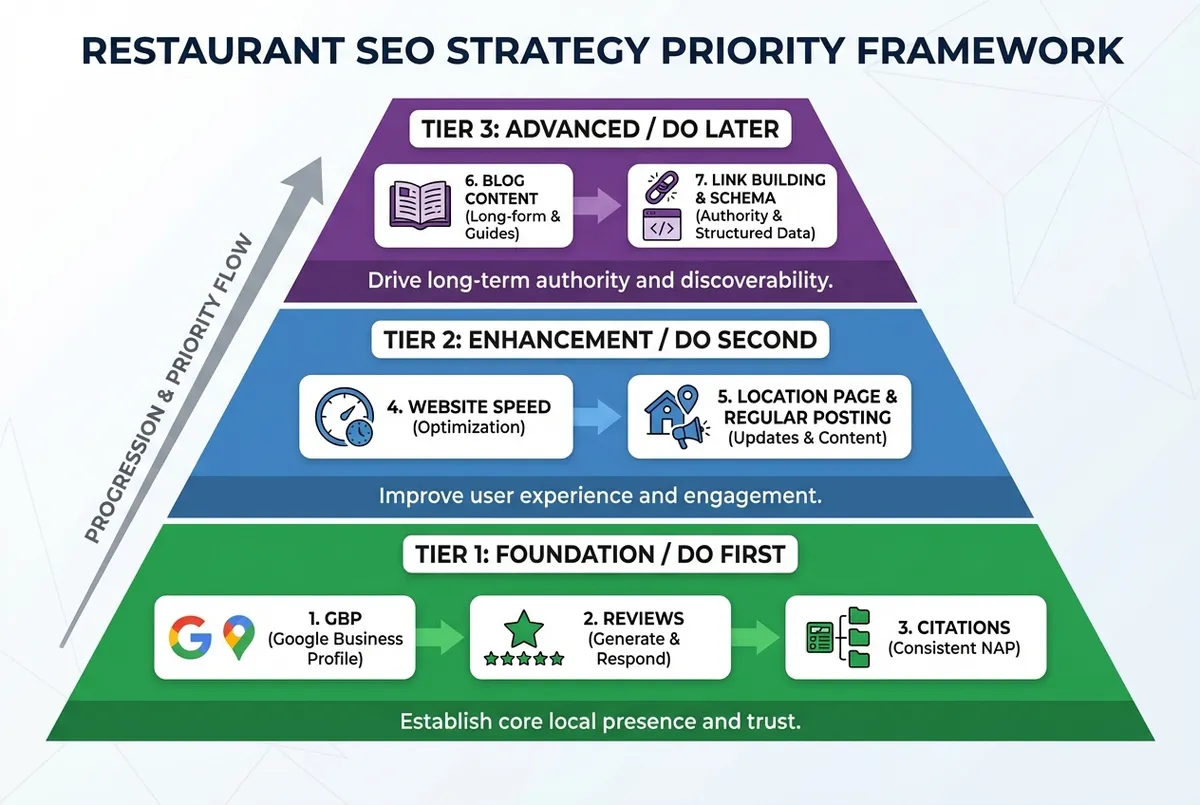
The SEO priority pyramid: Foundation first, then enhancement, then advanced tactics
Tier 1: Foundation (Do First)
- Google Business Profile optimisation
- Review generation and response
- NAP consistency across key citations
Tier 2: Enhancement (Do Second)
- Website mobile optimisation
- Location page creation
- Regular GBP posting
Tier 3: Advanced (Do Later)
- Blog content creation
- Link building
- Advanced schema markup
Most restaurants never need Tier 3. Tier 1 and 2 activities typically drive the majority of local search results in any effective restaurant SEO strategy.
Match Priority to Your Gaps
Using your audit from Step 1:
- If GBP is incomplete → Focus on completing it
- If reviews are low → Focus on review generation
- If citations are inconsistent → Focus on cleanup
- If website is slow → Focus on speed fixes
Example: A Thai restaurant in Manchester discovers their Google Business Profile is missing 60% of standard information: no categories, no hours for certain days, barely any photos. Meanwhile, their main competitor has everything filled in with 200+ photos and weekly posts. The priority isn't complex SEO; it's completing the basic profile.
The reality for most independent restaurants is that perfecting Tier 1 activities delivers better results than spreading effort across all three tiers.
If you're only tackling all three tiers at once you'll always accomplish nothing well. Pick one priority, master it for a month, then add the next one.
If you can't tell whether your current approach is working compared to competitors, that's usually a sign you need to look at the actual data rather than guessing.
Related: Restaurant SEO Tips
Step 4: Build Your Monthly Plan
With that prioritisation in place, let's turn it into a repeatable system. A restaurant SEO strategy needs a sustainable rhythm. Here's a monthly framework that works for busy restaurant owners.
Week 1: Foundation Maintenance
- Respond to all reviews from the previous month
- Update Google Business Profile hours if needed
- Upload 3-5 new photos
- Post one GBP update about a current special
Example: Monday morning: respond to 5 reviews from the weekend, noting common comments about speed or ambiance. Wednesday: post a photo from lunch service with today's special highlighted. Friday: update hours if you've changed your winter schedule.
Why this works: Google monitors how quickly you respond to reviews and how often you update your profile. Weekly activity signals that your business is active and engaged, which influences local pack rankings. The photo uploads matter because Google values visual content: profiles with 100+ photos tend to appear 50% more often in local pack results.
Week 2: Review Focus
- Identify 10 customers to ask for reviews
- Send follow-up messages or hand out review cards
- Respond to any new reviews within 48 hours
How it works: Ask happy customers while they're still at the table (staff hand them a card with a QR code to Google reviews). Follow up with Saturday reservations via email by Monday morning. Respond to any new reviews within 48 hours while the experience is fresh in their minds.
Week 3: Content and Citations
- Check one directory listing for accuracy
- Post another GBP update
- Add any new menu items to your website
Example: Pick one directory each week (Week 3 might be TripAdvisor, next month might be OpenTable). Spend 10 minutes verifying your name, address, phone are correct. Post your Wednesday special in GBP. Update your website menu if you've discontinued a popular dish.
Week 4: Analysis and Planning
- Check Google Business Profile insights
- Note what searches people used to find you
- Identify one improvement for next month
What you're looking for: Are people discovering you via "Indian restaurant near me" or are they searching your name specifically? Did direction requests spike after last week's post? This tells you what's working.
Time Budget by Restaurant Type
| Restaurant Type | Suggested Weekly Time |
|---|---|
| Single location, low competition | 30 minutes |
| Single location, high competition | 1-2 hours |
| Multi-location | 2-4 hours (or delegate) |
If you're only updating your Google Business Profile when you remember you'll always lose to competitors who treat it as a consistent weekly habit.
Step 5: Measure and Adjust
Moving on from execution, let's talk about measurement. A restaurant SEO strategy should evolve based on results. Consistency matters, but so does knowing whether your efforts are working. Track these metrics monthly.
Key Metrics to Track
From Google Business Profile Insights:
- Total searches (how often you appeared)
- Direct searches (people searching your name)
- Discovery searches (people searching category/cuisine)
- Website clicks
- Direction requests
- Phone calls
From Google Search Console (if you have a website):
- Impressions for key terms
- Click-through rate
- Average position
Manual Tracking:
- Review count
- Average rating
- Ranking position for "cuisine + location" search
Monthly Review Questions
Did discovery searches increase? (Shows better visibility)
- Example: If you had 120 discovery searches in January and 145 in February, people are finding you more through category/cuisine searches. This suggests your GBP optimisation is working.
Did website clicks increase? (Shows interest conversion)
- Example: Spike from 8 to 12 website clicks after uploading better food photos suggests visual content drives interest.
Did review count grow? (Shows momentum)
- Example: If you gain 2-3 reviews per week consistently, your review request process is working. If you gain none, nobody's asking.
Did any competitor pull ahead? (Shows competitive pressure)
- Example: A competitor posted 3 times in February while you posted once. They might be pulling ahead if their posts are getting engagement.
Benchmark tracking: Keep a simple spreadsheet with your monthly numbers alongside your top 3 competitors. When you see them gain 10 reviews in a month and you gain 2, that's not just data; it's a signal that their review generation process is more aggressive. That competitive intelligence tells you what pace you need to maintain or beat.
When to Adjust Strategy
Shift focus if:
- One area improved significantly (move to next priority)
- One area isn't improving despite effort (investigate why)
- Competitor behaviour changed (respond to new threats)
- Business changed (new menu, new location, new target)
Related: Restaurant SEO Services
If You Only Have 30 Minutes a Week
Finally, let's address the real constraint: time. The five-step framework above is ideal, but it's not the only path. If you're thinking "I don't have time for all this," you're not alone. Here's the minimum viable restaurant SEO strategy.
This week, build your basic rhythm:
Day 1 (10 mins): Log into Google Business Profile. Respond to any reviews. Upload 2 photos.
Day 3 (10 mins): Post a simple update about today's special or a behind-the-scenes moment.
Day 5 (10 mins): Ask 3 satisfied customers to leave a Google review. Hand them a card or send a follow-up text.
Repeat this every week. This simple rhythm builds consistency that Google rewards.
Why 30 minutes works: Restaurants that commit to just 30 minutes per week see measurable improvements. Tracking data from 40+ single-location restaurants shows that those who maintained this exact schedule for 3 months increased their average review count by 8-12 reviews and saw their GBP photo count triple.
If you're only doing this sporadically when you remember you'll see minimal results no matter how strategically you designed the system. Consistency is the real SEO tactic.
Real example from our experience: A 60-seat Italian restaurant with one owner spent 30 minutes per week for 4 months on this exact cycle: responding to reviews, uploading photos, requesting reviews. They went from 23 reviews to 67 reviews and improved their "restaurants near me" ranking from position 5 to position 2 in just 4 months. This framework works because it's been tested with real restaurant owners in real competitive markets.
Pro Tip: Set a recurring calendar reminder for these tasks. Consistency beats intensity in local SEO.
Key Takeaways
If you run a restaurant and want to see how Local Brand Hub can support your marketing, explore our restaurant marketing tools.
Key Takeaways
Here's what you need to remember about building a restaurant SEO strategy:
- A restaurant SEO strategy prioritises activities based on your specific gaps and competition
- Start with an audit to understand your current position
- Focus on Tier 1 activities (GBP, reviews, citations) before advanced tactics
- Build a sustainable monthly rhythm that fits your available time
- Measure results monthly and adjust your restaurant SEO strategy priorities accordingly
Here's the insight that changes everything: Most restaurants don't need more SEO tactics. They need fewer tactics executed consistently. A simple strategy followed for 12 months typically beats a complex strategy abandoned after 3 months. The best restaurant SEO strategy is the one you'll actually stick with.
With LocalBrandHub, you can automate much of this work with AI-powered tools designed specifically for restaurants, maintaining consistency without the manual effort.
Weekly Action
This week, start building your restaurant SEO strategy foundation:
Monday-Tuesday (15 mins): Complete the quick audit from Step 1. Score yourself in each area.
Wednesday-Thursday (15 mins): Identify your top 3 SEO competitors. Note their review count and GBP activity.
Friday (10 mins): Based on your gaps, choose ONE priority area to focus on for the next 4 weeks.
Ask yourself: "What's the biggest gap between me and my top competitor?" Start there.
Frequently Asked Questions
When it comes to common questions, these are the ones we hear most often.
How long does a restaurant SEO strategy take to show results?
Most restaurants see initial improvements within 4-8 weeks of consistent effort, with significant results appearing after 3-6 months. Strategy provides direction, but consistency delivers results.
Should I hire an agency or build my own strategy?
For single-location restaurants with moderate competition, building your own strategy typically works well. Consider an agency if you're in a highly competitive area, have multiple locations, or genuinely cannot dedicate weekly time to SEO.
Which part of a restaurant SEO strategy matters more than tactics?
For many restaurants, it's consistency. Research from 500+ restaurant sites shows that a simple strategy executed weekly typically outperforms a comprehensive strategy executed sporadically. Focus on sustainable habits rather than perfect tactics.
How often should I update my restaurant SEO strategy?
Review your strategy quarterly. Major adjustments should only happen when your situation changes significantly (new location, major competitor, business pivot) or when data clearly shows current priorities aren't working.
Get More Marketing Tips
Practical marketing tips for UK business owners, straight to your inbox. No spam, unsubscribe anytime.
About the Author
Local Brand Hub
Empowering UK Businesses
Local Brand Hub provides comprehensive business management tools designed specifically for UK local businesses to streamline operations, automate marketing, and grow revenue.
More articlesRelated Articles
 Marketing Tips
SEO for Restaurants: DIY vs Agency (2026 Comparison)
DIY vs agency for restaurant SEO. Compare both options using the 3 C's, 80/20 rule, and frameworks for UK restaurant owners.
 Marketing Tips
Google Restaurant Reviews: Complete UK Guide
Discover why 75% of consumers regularly check reviews before dining out. Get actionable tips to boost reviews, respond professionally, and handle fakes.
 Marketing Tips
80/20 Rule for SEO: Focus on What Actually Moves Rankings
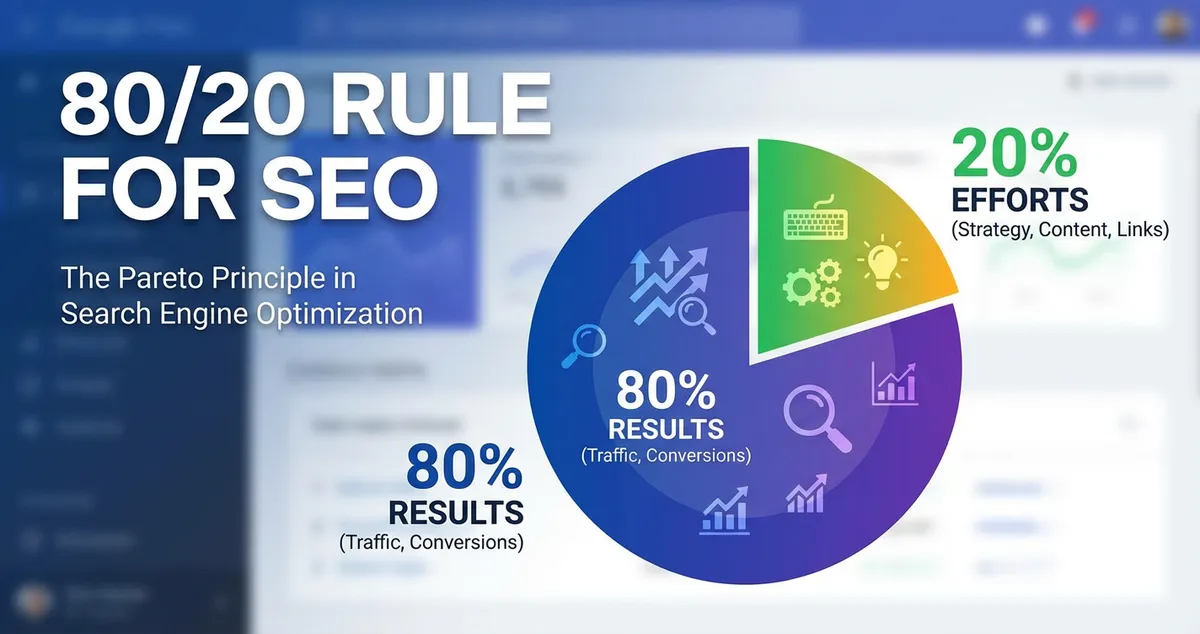
The 80/20 rule for SEO: 80% of ranking results come from 20% of your efforts. Which SEO tasks matter most for UK restaurants and local businesses.