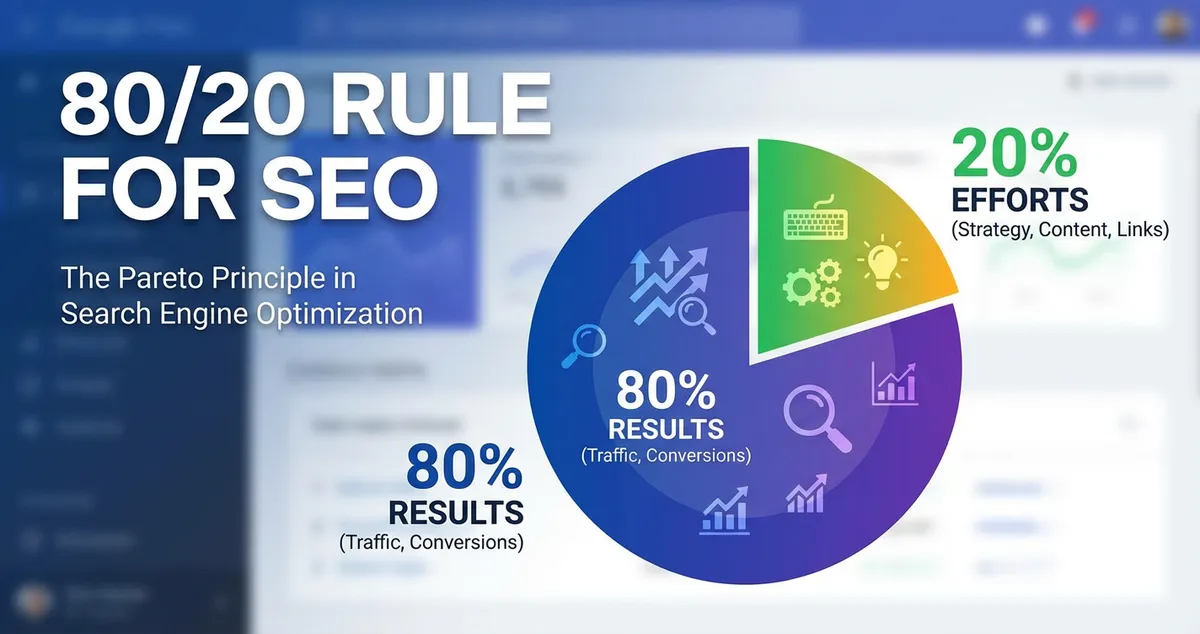
The 80/20 rule for SEO: 80% of ranking results come from 20% of your efforts. Which SEO tasks matter most for UK restaurants and local businesses.
The 80/20 rule for SEO means that roughly 80% of your ranking results come from just 20% of your efforts. You've spent hours creating blog posts about food trends, hired someone to build backlinks, and optimised your meta descriptions three times, yet your rankings haven't budged. If you're thinking "there must be a smarter way," there is.
Meanwhile, the new restaurant down the road, with a basic website and no content strategy, is appearing in the local pack for every relevant search.
What's going on? They're probably focusing on the 20% that matters while you're drowning in the 80% that doesn't.
According to Ahrefs' SEO statistics, most pages get zero organic traffic from Google. The 80/20 rule for SEO explains why: most businesses spread their efforts too thin across low-impact activities instead of doubling down on what actually works.
What You'll Learn
- What the 80/20 rule for SEO actually means in practice
- The specific 20% of SEO activities that drive 80% of results
- How to identify which tasks to eliminate from your strategy
- Real examples of businesses applying this framework
Related: Restaurant SEO (complete guide)
Let's break down exactly what the 80/20 rule for SEO means and why it matters.
What Is the 80/20 Rule for SEO?
The 80/20 rule for SEO is a framework that applies the Pareto Principle to search engine optimisation, stating that roughly 80% of your organic traffic and ranking improvements come from approximately 20% of your SEO activities. This principle helps businesses prioritise high-impact work over busywork.
The Pareto Principle itself comes from Italian economist Vilfredo Pareto, who observed that most of Italy's land was owned by a small fraction of the population. The ratio applies surprisingly consistently across many fields.
In SEO terms, this means:
- A small portion of your keywords drive most of your traffic
- A small portion of your pages generate most of your conversions
- A small portion of your SEO tasks produce most of your ranking improvements
For example: A gastropub in Liverpool tracked all their SEO activities over several months. They discovered that weekly Google Business Profile updates and review responses accounted for nearly all their ranking improvements, while their regular blog posts generated essentially zero organic traffic.
Related: Restaurant SEO Tips
Understanding the principle is one thing. Knowing what to focus on is another.
The 20% of SEO That Matters Most
Now that you understand the framework, let's get specific about what actually moves the needle. For local businesses and restaurants, the 80/20 rule for SEO consistently points to a handful of high-impact activities, all of which you can work through with our local SEO checklist:
1. Google Business Profile Optimisation
According to Moz's Local Search Ranking Factors, GBP signals account for roughly a third of local pack ranking factors. That's nearly a third of what determines your local visibility from a single platform.
High-impact actions:
- Complete every section of your profile
- Upload photos weekly
- Respond to reviews promptly
- Post updates regularly
2. Review Quantity and Quality
Reviews influence both rankings and customer decisions. According to Statista's consumer research, the majority of consumers check reviews before visiting a local business. A restaurant with many genuine reviews will almost always outrank one with few, assuming other factors are equal.
High-impact actions:
- Create a systematic review request process
- Train staff to ask satisfied customers
- Respond to every review, good and bad
3. Consistent NAP Citations
Your Name, Address, and Phone number appearing consistently across directories builds trust signals with Google. Inconsistencies create confusion.
High-impact actions:
- Audit your listings on major directories
- Fix any variations in format
- Maintain a master NAP document
4. Basic On-Page SEO
This includes location in title tags, contact information on your website, and mobile-friendly design. Nothing fancy: just the fundamentals done right.
If you can't tell whether your website is actually helping you rank or just existing online, that's usually a sign the basics aren't in place.
High-impact actions:
- Include location in page titles
- Ensure fast mobile loading
- Have clear contact information
| Priority | Activity | Time Investment | Impact |
|---|---|---|---|
| 1 | Google Business Profile | Weekly updates | High |
| 2 | Review management | Daily responses | High |
| 3 | Citation consistency | One-time + audits | Medium |
| 4 | Basic on-page SEO | One-time setup | Medium |
Related: Restaurant Local SEO
If you know what matters, you also need to know what doesn't.
The 80% You Can Probably Ignore
With the high-impact activities clear, here's where the 80/20 rule for SEO gets uncomfortable. These activities feel productive but rarely move the needle for local businesses:
Content Marketing (Usually)
Unless you're targeting informational keywords with significant search volume, blog posts rarely drive meaningful traffic for restaurants. A post about "seasonal ingredients" might get a handful of visits, but appearing in the local pack could bring new customers daily.
If you can't track whether your blog is actually bringing in customers, that's usually a sign it isn't.
Complex Backlink Campaigns
Building links from food blogs and local press helps, but the ROI compared to review generation is often poor. Most restaurants would see better results from more reviews than more backlinks.
Technical SEO Beyond Basics
Schema markup, canonical tags, and crawl optimisation matter, but usually not as much as people think. A technically perfect website with no reviews will lose to a basic site with plenty of five-star reviews.
Social Media as an SEO Factor
Social signals are not a direct ranking factor. Your Instagram following doesn't influence your Google rankings. Social media is valuable for other reasons, but not for SEO specifically.
For example: A tapas bar in Manchester spent most of their marketing time on Instagram "SEO" strategies: hashtag optimisation, posting schedules, engagement tactics. Their rankings didn't move. When they reallocated that time to GBP updates and review responses, they appeared in the local pack within a couple of months.
A cautionary note: If you're only working on your SEO when business is slow you'll always lose to competitors who treat it as part of daily operations, not an emergency response.
Related: Restaurant Marketing Plan
Let's see how this plays out with real numbers.
Applying the 80/20 Rule: A Practical Example
Theory is helpful, but numbers tell the real story. Based on our experience helping restaurant owners, here's a typical example:
Before applying 80/20:
- Most time on blog content and social media
- Minimal time on Google Business Profile
- Almost no time on review responses
- Scattered hours on backlink outreach
Result: Marginal ranking improvements
After applying 80/20:
- Primary focus on Google Business Profile updates
- Significant time on review generation and responses
- Regular citation audits
- Basic website maintenance only as needed
Result: Local pack visibility within three months
Same time investment. Completely different outcomes.
For example: A fish and chip shop in Brighton reallocated their SEO efforts using the 80/20 rule. They stopped blogging entirely and redirected that time to GBP updates and review requests. Within a few months, they went from invisible to appearing in the local pack for their target searches and saw a significant increase in midweek orders.
How do you know if you're focusing on the right 20%?
Finding Your Personal 80/20 Split
So how do you apply this to your own situation? The 80/20 rule for SEO isn't one-size-fits-all. Here's how to identify your specific high-impact activities:
1. Audit Your Current Activities
List every SEO-related task you do. Be honest about time spent.
2. Track Actual Results
Which activities have ever directly led to ranking improvements or customers? If you can't answer this for a specific task, it's probably in the 80%.
3. Check Competitor Basics
Look at the restaurants ranking above you. Are they doing anything special, or are they just doing the basics better?
4. Ask the Right Question
For every SEO activity: "Would this time be better spent on GBP, reviews, or citations?" If yes, stop and reallocate.
If you're reading this after a quiet Wednesday night thinking "I barely have time to close up properly, let alone do SEO", you're not alone. The reality for most independent restaurants is that marketing competes with operations for the same exhausted hours. That's exactly why the 80/20 approach matters.
Pro tip: Research shows that most businesses that struggle with SEO aren't doing too little: they're doing too much of the wrong things.
Related: Restaurant SEO Checklist
Key Takeaways
If you run a restaurant and want to see how Local Brand Hub can support your marketing, explore our restaurant marketing tools.
Key Takeaways
Let's bring this all together. The 80/20 rule for SEO is a framework for focus: identify the 20% of activities that drive 80% of your results, and ruthlessly deprioritise everything else.
For restaurants and local businesses, that crucial 20% almost always includes:
- Google Business Profile optimisation and weekly maintenance
- Review generation and prompt responses
- Citation consistency across directories
- Basic on-page SEO with location signals
The 80% you can probably reduce or eliminate:
- Blog content (unless targeting high-volume keywords)
- Complex backlink campaigns
- Advanced technical SEO
- Social media for SEO purposes
The restaurant down the road that's outranking you isn't doing more. They're doing the right things consistently while you're spreading effort across low-impact activities.
Ask yourself: what percentage of your SEO time goes toward the activities that actually matter?
80/20 SEO quick-win checklist:
- Claim and verify your Google Business Profile
- Complete every section of your GBP profile
- Set up a systematic review request process
- Create a master NAP document for citation consistency
- Add your location to your website title tags
Weekly Action
This week, conduct an SEO activity audit:
- Early in the week: List every SEO task you've done in the past month with approximate time spent.
- Midweek: Categorise each task as either low-impact or high-impact based on the criteria above.
- End of week: Create a new weekly schedule that reallocates most of your low-impact time to high-impact activities.
If you discover you've spent zero hours on GBP, reviews, or citations, that's your answer right there.
Frequently Asked Questions
Does the 80/20 rule for SEO apply to all businesses?
The specific 20% varies by business type. For local businesses like restaurants, the high-impact activities are GBP, reviews, and citations. For e-commerce, it might be product page optimisation and internal linking. For publishers, content quality and backlinks. The principle applies, but the specific focus areas differ.
How do I know if something is in the 80% or 20%?
Ask three questions: Has this activity ever directly improved my rankings? Can I measure its impact? Would a competitor who's outranking me prioritise this? If you answer "no" to all three, it's probably in the 80%.
Should I completely stop doing 80% activities?
Not necessarily. Some activities have value beyond SEO: social media builds brand awareness, blog content can be repurposed for email marketing. But don't confuse those benefits with SEO benefits. Be honest about why you're doing something.
What if I'm already doing the 20%?
If you're consistently doing the basics well and still not ranking, the issue might be competition level (you need to do them better), location (hyper-local competitors), or technical problems (site speed, mobile issues). The 80/20 rule for SEO assumes fundamentals are in place: it's about focus, not magic.
Get More Marketing Tips
Practical marketing tips for UK business owners, straight to your inbox. No spam, unsubscribe anytime.
About the Author
Local Brand Hub
Empowering UK Businesses
Local Brand Hub provides comprehensive business management tools designed specifically for UK local businesses to streamline operations, automate marketing, and grow revenue.
More articlesRelated Articles
 Marketing Tips
Restaurant SEO Strategy: Build a Plan That Brings Customers
Restaurant SEO strategy that fits your time and budget. Framework for Google Business Profile, reviews, content, local visibility.
 Marketing Tips
SEO for Restaurants: DIY vs Agency (2026 Comparison)
DIY vs agency for restaurant SEO. Compare both options using the 3 C's, 80/20 rule, and frameworks for UK restaurant owners.
 Marketing Tips
Google Restaurant Reviews: Complete UK Guide
Discover why 75% of consumers regularly check reviews before dining out. Get actionable tips to boost reviews, respond professionally, and handle fakes.