Why a hospitality branding agency outperforms generalists for restaurants, hotels, and bars. UK agency costs, what they deliver, and when to hire.
A hospitality branding agency is a specialist firm that builds brand identities for restaurants, hotels, bars, and cafes. These agencies know that your brand must work across physical spaces, menus, screens, and delivery apps all at once. That is a challenge generalist design firms rarely see coming.
You've spent thousands on a rebrand. Looks great on screen, right? Then you put it on a menu and the text was unreadable in candlelight. You printed it on takeaway bags and the detail vanished. You uploaded it to Deliveroo and it became a smudge at 32 pixels wide.
What You'll Learn
- Why hospitality-specific agencies deliver better results than generalists
- What specialist agencies understand about the sector that others miss
- UK agency landscape and typical costs for hospitality branding
- How brand strategy differs across restaurants, hotels, bars, and cafes
- When a hospitality specialist is worth the investment versus other options
Info
Related: Restaurant marketing agency guide: how to choose the right agency for ongoing marketing
What Makes Hospitality Branding Different
First, let's be clear about what makes this sector unique. Hospitality is not like selling software or clothing online. Your brand is experienced physically. People walk into it, sit inside it, eat off it, and photograph it. That changes everything about how branding needs to work. It is why a hospitality branding agency exists as its own specialism.
A restaurant marketing strategy promotes your business. A brand strategy defines what your business actually is in the minds of your customers. Hospitality brands face challenges that most industries simply do not:
- Multi-sensory environments: your brand must work as lighting, music, furniture, and tableware. Not just screens.
- Perishable first impressions: a customer decides in seconds whether the vibe matches what they expected
- Platform fragmentation: one logo must work on a three-metre sign, a 44mm delivery app icon, and a paper receipt
- Staff as brand ambassadors: your team shows brand values in every chat. Uniforms, training, and tone of voice all matter.
74% of diners choose where to eat based on social media (Cropink, 2026). That means your brand is being judged on a phone screen before anyone walks through the door. A hospitality branding agency understands this entire journey: from phone screen to front door to table to takeaway bag. A generalist typically sees only the screen.
For example, a boutique hotel restaurant in Bath might have a stunning website. But if the printed dinner menu uses different typography and colour, the in-person experience feels off. A hospitality branding agency would catch that mismatch before it reaches customers.
The Generalist Problem: Why Most Agencies Get Hospitality Wrong
Now that you understand the complexity, here's the problem. Generalist agencies build brands for the digital world. They think in websites, social feeds, and email templates. That is fine for an e-commerce brand. It is not fine for a restaurant where the physical experience is the product.
Here is what generalists typically miss:
Print and production knowledge. Menus get greasy fingers, spills, and dim lighting. A generalist picks a font that looks great on screen. It becomes unreadable at 9pt on textured paper under warm light.
Spatial brand application. How does the brand work on an awning? A chalkboard? A bathroom sign? A cocktail napkin? These touchpoints shape the guest experience, but they rarely appear in a generalist's deliverables.
Delivery platform requirements. Many delivery platforms now need SVG logos (Kitchen Space Rentals, 2025). Generalist firms often deliver PNG or PDF only. That leaves you to fix the technical gaps yourself.
Seasonal flexibility. Hospitality brands need systems that flex. Christmas menus, summer terraces, event promotions, all without losing consistency. A rigid brand system breaks within months.
If you're thinking "my current agency seems fine," ask yourself whether they have ever visited your restaurant during service. If the answer is no, that's usually a sign they are designing for a screen, not an experience.
Investing in a hospitality branding agency that understands the sector pays off in the long run. The savings upfront with a generalist often cost more in rebrand fees later.
Info
Related: Branding agency for restaurants: our guide to choosing a restaurant-specific agency
What a Hospitality Branding Agency Delivers
Here's what a specialist actually gives you. A strong hospitality branding agency works across the full customer journey. From the moment someone finds you online to the moment they leave a review, a good hospitality branding agency covers every step.
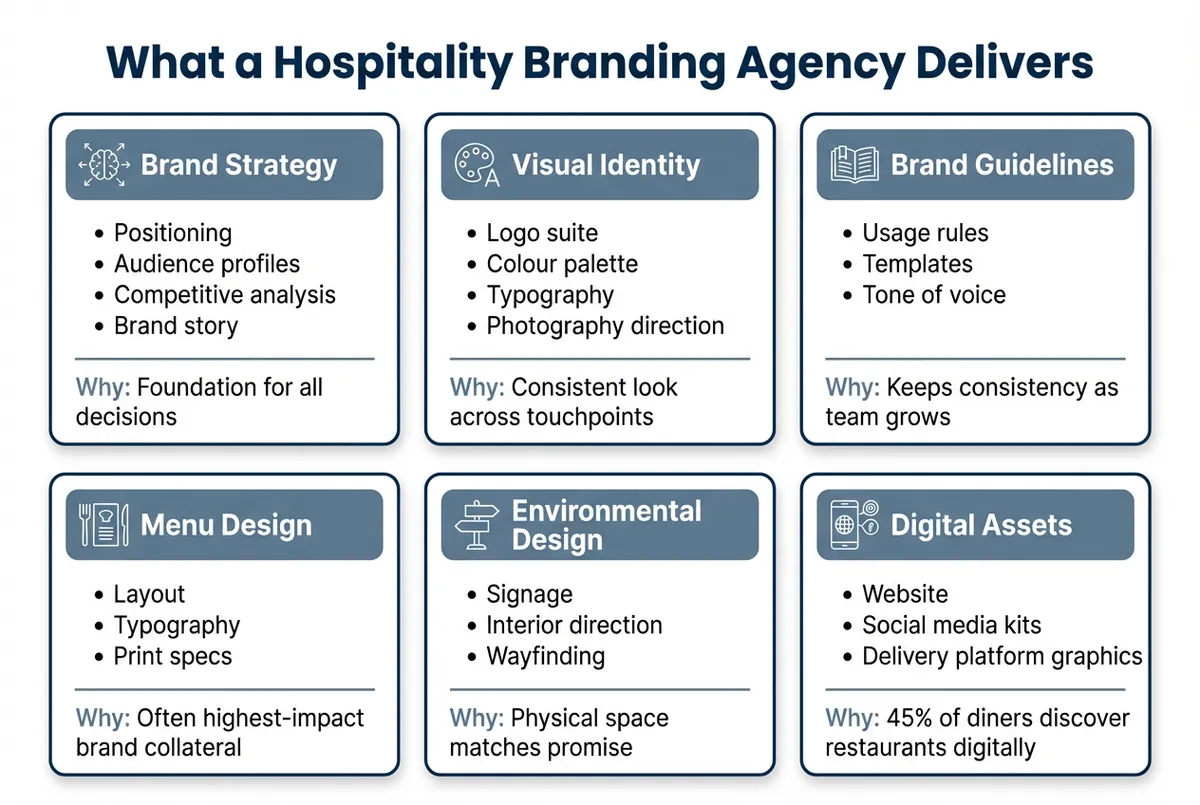
Six-part deliverables diagram showing brand strategy, visual identity, guidelines, menu, environment, and digital
Core Deliverables
| Deliverable | What It Includes | Why It Matters |
|---|---|---|
| Brand strategy | Positioning, audience profiles, competitive analysis, brand story | The foundation every visual decision builds on |
| Visual identity | Logo suite, colour palette, typography, graphic elements, photography direction | Consistent look across every touchpoint |
| Brand guidelines | Usage rules, do's and don'ts, templates, tone of voice | Keeps branding consistent as your team grows |
| Menu design | Layout, typography, print specifications | Often the highest-impact piece of brand collateral |
| Environmental design | Signage, interior direction, wayfinding | Makes the physical space match the brand promise |
| Digital assets | Website templates, social media kits, delivery platform graphics | Where 45% of diners first discover new restaurants (SevenRooms, 2025) |
The Brand Strategy Layer
What separates a specialist from a designer-for-hire is the strategy work. This happens before anyone opens a design tool. A specialist agency will typically:
- Audit how your brand is seen versus how you want it seen
- Study how competitors position themselves in your local area
- Define your target customers, not just age and income, but why they dine out
- Build a brand story that connects your origin to what customers expect
- Create a brand system if you run multiple concepts or locations
For example, a boutique hotel group with a rooftop bar and ground-floor restaurant needs a brand system. Each venue needs its own feel while clearly belonging to the same family. That is specialist thinking. A generalist rarely provides it.
Info
Related: Restaurant marketing services: what happens after branding is established
UK Hospitality Branding Agencies Worth Knowing
Additionally, it helps to know who actually does this well. The UK has a strong pool of specialist talent, particularly in London. Choosing the right hospitality branding agency means matching their portfolio strength to your specific sub-sector. Here are agencies with proven track records.
Established specialists:
- & Smith (London): branding for hotels, food, and drink. Known for luxury hospitality positioning. Widely regarded as one of the leading names in UK hospitality branding.
- Colt (London): creative agency focused exclusively on hospitality brands across hotels, restaurants, and bars.
- Crown Creative: hospitality branding, strategy, and design with a portfolio spanning independent restaurants to hotel groups.
- CAB Hospitality (UK-wide): creative services specifically for the hospitality sector.
Full-service agencies (branding + marketing):
- We Are MeMo: full-service hospitality marketing and branding, positioning themselves as a complete solution for restaurants.
- SideDish Media: restaurant-focused marketing with branding capabilities.
- Mason Circle: hospitality marketing with brand strategy services.
Boutique and emerging:
- Studio Noel: food and restaurant brand specialists.
- Boost Brands: hospitality brand development.
Most are London-based, but that matters less than you might expect. After an initial site visit, much of the branding work happens remotely. A London agency can brand a restaurant in Birmingham or Edinburgh effectively.
Example: Hiring a London Agency Remotely
A pub group in Manchester might hire a London-based hospitality branding agency like Colt because their portfolio shows deep pub and bar experience. One discovery visit, then video calls and shared design files handle the rest.
If you're reading this thinking "I can't afford any of these after a 12-hour shift just keeping the lights on," you are not alone. For most independent restaurants, hiring a hospitality branding agency is a big spend. But a good one will offer options at every budget level.
Cost Expectations for Hospitality Branding
When it comes to pricing, hospitality branding sits at a premium compared to generalist design work because the scope is broader and the sector knowledge is deeper.
| Service Level | UK Price Range | Suited To |
|---|---|---|
| Freelance designer | £500-£3,000 | Single-location, basic identity needs |
| Basic agency package | £3,000-£8,000 | Independent restaurant needing logo, menus, and guidelines |
| Comprehensive rebrand | £8,000-£20,000 | Established restaurant or small group needing full identity overhaul |
| Premium full-service | £20,000-£50,000+ | Hotel groups, luxury hospitality, multi-venue operations |
Source: Industry average for UK hospitality branding (2025)
Basic brand identity packages typically range from £3,000 to £15,000 depending on scope (industry average, 2025). Marketing retainers from UK SME agencies run £1,250 to £3,500 per month (Ysobelle Edwards, 2025).
Pro Tip
Ask for a phased payment structure. Many agencies will split the cost across project milestones (strategy sign-off, design concepts, and final delivery), so you are not paying the full amount upfront.
For most independent UK restaurants, the sweet spot often sits between £5,000 and £12,000. That gets you a logo, menus, signage direction, digital templates, and brand guidelines. Below that, you are likely getting a logo with some extras. Above that, you are paying for luxury-level strategy and production.
For instance, a cafe chain with three locations might spend £15,000 to £20,000 to create a system that works across all sites. A single-location wine bar might get excellent results at £5,000 to £8,000. Ask yourself: how many customer touchpoints does your business have? More touchpoints means more value from a specialist agency.
Info
Related: Digital marketing for restaurants: how to amplify your brand once it is built
How Brand Strategy Differs Across Hospitality Sectors
Furthermore, a hospitality branding agency's real value is knowing that a restaurant brand operates differently from a hotel brand, which operates differently from a bar brand. Here is how strategy shifts across the sector.
Restaurants
Brand priority is food-first positioning. The visual identity must make people hungry. Warm colours (reds, oranges, and yellows) increase appetite, while green signals healthy eating (Vistaprint, 2025). Menu design is often the single highest-impact brand touchpoint.
Based on our experience reviewing hospitality brands, a gastropub in Yorkshire needs a fundamentally different brand expression than a sushi restaurant in Soho, even if both target the same income demographic.
Hotels
Brand priority is experience promise. Guests commit to a multi-hour or multi-day stay. Brand trust must be built before booking. Photography, website quality, and review presence carry more weight than menu design.
Bars and Pubs
Brand priority is atmosphere and social identity. People choose bars based on what the venue says about them to their friends. Brand expression leans on interior design, lighting, music, and social media tone.
Cafes and Coffee Shops
Brand priority is daily habit and community. These brands compete for routine visits. Consistency, warmth, and neighbourhood identity matter more than aspirational vibes.
For example, a hospitality branding agency might use warm, rustic imagery for a countryside gastropub and then switch to sleek, moody visuals for an urban cocktail bar. Same hospitality branding agency, completely different output. That range is only possible with deep sector knowledge.
The best specialist agencies move fluidly between these contexts. A cookie-cutter approach to every brief rarely works.
This Week's Action Plan
This Week's Action Plan
With that in mind, here is how to start evaluating agencies this week:
- Day 1-2: List every touchpoint where your brand appears: physical, digital, and print. Photograph each one. Lay them out. Do they look like they belong to the same business?
- Day 3-4: Shortlist two specialist hospitality agencies from the list above. Review their portfolios specifically for projects in your sub-sector (restaurant, hotel, bar, or cafe).
- Day 5-7: Book a discovery call with your top choice. Ask them to walk you through one full case study (from strategy through to final delivery) so you can see the depth of their process.
If You Only Have 30 Minutes a Week
However, not everyone can dedicate a full week to this. If you only have 30 minutes a week, do this:
- Day 1-2: Does your logo work at every size? Open it on your phone at thumbnail size. If you cannot read or recognise it, that is your first problem to address.
- Day 3-4: Read your last ten social media posts. Do they sound like they were written by the same person? If not, you need brand voice guidelines before you need a new logo.
- Day 5-7: Google three competitors in your area. Compare their visual presentation to yours. Note what makes them look more or less professional.
Those 30 minutes will tell you whether you need a full rebrand from a hospitality branding agency, a simple refresh, or just better everyday consistency, which our all-in-one marketing tools help you hold across social media, menus, and your online presence. If you're thinking "I don't have time for this on top of everything else," remember that good branding is a one-off investment. It cuts decision-making stress for years.
FAQ
As a result of all this detail, you probably have some specific questions. Here are the ones we hear most often.
What is the difference between a hospitality branding agency and a restaurant branding agency?
The distinction revolves around scope. A hospitality branding agency works across the full hospitality sector: restaurants, hotels, bars, cafes, and leisure venues. A restaurant branding agency focuses specifically on restaurants. If you only operate restaurants, either can serve you well. If you have multiple venue types, a hospitality specialist provides the broader expertise.
How long does hospitality branding take?
A basic identity package typically takes one to two months. A full rebrand (strategy, visuals, menus, signage, and digital assets) takes three to six months (Fishbowl, 2025). Luxury or multi-site projects can take six to twelve months.
Can I hire a hospitality branding agency outside London?
Yes. While London has the most hospitality branding talent, the work is mostly remote after an initial visit. Agencies in Manchester, Bristol, and Edinburgh also have strong portfolios. Pick sector expertise and portfolio quality over location.
Do hospitality branding agencies handle marketing too?
Some do. Full-service firms like We Are MeMo combine branding with ongoing marketing. Others focus purely on brand creation and hand off to a restaurant marketing agency for ongoing work. Clarify this before signing. You do not want a gap between brand creation and brand activation.
Is hospitality branding worth the investment for a single independent restaurant?
For restaurants planning to operate for three or more years, a specialist agency typically pays for itself. You get stronger recognition, higher perceived value, and more effective marketing. Your brand is not what you say about your restaurant: it is what customers say when you are not in the room. A specialist helps you shape that conversation. If your budget is under £3,000, consult our restaurant branding guide and pair it with a good freelance designer for professional advice on the visual execution.
Key Takeaway
If you run a restaurant and want to see how Local Brand Hub can support your marketing, explore our restaurant marketing tools.
Key Takeaway
A hospitality branding agency brings sector-specific knowledge that generalist firms simply do not have: from menu design under candlelight to delivery app icon sizing. For UK restaurants, hotels, bars, and cafes, expect to invest £5,000 to £12,000 for a comprehensive brand package from a specialist. Choose an agency whose portfolio matches your sub-sector, ask for phased payment, and prioritise strategy depth over visual flashiness. Your brand is experienced physically, not just digitally, and only a specialist truly understands that difference.
For UK restaurant owners
Brand Your Hospitality Business
LocalBrandHub helps UK hospitality businesses build consistent brands across social media, menus, and online presence, without agency fees.
Start FreeGet More Marketing Tips
Practical marketing tips for UK business owners, straight to your inbox. No spam, unsubscribe anytime.
About the Author
Local Brand Hub
Empowering UK Businesses
Local Brand Hub provides comprehensive business management tools designed specifically for UK local businesses to streamline operations, automate marketing, and grow revenue.
More articlesRelated Articles
 Marketing Tips
Restaurant Branding Agency UK: What They Do and Why
What does a restaurant branding agency do vs a marketing agency? Visual identity, brand strategy, menu design, and when UK restaurants need branding help.
 Marketing Tips
Branding Agency for Restaurants: How to Choose
How to choose a branding agency for restaurants in the UK. Covers realistic costs, timelines, portfolio red flags, and what specialist agencies deliver.
 Marketing Tips
How to Brand Your Restaurant: A 7-Step Guide
How to brand your restaurant with this practical 7-step guide. Covers logo, colours, voice, menu design, and digital presence for UK restaurant owners.