
How to brand your restaurant with this practical 7-step guide. Covers logo, colours, voice, menu design, and digital presence for UK restaurant owners.
You have spent thousands on your fit-out, weeks perfecting the menu, and months building a team. Then a regular recommends you to a friend and the friend says "which one is that again?" Not because the food is bad. Because nothing about your restaurant brand sticks in their memory. That is the problem knowing how to brand your restaurant solves.
Branding your restaurant means creating a consistent identity that connects your food, space, and story into something customers remember and return to. This guide walks you through the process step by step, from defining your personality to building a digital presence that matches your in-person experience.
Info
The real cost of weak branding: restaurants with inconsistent branding don't just lose customers: they lose the ability to charge premium prices, attract quality staff, and build the kind of recognition that turns first-time visitors into regulars.
What You'll Learn
Here's what this guide covers:
- How to define a brand personality that fits your restaurant, the foundation everything else builds on
- Choosing colours, typography, and a logo that work everywhere, from storefront to delivery app
- Developing a brand voice for menus, social media, and staff communication
- Aligning your physical space with your brand identity
- Building a digital presence that matches the in-person experience
- When to handle branding yourself and when to hire a professional
Step 1: Define Your Brand Personality
First, how to brand your restaurant starts with a simple question: how should your restaurant feel?
Not look. Feel. A cosy neighbourhood Italian and a sleek cocktail bar might both use dark colour palettes, but they feel completely different. The feeling is your brand. The visuals just communicate it.
How to find your brand personality:
- Write down three to five words that describe the experience you want customers to have. Not words like "good food": words like "relaxed," "nostalgic," "adventurous," or "indulgent."
- Ask five regular customers the same question: "What three words would you use to describe this place to a friend?" The overlap between your answers and theirs is your true brand.
- Ask your staff the same question. They live inside the brand every day and often see it more clearly than you do.
For example, a seafood restaurant in Brighton might land on "coastal, unpretentious, fresh." A fine dining spot in Edinburgh might choose "refined, intimate, seasonal." These words become the filter for every brand decision that follows.
If you're thinking "this feels too abstract to be useful", stick with it. As you work through the process, these three to five words will save you thousands in wasted design decisions later. Every time you are choosing between two fonts, two colours, or two menu layouts, ask: "which one feels more [your words]?"
Info
Related: Restaurant branding agency, when to bring in professional help for this step
Step 2: Research Your Local Market
So you have your personality words. But your brand does not exist in isolation. The next part of the process is understanding the neighbourhood you operate in. That landscape is how you find the gap your brand can own.
Practical research steps:
- Map your competitors. List every restaurant within a 10-minute walk (or drive, if you are outside a city). Note their positioning: family-friendly, date night, quick lunch, fine dining, casual.
- Identify the gap. Where is the white space? If every restaurant nearby targets families, there might be an opportunity for a sophisticated adults-only experience. If everything is casual, perhaps polished but affordable is the gap.
- Study their branding. Screenshot their websites, Instagram profiles, Google Business listings, and delivery app pages. Note what works and what feels generic or dated.
- Check customer language. Read their Google reviews. What words do customers use? Those are the words real people use to describe dining experiences in your area.
This is not about copying anyone. A core part of branding is finding the space nobody else occupies so your brand can be distinctive from day one.
A curry house in a neighbourhood full of curry houses, for instance, might differentiate through regional specificity: "South Indian coastal cuisine" rather than generic "Indian restaurant." The branding then supports that positioning through colour choices, menu descriptions, and photography style.
Info
Related: How to create a restaurant marketing plan, connecting your brand to a practical marketing strategy
Step 3: Design Your Visual Identity
Now that you have personality and positioning, it is time for the part most people start with. But it should be step three, not step one. Without personality and positioning defined, visual design becomes guesswork.
Logo
Your logo needs to work at every size: from a three-metre storefront sign to a 32-pixel delivery app icon (our guide to designing a logo for restaurant signs, menus and apps starts from that constraint). That means:
- Keep it simple. Intricate details disappear at small sizes.
- Test at multiple scales. Print it at business card size and billboard size. If it does not work at both, simplify.
- Get SVG format. Many delivery platforms require SVG logos as standard. Make sure your designer delivers this as standard.
- Create variations. A full logo, a simplified icon version, and a text-only version give you flexibility across different touchpoints.
Colour Palette
Colour affects appetite and perception more than many restaurant owners realise. Warm colours (reds, oranges, and yellows) increase appetite, while green signals healthy eating.
Build a palette of:
- 1 primary colour: your dominant brand colour
- 1 to 2 secondary colours: for variety without chaos
- 1 neutral: for backgrounds, text, and breathing room
- 1 accent: for call-to-action buttons, specials highlights, and digital elements
When defining your brand visually, record the exact hex codes, RGB values, and Pantone references so your colours stay consistent whether printed on a menu, displayed on a screen, or painted on a wall.
Typography
Choose two fonts maximum:
- One for headings: this carries personality
- One for body text: this needs readability above all else
Make sure the body font is legible at 9 to 10pt on paper under restaurant lighting: this rules out many elegant but impractical typefaces.
For example, a modern brunch cafe might pair a clean sans-serif heading font like Montserrat with a friendly body font like Open Sans, while a fine dining restaurant might use a refined serif like Playfair Display with a classic body font like Garamond.
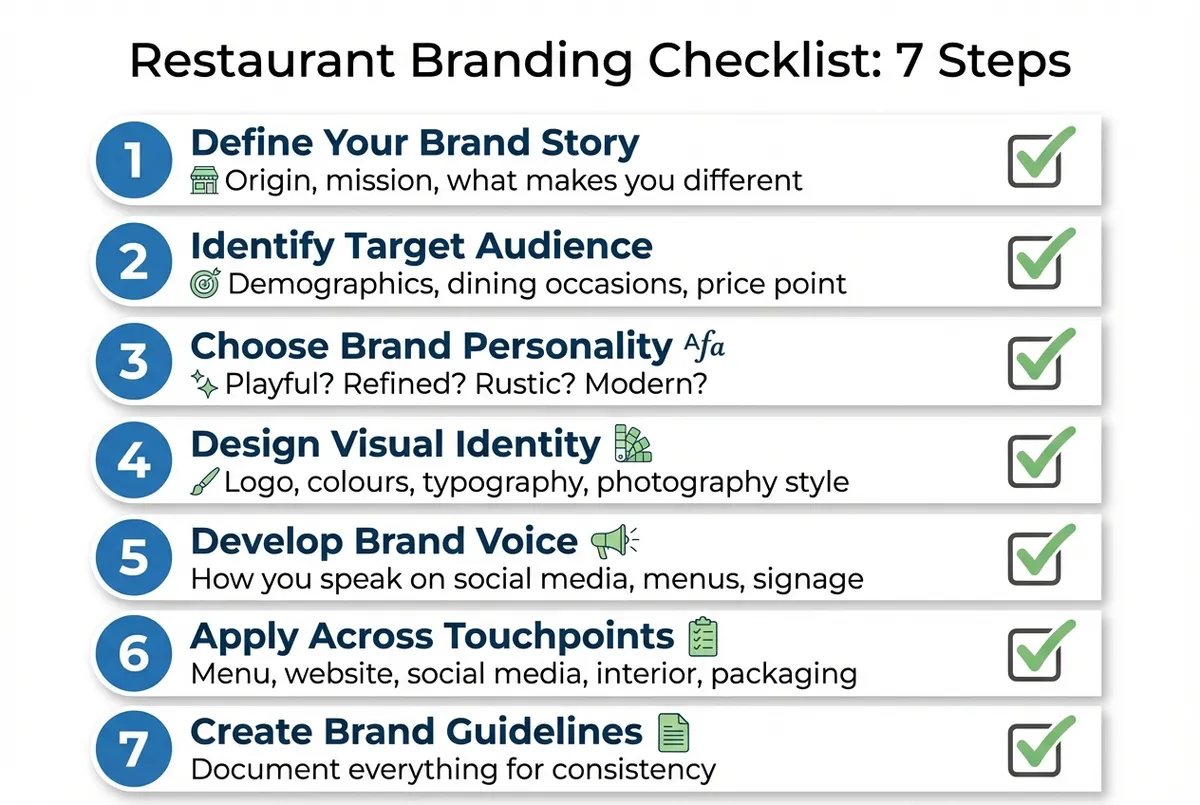
The key elements of restaurant visual identity and how they connect
Pro Tip
If you're only doing one thing right in your visual identity, make it consistency. A mediocre colour palette used consistently looks more professional than a brilliant one applied randomly. And if you're only picking colours you personally like, you'll always lose to competitors who choose colours based on how their target customers feel.
Info
Related: Restaurant website design, applying your visual identity to your online presence
Step 4: Develop Your Brand Voice
With visuals sorted, the next step goes beyond what people see. Your brand speaks every time you write a menu description, post on Instagram, respond to a review, or train a new staff member.
Many restaurants never think about this, and it shows: their social media sounds nothing like their menu, which sounds nothing like their staff.
If you're thinking "I barely have time to post, never mind developing a brand voice", this does not need to be complicated. Three parameters are enough.
Define your voice with three parameters:
| Parameter | Range | Example |
|---|---|---|
| Formality | Casual to formal | A street food vendor is casual; a tasting menu restaurant is formal |
| Personality | Playful to serious | A burger joint might be playful; a steakhouse might be understated |
| Warmth | Friendly to reserved | A family trattoria is warm; a members' club is reserved |
Your verbal identity is just as important as the visual side. Apply it consistently:
- Menu descriptions: these are your most-read copy. Every dish description should sound like it was written by the same person with the same personality.
- Social media: match your in-person atmosphere. If your restaurant is relaxed and fun, your Instagram should not read like a corporate press release.
- Review responses: how you respond to reviews is public brand communication. Set a tone and stick to it.
- Staff scripts: phone greetings, booking confirmations, and welcome phrases should reflect your brand voice.
For instance, a casual ramen bar might describe a dish as "rich, porky broth simmered for 18 hours: this is the bowl your hangover has been waiting for." A fine dining restaurant would never use that language. But if a fine dining restaurant also writes casually on Instagram, the brand feels confused.
Step 5: Design Your Menu as a Brand Asset
Your voice is set. The next step is applying it to the thing customers read the longest. Remember that your menu is arguably your single highest-impact piece of brand collateral. Customers typically spend more time looking at it than your website, your signage, or your social media combined.
Menu branding essentials:
- Layout reflects positioning. A single-page menu communicates confidence and focus. A multi-page menu communicates variety and value. Choose deliberately.
- Descriptions match your voice. Do not write "pan-seared Scottish salmon on a bed of wilted greens" if your brand voice is casual. Write "Scottish salmon, greens, lemon butter."
- Typography is readable. This sounds obvious, but test your menu in actual restaurant lighting conditions, not on a computer screen in a bright office.
- Design connects to identity. Colour palette, fonts, and graphic elements should match your brand guidelines exactly.
- Material matters. Paper stock, coating, and binding communicate quality. A laminated single sheet says "high-turnover casual." A heavy card stock with embossed logo says "occasion dining."
For example, a tapas bar might use a single folded card with bold typography and a few hand-drawn illustrations, while a steak restaurant might opt for heavy card stock with embossed branding. Both approaches are correct if they match the brand personality defined in Step 1.
If you're thinking "it's just a menu", consider that 45% of diners discover new restaurants through social media, and your menu is often among the most-photographed things in your restaurant. It is doing brand work whether you designed it to or not.
Info
Related: Restaurant social media strategy, making your branded assets work harder online
Step 6: Align Your Physical Space
Your menu is sorted, but what about the space around it? Step 6 focuses on your physical space. Your interior is your brand expressed in three dimensions. Customers do not consciously think about this, but they feel it. When the brand is consistent (same colours, same mood, same level of detail from the menu to the bathroom), the experience feels considered and trustworthy.
Key alignment points:
- Signage: exterior signage is your first physical brand impression. It should match your logo, colour palette, and positioning exactly.
- Tableware: plates, glasses, and cutlery communicate quality and personality. They do not need to be branded, but they should feel intentional.
- Uniforms: staff appearance is part of the brand. Even a simple "all-black with branded apron" creates consistency.
- Lighting: this affects how every colour in your palette is perceived. Test your brand colours under your actual lighting conditions.
- Music: sound is branding too. A curated playlist that matches your brand personality reinforces the experience.
You do not need to spend thousands on interior design. But strong branding means walking through your space as a first-time customer and asking: does every touchpoint tell the same story?
For example, a farm-to-table restaurant might use reclaimed wood tables, earthy ceramics, and linen napkins to reinforce its rustic, sustainable positioning. Every physical element communicates the brand without saying a word.
If your signage says "modern British" but the interior has sticky carpets, brass fixtures from 1987, and a jukebox playing classic rock, that's usually a sign your brand alignment needs work that no logo redesign will fix. Ask yourself: would a customer who saw your Instagram first feel confused when they walked in?
Step 7: Build Your Digital Presence
Your physical space is aligned. The final piece is bringing that consistency online. The final step is your digital presence. 74% of diners choose where to eat based on social media. Your digital presence is not an afterthought: for many customers, it is their first and only impression before they decide whether to visit.
Digital brand checklist:
- Google Business Profile: update your photos, description, and category to match your brand positioning. This is often the very first thing people see.
- Website: apply your colour palette, typography, and voice consistently. Ensure your menu is up to date and easy to read on mobile.
- Social media profiles: use your logo as the profile image across all platforms. Write bios that reflect your brand voice. Keep visual content consistent in style and quality.
- Delivery platforms: upload high-quality food photography, your logo in SVG format, and a menu that matches your in-house version.
- Review sites: respond to reviews in your brand voice. This is public communication and part of your digital brand identity.
For example, a brunch cafe with a bright, playful brand should have an Instagram feed that looks bright and playful, not dark and moody because someone heard that looks "professional." Consistency beats trends every time when you take your brand online, and our all-in-one marketing tools make it easier to hold that look and voice across your profiles, menu, and Google listing.
Info
Related: Build your restaurant's digital presence, a deeper dive into online brand management
When to DIY vs When to Hire a Professional
You have the complete framework for how to brand your restaurant. The question is whether to handle it yourself or hire help.
If you've read this whole guide and it sounds like a lot of work on top of actually running a restaurant, you are right. It is. But the good news is that branding is a one-off project, not an ongoing commitment like marketing.
Quick Decision Guide
- Single location, budget under £3,000: DIY using this guide plus a freelance designer for logo and menu layout
- Pre-opening with investors: hire a branding agency to demonstrate seriousness
- Rebrand of established restaurant: hire a specialist who understands managing existing customer expectations
- Multi-site expansion: hire an agency for consistent brand systems across locations
- Menu and signage refresh only: a freelance designer is enough if the core brand is solid
If you pick just one approach: For most single-location restaurants, start with this guide's DIY process and hire a freelance designer for the logo and menu layout only.
What to Budget
A basic brand identity package from a specialist restaurant branding agency costs £3,000 to £15,000 depending on scope. A comprehensive rebrand typically takes three to six months from briefing to delivery.
For most independent restaurants, the DIY approach described in this guide combined with a freelance designer is often the smartest way to build your brand. Invest in defining your brand properly using the steps above, then spend your design budget on the touchpoints that matter most: logo, menu, and signage.
This Week's Action Plan
Here's how to brand your restaurant this week:
- Day 1 to 2: Complete Step 1. Write your three to five brand personality words. Ask three regulars and two staff members the same question. Compare answers.
- Day 3 to 4: Walk through your restaurant as a first-time customer. Photograph every touchpoint: sign, menu, table setting, bathroom, exterior. Does everything tell the same story?
- Day 5 to 7: Audit your digital presence. Screenshot your Google Business Profile, website homepage, Instagram profile, and delivery app listing. Compare them side by side.
Your brand is not your logo. It is the promise customers make to their friends when they say "you have to try this place." Learning how to brand your restaurant is learning how to control that promise.
Pro Tip
Branding is not about making your restaurant look expensive. It is about making your restaurant look intentional. The fish and chip shop with consistent branding across its sign, wrapper, and Instagram feels more trustworthy than the fine dining spot with a beautiful logo and a chaotic online presence.
If You Only Have 30 Minutes a Week
Here's how to build your brand with minimal time:
- Day 1 to 2: Write down three words that describe how your restaurant should feel. Ask one regular customer the same question. Note the overlap: this is the foundation of your brand.
- Day 3 to 4: Take a photo of your menu, your exterior sign, and your Instagram profile. Put all three side by side. Do they look like they belong to the same restaurant?
- Day 5 to 7: Fix the one thing that sticks out most. Often it is an outdated profile photo, a menu that does not match your signage, or social media with no consistent visual style.
That is enough to start building a more consistent brand without spending anything.
Key Takeaway
If you run a restaurant and want to see how Local Brand Hub can support your marketing, explore our restaurant marketing tools.
Key Takeaway
Learning how to brand your restaurant is a seven-step process: define your personality, research your market, design your visual identity, develop your voice, brand your menu, align your physical space, and build a matching digital presence. Start with three to five personality words, then work through each step systematically. For most independent restaurants, combining this DIY approach with a freelance designer for logo and menu layout is the smartest investment.
FAQ
Here's what restaurant owners frequently ask about branding.
What is the 3-7-27 rule of branding?
Understanding your brand includes knowing key frameworks. The 3-7-27 rule is a branding framework that suggests:
- 3 seconds for someone to notice your brand
- 7 seconds to form a first impression
- 27 interactions before they develop brand loyalty
For restaurants, this means your signage and exterior have 3 seconds to catch attention, your entrance and atmosphere have 7 seconds to confirm expectations, and consistent quality over roughly 27 visits builds a loyal regular.
How do you build a restaurant brand?
Building a restaurant brand follows these core steps:
- Define your brand personality in three to five words
- Research your local competitive landscape
- Create a visual identity (logo, colours, typography)
- Develop a consistent brand voice
- Design your menu as a brand asset
- Align your physical space
- Build a matching digital presence
The process typically takes one to six months depending on whether you handle it yourself or hire a branding agency for restaurants.
What are the 5 P's of service in restaurants?
The 5 P's of restaurant service are:
- Product: food and drink quality
- Place: your venue and atmosphere
- Price: value proposition and pricing strategy
- Promotion: how you market yourself
- People: staff recruitment, training, and hospitality
All five directly influence your brand: an excellent product in a poorly maintained space with untrained staff creates a confused brand that customers struggle to recommend.
What is the rule of 7 in branding?
The rule of 7 in branding is a framework that states a potential customer needs to encounter your brand at least seven times before they take action: whether that is making a booking, visiting your restaurant, or following you on social media.
For restaurant owners, this means your brand needs to be consistently visible across multiple channels: social media, Google, review sites, delivery apps, local signage, and word-of-mouth. Each touchpoint is an encounter, which is why consistency across all of them matters so much.
How much does it cost to brand a restaurant in the UK?
If you are branding on a budget, DIY restaurant branding (your time plus a freelance designer for the logo) can cost as little as £500 to £2,000. A basic agency identity package runs £3,000 to £8,000. A comprehensive rebrand covering visual identity, menus, signage, and digital assets typically costs £8,000 to £15,000. Premium full-service branding from a specialist hospitality branding agency can exceed £20,000 for multi-site or luxury hospitality projects.
For UK restaurant owners
Build Your Restaurant Brand
LocalBrandHub helps UK restaurants create consistent branding across social media, menus, and online presence, with tools designed for independent operators.
Start FreeGet More Marketing Tips
Practical marketing tips for UK business owners, straight to your inbox. No spam, unsubscribe anytime.
About the Author
Local Brand Hub
Empowering UK Businesses
Local Brand Hub provides comprehensive business management tools designed specifically for UK local businesses to streamline operations, automate marketing, and grow revenue.
More articlesRelated Articles
 Marketing Tips
Restaurant Branding Agency UK: What They Do and Why
What does a restaurant branding agency do vs a marketing agency? Visual identity, brand strategy, menu design, and when UK restaurants need branding help.
 Marketing Tips
Branding Agency for Restaurants: How to Choose
How to choose a branding agency for restaurants in the UK. Covers realistic costs, timelines, portfolio red flags, and what specialist agencies deliver.
 Marketing Tips
Hospitality Branding Agency: Why Specialists Win
Why a hospitality branding agency outperforms generalists for restaurants, hotels, and bars. UK agency costs, what they deliver, and when to hire.