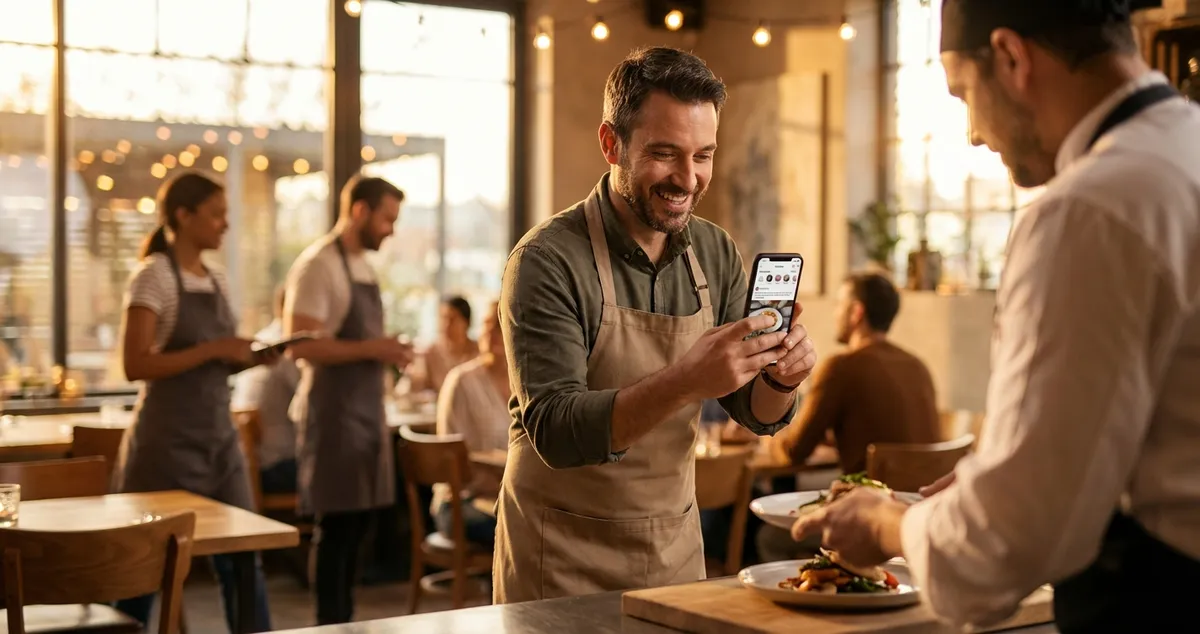
A restaurant social media strategy is four decisions, not a posting schedule. Who it is for, which platform, what job it does, and a rhythm you can hold.
A restaurant social media strategy is four decisions written down: who you are posting for, which single platform those people already use, the one job the account has to do, and the weekly rhythm you can hold through a full service. Captions, filters and hashtags are downstream of those four.
Related: Restaurant Social Media Marketing is the hub guide this sits under, covering every platform together.
Here is the part nobody selling a content calendar mentions. Among the UK small and micro food businesses the Food Standards Agency tracks, the share with any social media presence fell to 71% in 2025, level with where it sat four years earlier and down from 77% two years before (Food Standards Agency). That is a trade quietly backing out, not piling in.
Why, the survey does not say. But if you have ever let a feed go quiet for six weeks and felt a small pang every time you opened the app, you can probably guess. Feeds rarely die of bad photography. They die of abandonment, and abandonment is a planning problem, not a talent one.
What you'll learn:
- The four decisions that make up a strategy, in order
- How to choose one platform on evidence, then test it against your own bookings
- What job the account should do, and the number that proves it
- A weekly rhythm and checklist that survive a bad week
What Is a Restaurant Social Media Strategy?
A restaurant social media strategy is the answer to four questions, in this order, written somewhere you will see them again.
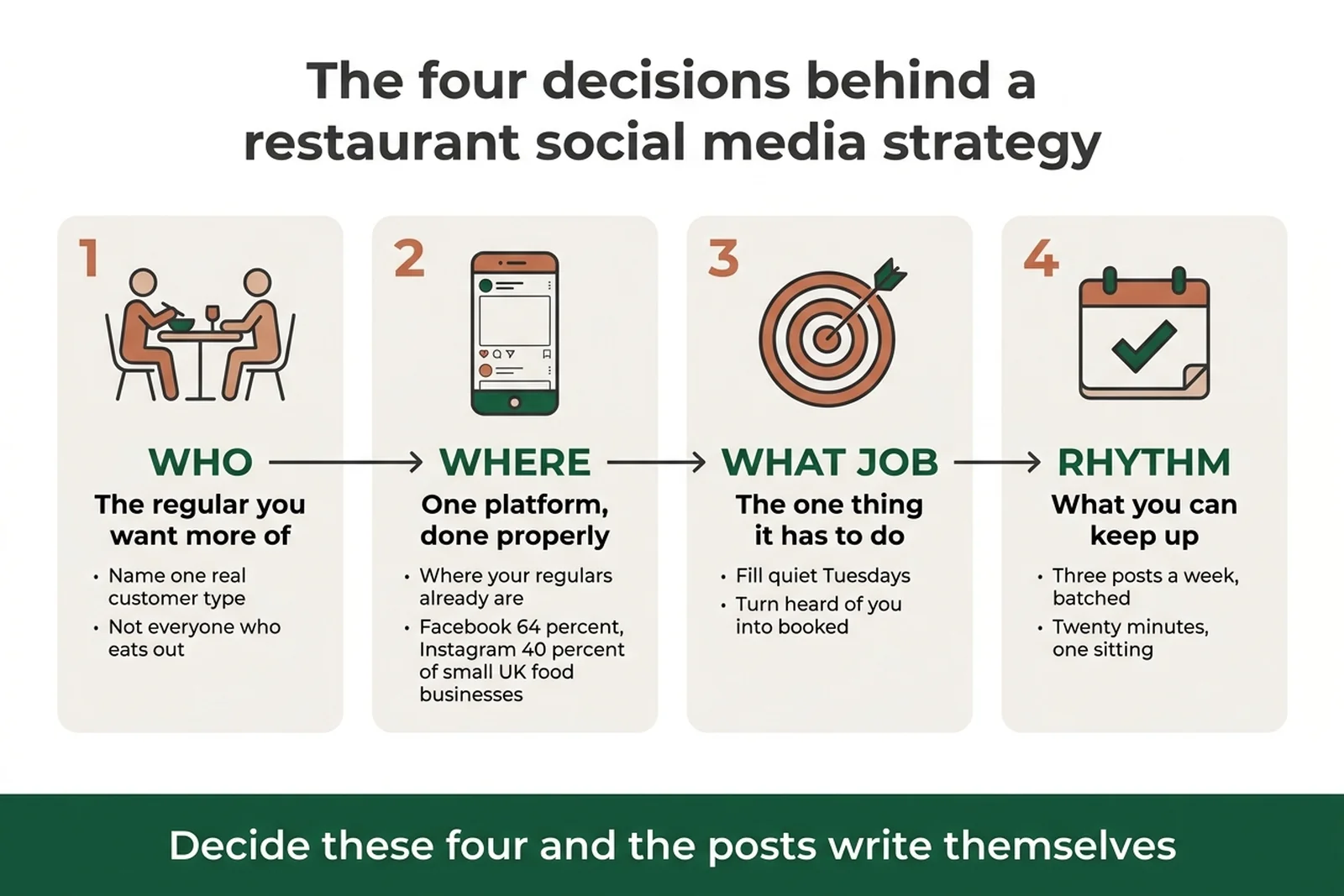
The four decisions, in order. Get these down and posting stops being a daily invention.
Who. Not "diners". One customer type you want more of: the Thursday work lunch four, the couple who book the window table, the family who need a high chair. You can write to one of those. You cannot write to all of them at once.
Where. One platform, done properly, beats four done badly.
What job. Filling Tuesdays is a job. Selling out the Sunday roast is a job. Building brand awareness is not a job, it is a mood.
Rhythm. Whatever you can still manage in the week the walk-in fridge dies. Be honest here or the other three decisions are decoration.
Write them on one side of paper. If you cannot say them out loud without reading, you do not have a strategy yet. You have a habit.
Which Platform Should Your Restaurant Choose?
Start with where operators like you already are. Among the UK small and micro food businesses the Food Standards Agency surveys, the accounts held most often in 2025 were Facebook, held by 64% of businesses, and Instagram, held by 40% (Food Standards Agency). On the customer side of the counter, Ofcom found the Meta apps WhatsApp, Facebook, Facebook Messenger and Instagram were the most-visited smartphone apps by UK adults on an average day in 2023 (Ofcom).
| Platform | Pick it when | Time it really takes |
|---|---|---|
| The food photographs well and you want younger midweek covers | Highest, it is a visual habit | |
| You run events, regulars are over forty, or bookings arrive by message | Medium, posts last longer | |
| TikTok | Someone on the team genuinely enjoys being on camera | Highest, volume is the entry price |
Rule of thumb only; it shifts with neighbourhood, cuisine and team.
Be careful what those figures measure. One counts which accounts food businesses hold. The other counts which apps UK adults open. Neither measures who is hungry within a mile of your door on a wet Wednesday. They tell you where the traffic is, not where your table is. Treat them as an opening bet, then test it against the one dataset genuinely about your restaurant: ask the next twenty people who book how they found you.
The caution runs both ways. A platform few operators hold has not been shown to fail there, only to be less common, which is a fact about supply rather than results. A gap can be an opening as easily as a warning.
Related: Instagram Marketing for Restaurants covers the visual side, and Facebook for Restaurants picks up events and messages.
What Job Should the Account Actually Do?
One number should reset your expectations. Just 9% of those UK small and micro food businesses said they use their social media accounts to take orders, while 91% do not (Food Standards Agency).
That is a fact about how the channel gets used, not about whether it pays, and read correctly it is liberating. For almost every restaurant, social media is not the till. It sits one step before the till, and its job is to be the reason someone remembers you exist on the evening they cannot face cooking.
Why this matters: grading the account on sales it was never going to make is the usual reason owners conclude social media does not work and quietly stop. Grade it on the step it owns.
Imagine a 40 cover bistro with dead Tuesdays. The job is not more followers. The job is 6 extra Tuesday covers a week. The content is Tuesday specific, the call to action is a booking link, and the number checked on a Sunday is Tuesday covers, not likes.
What to Post: Pillars, Not Prompts
The government's own communicators work to content pillars. The GOV.UK social media playbook advises setting 3 to 5 content pillars that all social output must align with (GOV.UK). That guidance was written for press offices, not kitchens, so do not import the topics. Import the discipline. A pillar changes the question from "what shall we post", which has no answer at 4pm on a Friday, to "which pillar is thin this week", which has an obvious one.
Four pillars that suit a restaurant:
- The making. Prep, the pass, a sauce coming together, the delivery arriving at 7am.
- The people. Whoever is on section, whoever has been with you six years, whoever just started.
- The place. The room at 5pm with the light coming in. Your best table. The street in the rain.
- The offer. Specials, events, the thing you want booked. Roughly one post in five, no more.
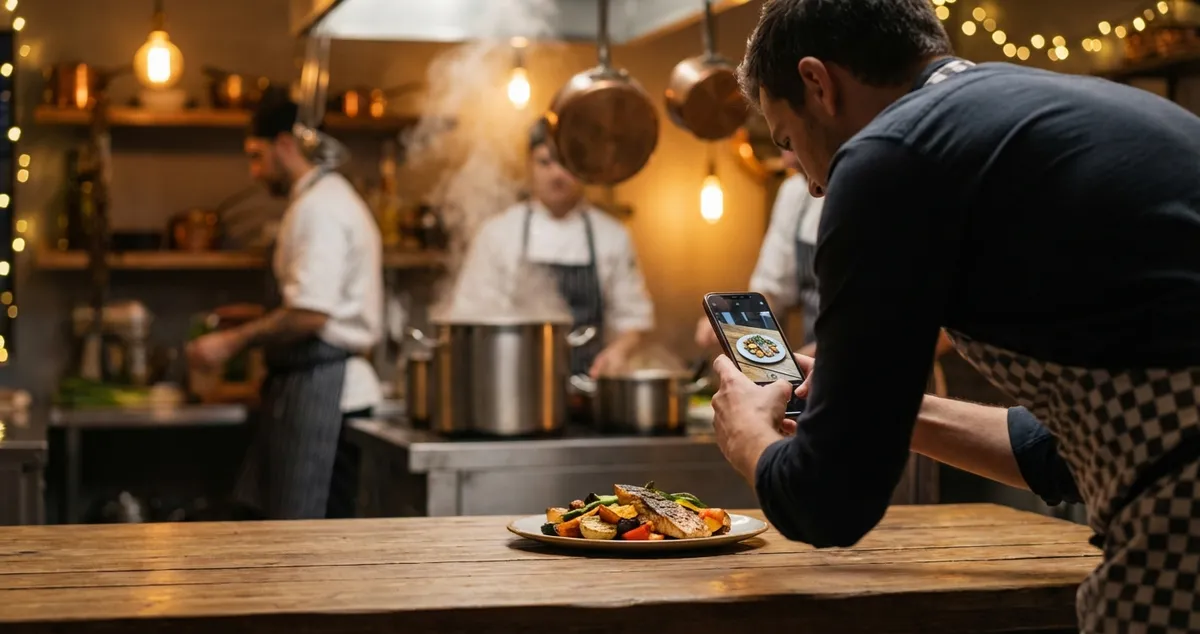
Shoot everything for a phone held at arm's length, because that is where it will be seen. In 2024 Ofcom measured 75% of the time UK adults spent online each day, some 3 hours 15 minutes, as time on a smartphone (Ofcom, Online Nation). Vertical, close, well lit, nothing smaller than a menu price.
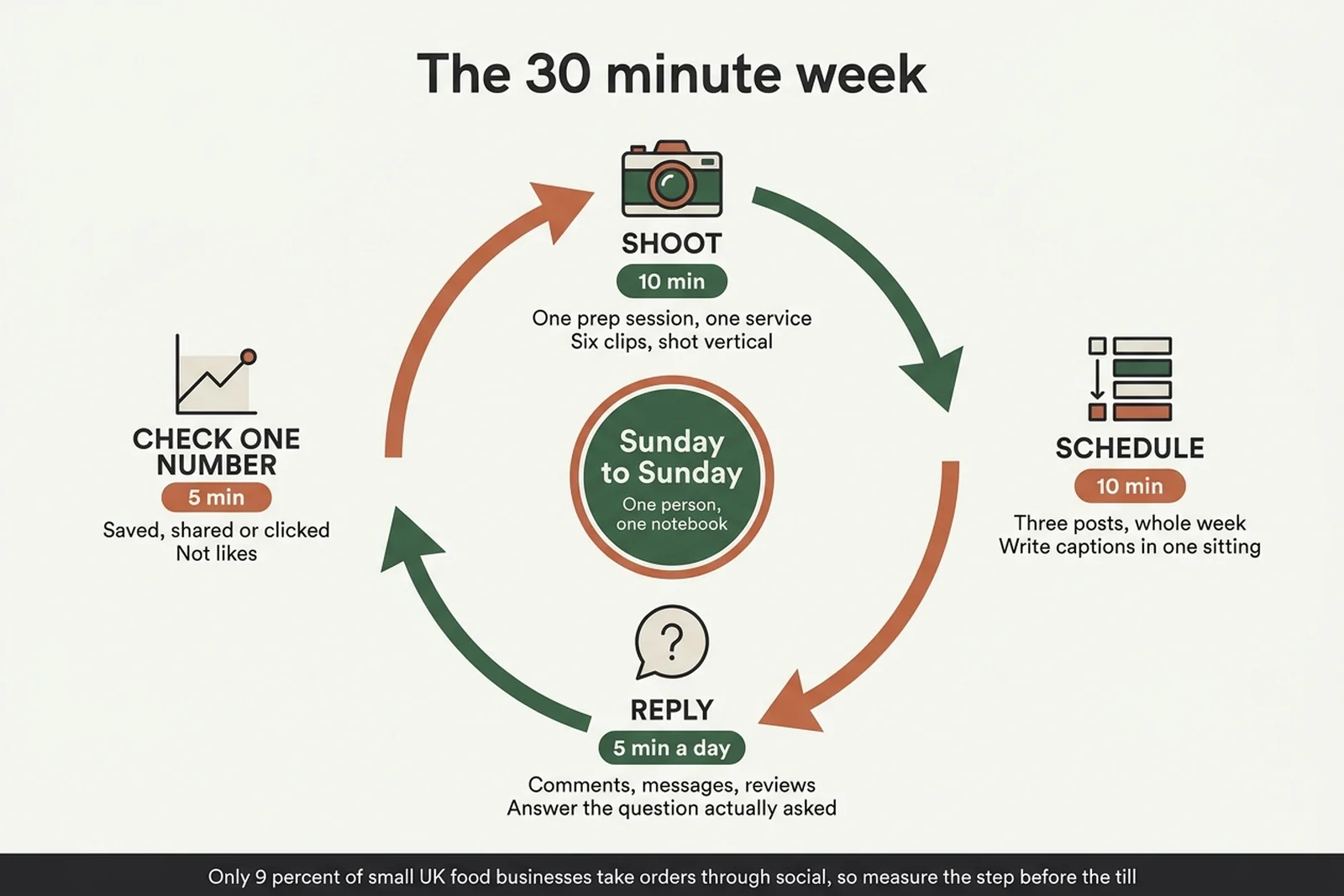
The weekly loop, timed. Measure the step before the till rather than the till itself.
Batching is what makes a rhythm survivable. Ten minutes filming during one prep session gives six clips. Ten minutes on a Sunday writes and schedules the week. Five minutes a day answers messages. It is deliberately small, because the plan you keep beats the plan you admire.
Related: Restaurant Social Media Posts has caption shapes to fill in, and Restaurant Social Media Ideas covers the shot list.
How Do You Know It Is Working?
Pick one number that moves when the job gets done, and one only. If the job is Tuesday covers, the number is Tuesday covers. Follower count is the number you check when you are avoiding the real one. If last month's new followers changed nothing about a Tuesday, you are measuring the wrong thing.
Two habits make the answer trustworthy:
- Ask at the table. "How did you hear about us", written on the booking sheet, is the only source connecting a post to a chair.
- Watch saves, shares and clicks, not likes. A save is someone planning to come. A like is someone being polite.
Give it 8 weeks before judging. Anything shorter and you are reading weather, not climate. Keep review replies current while you wait: whoever found you on Instagram reads your reviews before booking, as our guide to getting more Google reviews explains.
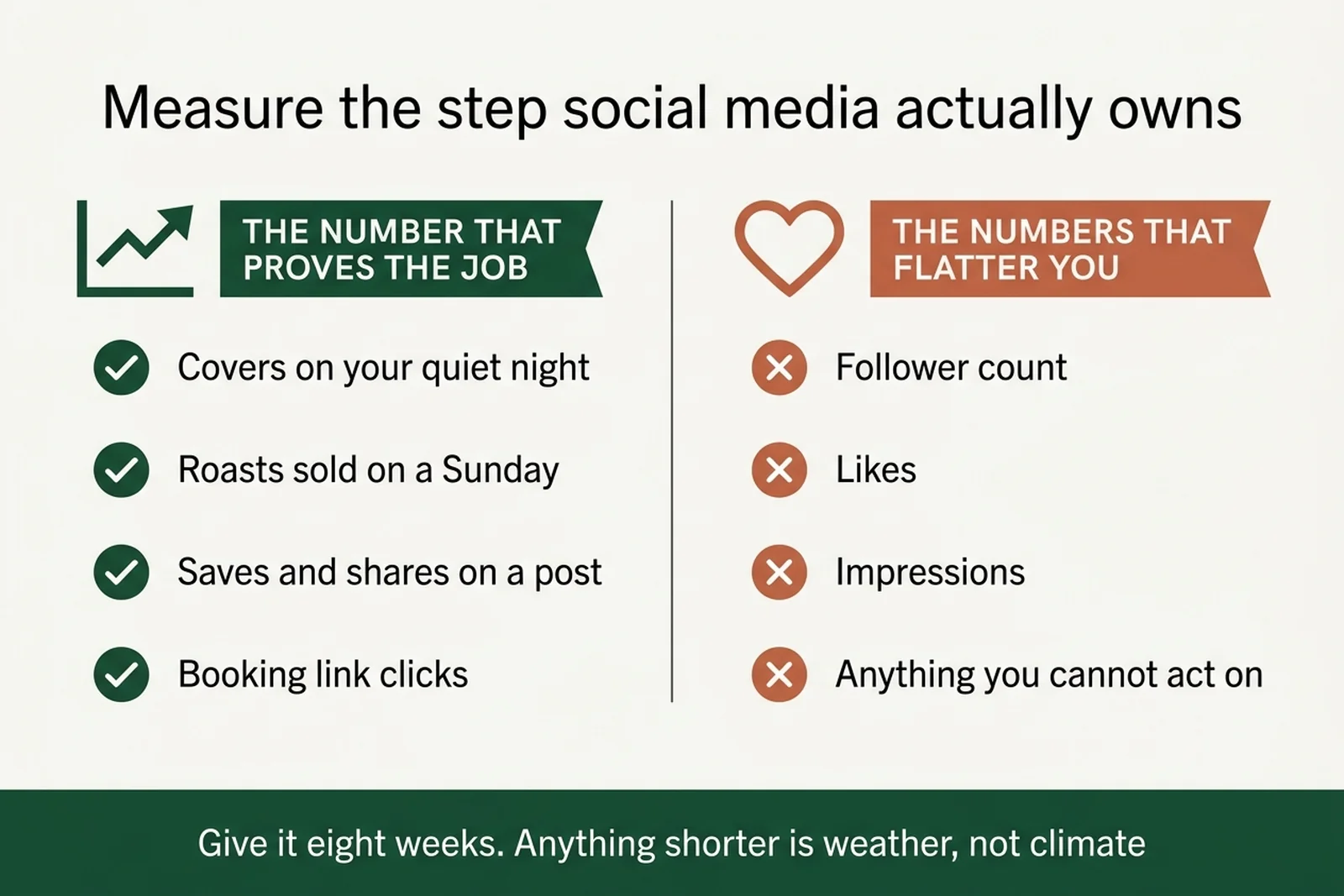
Two columns, one honest. If you cannot act on a number, it is decoration.
The minimum that still works: one platform, one post a week, replies inside a day, and the covers on your quiet night written on a Sunday. The budget is the half hour, since every step runs on the platforms' free tiers. Paid tools and freelancers buy back time, not results, so add them once the loop is running.
Where Restaurant Social Media Goes Wrong
Posting only when it is quiet. Three posts in January, silence until March, then confusion about why the summer posts land flat. The account needs the steadiness of the opening hours on your door.
Broadcasting. A comment left unanswered for a week is a shop with someone behind the counter ignoring you. Replying is the cheapest thing on this page and the most often skipped.
Being everywhere. Five neglected accounts read worse than one good one, and every extra platform is another thing to abandon in a hard month.
Copying a chain. A national brand posts to be recognised. You post to be visited. Borrow their craft and leave their strategy.
Frequently Asked Questions
What is the 5 5 5 rule for social media?
The 5 5 5 rule is a coaching convention, not research, and it runs daily: comment on 5 posts from accounts you want to reach, reply to 5 comments on your own, and share or save 5 pieces of other people's content. For a restaurant it is a workable way onto the radar of local accounts.
What is the 5-3-2 rule on Instagram?
The 5-3-2 rule, likewise a convention, is a posting ratio: of every 10 posts, 5 come from other people, 3 are your own, and 2 are personal or behind the scenes. It stops a feed becoming an advert. Our guide to the 5-3-2 rule for social media breaks it down.
What are the 7 C's of social media strategy?
Content, community, conversation, curation, creation, connection and conversion. Treat it as an audit checklist rather than a plan: it names ingredients without telling you which one your restaurant is short of.
What is the 3-3-3 rule in marketing?
The 3-3-3 rule is a focus device, again convention not research: 3 seconds to stop the scroll, 3 minutes to hold attention, 3 hours before you are forgotten. For a restaurant the first three seconds do the work, which is why the dish belongs in shot immediately. Our 3-3-3 rule in marketing explainer has the rest.
How often should a restaurant post on social media?
Three posts a week, held for months, beats seven a week held for a fortnight. Consistency is the variable you control, and with presence among the small food businesses in that Food Standards Agency survey falling rather than rising, staying on the pitch is most of the game.
Does my restaurant need to be on TikTok?
Only if someone on the team enjoys making video. TikTok rewards personality and volume, and a reluctant account posting once a month will not repay the effort. If nobody wants to be on camera, put the time into Instagram or Facebook.
Where LocalBrandHub Fits
If the sticking point is the writing, our free social post generator turns a template into a week of posts in about twenty minutes, and the free social media calendar shows the month at a glance so a gap is visible before it becomes a silence. The Standard plan adds scheduling in advance and a Monday morning email on what is working. See what it covers.
Weekly Action
This week, take the four decisions and run one loop:
- Name the one customer type you want more of
- Pick one platform and mute the others for a month
- Write the job in one sentence, with the number that proves it
- Film six clips in one prep session
- Schedule three posts on Sunday, then reply to everything waiting
Run that for 8 weeks and you will know more about your own market than any survey can tell you.
Key Takeaways
Key Takeaway
- A strategy is four decisions, not a posting schedule: who, where, what job, what rhythm.
- Presence is falling, not rising. 71% of the small and micro food businesses the Food Standards Agency tracks had a social presence in 2025, down from 77% two years earlier, so the thing to beat is your own drop-off.
- Social sits before the till. Only 9% of those businesses said they take orders through it.
- One platform, chosen on evidence and then checked against your own bookings.
- Batch the week into half an hour and defend that half hour like a delivery slot.
The account you can keep up in a bad week is worth more than the account you plan in a good one.
For restaurants, salons, and local businesses
Need help with your marketing?
We help UK businesses turn social media into real results, not busywork.
Start freeSources
Get More Marketing Tips
Practical marketing tips for UK business owners, straight to your inbox. No spam, unsubscribe anytime.
About the Author
Local Brand Hub
Empowering UK Businesses
Local Brand Hub provides comprehensive business management tools designed specifically for UK local businesses to streamline operations, automate marketing, and grow revenue.
More articlesRelated Articles
 Tutorials
The 5 3 2 Rule for Social Media: Content Mix That Works
The 5 3 2 rule for social media: 50% curated, 30% original, 20% promotional content mix for engagement. A guide for UK restaurants in 2026.
 Tutorials
Restaurant Social Media Agency: When to Hire One (2026)
When hiring a restaurant social media agency makes sense. Services, UK pricing £500-£4,000/month, and how to choose wisely.
 Tutorials
Instagram Marketing for Restaurants: The 13 Minute Problem
Instagram reaches most UK online adults but takes 13 minutes a day. What to post, what the 5-3-2 and 5-3-1 rules are worth, and how to prove it works.