Watch the visual overview· 89 seconds
Instagram reaches most UK online adults but takes 13 minutes a day. What to post, what the 5-3-2 and 5-3-1 rules are worth, and how to prove it works.
Instagram marketing for restaurants is the work of using photos, Stories and Reels to make nearby diners pick you, then proving it filled a table. Finding the audience is the easy half. Ofcom measured Instagram reaching 76% of UK online adults, but just 13 of the daily minutes they give Meta's apps.
Related: Restaurant Social Media Marketing is the hub guide this sits under, covering every platform together.
Thirteen minutes is not much of a shop window. That is an average across all UK online adults, so a committed scroller gives it far more and plenty give it nothing, but the shape of the problem holds. The platform has already carried you to the audience. It cannot make anybody stop.
Which is why "post more" is thin advice, and why a guide promising twelve tactics leaves you no better off at four o'clock on a wet Tuesday. You need a posting shape you can hold through a bad week, and one number that says whether it worked.
What you'll learn:
- The four moves that actually promote a restaurant, in order
- What the 5-3-2 and 5-3-1 rules are, and how much weight they can carry
- How to tell whether Instagram brought anyone through the door
How Do I Promote My Restaurant on Instagram?
Four moves, done consistently rather than perfectly. None needs a hire, a camera or a budget, and the lot takes a fortnight with the phone in your apron pocket.
- Switch to a free business or creator account. This unlocks Insights, which tells you when your own followers are awake, plus one tap call, directions and booking buttons.
- Rebuild the bio into a signpost. You have about 150 characters. Say what you cook, which street you are on, and how to book. Wit is optional. Being findable is not.
- Pin three posts that answer the three questions a stranger actually has. Is the food any good, is this place for someone like me, and can I get a table. One post each.
- Answer every comment and message the same day. A comment is a question asked in public; a message is the same question asked quietly. Neither is a booking, but both are somebody who stopped scrolling to speak to you. You cannot control who sees a post. You can control whether the person asking about Saturday hears back.
Then let the format follow the job. Feed posts are the shop window: your best dish, your room, your people, and they stay on the grid for the stranger scrolling back through it. Stories are today, the specials board and the polls and questions, gone by tomorrow. Reels are short video with the sound on, the prep and the personality, and your best shot at somebody who does not follow you yet.
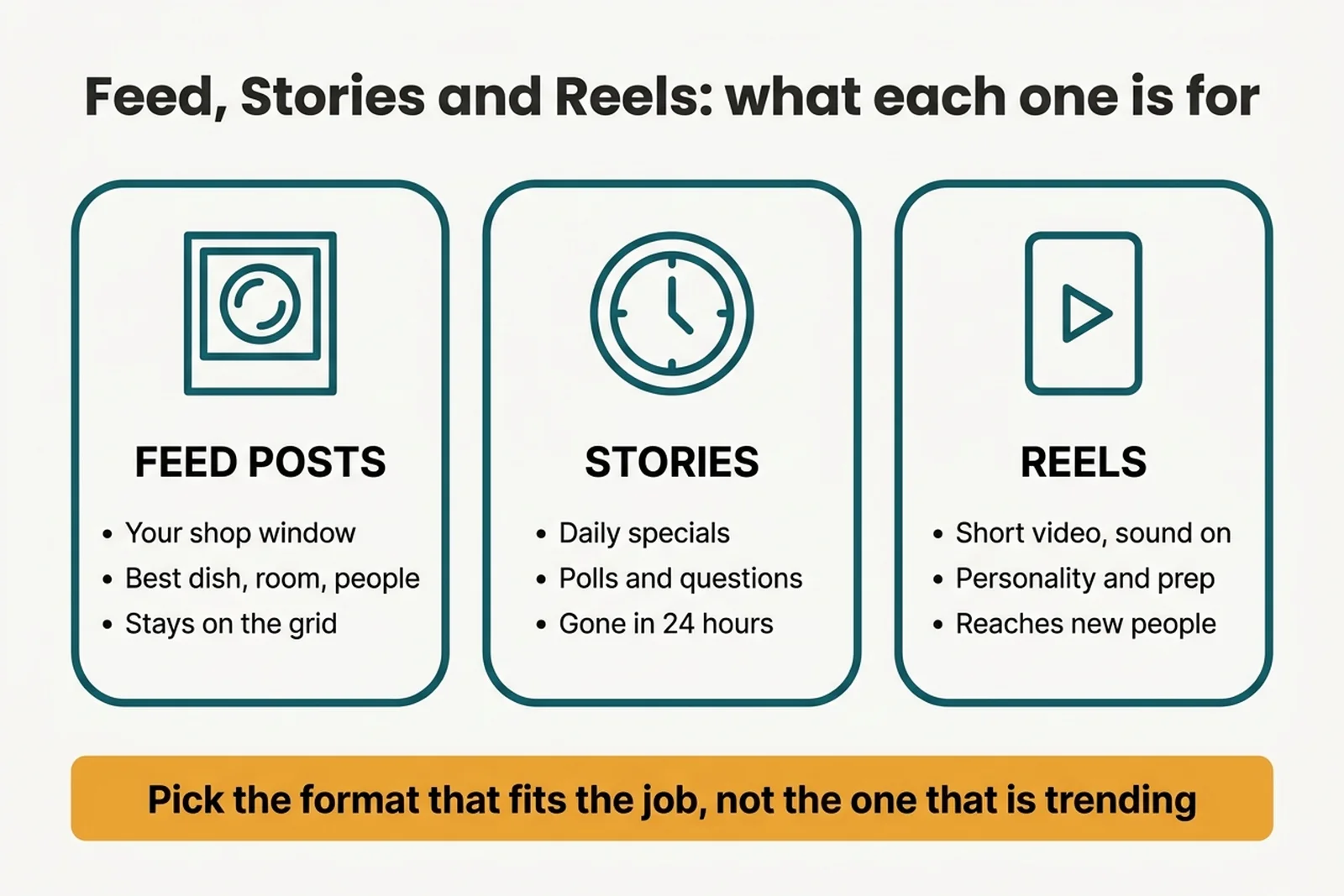
Three formats, three jobs. Choosing on the job rather than the trend separates a working feed from a busy one.
Treat hashtags as a discovery aid, not a growth engine, so they get a line here rather than a section. A tight set naming your area and your food is the sensible default; thirty of them mostly describes your desperation.
Related: Restaurant User-Generated Content covers the photos your diners take, which are worth more than any tag you can add.
What Is the 5-3-2 Rule on Instagram?
The 5-3-2 rule is a posting ratio for every ten posts: five pieces of other people's content you reshare, three pieces of your own, and two that are personal or behind the scenes. It comes from general social media coaching rather than from anybody's published research.
It is a convention rather than a finding, so treating it as a formula is a category error. What it does do is stop a feed becoming a laminated menu, because a ratio makes you notice you have posted the same risotto from the same angle four times this month.
Flip it if your own kitchen is the interesting bit, borrowing the discipline about variety and none of the arithmetic. If you want the ratio's origins and the arguments about it, our explainer on the 5-3-2 rule for social media has them.
What Is the 5-3-1 Rule for Instagram?
The 5-3-1 rule tightens the same idea into a single week: five posts in your core subject, three that are useful or educational, and one that is personal. Nine posts across seven days, so slightly more than one a day, and no spreadsheet required.
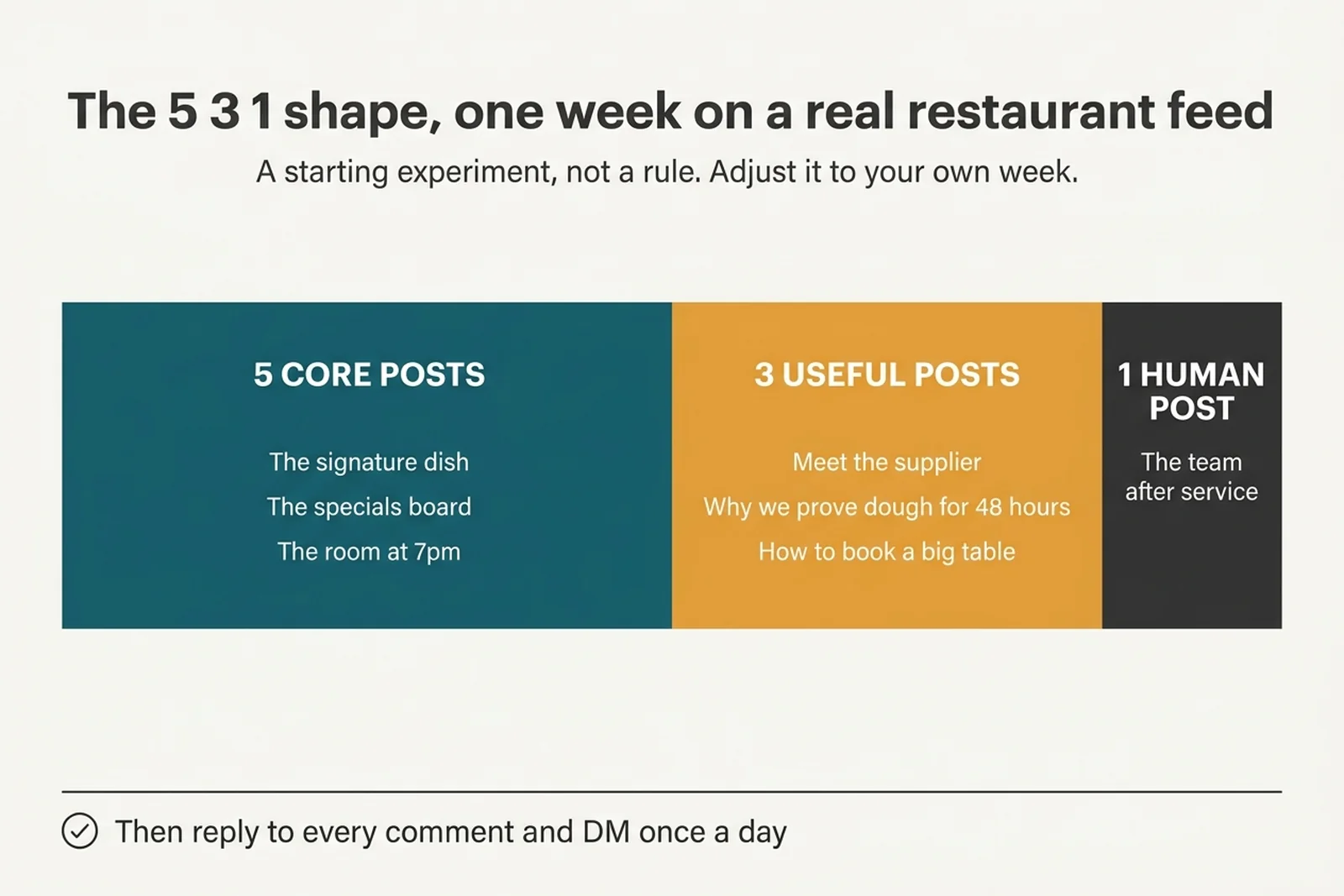
A starting experiment rather than a rule. The point is the shape, not the arithmetic.
Here is the honest version of every posting cadence you will read this year, including this one. Nine is not a threshold and five is not a minimum, because both numbers come from the rule's own definition rather than from anything anyone measured. Run the shape for a month, weigh the cost against what lands in the diary, then move the numbers. A cadence you adjusted beats one you inherited and resented.
What it really buys is the end of the blank grid: Thursday afternoon stops being an invention and becomes a choice between three options.
What Are the Best Tips for Instagram Marketing for Restaurants?
Shoot for a thumb, put a person in the frame, and give the account one job. Everything below follows from those three.
Shoot vertical, close and in daylight. The photo will be seen at arm's length on a phone in a queue, not on a gallery wall. One subject, filling the frame.
Let somebody be in it. A plate tells a stranger what you sell. A person carrying it tells them what it is like to sit down in your room. They are choosing on both, and the room is the half a plate photo cannot show.
Give the account one job this quarter, such as filling Tuesdays, and let that job pick the content. One job is a stricter version of the only official guidance going: the government's own social media playbook advises setting content pillars of 3 to 5 areas that everything you publish must align with (GOV.UK). Written for press offices, not kitchens, so import the discipline and leave the topics.
Related: Restaurant Social Media Strategy works through choosing that job properly.
Make booking one tap from the bio and from Stories. Every extra step is a place to lose somebody who was, briefly, hungry.
Then measure it at the door. A save is a bookmark, not a booking. Instagram will tell you a post was saved dozens of times and still cannot say whether one of those people turned up on Saturday. Add Instagram to your "how did you hear about us" question and log the answers for a month.
Where LocalBrandHub Fits
If writing the captions is the sticking point, our free social post generator turns a template into a week of posts in about twenty minutes, and the free social media calendar shows the month at a glance. See what it covers.
Weekly Action
This week, run one loop rather than a relaunch:
- Batch three dish photos in one quiet afternoon
- Pin the three posts that answer a stranger's three questions
- Clear every comment and message once a day
- Ask the next twenty bookings where they found you
Frequently Asked Questions
How often should a restaurant post on Instagram?
Start with three feed posts a week plus Stories on the days you are open, hold it for a month, then adjust. That is a starting experiment rather than a proven minimum, and deliberately lighter than the 5-3-1 shape above. A rhythm you keep through a staff shortage beats a busier one you abandon.
Should my restaurant be on Instagram or TikTok?
Both reach UK adults, but not equally. Ofcom found Bytedance, TikTok's owner, reaching 51% of UK online adults and 75% of online 18 to 24 year olds (Ofcom). Neither number tells you who walks into your dining room, so pick on who enjoys being on camera. Our TikTok marketing for restaurants guide covers the trade-offs.
Do hashtags still work for restaurants on Instagram?
They work as a discovery aid rather than a growth hack. A short, honest set naming your area and your food helps the right nearby person trip over you. Piling on thirty tags makes a caption tiring to read.
How do I get more restaurant bookings from Instagram?
Make booking one tap from the bio and from Stories, post proof the room is worth crossing town for, and answer messages the same day. Then ask new diners where they found you, because that is where the platform stops guessing and you start knowing.
Is Instagram marketing for restaurants worth the time?
For most places chasing younger and midweek covers, yes, provided the effort survives a bad month. Keep it to a batched hour a week. If your regulars are older and book by phone, weigh that hour against your Google listing.
Key Takeaways
Key Takeaway
- Reach is not your problem. Instagram got to 76% of UK online adults in Ofcom's count, so the audience is already there.
- Attention is your problem. Instagram took 13 of the daily minutes UK online adults spent on Meta's services, against 36 minutes on Facebook and Messenger.
- Ratios are memory aids, not mechanisms. Use 5-3-2 or 5-3-1 to force variety, then adjust the numbers to your own week.
- Formats have jobs. Feed posts are the shop window, Stories are today, and Reels are your best shot at people who do not follow you yet.
- One number settles it, and you collect it yourself at the point of booking.
Instagram will never tell you it filled a table. Your host stand will.
For restaurants, salons, and local businesses
Need help with your marketing?
We help UK businesses turn social media into real results, not busywork.
Start freeSources
Get More Marketing Tips
Practical marketing tips for UK business owners, straight to your inbox. No spam, unsubscribe anytime.
About the Author
Local Brand Hub
Empowering UK Businesses
Local Brand Hub provides comprehensive business management tools designed specifically for UK local businesses to streamline operations, automate marketing, and grow revenue.
More articlesRelated Articles
 Tutorials
The 5 3 2 Rule for Social Media: Content Mix That Works
The 5 3 2 rule for social media: 50% curated, 30% original, 20% promotional content mix for engagement. A guide for UK restaurants in 2026.
 Tutorials
Restaurant Social Media Agency: When to Hire One (2026)
When hiring a restaurant social media agency makes sense. Services, UK pricing £500-£4,000/month, and how to choose wisely.
 Tutorials
Restaurant Facebook Marketing: A Practical UK Guide
Learn restaurant Facebook marketing that drives bookings. Proven content strategies, the 30-30-30 posting rule, and whether paid ads are worth it.