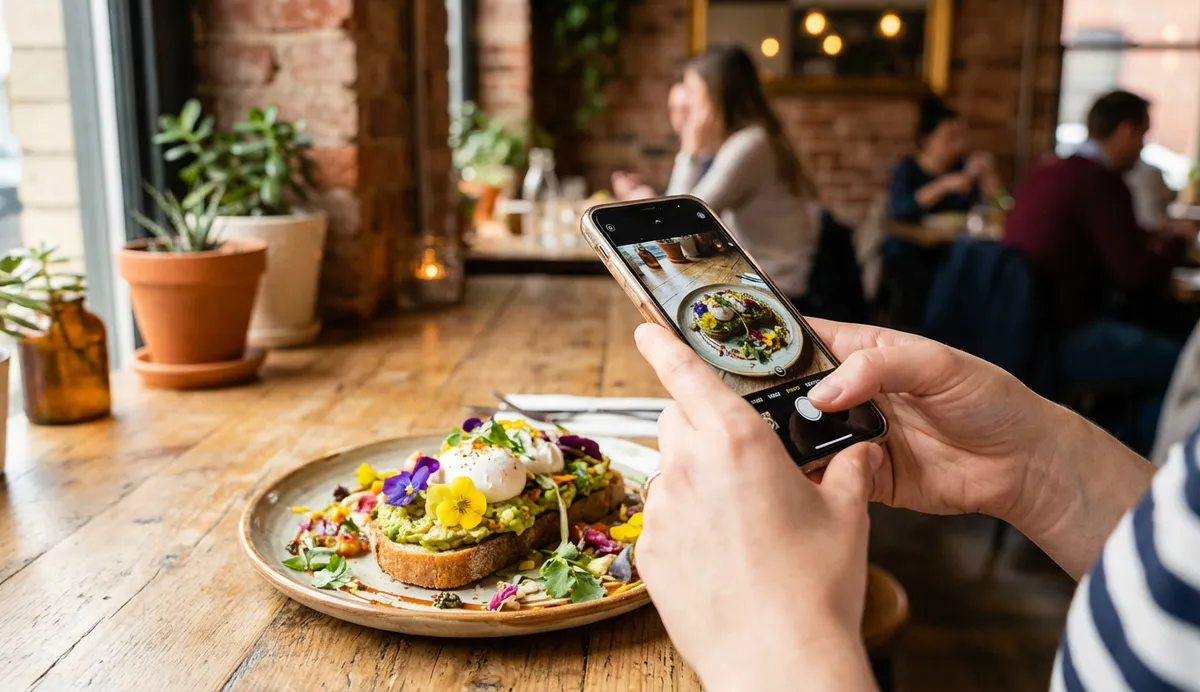
Learn how restaurant user generated content builds trust and drives bookings. Practical UK strategies for collecting customer photos and reviews.
92% of consumers trust user-generated content more than traditional advertising. Your food photos are gorgeous: professional lighting, perfect angles, not a crumb out of place. But customers scroll right past them. They're looking for what real people posted: the slightly imperfect shots, the genuine reactions, the proof that actual humans enjoyed eating there.
Restaurant user generated content isn't just cheaper than professional shoots. It's significantly more trusted.
Related: Restaurant Social Media Marketing (hub page)
For content ideas to share, see our restaurant social media ideas guide. For platform-specific tactics, check our guides on Instagram and TikTok marketing.
Restaurant user generated content (UGC) is any content (photos, videos, reviews, or social posts) created by your customers rather than your marketing team. It's authentic, cost-effective, and statistically more persuasive than anything you could create yourself.
The numbers are clear: 92% of consumers trust user-generated content more than traditional advertising (Bazaarvoice). For restaurants specifically, 40% of people visit a restaurant after seeing food photos online (Cropink). Your customers are already creating marketing content for you: the question is whether you're capturing and using it.
What You'll Learn
- What counts as restaurant UGC and why it outperforms professional content
- The types of customer content worth collecting
- How to encourage guests to create content naturally
- Where to use UGC across your marketing channels
- Legal basics for using customer content in the UK
- How to measure what's actually working
Why Restaurant UGC Outperforms Professional Content
If you're thinking "we already take good photos", that's not the point. Let's start with the data on restaurant user generated content.
Before investing more in professional shoots, consider what customers actually respond to. 90% of consumers say they find UGC more authentic and trustworthy than brand-created content (Bazaarvoice). That's not a marginal preference; it's overwhelming.
The conversion impact is equally striking. Brands using UGC see 29% higher web conversions than campaigns without it. For paid advertising specifically, UGC-based ads achieve 4× higher click-through rates and 50% lower cost-per-click compared to traditional creative (Bazaarvoice).
Why this matters
85% of consumers turn to visual UGC over branded content when making purchasing decisions. Your polished photos might impress other marketers, but customers want to see what their meal will actually look like.
Example: A gastropub might post a professional shot of their Sunday roast: beautifully lit, steam rising perfectly. But the photo that drives bookings? The slightly chaotic customer snap with three generations crowded around the table, Yorkshire puddings half-eaten, everyone smiling. That's the proof people want.
The Trust Gap
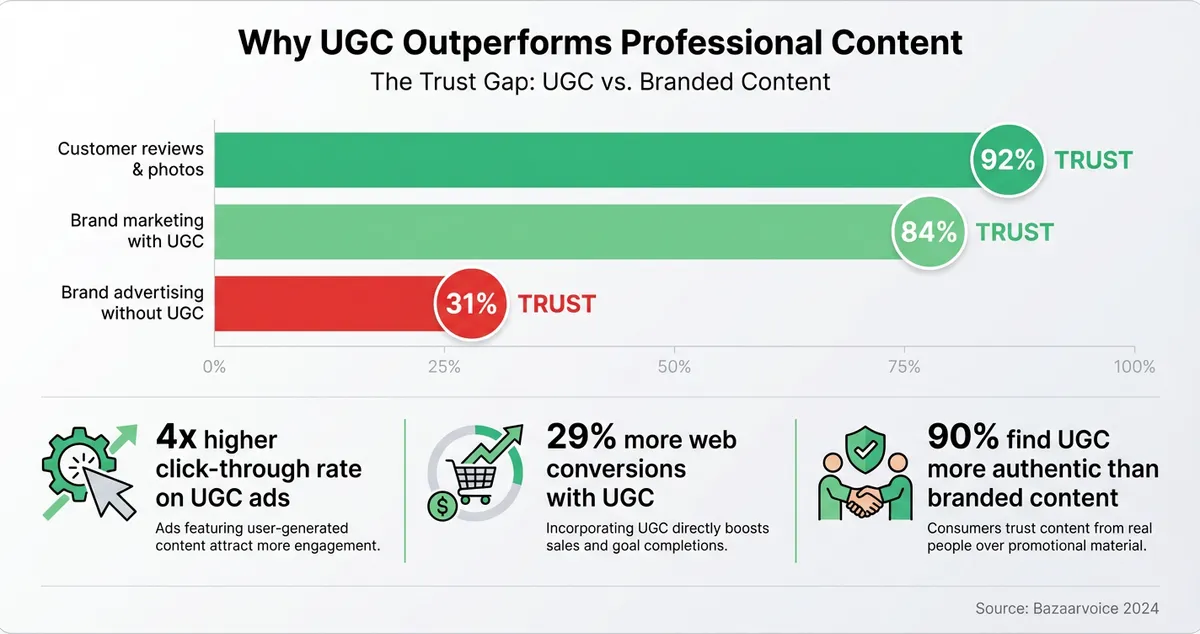
Here's what creates the trust gap:
| Content Type | Consumer Trust Level |
|---|---|
| Customer reviews and photos | 92% trust |
| Brand marketing with UGC | 84% trust |
| Brand advertising without UGC | 31% trust |
Source: Bazaarvoice UGC Statistics
If you're only posting professional content, you're operating at a trust disadvantage. The fix isn't to abandon quality; it's to balance it with authentic customer voices.
Types of Restaurant User Generated Content Worth Collecting
Moving on to what you should actually collect. Not all restaurant user generated content is equally valuable. Focus your efforts on these categories.
Customer Photos
The bread and butter of restaurant UGC. 86% of diners post about their meal if it looks good enough (Cropink). These photos show potential customers what to expect: real portions, real presentation, real atmosphere.
What makes a customer photo valuable:
- Clear enough to repost (not blurry or dark)
- Shows the food or experience authentically
- Ideally includes context (the table, the view, the company)
Video Content
Short-form video dominates social platforms. Customer TikToks and Reels showing their dining experience reach audiences you couldn't access through your own channels. A genuine reaction video carries more weight than any scripted content.
Written Reviews
Google reviews, TripAdvisor feedback, and Yelp comments remain crucial. 88% of shoppers consult reviews before making a purchase decision (Bazaarvoice). For restaurants, reviews directly influence whether someone walks through your door.
Check-ins and Tags
Every time someone checks in or tags your location, they're telling their network about you. These micro-endorsements add up. 55% of consumers share their restaurant experiences on social media (Cropink). Make sure they can find and tag you easily.
Story Mentions
Instagram and Facebook Stories disappear after 24 hours, but they drive immediate action. When a customer shares your restaurant to their Stories, their close friends see it. That's high-value word-of-mouth.
How to Encourage Customers to Create Content
The reality for most restaurants: you know restaurant user generated content matters, but customers aren't posting.
Here's where strategy meets reality. You can't force UGC, but you can create conditions that make it more likely. The goal is to make sharing natural, not awkward.
Create Photo-Worthy Moments
The most effective UGC strategy doesn't involve asking at all. Design experiences people want to photograph.
Practical approaches:
- Presentation that pops: A signature dish served in an unusual vessel, a cocktail with an Instagram-worthy garnish
- Lighting that works: Natural light near windows, or warm accent lighting that doesn't cast harsh shadows on food
- A "feature wall" or corner: A distinctive backdrop that becomes your restaurant's visual signature
- Tableside theatre: Anything prepared or finished at the table (cheese wheels, flambé, gravy poured) triggers phones to appear
If you're only collecting restaurant user generated content when it's quiet, you'll miss the moments when customers are most excited to share. Your competitors with consistent UGC strategies are building trust you're not.
Use a Branded Hashtag
Create a simple, memorable hashtag specific to your restaurant. Include it on menus, table cards, and receipts. Make it easy to find and spell.
What works:
- Short (under 20 characters)
- Includes your restaurant name or a distinctive element
- Easy to spell without looking it up
- Not already in use for something else
Don't do this: Creating a generic hashtag like #BestFoodEver that gets lost in millions of posts.
Timing Your Ask
There's a right moment to encourage restaurant user generated content, and several wrong ones. The peak experience moment is when customers are most receptive: after the main course arrives but before the bill, or during a particularly impressive dessert presentation.
Example: A seafood restaurant noticed most customer photos came during dessert service. They now bring a small "Photo spot" card with the dessert menu, including their hashtag. UGC increased 40% within a month.
Never ask when customers are:
- Just sitting down (too early)
- Waiting for food (frustrated)
- Paying the bill (thinking about cost)
Incentives That Work
Incentives can encourage UGC, but they need careful handling. Heavy incentives can make content feel transactional and less authentic.
| Incentive Type | Effectiveness | Risk |
|---|---|---|
| Chance to be featured | High | Low (feels like recognition) |
| Small discount on next visit | Medium | Medium (can feel transactional) |
| Free dessert for posting | Medium | Medium (may attract deal-seekers) |
| Large discounts | Low | High (devalues content authenticity) |
(Rule of Thumb: your mileage may vary based on your audience and brand positioning)
The most effective incentive? Simply resharing customer content. Being featured on a restaurant's page feels rewarding without commercial overtones. For ready-to-use caption templates when resharing, see our restaurant social media posts guide.
Collecting and Curating Restaurant UGC
Now let's cover the practical side of restaurant user generated content. Customer content is useless if you never see it. Build a simple system for monitoring and collecting.
Monitor Your Mentions
Check these daily:
- Tagged posts on Instagram and Facebook
- Mentions in Stories (these disappear in 24 hours)
- Location tags and check-ins
- Your branded hashtag
- Google and TripAdvisor reviews
If you can't tell whether your social posts bring bookings or just likes, that's usually a sign you need better tracking. Start with monitoring mentions consistently.
Get Permission Properly
Before using customer content, get explicit permission. This protects you legally and builds goodwill.
Simple permission request template:
"Hi [Name], we love this photo! Would you mind if we shared it on our [Instagram/website]? We'll credit you, of course. Thanks for dining with us!"
Most people say yes: it's flattering to be asked. But always wait for confirmation.
Build a UGC Library
Create a simple folder system:
- Ready to use: Permission granted, high quality
- Pending permission: Waiting for response
- Saved for reference: Good content you've seen but not contacted
Review weekly. Aim for a rolling library of 10-20 posts ready to use so you're never scrambling for content.
Quality vs Quantity
Not every customer photo deserves a repost. Curate for:
- Image clarity (no blur, reasonable lighting)
- Positive sentiment (genuine enjoyment visible)
- Brand alignment (matches your restaurant's vibe)
- Diversity (don't repost only one type of customer)
A smaller collection of great UGC beats a flood of mediocre content.
Ask yourself: does your UGC library have at least 10-15 posts ready to use at any time? If not, that's your first priority.
Where to Use Restaurant User Generated Content
Here's where restaurant UGC earns its value. With that library built, deploy content strategically across channels.
Social Media Feeds
The obvious choice. Repost customer photos to your grid with credit. This shows appreciation, encourages more UGC, and fills your content calendar with authentic material.
Best practice: Mix UGC with your own content at roughly 30-40% UGC, 60-70% original. Too much UGC can make your feed feel like you've outsourced your marketing entirely. For the original 60-70%, an AI social post generator keeps your feed consistent between customer reposts.
Instagram and Facebook Stories
Stories are perfect for UGC. Repost customer Stories (while they're live) to your own. The casual, temporary format suits authentic customer content perfectly.
Your Website
Websites with UGC see visitors spending 90% more time on site (Bazaarvoice). Add customer photos to your homepage, menu pages, or a dedicated gallery. Real customer images build trust faster than stock photography ever could.
Email Marketing
Include customer testimonials and photos in newsletters. "Here's what customers are saying" sections perform well because they provide social proof in a format people trust.
Menu Integration
This one's clever: add short review quotes next to popular dishes. "Best fish and chips in Manchester" (Google Review). It's social proof at the moment of decision.
Google Business Profile
Post customer photos (with permission) to your Google Business Profile. This content appears in search results and Maps, influencing people before they even visit your website.
Paid Advertising
UGC ads outperform traditional creative. 42% of shoppers trust ads featuring UGC compared to 31% for ads without (Bazaarvoice). If you're running Facebook or Instagram ads, test customer photos against your professional shots.
Legal and Ethical Considerations
Moving on to the serious stuff. Using customer content without proper permission can create legal problems. Here's what UK restaurants need to know.
Always Get Permission
The person who took the photo owns the copyright. Sharing without permission, even with credit, can technically be infringement. Always ask before using content beyond a simple Story reshare.
Credit the Creator
When you repost, tag the original creator. This is both legally sensible and good manners. It also encourages future UGC: people like being credited.
What You Can Do Without Permission
- Reshare to Stories (temporary, considered sharing not copying)
- Quote written reviews (with attribution)
- Link to customer posts (rather than reposting)
What Requires Permission
- Posting to your feed
- Using in advertising
- Featuring on your website
- Any commercial use
Keep Records
Screenshot or save permission responses. If someone later claims you used their content without consent, you have documentation.
Don't do this: Assuming that tagging you or using your hashtag grants automatic permission. It doesn't. Restaurants have received takedown requests after using customer photos in Facebook ads without asking first, even though the customer originally tagged them. Always ask.
When was the last time you followed up with a permission request? If you can't remember, check your pending folder now.
Measuring Restaurant UGC Success
Finally, let's talk measurement. If you're reading this thinking "I don't have time for analytics", you're not alone. But with your restaurant user generated content system running, you need to know if it's working. Focus on metrics that connect to business outcomes.
Example: A neighbourhood bistro tracks three things: weekly mention count, engagement on UGC reposts vs original content, and whether Friday/Saturday bookings correlate with mid-week posting. Simple, actionable, takes 10 minutes weekly.
Key Metrics to Track
| Metric | What It Tells You |
|---|---|
| Branded hashtag usage | How often customers spontaneously share |
| Mention volume | Overall UGC generation rate |
| Engagement on UGC posts | Whether UGC resonates with your audience |
| Website traffic from UGC | Direct impact on discovery |
| Review frequency | Customer feedback generation |
Monthly Review Process
Once a month, review:
- Volume: Are you getting more or fewer mentions than last month?
- Quality: Is the content usable and on-brand?
- Engagement: Do UGC posts outperform your other content?
- Gaps: What types of content aren't you getting enough of?
Adjust your restaurant user generated content strategy based on what you find.
Putting It All Together
Restaurant user generated content works because it solves the trust problem that professional marketing creates. Customers don't believe you when you say your food is amazing. They believe other customers.
Example: A wine bar with 800 Instagram followers consistently outperforms a competitor with 5,000. The difference? Every week they repost 3-4 customer Stories, respond to every tag, and feature a "customer of the week" post. Their restaurant UGC strategy is simple but consistent.
If you pick just one thing: Set up daily monitoring of your mentions and tags. You can't use restaurant user generated content if you never see it. Start there, and build your system outward.
Weekly Action
This week, build your restaurant UGC foundation:
- Day 1-2: Set up notifications for tags and mentions on Instagram/Facebook
- Day 3-4: Search your branded hashtag and save any customer photos
- Day 5-7: Send permission requests to 2-3 customers with repostable content
That's 30 minutes total, and you'll have the start of a UGC library.
Frequently Asked Questions
What is restaurant user generated content?
Restaurant user generated content (UGC) is any content created by customers rather than your marketing team, including photos, videos, reviews, social media posts, and check-ins. It's authentic social proof that builds trust because potential customers see real experiences from real people.
Do I need permission to repost customer photos?
Yes, for commercial use. While resharing to Stories is generally acceptable, posting customer photos to your feed, website, or advertising requires explicit permission. Send a quick message asking, keep records of approvals, and always credit the creator.
How do I encourage customers to post about my restaurant?
Create photo-worthy moments through presentation and lighting, use a memorable branded hashtag displayed on menus and table cards, and time any asks for the peak experience moment: after food arrives but before the bill. Recognition (featuring their content) often works better than discounts.
How much UGC should I post compared to original content?
Aim for roughly 30-40% UGC and 60-70% original content. Too much UGC can make your feed feel outsourced, while too little misses the trust-building benefits. The right mix shows you value customers while maintaining your brand voice.
How do I track whether UGC is working?
Monitor branded hashtag usage, mention volume, engagement rates on UGC posts versus original content, and website traffic from social. Review monthly to spot trends and adjust your restaurant user generated content strategy based on what resonates.
If you run a restaurant and want to see how Local Brand Hub can support your marketing, explore our restaurant marketing tools.
Key Takeaways
- 92% of consumers trust UGC over traditional advertising
- 4× higher CTR on ads featuring customer content
- 40% of diners visit after seeing food photos online
- 86% post about meals that look Instagram-worthy
- Get permission before using customer content commercially
- Mix UGC with original content at roughly 30-40% ratio
Ask yourself: when did you last reshare a customer's photo? If you can't remember, you're leaving your most persuasive restaurant user generated content unused.
Ready for the complete social media framework? See our restaurant social media strategy guide for platform priorities and posting schedules that maximise your UGC investment.
Social media moves fast. We keep this restaurant user generated content guide updated regularly.
Related reading: Restaurant Social Media Strategy | Restaurant Social Media Ideas | Instagram Marketing for Restaurants
For UK restaurants
Ready to collect and leverage customer content?
Local Brand Hub helps UK restaurants discover, collect, and share user-generated content that builds trust and drives bookings.
Start freeGet More Marketing Tips
Practical marketing tips for UK business owners, straight to your inbox. No spam, unsubscribe anytime.
About the Author
Local Brand Hub
Empowering UK Businesses
Local Brand Hub provides comprehensive business management tools designed specifically for UK local businesses to streamline operations, automate marketing, and grow revenue.
More articlesRelated Articles
 Marketing Tips
Google Restaurant Reviews: Complete UK Guide
Discover why 75% of consumers regularly check reviews before dining out. Get actionable tips to boost reviews, respond professionally, and handle fakes.
 Marketing Tips
Importance of Restaurant Reviews: A Complete Guide
Most UK diners check reviews before booking. Learn why restaurant reviews matter, how to offset negative ratings, and build your online reputation.
 Marketing Tips
Restaurant Review Sites UK: Guide to Getting Found
Which restaurant review sites matter in the UK? Guide to Google Reviews, TripAdvisor, OpenTable plus a 30-minute weekly management system.