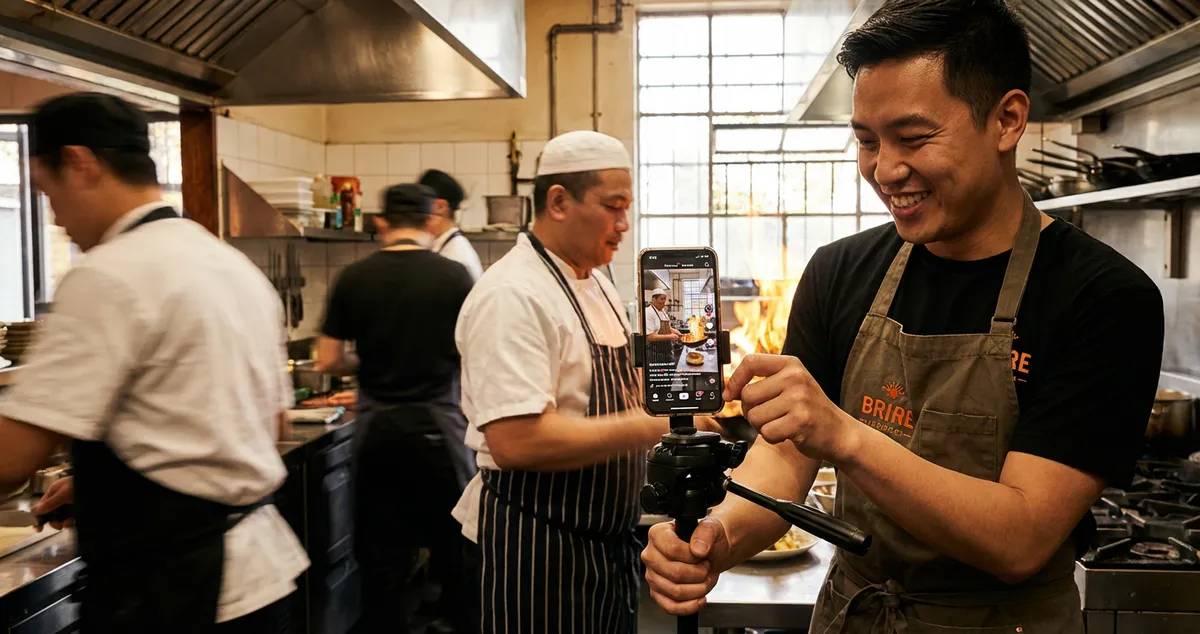
Learn TikTok marketing for restaurants that drives real bookings. Discover what content works, the 3-second rule, and how to reach hungry diners.
"Isn't TikTok just dancing teenagers?" You're not the first restaurant owner to ask. But here's the truth: while you're dismissing the platform, your competitors are filling tables with customers who discovered them scrolling at lunchtime. TikTok marketing for restaurants isn't about going viral. It's about showing up where millions of potential diners are already making decisions about where to eat.
Related: Restaurant Social Media Marketing (hub page)
For a broader social media framework, see our guide to restaurant social media strategy. For Instagram-specific tactics, see Instagram marketing for restaurants. For content inspiration, check our restaurant social media ideas guide.
TikTok marketing for restaurants is the practice of creating short-form video content to showcase your food, personality, and atmosphere to potential diners on the TikTok platform. Unlike Instagram's polished aesthetic, TikTok rewards authenticity, personality, and trend awareness, often with surprisingly low production values.
Here's why it matters: 61% of diners say TikTok food content influences where they eat, with 29% having picked a restaurant solely because it looked good on the platform (Nation's Restaurant News). That's millions of potential customers making dining decisions based on 30-second videos. The question isn't whether TikTok works for restaurants. It's whether you're using it.
What You'll Learn
- Why TikTok specifically works for restaurants (with UK statistics)
- The 3-second rule that determines whether anyone watches your content
- Content ideas that actually drive engagement
- How often to post without burning out
- Common mistakes that waste your time
Why TikTok Works for Restaurants in 2025
Before you invest time in a new platform, you need to know it works. TikTok has grown far beyond its teenage dancing reputation. The platform has 24.8 million active users in the UK, up 55% year-over-year (Sprout Social). More importantly, over 40% of UK TikTok users are over 35, making it relevant for a much broader customer base than many restaurateurs assume.
The demographics favour restaurants: 56.2% of UK TikTok users are 18-34, the prime dining-out age group. The 25-34 segment alone makes up 31.8% of users.
The Food Discovery Platform
TikTok has become a genuine food discovery tool. When Google's senior VP acknowledged that younger people prefer "visually rich forms" of search, including TikTok, it signalled a fundamental shift in how people decide where to eat. The platform isn't just entertainment; it's a restaurant recommendation engine.
Why This Matters
Unlike traditional review sites where people search after deciding to eat out, TikTok content finds users when they're bored, and makes them hungry. That's a fundamentally different discovery path.
TikTok vs Instagram for Restaurants
Both platforms matter, but they serve different purposes:
| Factor | TikTok | |
|---|---|---|
| Content style | Raw, authentic, trend-driven | Polished, curated, aesthetic |
| Engagement rate | 6-8% for food content | 2.2% average |
| Best for | Discovery, viral potential | Brand building, existing followers |
| Production effort | Low (phone + creativity) | Medium (lighting, editing) |
Choose based on your audience: TikTok for younger diners, Instagram for broader reach. Your mileage will vary.
When TikTok might NOT be right for you: If your target customers are primarily over 55, or if you genuinely can't commit to video content, focus your energy on Instagram and Facebook instead. TikTok without video is pointless.
The 3-Second Rule: Hooking Viewers
The demographics make sense, so how do you capture this audience? Before diving into content ideas, understand this: you have approximately 3 seconds to convince someone to keep watching. If your video doesn't hook them immediately, they scroll past, and TikTok's algorithm notices.
What is the 3-Second Rule?
The 3-second rule means your opening must immediately capture attention. TikTok measures watch time, and videos that lose viewers in the first few seconds get shown to fewer people.
Effective opening techniques for restaurants:
- Start with the action: Show the sizzle, the pour, the plate hitting the table
- Use text hooks: "The dish that sells out every Friday" or "Watch what happens when..."
- Open with a question: "Would you try this?"
- Show transformation: Before/after in the first second
Example: A pizza restaurant might open with dough being stretched in slow motion, text reading "Watch this stretch," then cut to the finished pizza. Three seconds, hook established.
Don't do this: Starting with your logo, a static shot of your restaurant, or "Hey guys, welcome to my TikTok..." You've already lost them.
Content Ideas That Work for Restaurants
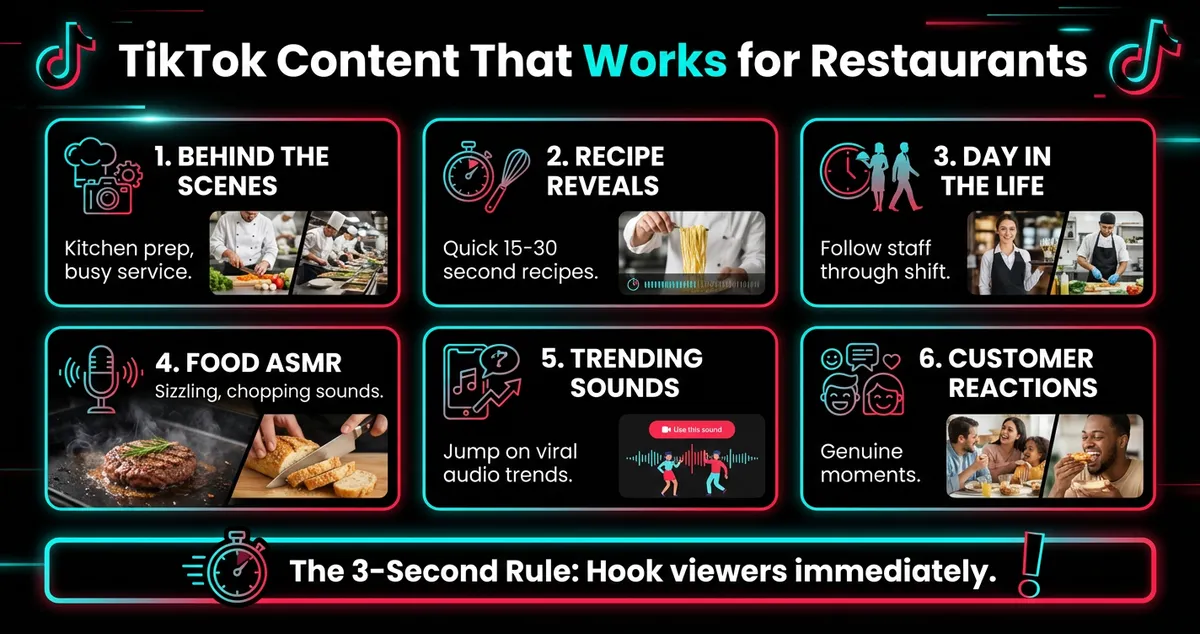
With the hook mastered, what should you actually post? Food content engagement rates on TikTok range from 6-8%, well above platform average (Brandwatch). Recipe videos can hit 70% engagement, but you don't need to teach cooking. Here's what works for restaurants specifically.
Behind-the-Scenes Kitchen Content
Show the chaos, the skill, the reality. TikTok audiences love seeing how things are made:
- Prep work at speed (time-lapse or real-time)
- Plating sequences
- The moment an order comes in during a rush
- Equipment in action (flames, slicing, mixing)
Trending Sounds and Challenges
TikTok rewards trend participation. When a sound goes viral:
- Adapt it to your restaurant context
- Move quickly: trends fade within days
- Don't force it if it doesn't fit
Example: A curry house might use a trending "transformation" sound to show ingredients becoming a finished dish. The sound drives discovery; your content keeps them watching.
Staff Personality Videos
Your team IS your restaurant. Showcase them:
- Quick introductions
- Reactions to busy shifts
- Kitchen banter (keep it appropriate)
- Staff picks and recommendations
Research shows photos featuring people perform significantly better than product-only shots; the same applies to video.
Satisfying Food Content
TikTok loves ASMR and satisfying visuals:
- Cheese pulls
- Sauce pours
- Crispy sounds
- Perfect plating
These work because they trigger appetite. Someone watching a cheese pull at 6pm is more likely to order dinner.
How Often to Post (And When)
You've got content ideas, so how frequently should you post? Consistency beats virality. One viral video might get views, but it won't build a following that consistently books tables.
Posting Frequency (Rule of Thumb)
| Approach | Posts/Week | Best For |
|---|---|---|
| Minimum viable | 3 | Testing the platform |
| Consistent growth | 5-7 | Building momentum |
| Aggressive growth | 1-2 per day | Rapid audience building |
More isn't always better; quality and consistency matter more than volume.
Here's why consistency pays off: UK users spend 49 hours per month on TikTok, nearly double Instagram. That's 49 hours of potential exposure for your restaurant, but only if you're regularly showing up in feeds.
Best Times for Food Content
Food lovers typically scroll around lunch and dinner times:
- 11am-1pm: Lunch decision-making
- 5pm-8pm: Dinner planning
- 9pm-11pm: Late-night cravings
Test and check your TikTok analytics to see when YOUR audience is most active.
Batching Content
If you're thinking "I can't post that often during service," you're right. The solution is batching:
Example: A café might spend one Monday morning filming:
- 3 drink-making clips
- 2 behind-the-scenes prep shots
- 1 staff introduction
That's a week of content from one focused session. Schedule or save as drafts and post throughout the week: a social media calendar keeps those clips organised so you stay consistent without scrambling mid-service.
Going Viral vs Consistent Growth
With your posting schedule set, let's address the elephant in the room. If you're only doing TikTok marketing for restaurants to "go viral," you'll likely be disappointed. Virality is unpredictable, but consistent local growth is achievable and more valuable.
Realistic Expectations
- Most videos won't go viral (that's normal)
- Building a local following takes 3-6 months
- 500 engaged local followers beats 50,000 random viewers
Focus on Local Discovery
Use location-specific hashtags and content:
- #BristolFood #ManchesterEats #LondonRestaurants
- Mention your area in videos
- Engage with local food accounts
A customer who lives nearby and follows your TikTok is worth more than a million views from people who'll never visit. Millennial and Gen Z TikTok users are particularly likely to visit restaurants they discover on the platform, but only if they can actually get there.
Common TikTok Mistakes Restaurants Make
That covers what TO do. Let's talk about what NOT to do. TikTok's algorithm specifically privileges consistent creators: sporadic posting buries your content regardless of quality. The platform's "For You" page favours accounts that post regularly, not just occasionally when the restaurant is slow.
Over-Producing Content
The biggest mistake is making TikTok look like TV. High production value often performs WORSE than authentic, slightly rough content. Promotional posts perform about 40% worse than educational or entertaining content.
Don't: Hire a videographer for scripted restaurant tours. Do: Hand your phone to a staff member and say "film me making this dish."
Ignoring Trends
TikTok rewards trend participation. If you only post your own original content without engaging with trending sounds or formats, you miss discovery opportunities.
Being Too Promotional
"Book a table now!" doesn't work on TikTok. The platform is for entertainment and discovery, not direct sales pitches. Show your food, your vibe, your people: let viewers decide to book themselves.
Not Engaging With Comments
Comments drive the algorithm. Reply to every comment, especially in the first hour after posting. Ask questions that invite responses. Create a conversation.
Putting It All Together
That covers the strategy. Here's how to start. TikTok marketing for restaurants isn't about becoming an influencer or going viral. It's about showing up consistently with authentic content that makes people hungry.
If you pick just one thing: Master the 3-second hook. Film 10 quick clips this week where the first frame immediately grabs attention. Post them, see what performs, adjust.
Weekly Action Checklist
- Film 3-5 short clips (15-60 seconds each)
- Use at least one trending sound
- Include location hashtags
- Respond to all comments within 24 hours
- Check analytics for best posting times
If You Only Have 15 Minutes This Week
This week, get your first TikTok live:
- Day 1-2: Film one behind-the-scenes clip during prep (30 seconds max)
- Day 3-4: Find a trending sound and add it to your clip
- Day 5-7: Post with your location hashtag and respond to any comments
That's your minimum viable TikTok strategy: one video is enough to start.
If you run a restaurant and want to see how Local Brand Hub can support your marketing, explore our restaurant marketing tools.
Key Takeaways
- 24.8 million UK users, and growing 55% year-over-year
- 61% of diners say TikTok influences where they eat
- The 3-second rule determines if anyone watches your video
- Authentic beats polished: raw content often outperforms produced content
- Consistency beats virality: 500 local followers beat 50,000 random views
Ask yourself: could someone watch your TikTok and immediately understand what eating at your restaurant feels like? If not, that's where TikTok marketing for restaurants starts.
Social media moves fast. We keep this guide updated, guide updated regularly.
Related reading: Restaurant Social Media Strategy | Instagram Marketing for Restaurants
For UK restaurants
Ready to start TikTok marketing for your restaurant?
Local Brand Hub helps UK restaurants create, schedule, and track social media content that drives real bookings, across all platforms.
Start freeGet More Marketing Tips
Practical marketing tips for UK business owners, straight to your inbox. No spam, unsubscribe anytime.
About the Author
Local Brand Hub
Empowering UK Businesses
Local Brand Hub provides comprehensive business management tools designed specifically for UK local businesses to streamline operations, automate marketing, and grow revenue.
More articlesRelated Articles
 Tutorials
Online Gift Card Restaurant Guide: UK Setup
Learn how to sell online gift card restaurant vouchers in the UK. Compare platforms, set up your store and market digital cards year-round.
 Tutorials
Restaurant Press Release Template: Free UK Templates
Free restaurant press release templates for menu launches, openings, awards, and seasonal events. Fill-in format with real UK examples.
 Tutorials
Restaurant Soft Opening: Test Before You Launch
Plan a successful restaurant soft opening with invite lists, feedback forms, menu testing and staff training tips. A practical UK guide.