Local SEO for restaurants, built on Google's own ranking documentation: why your position moves with the customer, and the weekly routine that holds.
Local SEO for restaurants decides whether you turn up when somebody nearby searches for a meal. Google says local results are mainly based on relevance, distance and popularity, and that distance is measured from the customer. It moves with them, not with you, which is why one rank check answers the wrong question.
Type your own restaurant's name into Google from behind the pass and you will find yourself. That is the least useful test in local search, and the one nearly everybody runs.
Walk four hundred metres up the road, open a fresh tab and search for somewhere to eat nearby. You may not be there at all. Your profile did not break between those two searches. Google was answering a different question, because a local search is not asking which restaurant deserves the crown. It asks which one suits somebody standing right here.
What you'll learn
- The three inputs Google names, and which you can actually edit
- Why your ranking is a surface across the map, not a number
- What money buys in local search, and what it provably cannot
- A weekly routine short enough to survive a bad service
How does Google decide which restaurants show up?
Google's Business Profile documentation names three inputs: relevance, distance and popularity. In plain terms, that is how well you match what was typed, how far you are from the searcher, and how well known you are. Only one of the three is fully yours to type.
One wrinkle worth knowing before you read anyone else on this: Google's summary sentence calls the third input popularity, while the section explaining it further down the same page is headed Prominence. Same factor, two labels, so do not be thrown when a guide uses the other word.
Distance is measured from the customer
Distance is the input that quietly ruins everybody's measurement. Google says distance refers to how far each business is from the customer who is searching. If they have not shared where they are, Google uses what it knows about their location.
The reference point is the customer, not your postcode. You do not have a position in the local results. You have a different position from every pavement in town.
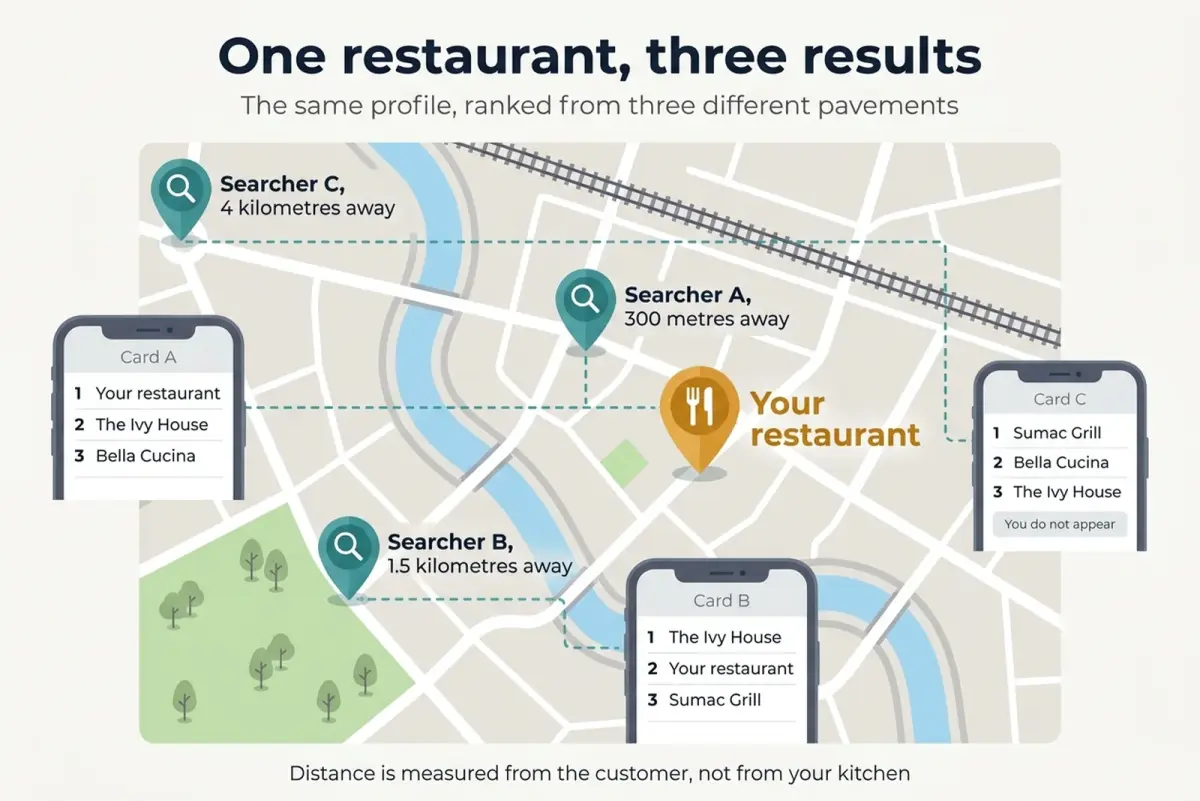
The same profile, ranked from three different pavements.
That makes the usual check, typing your cuisine and your town into your own phone in your own kitchen, a sample of one point on the map: the one where distance flatters you most. It is tasting the soup only from the pot nearest the door.
A better measurement takes five minutes
Search from the three places your customers travel from, on a phone, standing there if you can:
- The station or car park, where people arrive hungry and undecided
- The office block or school gate that fills your lunch trade
- The hotel three streets the wrong way that sends you Friday couples
Write down where you appear from each. Three answers rather than one, and repeated monthly it becomes a trend no single Google Maps check can give you.
Relevance is admin, and popularity is earned elsewhere
Relevance looks like paperwork because it is paperwork. Primary category, attributes, hours including the bank holiday you always forget, and a menu Google can read rather than a PDF that opens like a fax. Nobody feels creative doing it. It is still the fastest thing you can fix this week.
The evidence Google names for popularity is not kept on your property. A beautifully rewritten About page is not where that one is settled.
That factor, Google says, is also based on information like how many websites link to your business and how many reviews you have. That evidence lives on other people's websites and in other people's opinions. The words people search still belong in your own copy, but the two things Google names here are collected somewhere you do not control.
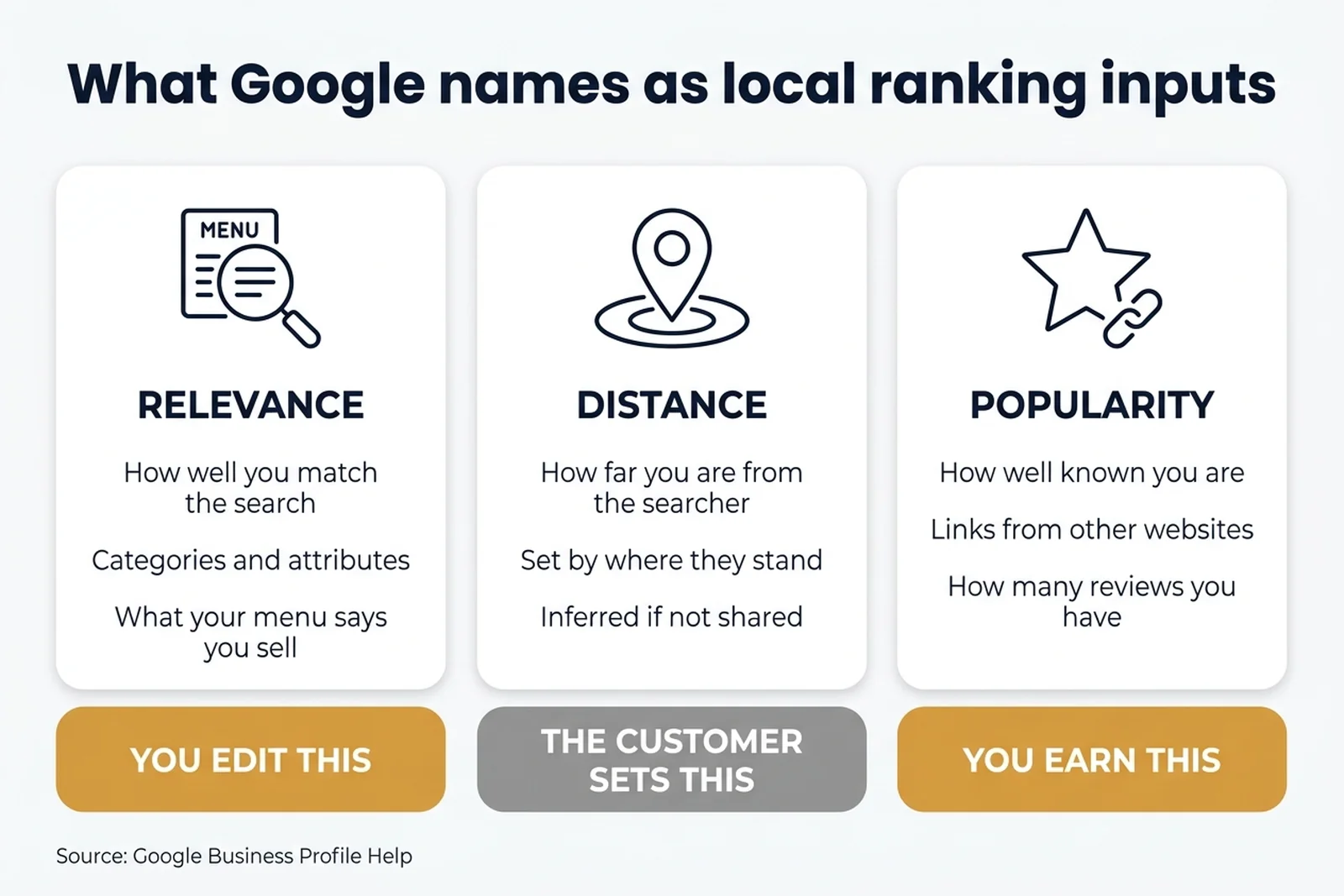
Two inputs you can influence, one the customer sets.
Related: Restaurant Google Business Profile
Can I do local SEO myself?
Yes, and for a single site restaurant you probably should. Strip the mystique away and the job is four things:
- Getting the profile claimed and verified, then keeping it true
- Photographing the room and the food often enough to look alive
- Replying to reviews, including the ones that sting
- Being mentioned by local websites that already have an audience
Imagine a forty cover bistro whose owner blocks out Tuesday at three, before evening prep. Week one, the category and the hours. Week two, photographs while the light is good. Week three, a reply to every review since Easter, including the sour one about parking. By week eight the profile looks tended rather than abandoned, on no budget.
What an agency sells is not secret knowledge. It is somebody else's Tuesday afternoon, plus the patience to chase a listing across a dozen directories that each want a different verification email.
Related: Restaurant SEO Checklist
How much should I pay for local SEO?
Start at zero and add only what you cannot do yourself. Google states there is no way to request or pay for a better local ranking on Google. Money buys labour and attention. It does not buy ranking.
Cost, and what it actually covers
| What you buy | Typical arrangement | Worth it when |
|---|---|---|
| Your own time | Free, half an hour weekly | One site, habit you can keep |
| Listings clean up | Fixed fee, one off | Details wrong in a dozen places |
| Ongoing retainer | Monthly, with a report | Several sites to cover |
| Photography | Half day, one off | Pictures are dark phone shots |
Arrangements and prices vary by agency, location and scope. Treat this as a way to frame the decision, not a price list.
Why this matters: the danger is not overpaying. It is paying for an outcome nobody can sell. A quote promising a fixed position in the local results describes a product Google says does not exist, and if a supplier will promise you that, read the monthly report they send with the same suspicion.
What is the 80/20 rule in SEO?
The 80/20 rule is the Pareto principle in a marketing jacket: the idea that a small share of the work produces most of the result. It is a planning heuristic, not a measurement, and it says nothing about which jobs move a restaurant in local search. No split has been published for restaurants, and any precise ratio quoted at you was invented by whoever quoted it.
What survives is the ordering instinct. Rank the jobs by how much of each sits inside your control and you get a queue rather than a to do list:
- Things you type: category, hours, address, phone, menu, attributes.
- Things you ask for: reviews, and replies to the ones you have.
- Things you earn: mentions and links from other local websites.
- Things you cannot touch: how far away the customer happens to be.
That order is ours rather than Google's, and it sorts by controllability instead of fashion. It is not a law. It is a queue, which is the thing a tired owner can work through without deciding anything twice.
Is doing local SEO worth it?
For a restaurant living on people within a few miles, yes, though the reason is narrower than the usual pitch. It is not that search is enormous. It is that the information a stranger uses to choose between you and the place next door is already online, and it is either right or wrong.
There is no version of this where you opt out. Your hours are almost certainly on the internet whether you put them there or not. The only choice is whether the version people find is the one you wrote, which is why the common mistakes and most local pack gaps are neglect rather than strategy.
The listings you do not own
Your Google Business Profile gets the attention. Several of the other records describing your restaurant are maintained by people who have never eaten your food.
The listing that worries you least is usually the one you cannot edit.
Your food hygiene rating is the clearest case. The local authority inspects, then uploads the result to the Food Standards Agency's ratings site. A rating of 5 is published as soon as the council uploads it, while ratings of 0 to 4 are published 3 to 5 weeks after the inspection date to leave room for an appeal (Food Standards Agency). The rating is not yours to set, and it sits one search from your name.
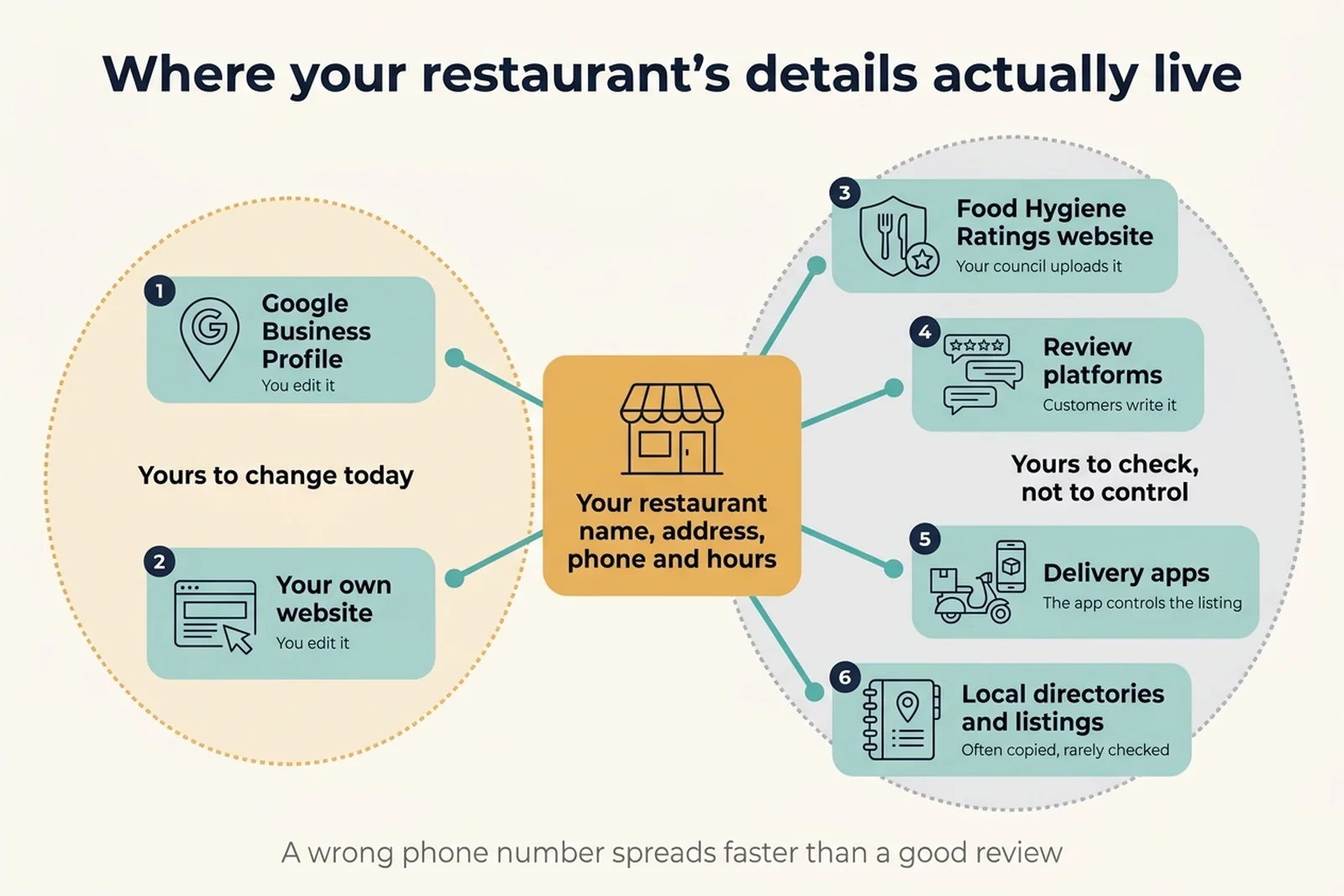
Two you change today, four you can only check.
The same goes for the rest of the estate:
- A delivery app holding a menu you updated last spring
- A directory carrying the phone number from two owners ago
- A review platform with a duplicate nobody claimed
None of it is glamorous. All of it decides whether a stranger finds one coherent restaurant or three slightly different ones.
Related: Restaurant Citations
Half an hour a week that actually holds
Pick a slot with a name. Weekly is a wish. Tuesday at three, before prep, is an appointment. Adjust the routine below once you know what your week carries: these intervals are a starting experiment, not a minimum dose.
- Reply to every review since last week, including the two star one (10 minutes)
- Add one photograph taken this week, of food or the room, not the logo (5 minutes)
- Check your hours against the next fortnight, bank holidays included (5 minutes)
- Search your signature dish plus your town from outside your own kitchen (5 minutes)
- Monthly, look yourself up on the food hygiene ratings site and one delivery app (5 minutes)
Nobody will thank you for any of this. That is rather the point. It is the sort of work that is easy to skip for a month and hard to notice you have skipped, which is why the appointment matters more than the enthusiasm.
If you would rather the checking stopped living in your head, that is roughly what LocalBrandHub is for. It gives you a visibility score, a single number from 0 to 100 for how easily nearby customers find you online, plus your Google rating and review count with a link out to Google for replying to reviews: see what it covers. It cannot rank you. What it can tell you is whether the number moved.
Frequently asked questions
How long does local SEO take to work for a restaurant?
The two halves move at different speeds. Categories, hours, address and menu can be corrected in an afternoon. Reviews and mentions on other websites accumulate slowly. Expect the tidying to feel instant and the standing to feel glacial.
Do I still need a website if I have a Google Business Profile?
Yes. Google states the popularity factor is also based on information such as how many websites link to your business and how many reviews you have. Links need somewhere to point, and a profile is not a place you control the wording of.
How many reviews does a restaurant need?
Google publishes no threshold, so treat any number quoted at you as a guess. Google says the popularity factor draws partly on how many reviews you have, which gives a direction of travel and no finishing line.
Why do I appear in one part of town and not another?
Because distance is measured from the customer. Google says distance refers to how far each business is from the customer who is searching, which produces different results from different pavements.
Can I pay Google for a better local ranking?
No. Google states there is no way to request or pay for a better local ranking on Google. Paid ads are a separate product that buys placement, not ranking. An agency quoting a price for a position is selling something Google says does not exist.
Key takeaways: local SEO for restaurants
Key Takeaway
- Google names relevance, distance and popularity as the main inputs, and distance is measured from the customer
- Your ranking is a surface across the map, so measure it from where customers travel from
- Relevance is data entry you can finish this week; the popularity signals Google names sit off your own property
- Nobody can sell you a position, because Google says one cannot be requested or paid for
- Some records about you, your hygiene rating among them, can only be checked
Local SEO for restaurants rewards the owner who keeps their information true and keeps turning up. The gap between invisible and findable is rarely a budget problem.
Your next step: walk to the end of your street, search for your kind of food nearby and write down what you see. Taken from anywhere but your own kitchen, that is your first honest measurement.
For restaurants, salons, and local businesses
Need help with your marketing?
We help UK businesses turn social media into real results, not busywork.
Start freeSources
Get More Marketing Tips
Practical marketing tips for UK business owners, straight to your inbox. No spam, unsubscribe anytime.
About the Author
Local Brand Hub
Empowering UK Businesses
Local Brand Hub provides comprehensive business management tools designed specifically for UK local businesses to streamline operations, automate marketing, and grow revenue.
More articlesRelated Articles
 Marketing Tips
Google Business Profile Verification Restaurant Guide
Google Business Profile verification explained step-by-step. Methods, troubleshooting tips, and why verified profiles get 4x more visits.
 Marketing Tips
Google Restaurant Reviews: Complete UK Guide
Discover why 75% of consumers regularly check reviews before dining out. Get actionable tips to boost reviews, respond professionally, and handle fakes.
 Marketing Tips
Restaurant SEO: UK Guide to Local Rankings 2026
Help UK restaurants rank higher when customers search online. The 80/20 rule, local SEO tactics, and tips you can implement today.