
Create a restaurant business plan UK lenders will approve. VAT registration, premises licensing, and business rates requirements British banks expect.
Why do UK banks reject restaurant plans? Not the food concept, but missing regulatory requirements. A restaurant business plan UK lenders will approve needs specific sections on VAT registration, premises licensing, business rates, and credible market data that British banks expect.
Short on time? Here's the quick version
- UK-specific requirements: VAT registration, premises licensing, business rates: miss these and lenders reject immediately
- 7 essential sections: Executive summary, business description, market analysis, menu/operations, marketing, management team, financial projections
- 30/30/30/10 rule: 30% food costs, 30% labour, 30% overheads, 10% profit as a benchmark
- Credible data sources: UKHospitality, ONS, CGA by NIQ, local authority planning portals
- Startup costs: £60k-£150k (small cafe) to £440k-£1.2m (fine dining)
Full UK-specific guide below
Related: For the complete framework, see our restaurant business plan guide which covers universal principles before diving into UK-specific requirements.
If you're reading this after a 12-hour shift, thinking "I don't have time for this," you're not alone. Most restaurant owners find the planning stage overwhelming. This guide breaks down exactly what you need, section by section.
This guide draws on analysis of successful UK restaurant funding applications and input from hospitality business advisors working with British lenders.
What You'll Learn
- How UK-specific requirements differ from generic restaurant business plan templates
- The seven essential sections British lenders expect to see in your plan
- Where to find credible UK market data for your financial projections
- How to navigate VAT registration, premises licensing, and business rates
- When hiring a professional writer makes sense (and when it does not)
How Do I Write a Business Plan for a Restaurant in the UK?
With the basics covered, let's dive into the structure itself. The foundation of any UK restaurant business plan involves seven core sections, but the details within each section must reflect British market realities. A plan that works for a Manhattan bistro will not convince a Barclays business manager in Birmingham. Your restaurant business plan UK document must demonstrate local knowledge.
Pro tip
Write your executive summary last. Complete every other section first. British lenders skim the summary quickly before deciding whether to read further, so it must capture your strongest points.
Your UK restaurant business plan structure should follow this format:
- Executive Summary: Your pitch in one page
- Business Description: Concept, location, legal structure
- Market Analysis: UK-specific data and local competition
- Menu and Operations: Food costs, suppliers, staffing
- Marketing Strategy: How you will attract customers (see our guide to restaurant marketing for ideas)
- Management Team: Experience and credentials
- Financial Projections: P&L, cash flow, break-even analysis
For example, a gastropub seeking funding would include local competition analysis, supplier relationships with British producers, and financial projections accounting for VAT and business rates.
Each section requires UK-specific evidence. Your market analysis should reference data from UKHospitality or the Office for National Statistics, not American industry reports.
Organisation tip
Create a folder structure mirroring these seven sections. Save relevant documents, quotes, and research in each folder as you go. When writing time comes, everything is organised.
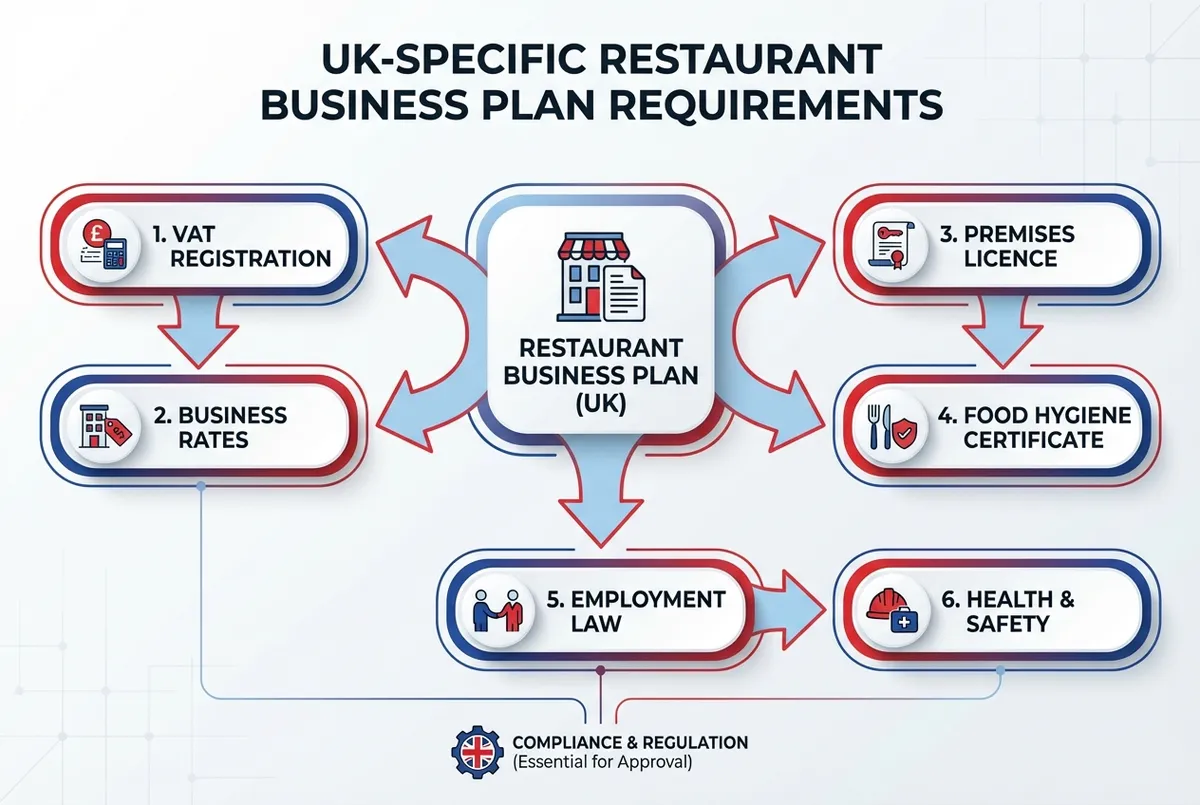
What UK-Specific Requirements Must Your Business Plan Address?
That covers the structure. But here is where most generic templates fail you completely. British restaurant business plans must demonstrate awareness of regulations that do not exist elsewhere. Miss these, and your plan signals inexperience to any UK lender.
VAT Registration and Implications
If your projected turnover exceeds the VAT registration threshold (check gov.uk for current figures), you must register for VAT. Your financial projections should show:
- VAT-inclusive pricing calculations for your menu
- Cash flow impact of quarterly VAT payments
- Whether you will use standard or flat-rate VAT schemes
For instance, a restaurant projecting significant annual turnover would need to account for VAT collected at 20%, minus input VAT on eligible purchases. Your cash flow forecast must show this money set aside, not treated as available profit.
Warning
If you're thinking "I'll worry about VAT later," that's exactly the attitude that causes cash flow crises. Plan for it from day one.
Premises Licence Requirements
Every UK restaurant serving alcohol or providing entertainment needs a premises licence from the local council. A thorough restaurant business plan UK document should include:
- Licence application costs (varies by rateable value)
- Timeline for approval (allow at least two months)
- Any conditions that might affect your operating hours
Warning
What many new restaurateurs miss: If you're planning a late-night venue, research your local authority's cumulative impact policy. Some areas like Westminster and Hackney have saturation zones where new licences are presumed to be refused. Discover this before signing a lease, not after.
Business Rates
Unlike rent, business rates are often overlooked in startup projections. The reality is that many restaurants fail not from poor food, but from underestimating fixed costs. Check your proposed premises on the gov.uk business rates calculator and factor in:
- The rateable value and multiplier
- Small business rate relief (if applicable)
- Transitional relief arrangements
A typical high-street restaurant might face significant annual business rates, potentially tens of thousands of pounds depending on location and size.
Where Do You Find Credible UK Market Data?
With the regulatory boxes ticked, let's move to research. Here is the part that separates amateur restaurant business plan UK documents from professional ones. British lenders scrutinise market claims carefully. Vague statements like "the restaurant industry is growing" will not suffice. You need specific, dated statistics from credible sources.
Reliable UK market data sources:
- UKHospitality: Industry trends, employment data, and policy updates
- ONS Consumer Spending: Official statistics on household spending on restaurants
- CGA by NIQ: Market data specific to hospitality
- Local authority planning portals: Competition mapping and demographic data
When citing statistics in your UK restaurant business plan, always include the year and source. For instance: "The UK eating-out market continues to show growth, according to UKHospitality's annual market report."
If you cannot find your exact niche data, be honest about it. Write: "While no specific data exists for Nepalese fine dining in Leeds, the broader Asian restaurant segment shows steady growth according to ONS data." Lenders respect intellectual honesty more than inflated claims.
Info
If you can't articulate your market size, that's usually a sign your research needs more work. Lenders do not fund dreams. They fund plans with evidence.
What is the 30/30/30/10 Rule for Restaurants?
So you have your market data. Next, let's talk about the numbers that actually matter to your business.
Key framework
The 30/30/30/10 rule is a benchmark for UK restaurant cost allocation that lenders expect you to understand.
It suggests your costs should roughly break down as:
| Cost Category | Percentage | Example (£500k Revenue) |
|---|---|---|
| Food costs | 30% | £150,000 |
| Labour costs | 30% | £150,000 |
| Overheads (rent, rates, utilities) | 30% | £150,000 |
| Profit | 10% | £50,000 |
This is a rule of thumb, not a guarantee. Your actual percentages will vary based on concept, location, and operational efficiency.
For example, a quick-service takeaway might achieve lower food costs but face higher rent percentages in prime locations. A fine-dining establishment might run higher food costs while commanding premium prices.
Info
Use the 30/30/30/10 rule as a sanity check, not a rigid target. If your labour costs project significantly above the benchmark without explanation, a lender will question your operational understanding.
Where many first-time restaurateurs go wrong: They project optimistic revenue without adjusting costs proportionally. If you are projecting double the revenue in year two, your staffing budget must scale accordingly. A plan showing flat labour costs across growing revenue signals inexperience to anyone who has actually run a restaurant.
Is It Worth Paying Someone to Write Your Business Plan?
At this point you might be wondering whether to outsource the whole thing. This is the question everyone asks but few answer honestly. The reality depends entirely on your circumstances.
Consider professional help if:
- You are seeking substantial funding from institutional lenders
- English is not your first language and precision matters
- You have never written a business plan and your deadline is tight
- Your concept is complex (multiple revenue streams, franchising plans)
Write it yourself if:
- You are self-funding or seeking smaller amounts from family
- You have strong writing skills and industry experience
- You have time to research and iterate
- You want to deeply understand every assumption in your plan
Professional business plan writers typically charge several thousand pounds for a comprehensive UK restaurant plan. Some accountants offer this service as part of a funding package.
Warning
One word of caution: No writer can invent your vision, experience, or operational knowledge. Even with professional help, you will spend significant time in interviews and reviews. The plan must reflect your business, not a template with your name inserted.
Info
Can AI help write a business plan? Tools like ChatGPT can help structure your thoughts and generate first drafts. However, AI cannot verify UK-specific regulations, validate your local market assumptions, or replace the financial modelling that lenders expect. Use it as a starting point, not a finished product.
How Much Money Do You Need to Open a Restaurant in the UK?
Whether you write it yourself or hire help, you need realistic numbers. This is the question that keeps every aspiring restaurant owner up at night.
UK restaurant startup costs vary dramatically based on location and concept. Here are realistic ranges:
| Cost Category | Small Cafe | Casual Dining | Fine Dining |
|---|---|---|---|
| Fit-out and equipment | £30k-£80k | £100k-£250k | £300k-£800k |
| Deposits and licences | £12k-£30k | £30k-£90k | £60k-£180k |
| Working capital (3 months) | £15k-£40k | £40k-£100k | £80k-£200k |
| Total | £60k-£150k | £170k-£440k | £440k-£1.2m |
Your restaurant business plan UK must justify every figure. Banks consistently reject plans that lack supporting documentation. If you are budgeting for fit-out, include contractor quotes. If your working capital calculation assumes breakeven early, show the revenue ramp-up that supports this. For guidance on building your customer base, see our local SEO for restaurants guide, or work through a local SEO checklist to cover the essentials before you open.
Info
Ask yourself: Would I invest in this plan if it were not my own idea? If your projections look too good, they probably are. British lenders have seen thousands of over-optimistic restaurant plans. Realistic, conservative projections with clear assumptions build more trust than hockey-stick growth charts.
Minimum Viable Action Plan
That is a lot to take in. If you only have 30 minutes a week to work on your restaurant business plan UK, start here:
This week, begin your UK restaurant business plan
- Day 1-2: Draft your executive summary and business description (even if rough)
- Day 3-4: Research your specific location's business rates on gov.uk
- Day 5-7: List your top three competitors and note what they do differently
You can refine and expand your restaurant business plan UK later. Getting the foundation right matters more than perfecting every paragraph immediately. A rough plan you can iterate on beats a perfect plan that never gets written.
Key Takeaways
If you run a restaurant and want to see how Local Brand Hub can support your marketing, explore our restaurant marketing tools.
Key Takeaways
Creating a restaurant business plan UK lenders will approve requires attention to British-specific requirements that generic templates ignore:
- Address VAT registration and its impact on cash flow from day one
- Include premises licence timeline and costs in your startup budget
- Research business rates for your specific location before signing a lease
- Use credible UK sources like UKHospitality and ONS for market data
- Apply the 30/30/30/10 rule as a sanity check on your projections
- Be realistic about costs: British lenders prefer conservative estimates
The best business plans tell a clear story: who you are, what you are building, why it will work in your specific location, and how you will manage the inevitable challenges.
Info
A restaurant business plan UK lenders approve is not paperwork for the bank: it is your blueprint for turning a good idea into a good living.
Your next step? Start with the section you know best. If you have strong operational experience, write your menu and operations section first. If you have done market research, start there. Building momentum matters more than following a strict sequence.
For the complete framework covering universal principles, return to our restaurant business plan guide which complements these UK-specific requirements.
For UK restaurant owners
Turn Your Plan Into Reality
LocalBrandHub supports UK restaurant owners with marketing strategies that complement solid business fundamentals: starting with understanding what British lenders actually want to see.
Start freeGet More Marketing Tips
Practical marketing tips for UK business owners, straight to your inbox. No spam, unsubscribe anytime.
About the Author
Local Brand Hub
Empowering UK Businesses
Local Brand Hub provides comprehensive business management tools designed specifically for UK local businesses to streamline operations, automate marketing, and grow revenue.
More articlesRelated Articles
 Business Growth
Restaurant Executive Summary: What to Include
Write a restaurant executive summary for UK bank managers. What to include, common mistakes, real funding-winning examples.
 Business Growth
Restaurant Opening Costs: What You Can Actually Price
Restaurant opening costs are two budgets, not one. Price the published UK rates today, quote the rest twice, then size your reserve in months.
 Business Growth
How to Write a Restaurant Business Plan: UK Lender Guide
How to write a restaurant business plan UK lenders will read: the seven sections, covers-based financial projections and real Start Up Loans cases.