Step-by-step guide to building a restaurant email list that drives repeat bookings. Covers collection tactics, segmentation, and UK GDPR compliance.
A restaurant email list is a collection of customer email addresses gathered with consent that you use to send promotions, updates, and offers. Done well, it becomes your most reliable way to fill tables on quiet nights and build a base of repeat customers who choose you first.
It is 9pm on a quiet Wednesday. You have three tables occupied. Meanwhile, the bistro down the road has a queue out the door. You posted on social media this week. You have good reviews. So what gives?
Here is what they know that you might not: 53% of diners have visited a new restaurant because of marketing emails (Stripo, 2025). That is not a minor channel. That is a direct line to filling empty tables.
Info
Related: Build your overall marketing presence with our Restaurant Social Media Marketing guide.
What You'll Learn
- How restaurants legally collect customer email addresses (GDPR methods)
- The exact signup incentives that work for UK restaurants
- How to write emails that customers open and act on
- Simple systems for turning subscribers into regulars
How Do Restaurants Get Your Email Address?
First, let's look at where the emails actually come from. You want to build a list, but how do restaurants collect them in the first place?
Restaurants collect email addresses through value exchanges. You offer something customers want in return for their contact details. The key is making the ask natural and the reward clear.
60% of customers sign up for restaurant email lists to get discounts and deals (MenuTiger, 2025). People will share their email if you give them a good reason.
Proven collection methods for UK restaurants:
- WiFi signup splash pages - Customers enter email to access free WiFi. Works well during the 3pm lull when people browse
- Digital receipt opt-in - Email the receipt instead of printing. Simple and captures emails naturally
- Reservation confirmations - Ask if they want updates about special events. 75% of UK restaurants accept reservations (Tableo, 2025)
- Table ordering QR codes - Add a "join for 10% off next visit" option on your digital menu
- Loyalty programme signup - 77% of loyalty members are more likely to return (Stripo, 2025)
For example, a neighbourhood Italian might add a simple "Get 10% off your next meal" card with each bill. No app download, no complex signup. Just a QR code that leads to a one-field email form.
If you are only collecting emails when customers ask to join your mailing list you will always lose to competitors who build collection into every touchpoint.
What About GDPR Compliance?
But with all these collection methods, you need to get the legal side right.
Under UK GDPR, you need explicit consent before sending marketing emails. This means:
- Pre-ticked boxes are not allowed
- You must explain what you will send and how often
- Customers need an easy way to unsubscribe
- You must keep records of consent
The Information Commissioner's Office provides detailed guidance for small businesses (ICO, 2025). Getting this wrong can result in fines, but more importantly, it damages customer trust.
Info
Related: Complement your email strategy with Local SEO for Restaurants.
How Do I Write an Email for a Restaurant?
Next, let's tackle what to actually write. You have a list, so what do you say?
Writing effective restaurant emails means knowing that 43% of subscribers leave because of too many emails (Tablein, 2025). Quality beats quantity.
The anatomy of a restaurant email that works:
- Subject line (40 characters max) - Be specific. "Your Sunday roast table awaits" beats "Newsletter #47"
- Preview text - The first line readers see. Complete your subject line's promise
- One clear goal - Book a table, try a new dish, or attend an event. Pick one
- Mobile-first design - 60% of opens happen on phones (CodeCrew, 2025)
Email Types That Work for Restaurants
With the basics covered, let's look at what kinds of emails actually work.
| Email Type | When to Send | Goal |
|---|---|---|
| Welcome email | Immediately after signup | Set expectations, offer first-visit discount |
| Special event | 2 weeks before | Drive reservations for specific dates |
| Birthday offer | On customer's birthday | Personal touch that drives visits |
| Win-back | 60+ days since last visit | Re-engage lapsed customers |
| Feedback request | 24 hours after visit | Build reviews and show you care |
Your specific results will vary based on your restaurant type and audience.
For instance, a gastropub might send a "Sunday roast reminder" every Thursday. A fine dining spot might focus on monthly event emails. Match your frequency to what your customers expect.
If you're thinking "I don't have time to write all these emails" you're not alone. That's usually a sign the strategy needs simplifying, not abandoning.
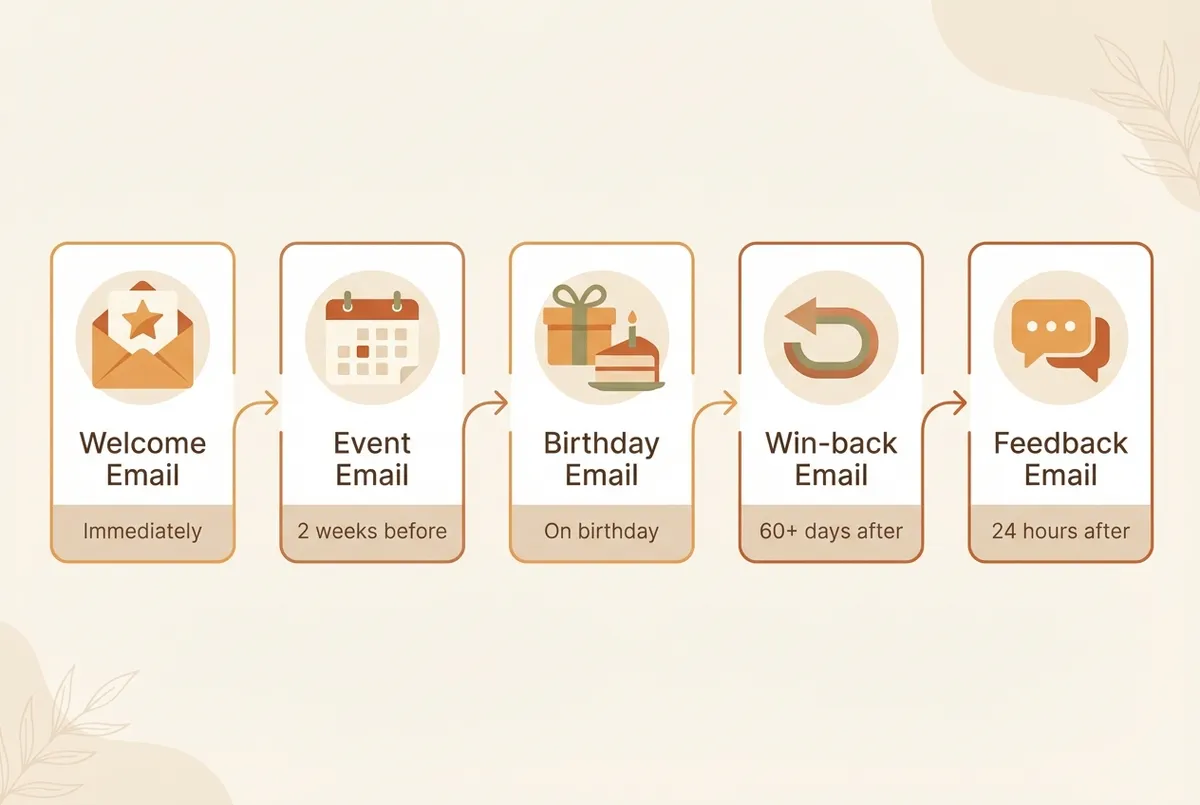
Match your email types to your restaurant's needs and customer expectations
Info
Related: For more customer engagement tactics, see our Restaurant Marketing Ideas guide.
How Do I Attract Customers to My Restaurant Using Email?
Now let's talk about what actually brings people in. Getting emails is one thing. Getting people through the door is another.
Email works by staying present without being pushy. 55% of diners are influenced by quality emails (Stripo, 2025). The word "quality" matters.
What makes an email "quality" to customers:
- Personalisation - 80% of customers are more likely to buy from brands with personalised offers (Stripo, 2025)
- Relevance - Send vegetarian specials to vegetarians, not everyone
- Timing - A bank holiday brunch email should arrive before people plan
- Value - Offer something real: info, a deal, or something entertaining
For example, a seafood restaurant might email their list on Thursday about the weekend's fresh catch. The timing matters. Send it Monday and people have already made plans. Send it Friday and the tables are already booked elsewhere.
The 70/20/10 Email Content Rule
Beyond timing, you need to think about what to actually send; our restaurant newsletter guide covers what to send and how often.
A practical framework for planning your email content:
- 70% value content - Recipes, behind-the-scenes, chef tips, local food news
- 20% promotional - Events, seasonal menus, limited offers
- 10% direct sales - Book now, buy gift cards, join loyalty programme
This ratio keeps subscribers engaged without feeling sold to. The split that rarely works: 90% promotional emails with occasional "value" thrown in. Subscribers see through that quickly.
If you only have 30 minutes a week, focus on one quality email every two weeks rather than rushed weekly sends.
Keep It Focused
Promotional emails that list every single item rarely work. Pick one dish, one event, or one offer per email. Your click rates will thank you.
Segmentation That Makes Sense
Sending the same email to everyone rarely works. Instead, divide your list:
- By visit frequency - Regulars get different messages than first-timers
- By spending level - High spenders might appreciate private dining invites
- By preferences - Track what dishes customers order to personalise recommendations
- By location - Particularly relevant for groups with multiple sites
67% of restaurateurs have automated their email marketing, with 64% sending personalised offers (GoGoGuest, 2025). Automation handles the complexity while you focus on running the restaurant, especially when email sits alongside social and local SEO in one marketing platform.
How Do You Email a Restaurant Reservation?
Here's where many restaurants leave money on the table.
Reservation emails are the unsung heroes of restaurant marketing. 66% of diners make same-day bookings (Tableo, 2025). Your confirmation and reminder emails directly impact whether people show up.
Essential reservation email sequence:
- Instant confirmation - Sent automatically when booking is made
- Reminder (24 hours before) - Include address, parking info, and cancellation policy
- Day-of reminder - For dinner reservations, a morning text or email reduces no-shows
- Follow-up (next day) - Thank them, ask for feedback, invite them back
Reducing No-Shows Through Email
Here's where email really earns its keep.
No-shows cost UK restaurants millions annually. Your email sequence can help:
- State your cancellation policy clearly in confirmations
- Make it easy to modify bookings (include a link)
- Send reminders at appropriate intervals
- Consider requiring card details for larger parties
A reservation confirmation that rarely works: three paragraphs about your restaurant's history before the actual booking details. Lead with what the customer needs. Date, time, party size, address. Everything else is secondary.
How to Find Business Owner Emails (For B2B Partnerships)
Moving on from customer emails, what if you want to reach other business owners, not just diners?
If you are building B2B relationships for corporate catering or event partnerships, the approach differs from consumer email collection.
The good news is that B2B connections often come from places you already are.
Legitimate ways to build B2B restaurant contacts:
- LinkedIn networking - Connect with local business owners, event planners, and office managers
- Local business directories - Companies House lists UK business information
- Chamber of Commerce events - Meet potential corporate clients directly
- Industry associations - UKHospitality connects hospitality businesses (UKHospitality)
- Supplier introductions - Your food suppliers may know complementary businesses
64% of small businesses use email to reach customers (Tabular, 2025). Potential B2B partners are already email-friendly.
For example, a pub with a private function room might partner with a local events company. Email the events coordinator directly after meeting them at a Chamber event. Offer a commission on bookings they refer. That one relationship could fill your function room every month.
Important note: Never buy email lists. Purchased lists violate GDPR, damage your sender reputation, and rarely convert. Building real relationships takes longer but produces actual business. If it sounds too easy, it probably is.
Weekly Action
If you are reading this after a 12-hour shift and want something you can actually do, here is a minimum viable approach.
This week, start building your restaurant email list:
- Day 1-2: Choose one collection method. WiFi signup or reservation opt-in works for most restaurants
- Day 3-4: Write your welcome email. Keep it under 150 words with one clear offer
- Day 5-7: Set up a free email tool. Mailchimp, Brevo, or MailerLite all offer free tiers for small lists
That is enough to start. Add complexity later when you see what works.
Measuring What Matters
Once your system is running, you'll want to track what's working.
Track these metrics monthly:
- List growth rate - Are you adding more subscribers than you lose?
- Open rate - Food and beverage averages around 40% (Klaviyo, 2025)
- Click rate - Are people taking action?
- Booking attribution - Can you trace reservations back to emails?
If you can't tell whether email brings bookings or just opens, that's usually a sign the strategy needs tightening. Most email tools offer basic tracking that connects opens to actions.
Key Takeaways
If you run a restaurant and want to see how Local Brand Hub can support your marketing, explore our restaurant marketing tools.
Key Takeaways
Finally, let's bring it all together.
A restaurant email list is one of the few marketing channels you actually own. Social media algorithms change. Review platforms adjust rankings. But your email list stays yours.
Remember:
- 53% of diners visit restaurants because of email marketing
- Start with one collection method and do it consistently
- Quality beats quantity: send better emails less often
- Personalisation and timing matter more than fancy design
- GDPR compliance protects your customers and your business
Email marketing for restaurants is not about sending the most emails. It is about being present when customers decide where to eat. One approach that rarely helps: sending emails only when business is slow. By then, your competitors have already filled their tables.
The restaurant down the road with the Friday queue? They started building their email list years ago. The best time to start was then. The second best time is now.
For UK restaurants
Need a Marketing System That Works?
Local Brand Hub combines email, social, and local SEO into one platform designed specifically for independent UK restaurants. No marketing degree required.
Start freeGet More Marketing Tips
Practical marketing tips for UK business owners, straight to your inbox. No spam, unsubscribe anytime.
About the Author
Local Brand Hub
Empowering UK Businesses
Local Brand Hub provides comprehensive business management tools designed specifically for UK local businesses to streamline operations, automate marketing, and grow revenue.
More articlesRelated Articles
 Marketing Tips
Email Marketing for Restaurants: A Practical Guide
Set up restaurant email marketing that earns £36 for every £1 spent. Includes software picks, templates, and the 80/20 content rule.
 Marketing Tips
Restaurant Loyalty Scheme: A UK Beginner's Guide (2026)
Learn how restaurant loyalty schemes drive repeat visits and boost revenue. The 4 types of loyalty programs and tips for UK independents.
 Marketing Tips
Restaurant CRM: A Practical Guide for UK Restaurants
Learn how a restaurant CRM system helps UK restaurants boost repeat visits by up to 67%. Discover which features matter for indies and how to choose.