
A restaurant membership sells access, not discounts. How UK operators pick the benefits, price the fee, write renewal terms that hold up, and launch small.
A restaurant membership is a recurring fee a customer pays you for defined benefits: priority tables, a standing discount, member events, or prepaid dining credit. Unlike a stamp card, the customer has paid for it, which makes it a consumer contract. The promise has to survive your busiest Saturday, and the terms have to survive a member asking to leave.
Twenty past two on a Tuesday, and the couple at table six are in again. Third time this month. The only thing your business formally offers them is the same laminated stamp card you hand the man who came once and complained about the parking. Somewhere around the fourth stamp, the thought arrives: what if the good ones could just pay to be the good ones?
What is a restaurant membership and how does it work?
A customer pays a fee, monthly or annually, and gets benefits non-members cannot buy at the door. You take the money up front, you hold something back for them, and you both agree a term with a renewal date on it.
Three shapes cover almost every version worth running.
- The access club. The fee buys priority: a table held until 8pm on a Friday, first refusal on the chef's table, tickets before general release.
- The account. The member pays in advance and draws the balance down over the year, often with a bonus for prepaying.
- The perks card. A standing discount, a bottle on a birthday month, member evenings when the room would otherwise be dark.
Underneath all three, the customer is not buying food. Food was already on sale to them. They are buying the removal of uncertainty, which a competitor cannot copy by cutting prices. That is also the catch: certainty is only sellable by a business that can supply it.
Is a membership better than a restaurant loyalty scheme?
Neither is better. They do opposite jobs. A loyalty scheme rewards visits you have already had. A membership sells visits you have not had yet, and takes the money first, which is why it carries an obligation a stamp card never does.
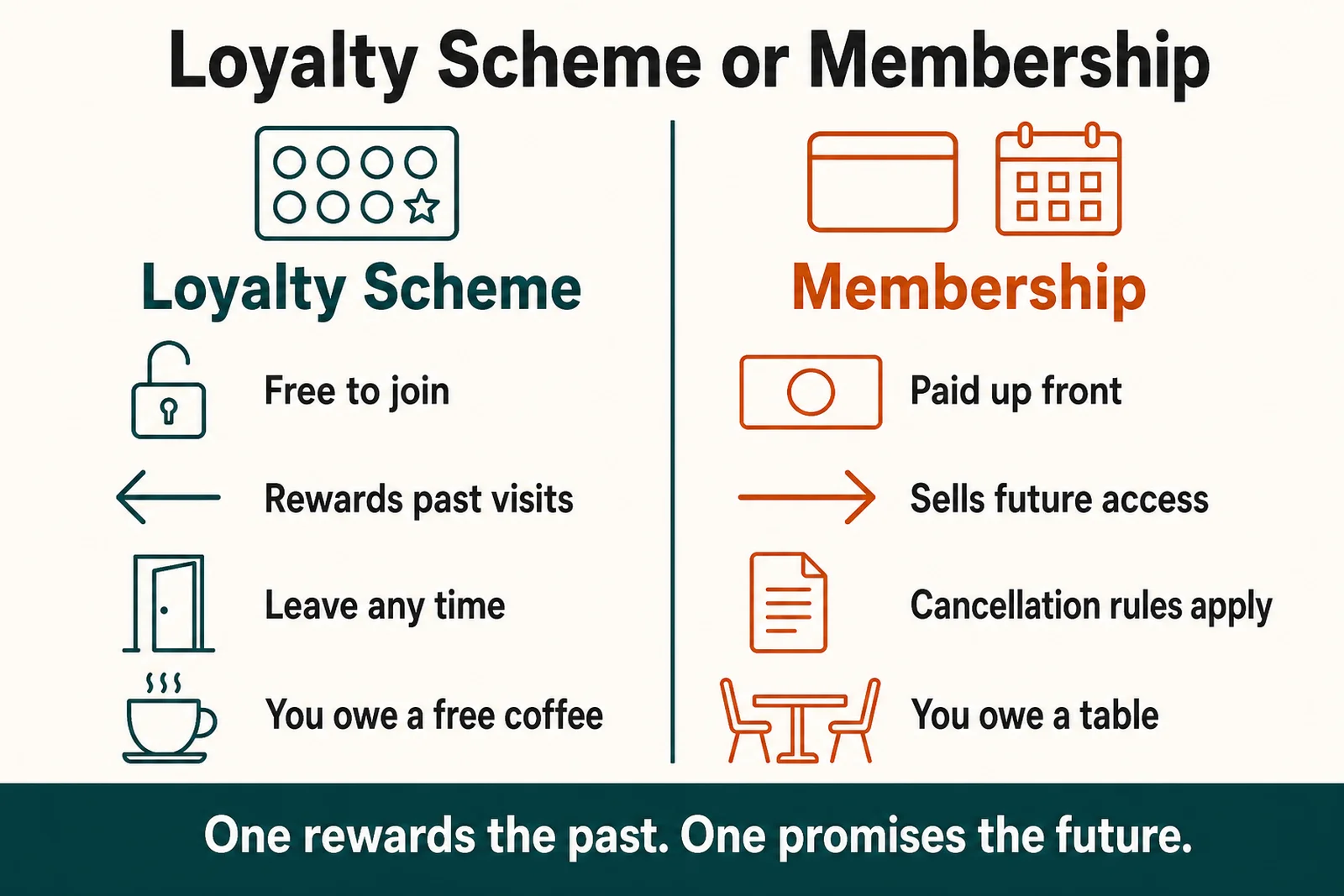
One rewards the past. The other promises the future, which is the harder thing to underwrite.
A loyalty card costs you a free coffee. A membership costs you a table on the night you least want to give one away.
So the useful question is not which scheme is smarter, but whether you have anything spare to sell. If Saturday is committed by six o'clock, priority Saturday tables are not a benefit, they are a queue you have promised to jump on someone else's behalf. Sell your surplus instead: midweek covers, early sittings, the private room nobody books in February, all of which have a playbook in restaurant midweek offers. Get that right and membership becomes the sharpest customer retention tool an independent has, because it is the rare one where the customer chose you in advance, and paid to.
What goes in a restaurant membership, and what should it cost?
Put in benefits you own spare capacity in, and price against the size of the promise rather than a market rate. Published UK fees sit a very long way apart, which tells you there is no going rate to copy.
A benefit earns its place by passing three tests.
- It costs you little on a quiet night. Surplus is cheap to give and expensive to buy.
- The member notices it every time. A perk nobody feels is a perk nobody renews.
- It cannot be had by walking in off the street. This is where a ten percent discount fails the test in any room where a walk-in who asks nicely gets one too.
On price, look at what real UK schemes publish. The Dining Club in Deal, Kent states an annual membership fee of £25 per household, payable on submission of the completed form. The Ivy Club lists an Individual Membership Rate of £1350 on top of the £500 joining fee a new individual member pays, with memberships running on a 12 month basis.
Two published UK prices, and they are not competing. One sells a place on a neighbourhood list. The other sells a room in central London you would otherwise never sit in.
The fee follows the promise, and so should yours.
Picture a bistro that never fills its Wednesday. It offers fifty memberships: a table held until eight on any weeknight, a glass of wine on arrival, two member suppers a year in the dead week after Christmas. The fee covers the suppers and the wine, while the held tables cost nothing because Wednesday was empty anyway. Those details are invented for illustration. The order you work them out in is not.
Whatever number you land on, ask your accountant how the fee is treated before the first payment rather than after.
What are the UK rules on membership renewals and cancellations?
Take a recurring fee and you are in consumer contract territory. Two things point the same way: what current guidance calls a fair renewal term, and what the government says the coming subscription rules will require. Both come down to the member knowing what they agreed to and being able to leave.
Start with the renewal itself. The Competition and Markets Authority guidance on unfair contract terms states that a term which could have the effect of automatically renewing a contract is more likely to be fair if the consumer is sent appropriate reminders at a reasonable time before the renewal takes effect and gives express consent to the automatic renewal. That is a fairness test rather than a rule naming your restaurant, so treat the reminder and the tick box as the standard your terms get measured against, not as a scheme requirement.
Looking ahead, the government's response on implementing the new subscription contracts regime states that for contracts covered by the new rules, consumers will have 14 days after a trial or a 12 month or longer contract auto-renews in which to cancel and receive a full or proportionate refund. The same response states that traders will also have to ensure it is straightforward for people to exit contracts, and allow them to exit online if they signed up online.
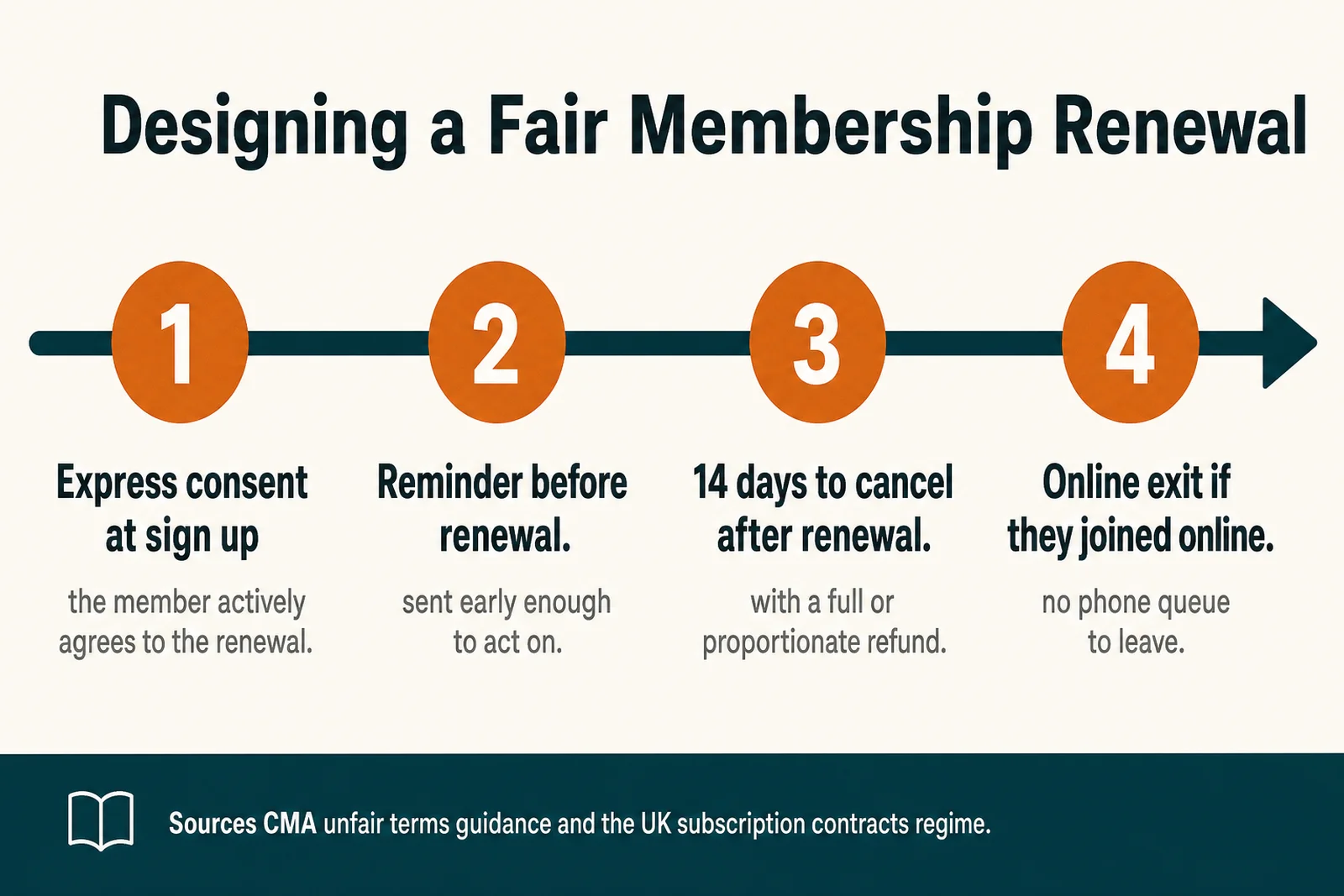
The four steps a member experiences, in the order they meet them.
Notice what none of that asks you to buy.
Easy exit is an outcome, not an architecture.
A restaurant with forty members and a spreadsheet delivers it through a reply-to address a human reads. A beautiful portal that buries the cancel button three screens deep does not, whatever it cost.
So write the one page before the marketing. It needs to answer six things and nothing else.
- What is included, and what explicitly is not.
- How long the term runs, and the date it renews.
- How somebody cancels, and where.
- What happens to unused credit.
- Which dates are blacked out.
- Who to contact when the promise goes wrong on the night.
Put the blackout dates in plain words, because Valentine's night is when a member will test the promise.
Should you join a discount membership scheme instead?
A third party dining card is a different product, not a cheaper version of your own. It sells your restaurant to their members. Your membership sells access to your restaurant, on your terms, to people you already know.
The case for joining one is real and narrow: empty midweek covers, no list of your own, strangers wanted through the door this quarter. That is a distribution problem, and a card with a large membership base solves it.
The case against is not that discounts cheapen the brand, which is a lazy line. It is that you are renting a relationship instead of building one. You do not set the renewal, you do not decide the offer, and when a member cancels the card they do not become your customer. They simply stop appearing. One question tells you which of the two you are doing: if that card folded tomorrow, would you still have a way to reach the people it sent you? Treat it as paid acquisition with a job to do, alongside your other restaurant discount ideas rather than as a strategy.
How do you launch a restaurant membership without building an app?
Sell twenty by hand before you buy anything. Write the one page terms, price it, then ask your regulars face to face, by name, and take payment the way you already take payment.
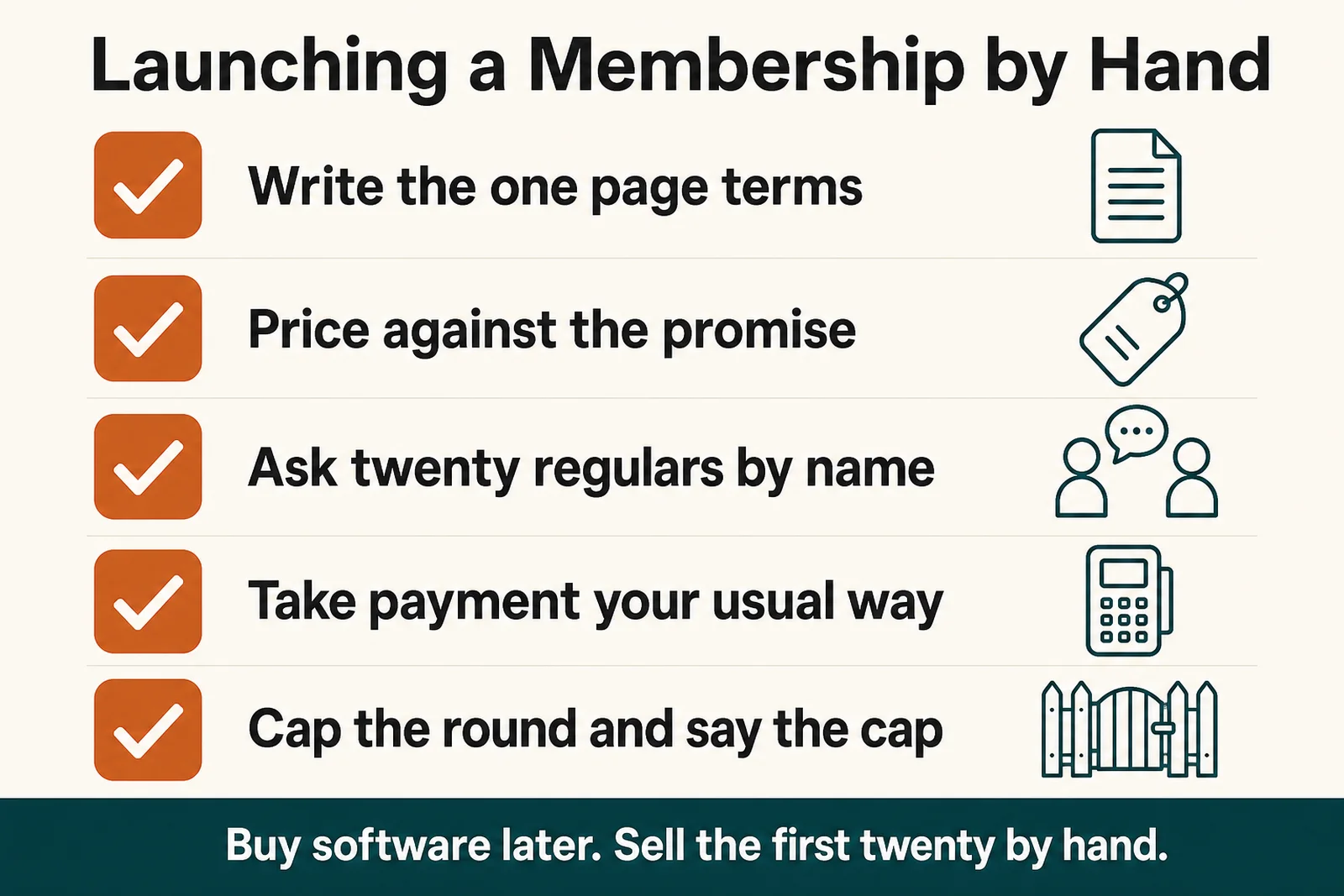
Five steps, in the order you actually do them. The software can wait.
Cap the first round and say the cap out loud. Fifty places, or thirty, or whatever number you could serve on your worst night without anyone noticing the strain. A cap is not manufactured scarcity. It is the simplest honest way to size a promise you have not tested, and it hands you a reason to reprice when you open round two.
Run the first cohort on a short fixed term, three months or six, treating that length as a starting experiment you adjust once you can see how often members turn up.
If you do one thing this week, write the one page and read it out loud to whoever runs your Friday service. Anything you catch yourself explaining out loud, treat as a term you have not written plainly enough yet: that is the part a member will argue with in March.
Keep the member record small. Hold the fields you genuinely use to serve them, keep it out of a shared inbox, and check any tool's current account and data use settings before that list goes anywhere near it.
When a scheme outgrows a spreadsheet, restaurant CRM is the next conversation. The permission side of speaking to that list is covered in email marketing for restaurants.
Want the launch posts and the offer page in one place? That is what LocalBrandHub's social post generator and products and offers tools are for. It will not take the membership payments, and no marketing tool should pretend otherwise.
Restaurant membership FAQs
How much does a restaurant membership cost in the UK?
There is no market rate. The Dining Club in Deal, Kent publishes an annual membership fee of £25 per household. The Ivy Club publishes an Individual Membership Rate of £1350 on top of the £500 joining fee a new individual member pays. Neither is the correct price for you. The fee follows the size of the promise.
Do restaurant loyalty programmes work?
They do the job they were built for, which is giving an existing customer a small reason to come back rather than go elsewhere. What they cannot do is bring money forward or limit how many people you owe, because a free scheme has no price to charge and no door to close. Quiet Tuesday, right tool. Best customers with nothing to buy, wrong tool.
Can a restaurant membership renew automatically?
It can, and the design matters more than the mechanism. The Competition and Markets Authority guidance on unfair contract terms says an automatic renewal term is more likely to be fair where the consumer gets appropriate reminders at a reasonable time before the renewal takes effect and gave express consent to it. Build both in.
What is the difference between a restaurant membership and a discount card?
Who owns the relationship. Your membership is a contract between you and a customer you already know, on terms you set and renew. A third party dining card is a contract between that company and its members, and you are a venue on their list.
Do you need software to run a restaurant membership?
Not to start. A member is owed clear benefits, a renewal date they knew about, and an easy way out. Software makes all three easier to deliver reliably at scale, which is a genuine reason to buy it. It is not a precondition for selling your first twenty memberships.
The short version
Key Takeaway
A membership is not a loyalty scheme with a price tag on it. It is a promise about your worst night, sold in advance to people who trust you to keep it, which is why it is worth more than a stamp.
The sequence is smaller than it looks. Find the capacity you genuinely have spare. Build the benefits out of that surplus and nothing else. Price against the promise, not somebody else's published fee. Write the terms so a member could leave without ringing you, then sell twenty by hand and cap the round.
The couple at table six have been telling you for months that they want more of a relationship with your restaurant than a card in a wallet. A membership is you answering.
For restaurants, salons, and local businesses
Need help with your marketing?
We help UK businesses turn social media into real results, not busywork.
Start freeSources
Get More Marketing Tips
Practical marketing tips for UK business owners, straight to your inbox. No spam, unsubscribe anytime.
About the Author
Local Brand Hub
Empowering UK Businesses
Local Brand Hub provides comprehensive business management tools designed specifically for UK local businesses to streamline operations, automate marketing, and grow revenue.
More articlesRelated Articles
 Marketing Tips
Restaurant Loyalty Scheme: A UK Beginner's Guide (2026)
Learn how restaurant loyalty schemes drive repeat visits and boost revenue. The 4 types of loyalty programs and tips for UK independents.
 Marketing Tips
Restaurant Customer Retention: How to Keep Tables Full
Proven restaurant customer retention strategies for UK independents. Turn first-time diners into loyal regulars who return.
 Marketing Tips
Restaurant Loyalty App: UK Independent's Guide for 2026
Choose the best restaurant loyalty app for your UK business in 2026. Compare free and paid options, features, and real costs for owners.