
A restaurant newsletter works when the structure is fixed and only the contents change. The five blocks to send, how often, and who you may email.
A restaurant newsletter is a recurring email to customers who agreed to hear from you, built on a structure that stays the same while the contents change. Send one thing that changed, one dated reason to book, one human voice, one useful thing and one ask. That is the whole edition.
Imagine it is the third Tuesday of the month and the newsletter is due. You open a blank email, type "Hello everyone," look at it, then go and check the fridge order instead.
That is not a discipline problem, it is a format problem. You have been asked to invent a small magazine from scratch, between the delivery and the lunch prep, forever.
So stop writing a newsletter and start filling in an edition.
The problem is sharpest where there is nobody to hand it to, and in an independent restaurant the person writing the newsletter is usually the person running service that night.
What Goes In a Restaurant Newsletter?
Five blocks, same order, every time: the news, the reason to book, the person, the useful thing, the one ask. You are never staring at a blank page, only answering five questions you already know.
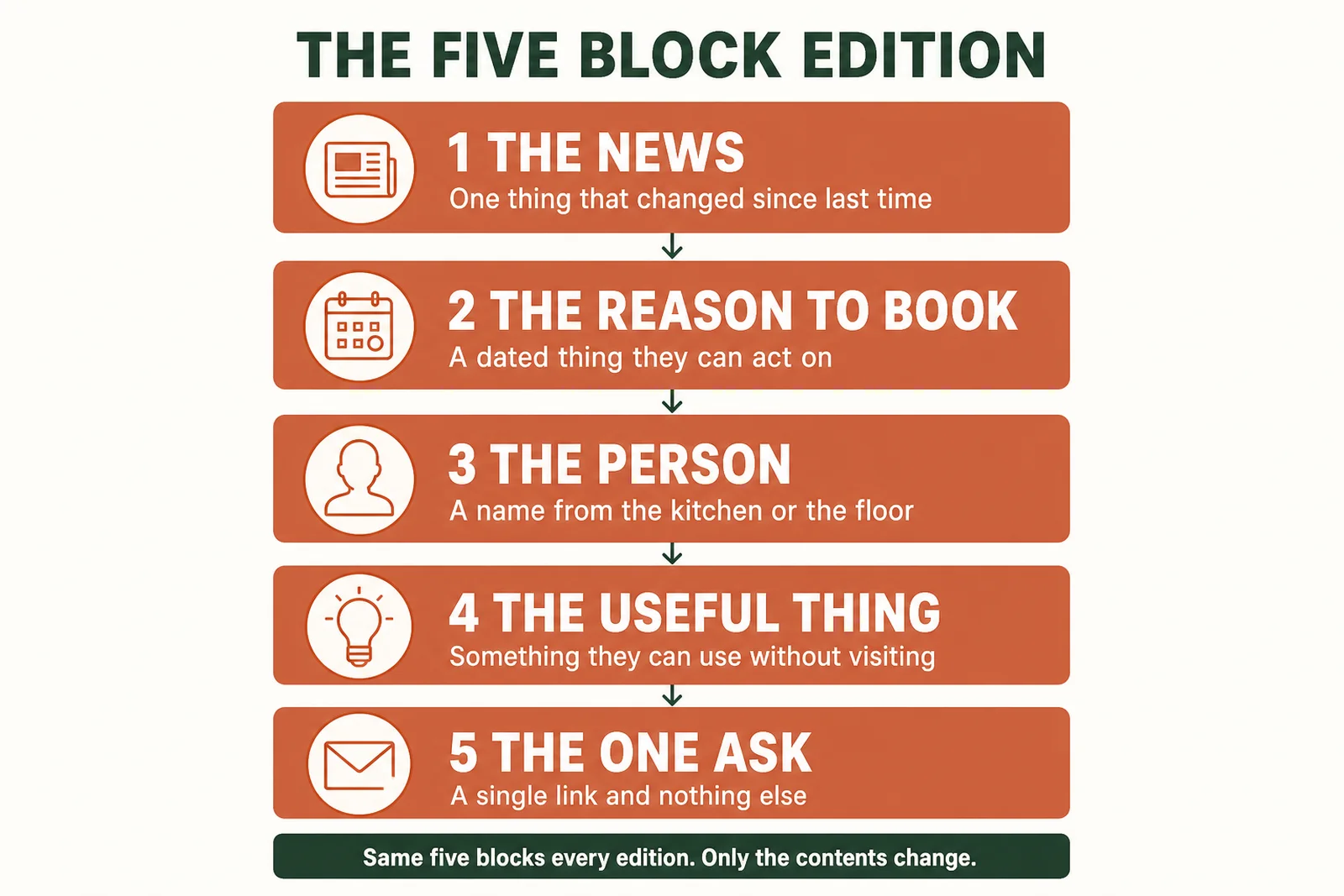
The five blocks stay put. Only what you pour into them changes month to month.
The news is the single thing that changed since last time. A dish came off, a supplier changed, you are shutting for a week in February. One sentence, no preamble.
The reason to book is one dated thing a reader can act on: the wine dinner on 14/11/2026, or the Christmas menu going live. With no date it is not a reason to book, it is an advert.
The person is two or three sentences from someone who works there, in their words. Ask the chef at the pass what has annoyed him this week and write it down. This is what stops the email sounding like a chain.
The useful thing is something readers can use without coming in. How to keep herbs alive, why you salt the water, what to do with the end of a loaf. It is the block that gives someone a reason to open the next one.
The one ask is singular, and that is the entire rule. An email with four buttons is an email with no message.
What Do You Write When Nothing Is Happening?
Nothing is always happening, but almost none of it feels newsworthy to the person it happened to. You are too close to your own week to notice it is interesting to someone who eats out twice a month.
Keep a note on your phone and drop lines in as they land: the crate of something unexpected, the regular who has ordered the same thing for six years, the reason the lamb died. Then you are choosing, not inventing.
A quiet month is not a reason to break the rhythm, it is a reason to send a shorter edition. Three honest paragraphs are worth more than a page of padding.
If knowing what to say is the sticking point, LocalBrandHub's seasonal campaigns library holds ready made campaigns for UK holidays, seasons and quiet spells. It will not write the kitchen's half, and that is the half that matters.
How Often Should You Send One?
Send at the rate your kitchen produces news, then hold the slot. Monthly is a sensible starting experiment for most independents rather than a minimum that works, and you should change it as soon as your own open and unsubscribe numbers give you a reason to.
You will be told to pick a frequency and never miss it, which is the right behaviour bolted to the wrong reason. Consistency does not make an email worth opening, it makes it expected, which only helps if what arrives is worth the space. Our rule of thumb is that cadence follows supply, not the calendar.
So the useful question is not how often restaurants send newsletters, but how often this kitchen has something a regular would want to know. If that is fortnightly, send fortnightly. If it is quarterly, send quarterly and stop apologising.
Our working assumption is that people rarely leave a list because a restaurant they like sent them news. They leave the one that only writes when it wants something.
Who Are You Allowed to Email?
Only people who gave you specific consent, or your own previous customers under a narrow exception. Settle this before the creative part, because a beautiful edition sent to the wrong list is still the wrong list. If you are reading that and quietly wondering about the addresses already sitting in your booking system, you are asking exactly the right question.
The ICO's guidance on the PECR electronic mail marketing rules states that you must not send marketing emails or texts to individuals without specific consent, and that there is a limited exception for your own previous customers, often called the soft opt-in.
That exception is narrower than the name suggests. The ICO states it applies where the person is an existing customer who bought, or negotiated to buy, a similar product or service from you in the past, and you gave them a simple way to opt out both when you first collected their details and in every message you have sent.
The way out is not optional either. GOV.UK states that every marketing email you send must give the person the ability to opt out of, or unsubscribe from, further emails.
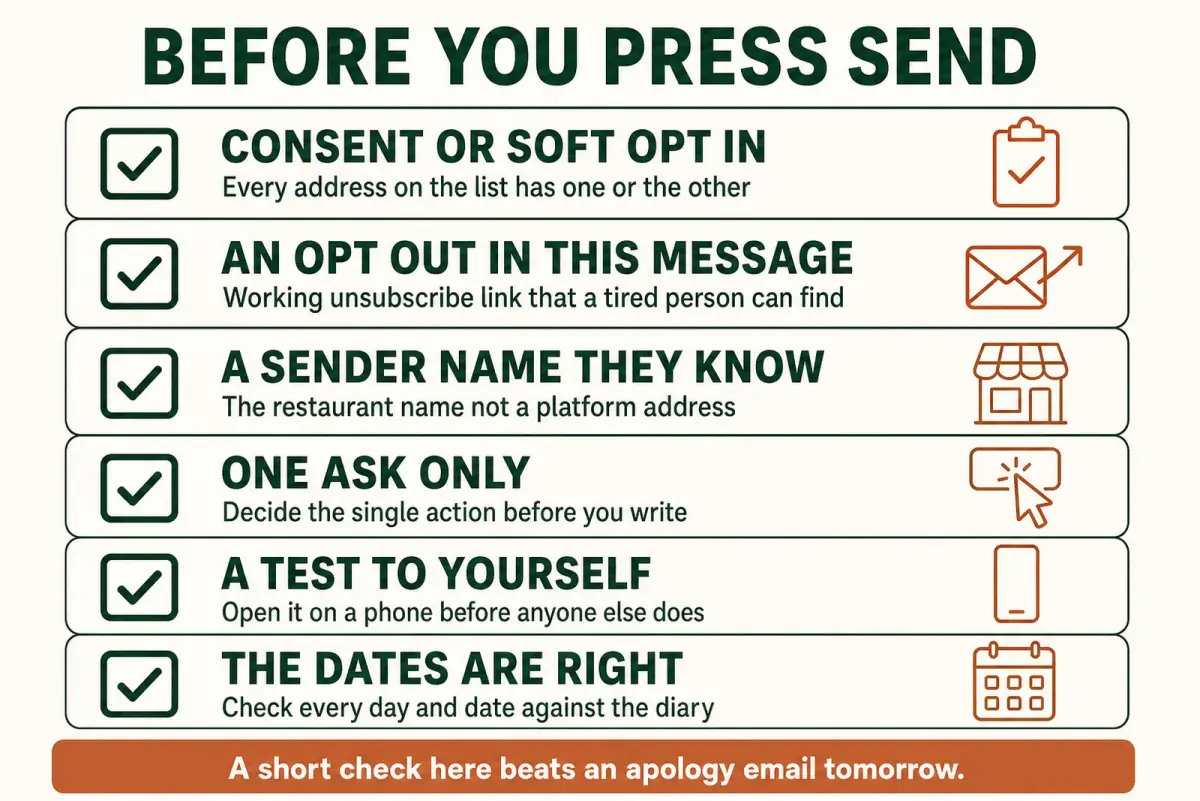
A short check here beats the apology email you send tomorrow.
Those sentences are the requirements. Anything stricter, such as asking people to confirm a signup twice, is your preference and not the guidance's demand.
Moving the list into an email tool is its own decision. Take the fields the newsletter needs and leave the rest: a first name and an address will do. Allergy notes, table preferences, phone numbers and spend history are not needed to say hello on a Tuesday, and every extra column sits in a system you do not run. Importing creates no consent you did not already have: the ICO rule governs the marketing emails you send, whatever tool you send them from. Read the platform's current account settings and data use terms first, since both change.
Related: Email Marketing for Restaurants
What Makes a Subject Line Worth Opening?
Name the thing. "October menu is up" beats "News from the kitchen", because one of them tells a busy person whether to bother. A subject line built on withholding asks that same person to click just to find out whether the click was worth it.
Write it short enough that a phone shows the whole line, which is a better test than any word count. Keep the word "newsletter" out of it, since the word names the format and tells a reader nothing about what is inside.
A Restaurant Newsletter Template You Can Copy
Paste this into whatever you send with. It is plain text on purpose, because the layout is not the hard part.
Subject: [ONE CONCRETE THING, SHORT ENOUGH TO SHOW ON A PHONE]
Hello [FIRST NAME],
[THE NEWS: one sentence on the single thing that changed. A dish, a supplier, an opening hour, a person.]
[THE REASON TO BOOK: one dated thing they can act on. Write the date as DD/MM/YYYY and say what happens.]
[THE PERSON: two or three sentences from someone who works here, in their words. Write down what they actually said.]
[THE USEFUL THING: something the reader can use at home. A method, a storage tip, what to do with leftovers.]
[THE ONE ASK: a single link. Book a table, reply to this email, or nothing at all.]
[YOUR FIRST NAME]
[RESTAURANT NAME] · [FULL ADDRESS] · [UNSUBSCRIBE LINK]
Every square bracket above is a hole, not a suggestion. Replace all of them with things that are true of your restaurant before this goes near a send button: no borrowed supplier names, no awards you have not won, no family recipe unless there is a family member who cooked it. A regular is exactly the person who will spot an invented specific.
Frequently Asked Questions
What are five elements of an effective newsletter?
The news, meaning the one thing that changed since last time. A dated reason to book. A person, quoted in their own words. A useful thing they can take away without visiting. And one ask, singular.
What are some good restaurant newsletter ideas?
Look at the week you actually had. The crate the greengrocer turned up with, why a dish left the menu, the Christmas diary opening, a member of staff hitting five years. None of it dramatic, all of it true.
How often should a restaurant send a newsletter?
At the rate your kitchen produces news, then hold that slot. Monthly is a sensible starting experiment for most independents rather than a minimum that works, and you should move it as soon as your own numbers give you a reason.
Can I email customers who booked a table but never opted in?
Not on the strength of the booking alone. The ICO states you must not send marketing emails or texts to individuals without specific consent, with a limited exception for your own previous customers, often called the soft opt-in. That exception covers an existing customer who bought, or negotiated to buy, a similar product or service, and who was given a simple way to opt out when their details were collected and in every message since.
Is there a free restaurant newsletter template worth using?
Most of them sell you a layout, and layout is not the hard part. What you need is a running order. No template is supplied here as a download. That five block skeleton earlier in this article is plain text and works in any email tool.
Key Takeaway
Keep the running order next month. The structure is what makes the second edition faster than the first, and fast is the only version of this that survives a real week.
For restaurants, salons, and local businesses
Need help with your marketing?
We help UK businesses turn social media into real results, not busywork.
Start freeSources
Get More Marketing Tips
Practical marketing tips for UK business owners, straight to your inbox. No spam, unsubscribe anytime.
About the Author
Local Brand Hub
Empowering UK Businesses
Local Brand Hub provides comprehensive business management tools designed specifically for UK local businesses to streamline operations, automate marketing, and grow revenue.
More articlesRelated Articles
 Marketing Tips
Email Marketing for Restaurants: A Practical Guide
Set up restaurant email marketing that earns £36 for every £1 spent. Includes software picks, templates, and the 80/20 content rule.
 Marketing Tips
How to Build a Restaurant Email List That Fills Tables
Step-by-step guide to building a restaurant email list that drives repeat bookings. Covers collection tactics, segmentation, and UK GDPR compliance.
 Marketing Tips
Restaurant Interior Signage: Menu Boards & Upselling
Plan your restaurant interior signage strategy. Compare menu boards, wayfinding signs, hygiene displays and upselling signage with UK costs and rules.