Master the 7 P's of restaurant marketing: Product, Price, Place, Promotion, People, Process, and Physical Evidence to attract more diners to your UK venue.
The 7 P's of restaurant marketing is a framework that helps you identify gaps between what you promise diners and what you actually deliver. This guide covers Product, Price, Place, Promotion, People, Process, and Physical Evidence to build a complete marketing strategy.
You've spent years perfecting your signature dish. You know exactly how much garlic goes in, how long to rest the meat, which suppliers have the freshest produce. But the dining room sits half-empty on a Tuesday night. The new place down the road has a queue out the door. You're not losing on food quality; you're losing on everything else.
That "everything else" is what the 7 P's of restaurant marketing addresses. 92% of consumers are likely to visit a restaurant they get referred to by close friends and family. Those referrals happen when you get all seven elements right, not just the food.
What You'll Learn
- How each of the 7 P's applies specifically to restaurants
- The difference between the 7 P's and the 7 steps of service
- Practical examples for each element of the framework
- A quick audit checklist to assess your current performance
Info
Related: Restaurant Marketing Guide - strategies beyond the 7 P's framework.
The 7 P's of restaurant marketing gives you a practical checklist to audit every aspect of your business, and if you want a quick benchmark before you dig in, our marketing score check rates where you stand in a couple of minutes. If you're looking for a comprehensive approach, this is where to start.
What are the 7 P's of service marketing in restaurants?
So what exactly makes up the 7 P's of restaurant marketing?
The 7 P's of service marketing in restaurants are:
- Product
- Price
- Place
- Promotion
- People
- Physical Evidence
- Process
This framework extends the traditional 4 P's marketing model. It addresses service-based businesses where customer experience matters as much as the product.
Here's what each element covers:
| P | What It Means | Restaurant Example |
|---|---|---|
| Product | Food, drinks, presentation, menu variety | Your signature dishes, seasonal specials |
| Price | Pricing strategy and perceived value | Happy hour deals, set menus |
| Place | Location and atmosphere | High street visibility, cosy interior |
| Promotion | Marketing and communications | Social media, local advertising |
| People | Staff and customer interactions | Trained servers, welcoming hosts |
| Physical Evidence | Tangible touchpoints | Menu design, table settings, decor |
| Process | Service delivery systems | Ordering, kitchen workflow, payment |
Example: A Gastropub Using the 7 P's
- Product: Locally sourced beef
- Price: Sunday roast at £16.95
- Place: Village location with free parking
- Promotion: Instagram posts showcasing the weekend menu
- People: Staff who remember regulars' names
- Physical Evidence: Rustic wooden tables and handwritten specials boards
- Process: Smooth reservation-to-dessert experience
The traditional 4 P's work well for selling physical goods. But restaurants sell experiences. The additional three P's capture what makes a first-time visitor become a regular.
What are the 7Ps of marketing in the hospitality industry?
Now that you understand the basics, let's see how the 7 P's of restaurant marketing fits within the broader hospitality context.
The 7Ps of hospitality marketing are the same seven elements. They apply across hotels, cafes, pubs, and restaurants. The key insight for the 7 P's of restaurant marketing? You can't separate the service from the person delivering it.
Quick Assessment
Start by rating your restaurant 1-5 on each P. The lowest-scoring element is usually your biggest opportunity for quick improvement.
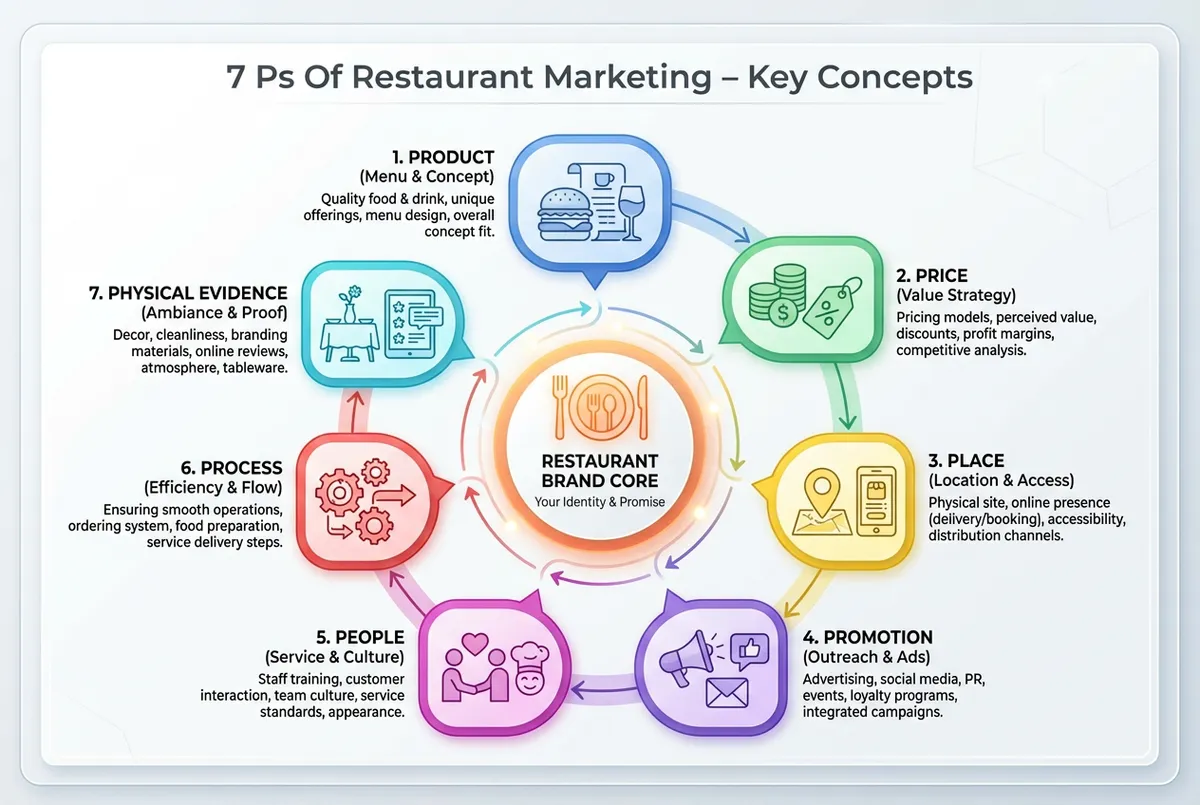
Diagram showing the 7 P's of restaurant marketing framework for UK businesses
The three additional elements address the service nature of hospitality.
How different hospitality businesses prioritise the 7Ps:
- Boutique hotel: Physical Evidence (luxury bedding, branded toiletries)
- Quick-service cafe: Process (speed of ordering, consistent coffee quality)
- Fine-dining restaurant: People (sommelier expertise) and Product (seasonal tasting menus)
Where restaurants differ from other hospitality businesses:
- Faster turnaround - A hotel guest stays overnight; a restaurant guest stays 90 minutes. Every touchpoint is compressed.
- Higher frequency - People might visit their favourite restaurant weekly, but their favourite hotel annually.
- More visible competition - Three restaurants on the same street compete directly for the same dinner crowd.
This means the 7 P's of restaurant marketing require faster execution with less margin for error. A hotel can recover from a slow check-in; a restaurant may not get a second chance after a 20-minute wait for the bill.
What are the 7 steps of service in a restaurant?
With the 7 P's of restaurant marketing framework understood, let's clarify a common confusion.
The 7 steps of service are different from the 7 P's of marketing. They're the operational sequence your staff follows to deliver a consistent dining experience.
Info
A Cornell University study found that 40% of the restaurant experience depends on just three factors: greeting speed, full drinks, and bill timing.
The classic seven steps are:
- Greet the guest within 60 seconds - Make eye contact, offer a warm welcome
- Offer water, menus, and initial service - Set the pace for the meal
- Take orders accurately - Listen for dietary requirements, suggest specials
- Deliver food and beverages efficiently - Serve hot food hot, cold food cold
- Check back after the first few bites - Catch problems early
- Clear plates and offer next steps - Dessert menu, coffee, the bill
- Present the bill with thanks - End on a positive note
These steps connect directly to the "Process" P in the marketing framework. If your service is inconsistent (great one visit, forgettable the next), no amount of promotion will build a loyal customer base.
For instance, a busy city centre bistro might find that step 5 (checking back) consistently gets skipped during Saturday service. That's not a staffing problem; it's a process problem. The fix might be retraining, or it might be redesigning the floor plan so servers pass tables more naturally.
What are the 7 components of service marketing?
Building on what we've covered about the 7 P's of restaurant marketing, let's address the terminology question.
The 7 components of service marketing are identical to the 7 P's. They're simply different terminology for the same framework. You'll see both phrases used interchangeably across marketing literature.
Why services need all seven components:
If you can't tell whether your marketing covers products or experiences, that's usually a sign you need a more service-focused framework. Services differ from physical products in four fundamental ways:
- Intangibility - You can't hold a "dining experience" before buying it
- Perishability - An empty table at 7pm cannot be sold at 9pm
- Variability - Tonight's service might differ from last Tuesday's
- Inseparability - The server delivering the food is part of the product
The traditional 4 P's (Product, Price, Place, Promotion) were designed for selling tangible goods. You can standardise quality, store inventory, and separate production from sales. A restaurant can't do any of that.
The additional three components address these gaps:
- People - Because your staff IS the product in many ways
- Process - Because consistency requires systems, not just training
- Physical Evidence - Because intangible services need tangible proof of quality
For instance, a Thai restaurant struggling with inconsistent reviews might find their People (friendly staff) and Product (authentic recipes) are strong, but their Process (long wait times during peak hours) lets them down. The 7 P's of restaurant marketing reveals where the actual problem lies.
What are the 7Ps of a restaurant?
Let's bring this back to practical application.
The 7Ps of a restaurant are the 7 P's of restaurant marketing framework applied to your food service business. Here's how each P translates into daily decisions.
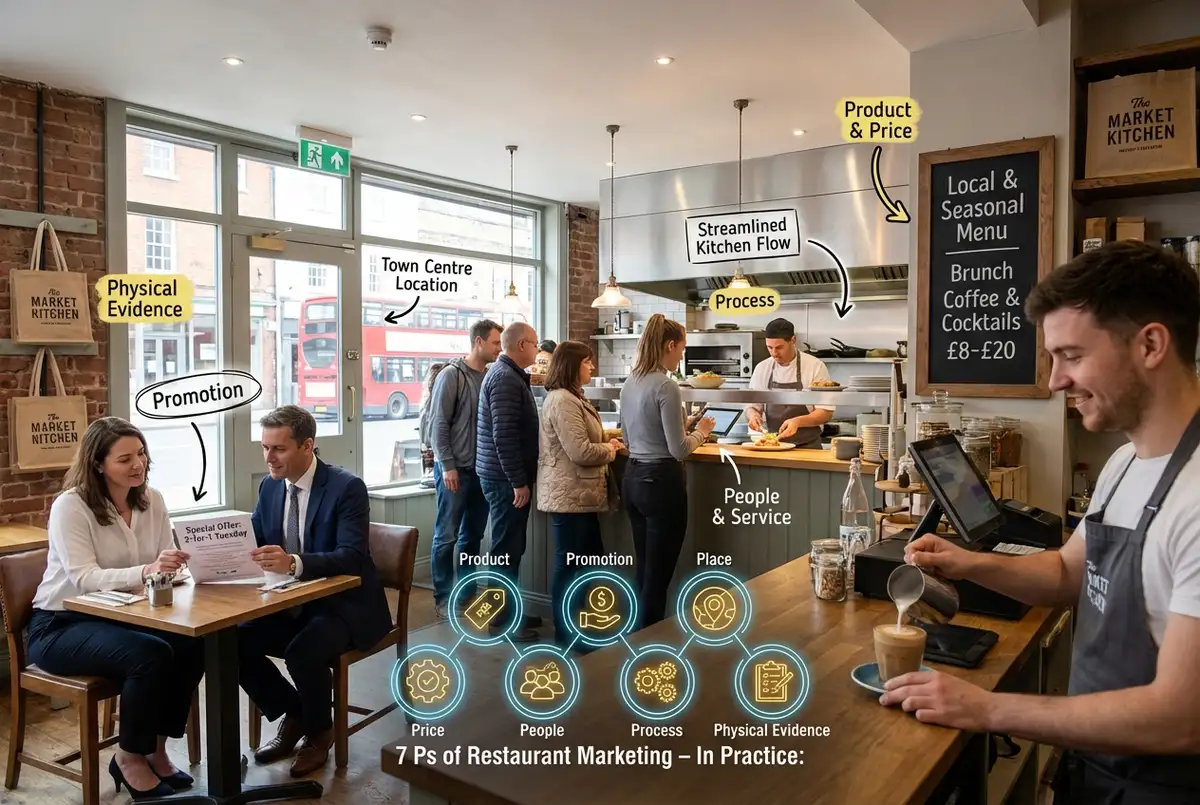
Illustration of 7 P's of restaurant marketing applied to a typical UK venue
Product
Your product isn't just the food: it's the complete dining experience. This includes:
- Menu variety and presentation
- Seasonal specials and limited-time offerings
- Dietary accommodations
- The overall ambiance and comfort
A neighbourhood Italian might differentiate through house-made pasta (quality) while a quick-service salad bar differentiates through customisation (variety). Both are valid product strategies.
Price
Price isn't about being cheap: it's about perceived value. Tactics that work:
- Happy hours and early bird discounts to fill off-peak times
- Set menus that simplify choice and improve margins
- Premium options that anchor lower prices attractively
If you're reading this thinking "I can't compete on price with the chains," you're right, so don't. Compete on value, which is price relative to experience.
Place
Physical location matters, but "place" now includes digital presence too:
- Your Google Business Profile
- Delivery platform listings
- Social media profiles
- Your website and online booking system
A restaurant in a tucked-away location can thrive if their digital "place" is prominent. Learn more about optimising your online presence in our guide to restaurant social media marketing.
Promotion
Promotions attract cost-conscious customers and introduce new menu items to gauge customer interest. Effective promotional channels for UK restaurants include:
- Instagram and Facebook for visual content
- Google Business Profile posts for local visibility
- Email newsletters for regulars
- Local partnerships and events
People
Employee satisfaction directly correlates with customer satisfaction. Starbucks trains baristas to learn customer names: a practice any restaurant can adapt.
Warning
If you're down two staff on a Saturday rush, training and systems matter more than ever. A well-trained team of four will outperform a poorly-trained team of six.
Process
Process covers how you handle reservations and how the kitchen communicates with the floor.
- Standardised procedures ensure consistent quality
- Every customer receives equivalent service
- Works regardless of which staff are on shift
Physical Evidence
This includes:
- Menu design and tableware
- Staff uniforms
- Interior decor
- Takeaway packaging
McDonald's golden arches are a well-known example of physical evidence creating instant brand recognition.
If you're only addressing product and price you'll always lose to competitors who master all seven elements. A neighbourhood pizzeria might have great Product, but if their Process frustrates customers, those diners typically won't return.
Key Takeaways: Using the 7 P's of Restaurant Marketing
If you run a restaurant and want to see how Local Brand Hub can support your marketing, explore our restaurant marketing tools.
Key Takeaways: Using the 7 P's of Restaurant Marketing
Now that you've seen how the 7 P's of restaurant marketing breaks down, here's how to put it into practice.
The framework works because each element reinforces the others:
- Strong food (Product) means nothing if service (People, Process) drives customers away
- Beautiful decor (Physical Evidence) can't compensate for confusing pricing (Price)
- Great location (Place) won't help if nobody knows you exist (Promotion)
If you're thinking "I don't have time for a full marketing audit", you're not alone. Most independent restaurant owners are already stretched thin. But even a quick review using this framework can reveal your biggest opportunity.
Quick Audit Checklist:
- Product - When did you last update your menu based on customer feedback?
- Price - Do you have strategies for filling off-peak hours?
- Place - Is your Google Business Profile complete and current?
- Promotion - Are you posting consistently on social media?
- People - When did staff last receive service training?
- Physical Evidence - Does your decor match your brand promise?
- Process - Can a new server deliver consistent service on day one?
If you only have 30 minutes a week to work on the 7 P's of restaurant marketing:
- Day 1-2: Audit your Google Business Profile: update hours, photos, and respond to recent reviews
- Day 3-4: Walk through your restaurant as a customer: note anything inconsistent with your brand
- Day 5-7: Brief your team on one small service improvement for this weekend
The restaurants that thrive aren't necessarily the ones with the best food. They're the ones that master the 7 P's of restaurant marketing framework. Every touchpoint, from the first Google search to the final bill, tells the same story.
Your competitors don't have bigger marketing budgets. When they use the 7 P's of restaurant marketing effectively, they have fewer gaps between what they promise and what they deliver.
For more on building a complete marketing strategy, read our comprehensive restaurant marketing guide, then use the 7 P's of restaurant marketing as your foundation.
Frequently Asked Questions
What are the 7 P's of marketing?
The 7 P's of marketing are Product, Price, Place, Promotion, People, Process, and Physical Evidence. Booms and Bitner developed this framework for service industries. The 7 P's of restaurant marketing applies this same model to food service businesses.
What are the 7Ps of McDonald's?
McDonald's applies the 7Ps through:
- Product: Standardised menu items
- Price: Value meals and competitive pricing
- Place: Prime high-traffic locations
- Promotion: Recognisable advertising campaigns
- People: Uniformed trained staff
- Process: Assembly-line food preparation
- Physical Evidence: Iconic golden arches
How do the 7 P's differ from the 4 P's?
The 7 P's add three elements to the original 4 P's:
- People - Staff quality affects customer perception
- Process - Operational systems ensure consistency
- Physical Evidence - Tangible elements prove service quality
Which P is most important for restaurants?
All seven work together. However, "People" often has the greatest immediate impact. Research shows 40% of the dining experience depends on staff-dependent factors: greeting speed, drink refills, and bill timing.
For example, a country pub with average food but exceptional staff often outperforms a gastropub with great food but indifferent service.
Want more restaurant marketing strategies? Read our complete restaurant marketing guide for the full framework and proven tactics.
Get More Marketing Tips
Practical marketing tips for UK business owners, straight to your inbox. No spam, unsubscribe anytime.
About the Author
Local Brand Hub
Empowering UK Businesses
Local Brand Hub provides comprehensive business management tools designed specifically for UK local businesses to streamline operations, automate marketing, and grow revenue.
More articlesRelated Articles
 Marketing Tips
3 3 3 Rule in Marketing: Restaurant Framework Guide
Master the 3 3 3 rule in marketing for your restaurant. Focus on 3 messages, 3 audiences, and 3 channels for simpler, more effective marketing.
 Marketing Tips
12 Cafe Marketing Ideas That Actually Work in 2026
Try these 12 cafe marketing ideas used by top UK independents to grow footfall, boost repeat visits, and increase average spend.
 Marketing Tips
Coffee Shop Marketing: Guide for Independent Cafes
Build a coffee shop marketing plan that fits around your schedule. Covers loyalty programmes, social media, and local partnerships.