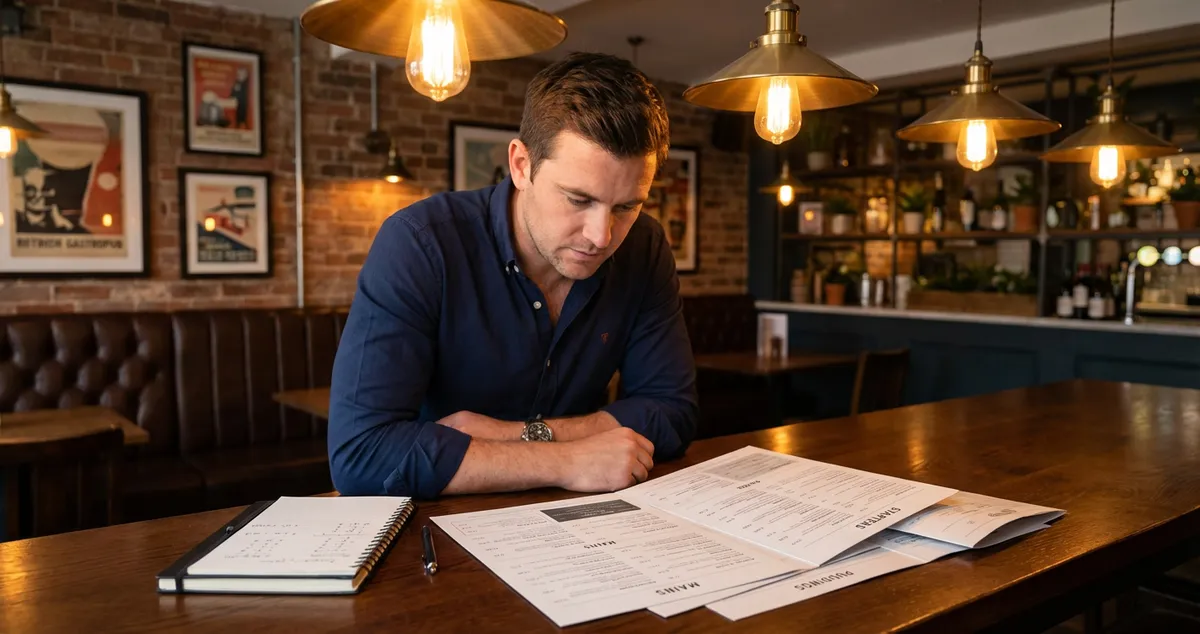
Master the four quadrants of menu engineering to boost restaurant profits. Learn how Stars, Plough Horses, Puzzles and Dogs increase your margins.
You're staring at this month's sales data wondering where the profit went. Your lamb shank has a 68% margin but nobody's ordering it. Fish and chips is slammed but barely breaks even. The four quadrants of menu engineering explain why, and how to fix it.
The four quadrants of menu engineering are Stars, Plowhorses, Puzzles, and Dogs. This system sorts each menu item by two things: profit per dish and how many people order it. Research shows restaurants using this method increase profits by 10-15% on average. Some see gains up to 27%.
Info
Related: Menu Engineering provides the complete framework including calculation methods and implementation steps.
What You'll Learn
- How each of the four quadrants works and what makes items fall into each category
- The specific strategies that transform underperformers into profit drivers
- How to calculate where your dishes belong on the matrix
- Common mistakes UK restaurants make when applying the quadrant system
- A practical weekly workflow for ongoing menu optimisation
Before we dive into each category, let's understand the four quadrants framework as a whole.
Understanding the Four Quadrants Framework
First, let's establish how the four quadrants of menu engineering works. This framework puts every dish into one of four categories. The two factors are: profit per dish, and how many times people order it.
The four quadrants concept originated from the Boston Consulting Group's growth-share matrix in the 1970s. It was adapted for restaurants by Professor Donald Smith of Michigan State University. Even in 2026, it remains one of the most widely used approaches for restaurant menu analysis.
Why this matters: Gut feelings about which dishes "should" sell give way to data. The four quadrants system removes emotion from menu decisions.
For instance, a Birmingham gastropub thought their fish pie was a top performer. The four quadrants of menu engineering analysis revealed it was a Plowhorse: popular but only 31% margin. Their lamb shank, which they rarely promoted, had a 67% margin. The four quadrants matrix made this obvious.
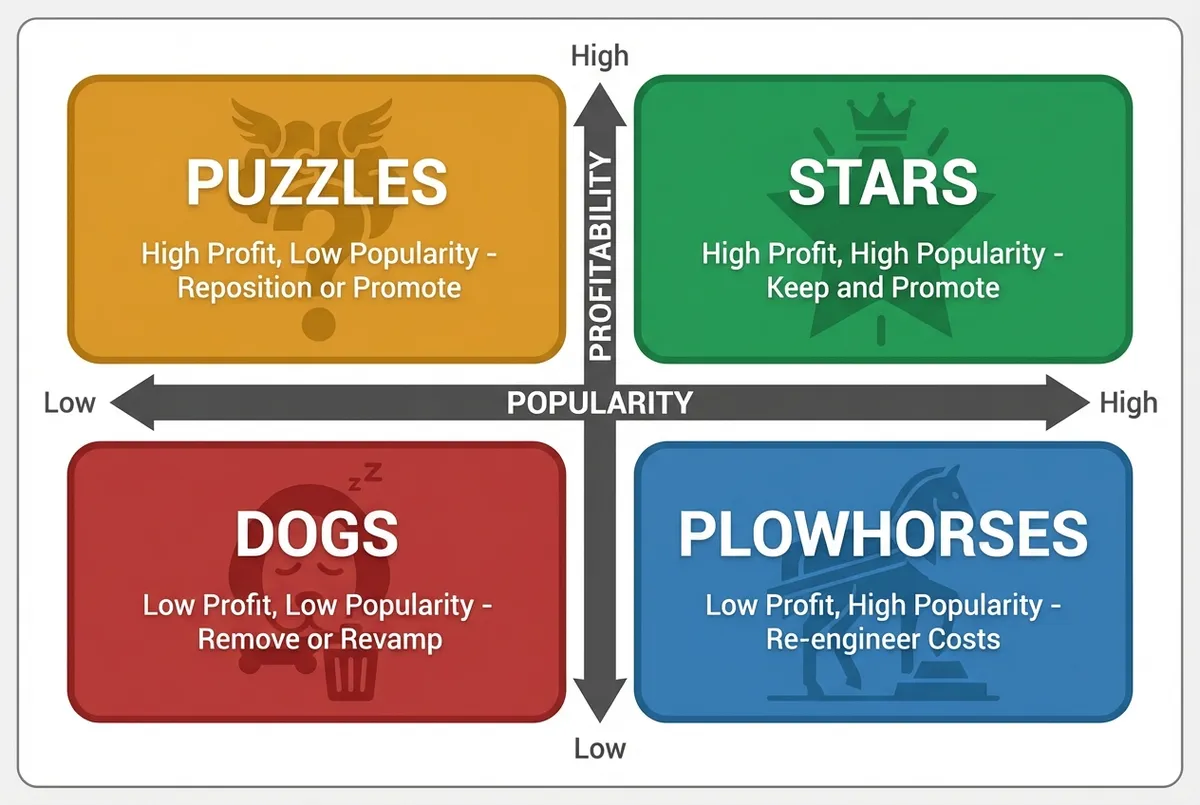
The four quadrants matrix: Stars, Plowhorses, Puzzles, and Dogs
| Quadrant | Profitability | Popularity | Strategic Priority |
|---|---|---|---|
| Stars | High | High | Protect and feature prominently |
| Plowhorses | Low | High | Engineer margins or accept strategically |
| Puzzles | High | Low | Increase visibility and sales |
| Dogs | Low | Low | Remove or completely reinvent |
Rule of thumb for the four quadrants of menu engineering: High and Low are determined by comparing each item to your menu's average contribution margin and average menu mix percentage. These are relative positions, not absolute values: your restaurant's quadrants will differ from others.
The four quadrants of menu engineering matrix works because it transforms subjective opinions into objective categories. If you're thinking "I already know which dishes sell well," that's usually a sign you need to run the numbers. The four quadrants of menu engineering often reveal surprises.
Info
Related: Menu Engineering Categories explores how to set your profitability and popularity thresholds for the four quadrants.
With the four quadrants of menu engineering framework established, let's examine each quadrant in detail. First up: Stars.
Stars: Your Profit Champions
Now let's examine each quadrant in detail. In the four quadrants of menu engineering, Stars are the top-right quadrant: high profit and high popularity. They form the backbone of your menu. Every Star order brings strong revenue and good margins.
Characteristics of Stars
Stars in the four quadrants of menu engineering typically share these traits:
- Contribution margin above your menu's weighted average
- Sales volume in the top tier of your menu mix
- Consistent customer demand without heavy promotion
- Recipes that can maintain quality at scale
- Positive reviews and word-of-mouth recommendations
For example, a Manchester gastropub might find their signature beef burger is a Star in the four quadrants: it sells 45 units daily with a 65% contribution margin. Customers specifically request it.
Strategic Actions for Stars
With these traits in mind, here's how to handle your Stars.
What to do:
- Feature in golden triangle positions (centre, top-right, top-left of menu)
- Never discount or include in promotions that erode margins
- Maintain quality religiously, even when busy
- Train staff to mention these items first in recommendations
- Protect supplier relationships to ensure consistent ingredients
What to avoid:
- Changing recipes based on trends or cost-cutting
- Assuming Stars will stay Stars without monitoring
- Using Star profits to subsidise underperforming items
- Hiding Stars in poor menu positions
If you're thinking "I don't need to promote something that already sells well," consider this: strategic menu placement can increase revenue by up to 35%. A Star in a prominent position becomes an even bigger Star.
Real-World Star Strategy
A Leeds tapas restaurant discovered their patatas bravas with alioli was a Star (high volume, 72% margin). They moved it from the middle of a crowded tapas list to the first item with a "House Favourite" callout box. Orders increased by 23% without any recipe or price changes.
Moving on from Stars, let's explore the quadrant where most UK restaurants leak profit. These are your Plowhorses.
Plowhorses: Popular but Problematic
Moving on to the next quadrant, here's where most UK restaurants leak profit. Plowhorses sit in the bottom-right: low profit but high popularity. Customers love these dishes but each sale adds less to your profit than you'd expect.
Characteristics of Plowhorses
Typical Plowhorse traits in the four quadrants of menu engineering include:
- High sales volume relative to other menu items
- Contribution margin below your menu average (often 30-45%)
- Customer expectation, especially comfort food or classics
- Price sensitivity from competitive pressure
- Ingredients with volatile or high costs
Fish and chips is the classic UK Plowhorse. Customers expect it. Competitors offer it. Price comparison is easy. Margins often sit around 35% when food cost inflation impacts ingredient costs.
For example, a Cardiff pub sold 120 fish and chips weekly at a 34% margin. Their lamb hotpot sold 25 portions at a 62% margin. The fish and chips kept the kitchen busy but the hotpot paid the bills.
Strategic Actions for Plowhorses
You have four options to improve Plowhorses:
Option 1: Engineer the margins
- Reduce portion sizes slightly (most customers won't notice)
- Negotiate better supplier prices on high-volume ingredients
- Find substitute ingredients without compromising quality
- Restructure the dish (smaller protein, more garnish)
Option 2: Reposition the price
- Increase prices gradually each quarter
- Create a premium variant at a higher price point
- Bundle with high-margin sides or drinks
- Add value through presentation rather than portion
Option 3: Accept the role
Some Plowhorses bring customers who order high-margin drinks and desserts. Track total table spend, not just individual dish margins.
Option 4: Strategic pairing
Design set menus or deals that combine Plowhorses with Puzzles within your four quadrants. The Plowhorse drives the purchase; the Puzzle improves the overall margin.
If you're reading this thinking "I don't have time to analyse every dish," start with your top 5 sellers. Those are almost certainly Plowhorses in the four quadrants of menu engineering, and small margin improvements there have the biggest impact.
Real-World Plowhorse Strategy
A Bristol curry house had butter chicken as a Plowhorse: high volume, low margin. They introduced "Signature Butter Chicken" with higher-quality cream, slightly larger chicken portions, and better presentation at a £3.50 premium. Nearly half of butter chicken orders shifted to the premium version, substantially lifting average margins.
Info
Related: Restaurant Menu Optimisation covers testing for Plowhorse improvements.
Having covered Plowhorses, let's turn to the top-left quadrant of the matrix. This is where your biggest untapped profit waits.
Puzzles: Hidden Profit Waiting
With that covered, let's move to the top-left quadrant. Puzzles in the four quadrants of menu engineering are high profit but low popularity. The margins are excellent but customers don't order these dishes often. Usually, this is a marketing issue, not a food quality issue.
Characteristics of Puzzles
Typical Puzzle traits within the four quadrants of menu engineering:
- Contribution margin above your menu average (often 60%+)
- Sales volume in the bottom tier of your menu mix
- Often unfamiliar, unusual, or poorly understood
- Buried in menu placement or weak descriptions
- Staff rarely recommend them
That lamb shank special with a 68% margin selling only 6 portions nightly? Classic Puzzle. The profit potential is there. It just needs help getting noticed.
As another example, a Norwich wine bar had a duck breast with a 64% margin. It sold 4 portions per week. When they moved it to the top of the mains section and added a "Chef's Favourite" badge, sales jumped to 18 per week.
Why Puzzles Underperform
So why do high-margin Puzzles sell so poorly? Understanding the root cause helps you fix them:
- Poor positioning: Hidden at the bottom of a long list
- Weak description: "Lamb shank" vs "Slow-braised lamb shank with rosemary-infused jus"
- Staff don't recommend: Not trained on margins or not motivated
- Price perception: Customers assume they're overpriced for the value
- Unfamiliarity: People default to dishes they know
Strategic Actions for Puzzles
With those causes in mind, here's how to turn Puzzles into performers.
Increase visibility:
- Move to golden triangle positions (centre, top-right, top-left)
- Add visual callouts: boxes, borders, icons, or "Chef's Recommendation" labels
- Include in specials boards or table talkers
- Feature on digital screens or social media
Improve descriptions:
Using vivid, sensory-rich adjectives boosts sales by 27%, according to Cornell research on menu psychology. Compare:
| Basic Description | Engineered Description |
|---|---|
| Lamb shank | Slow-braised Cumbrian lamb shank with rosemary jus |
| Duck breast | Pan-seared Gressingham duck with plum and star anise |
| Risotto | Creamy arborio risotto with wild mushrooms and truffle oil |
Train your team:
- Brief staff on why Puzzle items matter to profitability
- Create simple recommendation scripts
- Consider incentives for Puzzle sales
- Ensure staff have tasted Puzzle items
Test price adjustments:
Sometimes reducing a Puzzle's price by £1-2 dramatically increases volume. If the extra sales offset the margin reduction, you've turned a Puzzle into a Star.
Real-World Puzzle Strategy
A Sheffield brasserie had duck confit as a Puzzle: 67% margin, only 4 orders per service. They moved it to the top of the mains section, added "Voted Our Most Flavourful Main" as a callout, and trained servers to describe it as "the dish our chef makes for his own family." Orders jumped to 14 per service within three weeks.
Finally, we arrive at the bottom-left quadrant. These are your Dogs: the dishes nobody wants to discuss.
The Dog Dilemma
Finally, let's address the bottom-left quadrant. Dogs are low profit and low popularity. These dishes take up menu space and rarely justify their existence.
Characteristics of Dogs
Dogs in the four quadrants of menu engineering typically show:
- Contribution margin below your menu average
- Sales volume in the bottom tier
- Often legacy items ("we've always had this")
- Ingredients that don't cross-utilise well
- No clear customer demand driving their presence
That prawn cocktail starter from 1985 selling twice weekly with a 33% margin? That's a Dog.
Why Dogs Persist
If you're thinking "but I can't just remove a dish that's been on our menu for years," you're not alone. Restaurants keep Dogs for emotional reasons:
- "The original owner created this dish"
- "Some regulars still order it"
- "We need a vegetarian option here"
- "The chef is attached to it"
None of these are financial justifications. They're explanations for why you haven't made a decision.
Strategic Actions for Dogs
Despite the emotional attachment, here are your four options.
Option 1: Remove quietly
Most customers won't notice when a Dog disappears. Simply take it off the next menu print. If nobody complains within a month, you made the right call.
Option 2: Reinvent completely
If the concept has value but execution fails, rebuild from scratch:
- New recipe and preparation method
- New pricing structure
- New positioning and description
- Often a new name
Option 3: Convert to special
Run Dogs as occasional specials rather than permanent menu items. This tests demand without commitment and can help use up ingredients.
Option 4: Keep strategically
Some Dogs serve purposes beyond direct profit:
- Vegetarian options that complete the menu
- Children's meals that bring families
- Allergen-friendly choices that enable group bookings
If keeping a Dog strategically, accept the margin loss consciously and track whether it actually drives the intended benefit.
The Dog Audit Question
Ask yourself honestly: "If this dish wasn't already on my menu, would I add it today?" If the answer is no, it's time to let go.
Real-World Dog Strategy
A Nottingham bistro discovered their vegetable soup (a Dog) used expensive organic stock but only sold 3 portions weekly. They replaced it with a seasonal soup using the same prep time but 40% lower ingredient costs. They also renamed it specifically: "Roasted butternut squash with sage and toasted seeds." Sales tripled because the new description was far more appealing than generic "vegetable soup."
Info
Related: Menu Psychology explains why vivid descriptions boost sales.
At this point, you understand all four quadrants of the menu engineering matrix. Now you need to know: how do you determine where your dishes belong in the four quadrants framework?
How to Calculate Your Quadrant Placement
Now that you understand each quadrant, here's how to place your dishes. The process requires data and a simple approach. If you're tired after a 12-hour shift, start small. Even sorting your top 10 dishes makes a real difference.
Step 1: Gather Your Data
For each menu item in your four quadrants of menu engineering analysis, you need:
- Selling price (what customers pay)
- Food cost (ingredient cost per portion)
- Units sold (over 4-8 weeks of normal trading)
Most POS systems can generate sales reports. If yours can't, track manually for at least two weeks of typical trading (avoiding holidays or unusual periods).
Step 2: Calculate Contribution Margin
Contribution Margin = Selling Price - Food Cost
Example:
- Lamb shank sells for £18.50
- Food cost is £5.90
- Contribution margin = £12.60
Do this for every menu item.
Step 3: Calculate Menu Mix Percentage
Menu Mix % = (Item Units Sold / Total Items Sold) x 100
Example:
- Lamb shank sold 42 times this month
- Total mains sold: 520
- Menu mix = 8.1%
Step 4: Determine Your Thresholds
Calculate your menu's averages:
- Average contribution margin: Total all margins, divide by number of items
- Average menu mix: Total all menu mix %, divide by number of items
These averages become your dividing lines.
Step 5: Plot and Classify
Now place each dish into one of the four quadrants of menu engineering:
- Items above both averages = Stars (top-right of the four quadrants)
- Items above margin average, below mix average = Puzzles (top-left of the four quadrants)
- Items below margin average, above mix average = Plowhorses (bottom-right of the four quadrants)
- Items below both averages = Dogs (bottom-left of the four quadrants)
Quick Classification Checklist
Use this to classify your menu systematically:
- Sales data exported (minimum 4 weeks)
- Food cost calculated for each item
- Contribution margin calculated for each item
- Menu mix percentage calculated for each item
- Category averages determined
- Each item plotted and classified
- Strategic action identified for each category
- Implementation timeline set
If you can't immediately tell which items belong in which of the four quadrants, that's usually a sign your data tracking needs attention before you can apply the four quadrants of menu engineering effectively.
Key Takeaway
Key Takeaway
The four quadrants of menu engineering (Stars, Plowhorses, Puzzles, and Dogs) transform guesswork into data-driven decisions. Stars need protection and prominent placement, never discounting. Plowhorses need margin work: small improvements compound into large profits over time. Puzzles need visibility through better positioning and descriptions. Dogs need honest evaluation: most should go, but some serve strategic purposes. Reclassify quarterly as costs and tastes change, and remember that data beats intuition. Restaurants achieving consistent margins above 70% typically combine the four quadrants with operational discipline.
If you run a restaurant and want to see how Local Brand Hub can support your marketing, explore our restaurant marketing tools, and use our menu and offers management to put those quadrant decisions into action.
This Week's Action Plan
Day 1-2: Export last month's sales by item from your POS and write down food cost for your top 15 sellers.
Day 3-4: Calculate contribution margins: subtract food cost from selling price for each item (e.g., Lamb shank: £18.50 - £5.90 = £12.60 contribution margin).
Day 5-7: Identify your Puzzle (highest margin, lowest sales) and move it higher on your menu or add a "Chef's Favourite" callout.
Start with your top sellers because they have the biggest impact. A 5% margin improvement on a high-volume item matters more than fixing a low-volume Dog.
Frequently Asked Questions
What is the difference between the four quadrants and the four categories of menu engineering?
The four quadrants and four categories of menu engineering are the same thing. The four quadrants system is a framework that plots every menu item based on two axes, profitability and popularity, creating four distinct categories.
Both terms refer to Stars, Plowhorses, Puzzles, and Dogs. "Quadrants" describes how items are plotted on a matrix. "Categories" describes the resulting classifications. You'll see both terms used interchangeably.
How often should I reclassify my menu items?
Review your matrix quarterly at minimum. After significant changes such as supplier price increases, new dishes, or portion adjustments, rerun the analysis. Many successful UK restaurants review monthly because food inflation and cost pressures can shift items between quadrants quickly.
Can a Star become a Dog over time?
Yes. Rising ingredient costs can erode margins, turning Stars into Plowhorses. Changing customer preferences can reduce popularity, moving items toward the Puzzle or Dog quadrants. This is why ongoing monitoring matters. A dish that was a Star two years ago might be a Plowhorse today.
What if most of my items are Dogs?
This indicates a fundamental pricing or cost problem across your menu. Start by identifying items closest to the Plowhorse line (higher popularity) and work on their margins first. Consider whether your overall pricing aligns with your local market and cost base.
Should I remove all Dogs from my menu?
Not necessarily. Some Dogs serve strategic purposes: children's pasta brings families, allergen-friendly dishes enable group bookings, vegetarian options complete your offering. For example, a London restaurant kept a gluten-free risotto as a Dog because it enabled group bookings that included coeliac customers, worth the margin loss. Evaluate each Dog individually. Remove those with no strategic value; keep those that support broader business goals, but accept the margin trade-off consciously.
For UK restaurant owners
Systemise Your Menu Engineering
LocalBrandHub helps UK restaurants track performance across all four quadrants and identify opportunities, without manual data work.
Start FreeGet More Marketing Tips
Practical marketing tips for UK business owners, straight to your inbox. No spam, unsubscribe anytime.
About the Author
Local Brand Hub
Empowering UK Businesses
Local Brand Hub provides comprehensive business management tools designed specifically for UK local businesses to streamline operations, automate marketing, and grow revenue.
More articlesRelated Articles
 Marketing Tips
Menu Design Principles: 7 Rules That Drive Sales
Master menu design principles that guide customer choices. Learn golden triangle placement and strategic pricing layouts that boost restaurant profits.
 Marketing Tips
Menu Engineering: Complete UK Restaurant Guide
Master the four quadrants matrix: Stars, Plough Horses, Puzzles and Dogs. Learn how menu engineering boosts UK restaurant profits by 15% or more.
 Marketing Tips
Menu Engineering Matrix: Stars, Plowhorses, Puzzles, Dogs
The menu engineering matrix explained: classify Stars, Plowhorses, Puzzles and Dogs with a printable matrix, worked examples and UK actions.