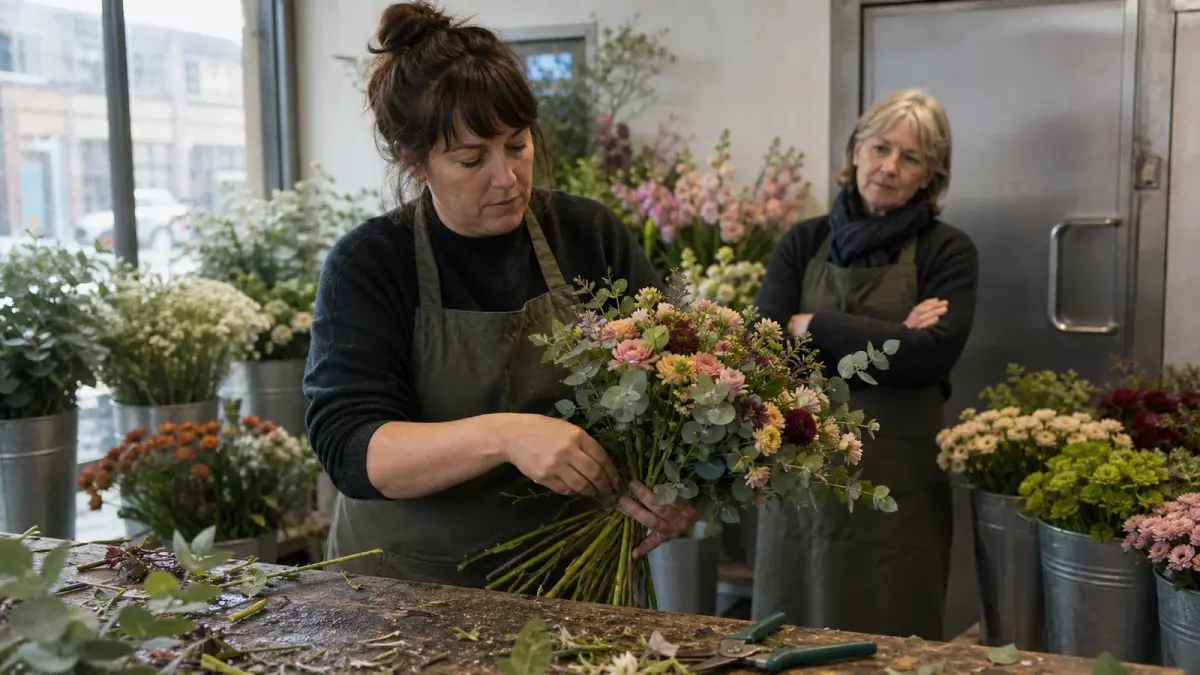
How to become a florist in the UK: the four routes in, what each one costs or pays you, and the first legal step to earning money from flowers.
Becoming a florist in the UK is a matter of skill, not paperwork. Four routes get you there: a paid apprenticeship, a college course, paid work in someone else's shop, or teaching yourself with a lot of stems. Choose on time, money and age, then let a portfolio do the arguing.
Ask how to become a florist and the answers come back as certificates. Nobody at a funeral has ever asked to see one. They looked at the flowers.
That is not permission to skip the training. This trade tests you on things a syllabus struggles to reach: whether your hand tie holds when a bride grips it, whether you can price a sympathy tribute without giving away your morning. All of it is learnable, just in specific places.
Related: How to Start a Florist Business
How long does it take to train as a florist in the UK?
Weeks to become useful, about two years to become formally qualified, and roughly two peak seasons before the busy weeks stop frightening you. Only the middle figure is written down anywhere, and it belongs to one route rather than to the trade.
England's Florist level 2 apprenticeship standard gives a typical duration of 24 months, not including the assessment period at the end.
The figure belongs to the standard, not to the trade. It says nothing about how long you need before you can hold a shop together on a Saturday, which turns on how many Valentine's Days you have survived rather than how many weeks you have attended.
A weekend course, at the other end, should have you making a passable hand tie by Sunday afternoon. Genuine skill, nowhere near a job.
What qualifications do you need to be a florist?
None, in the sense that matters. No exam result stops you buying stems, taking on a wedding or opening a shop. Entry requirements do exist, but they belong to particular routes and to the organisations that run them.
The National Careers Service sets out what the apprenticeship route asks for: some GCSEs, usually including English and maths, or equivalent, for an intermediate apprenticeship, and 5 GCSEs at grades 9 to 4 (A* to C), or equivalent, including English and maths, for an advanced apprenticeship.
Read that twice, because it is where people talk themselves out of the trade. Those grades are one door's policy, set by the people who run that door. They describe a route, not the craft. The four doors:
- Apprenticeship. An employer trains you and pays you while you learn. Slowest to start, because someone has to agree to take you on.
- College course. You pay for structure, a bench and somebody correcting you. Quickest to arrange, and it sells you no customers.
- Paid shop work. Paid from day one and learning at trade speed, with nothing to show for it on paper.
- Self-taught. Cheapest and slowest, and it still counts, provided you photograph everything you make.
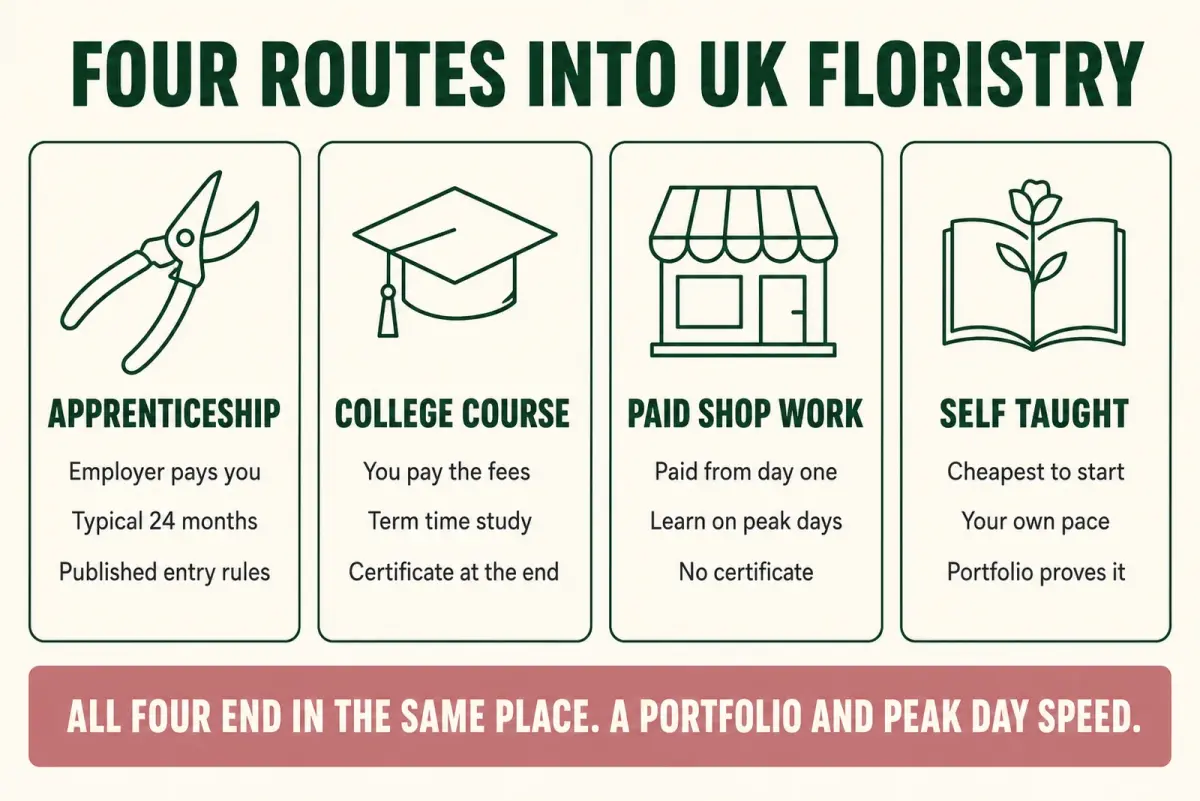
The four routes differ in who pays whom. They converge on the same two things: a portfolio and peak day speed.
Is it worth doing a floristry course?
Worth it for structure, feedback and a bench you are allowed to fail on. Not worth it as a substitute for trade speed or customers, neither of which a course can really sell you.
A good course compresses the fiddly mechanical work: wiring, taping, conditioning, spiral hand ties, buttonholes that survive a hug. Learning that from video is possible and slow, partly because nobody tells you your spiral is drifting until the bouquet slumps two days later.
What a course cannot hand over is what employers hire for: producing at that standard when the order board is full and the phone will not stop. Judge a course on bench hours, not on the certificate. Three questions before you pay:
- How many stems will I personally handle?
- How many finished pieces will I build?
- Who is standing behind me while I build them?
A cheap course with a lot of bench time beats an expensive one with a lot of slides.
How do I become a florist with no experience?
Get inside a shop during its worst week. Peak trading is when a florist is likeliest to take unskilled help, because a great deal of peak day work is not skilled: stripping thorns, conditioning buckets, boxing, labelling and running deliveries.
Make that offer plainly, and it is an easy one to say yes to. You are not asking to design anything. You are asking to absorb the ugly half of the workload while the skilled half happens a metre from your elbow.
Rule of thumb, adjust it to your local shops: ask in January for Valentine's and in February for Mother's Day. By the week itself the rota is usually settled.
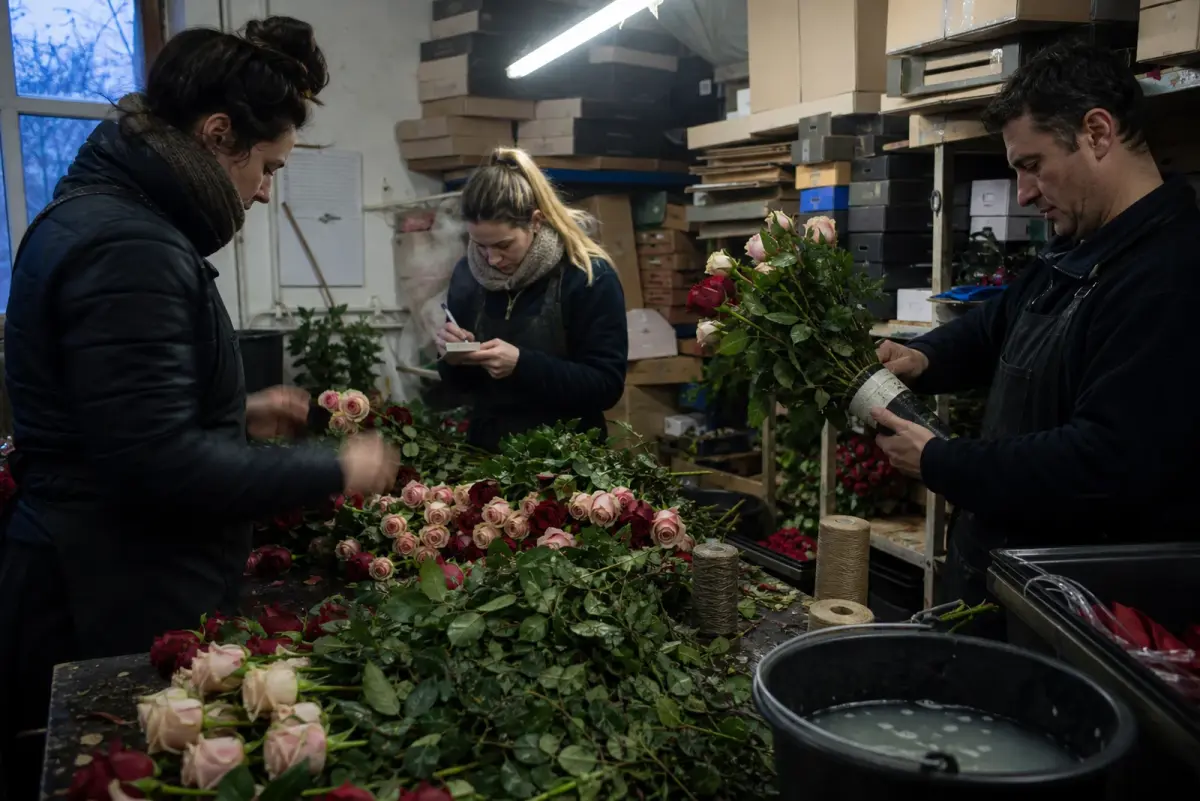
Peak days are the fastest way to learn this trade, and one of the few that pay you to turn up.
Then practise between shifts. One bunch of stems and one technique a week builds a portfolio faster than waiting to feel qualified, and if you can put only one thing in front of a shop owner, make it the portfolio.
Do florists make good money in the UK?
It depends which side of the counter you are on. Employed floristry pays modestly, especially at the start, while running your own book is where the range genuinely opens up.
The figure you can rely on is the floor. From April 2026 the apprentice rate of the National Minimum Wage is £8 an hour. gov.uk states that apprentices are entitled to that rate only if they are aged under 19, or aged 19 or over and in the first year of their apprenticeship, and that apprentices aged 19 or over who have completed the first year are entitled to the minimum wage for their age.
In practice that detail is worth real money to a career changer. Start an apprenticeship at 34 and the wage your employer must legally pay you steps up on the first anniversary, not at the end of the programme.
On your own book there is no such floor and no such ceiling. What you earn is set by what you can sell rather than by what somebody must pay you, which is a different question with a different answer.
Related: How Much Do Florists Make?
Turning your skill into a florist business
You can start earning from flowers before you register anything, and most florists should.
gov.uk states that you can start trading straight away without registering, but that you must register for Self Assessment as a sole trader if you earn more than £1,000 in a tax year, running from 6 April to 5 April, and that you can choose to register earlier.
The threshold is a fair description of a first year in this trade: a few funeral tributes by word of mouth, one friend's wedding, a Christmas wreath workshop. Keep a record of every sale from the first one, because the test is what you earned, not when you decided you were a business.
Once you are trading, your first problem will not be flowers. It will be being found. LocalBrandHub gives you a visibility score, a single number for how easily nearby customers can find you online, worth a look before you spend anything on marketing. See what it covers.
Frequently Asked Questions
What is the 3-5-8 rule for florists?
A teaching convention about proportion rather than a rule anyone enforces. Designers are taught to work in odd numbers and to stagger the main heights of an arrangement in a ratio roughly like three to five to eight. Treat it as a starting proportion for your eye to argue with.
Can I become a florist in Scotland the same way?
The routes are the same in spirit; the paperwork is not. The apprenticeship standard quoted above is an English one, so check the Scottish equivalent before planning around its duration or entry rules. Courses, shop work and self-teaching cross the border unchanged.
Can you become a florist from home?
Yes, and plenty do. A spare room, a cool garage and a reliable car will get a small wedding and funeral practice started. The constraints are storage, water and delivery, not qualifications. See starting a florist business from home.
How much does it cost to become a florist?
Anywhere from a bunch of stems to several thousand pounds, depending on the route. Self-teaching and shop work cost time rather than fees. Colleges and private schools charge, sometimes heavily. An apprenticeship inverts the question: your employer pays you while you train.
Am I too old to become a florist?
No, and the trade is full of second careers. The age-linked thing to understand is pay rather than entry: an apprentice aged 19 or over becomes entitled to the minimum wage for their age once the first year of the apprenticeship is done.
Do I need to be artistic to become a florist?
Less than you fear. Colour and proportion are trainable. The harder aptitudes are working quickly with cold wet hands and reading a grieving customer correctly. If you can assemble flat-pack furniture without swearing, you have the temperament.
The Short Version
Key Takeaway
Becoming a florist is a run of small commitments, not one large decision. Pick a route and get your hands cold.
- Entry requirements belong to routes, not to the trade. The GCSE line is one door's policy.
- Two of the four routes pay you instead of charging you. The apprentice wage rules change after your first year.
- Peak days teach fastest, and needing unskilled hands is why they let you in.
- A course buys feedback, not customers. Judge it on bench hours.
- You can earn before you register, up to the Self Assessment threshold.
Your week, in order:
- Buy one bunch of seasonal stems and practise a single technique
- Photograph the result in daylight against a plain wall
- Email two local florists offering peak day help, naming the week
- Read one route's real entry requirements rather than a summary of them
For restaurants, salons, and local businesses
Need help with your marketing?
We help UK businesses turn social media into real results, not busywork.
Start freeSources
Get More Marketing Tips
Practical marketing tips for UK business owners, straight to your inbox. No spam, unsubscribe anytime.
About the Author
Local Brand Hub
Empowering UK Businesses
Local Brand Hub provides comprehensive business management tools designed specifically for UK local businesses to streamline operations, automate marketing, and grow revenue.
More articlesRelated Articles
 Business Growth
How Much Do Florists Make? UK Salary & Profit Guide
How much do florists make in the UK? A realistic guide to florist salaries, shop profit margins, and how to make a florist business pay.
 Business Growth
Florist Business Plan: A Simple UK Template & Guide
A florist business plan made simple: a UK template and step-by-step guide to the sections that matter, so you can plan a flower shop without the jargon.
 Business Growth
Florist Startup Costs: What It Costs to Start in the UK
Florist startup costs explained: a UK breakdown of what it really costs to start a flower shop, home studio or online florist, line by line, from £500 up.