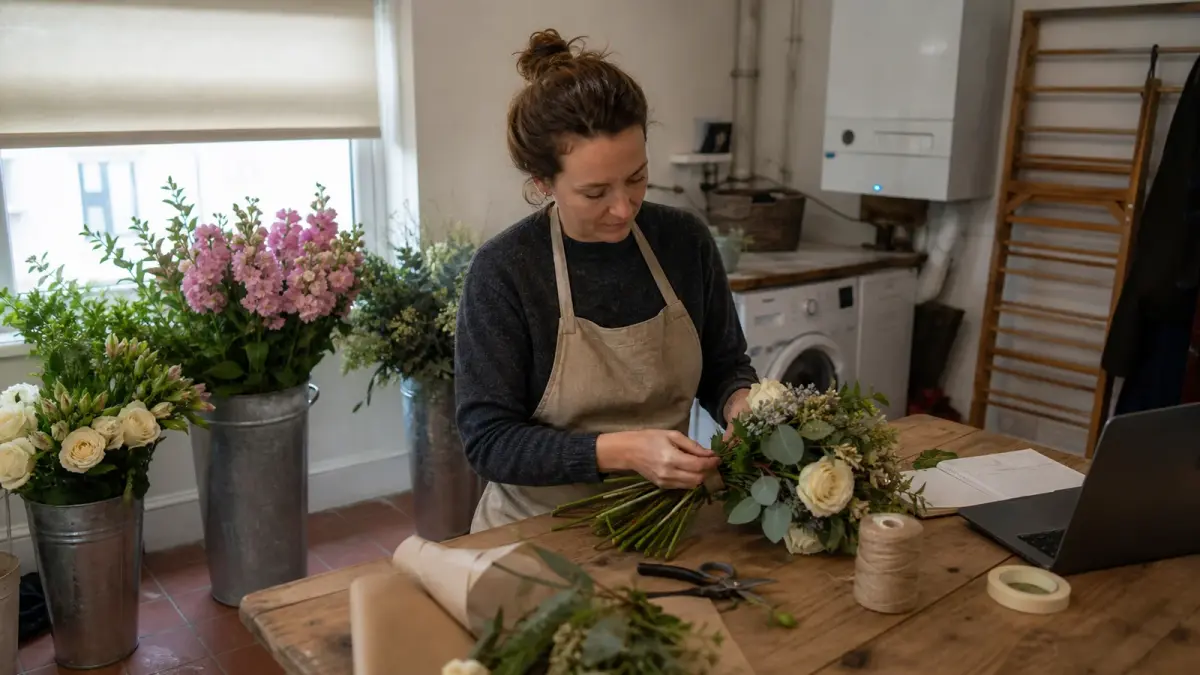
Starting a florist business from home: the four UK thresholds for planning, business rates, HMRC and cancellations, and what a house cannot give you.
You can start a florist business from home without asking anyone's permission first. What changes that is scale: planning permission when the house stops being mainly a home, business rates when customers come to the door or you rebuild a room for the work, and HMRC once you pass £1,000 of trading income in a tax year.
If you suspect that selling bouquets from your kitchen is quietly against some rule, the reality is duller than the worry. The planning and rates thresholds below are quoted from guidance for England; the HMRC one is UK wide.
What bites first is rarely the law. It is the temperature of your garage in July, the width of the table you also eat at, and how long the people you live with will tolerate buckets in the hall.
What you'll learn
- Which planning test decides whether your house is a home or premises
- The upgrade that quietly invites a business rates bill
- When HMRC needs to hear from you, and on what number
- The notice that decides whether a cancellation window is 14 days or 12 months
- Why rent avoided is not the same thing as profit earned
Related: How to Start a Florist Business
Can you run a florist business from home in the UK?
Yes. In England, permission is not normally required at all, and only enters the picture once the house stops behaving like a house.
Planning practice guidance for England is explicit on this: permission will not normally be required to run a business from home, provided the business use is incidental to the use as a dwellinghouse, and permission will be required where the use results in a material change of use.
Read that twice, because the test is about the house, not about you. A florist taking bookings by email, buying stems on a Wednesday and delivering on a Friday does something a house absorbs without noticing. It changes when the house starts behaving like premises: a van in and out all day, customers at the door, a workroom that could no longer be a bedroom without undoing something.
Why this matters: the test attaches to the property, so the same turnover can sit quietly in a detached house with a driveway and change what a terrace with shared parking is being used for. Your local planning authority decides, and asking costs an email.
When a home studio starts attracting business rates
Business rates are the easiest of the four to trip over, because the trigger is the sensible upgrade rather than the reckless one.
GOV.UK sets the position out plainly, in guidance that leaves Scotland and Northern Ireland to their own rating systems: you do not usually have to pay business rates for a home based business if you use a small part of your home for it or sell goods by post, but you may need to pay them as well as Council Tax if you sell to people who visit your property, if you employ others there, or if you have made changes to your home for the business, such as converting a garage.
Rule of thumb only: most of those triggers are things a neighbour would notice, customers arriving, someone else working there, building work. If none of them describes your week, you are probably still in small part territory. Check with your council rather than assume.
Read that list through a florist's eyes. Selling by post sits on the safe side; letting customers collect from the door does not. Notice too that the guidance names post, not driving the orders round yourself. And the example it reaches for is a converted garage, which is the room this whole question tends to be about.
Filling a garage with buckets is not a conversion. Ripping it out, insulating it and fitting a sink might be. Ask the council before you book the builder, because you can redraw a plan for nothing and you cannot unbuild a workroom for nothing.
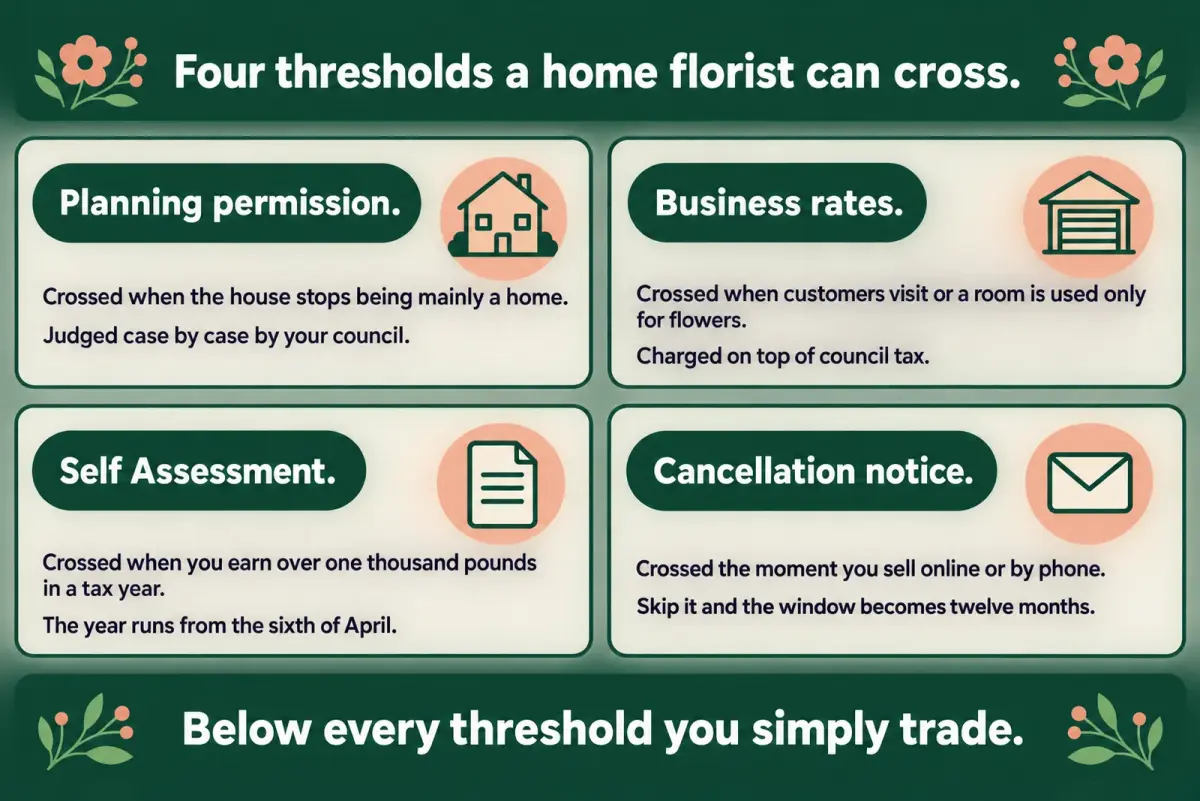
The four thresholds, and the single event that triggers each one.
Telling HMRC you have started
HMRC does not need to know you exist until you cross a number, and the number is lower than the word business suggests.
According to GOV.UK, you can start trading straight away without registering, but you must register for Self Assessment as a sole trader if you earn more than £1,000 in a tax year running from 6 April to 5 April, and you can choose to register earlier.
The word doing the work is earn, not keep. That means what comes in, before the stems come off.
Imagine a first summer at village markets. You take £1,400 and spend £950 at the wholesaler, so you are barely up on the season. You are still past the £1,000 line, because the line is drawn on what came in.
Registering early beats backdating a year you half remember, and every wholesaler receipt from the first bucket is what turns a frightening figure into a modest one.
Selling online means writing one notice
Take an order by website, phone or message and you are selling at a distance, which brings one duty carrying an unusually expensive penalty for skipping it.
GOV.UK's guidance on selling at a distance says a business must tell the customer they can cancel their order up to 14 days after delivery, that no reason is needed, and that if you do not tell the customer about that right, they can cancel at any time in the next 12 months.
Now the part that makes floristry different. Government guidance on the Consumer Contracts Regulations says there are exemptions to those cancellation provisions, and that for goods they include perishable items and tailor made or personalised items. Fresh flowers are perishable and a bridal bouquet is made to one person's order, so the flowers themselves are not coming back on a change of mind.
The trap is reading that as a reason to stay quiet. Whether the goods come back and whether the customer was told where they stand are two different questions, and the exemption runs item by item rather than shop by shop.
A vase or a dried wreath is not perishable, so a shop selling those beside fresh work holds two positions at once. On the items that do keep the cancellation right, saying nothing is what turns a fortnight into a year. Write the notice, say which items it covers, and put it where the customer reads it before paying. The duty is discharged by telling the customer, so which plugin or platform you use is your choice, not a legal requirement.
What a house cannot give you
Home does not remove the cost of premises. It moves that cost into a building you share with other people, and pays it in a currency other than money.
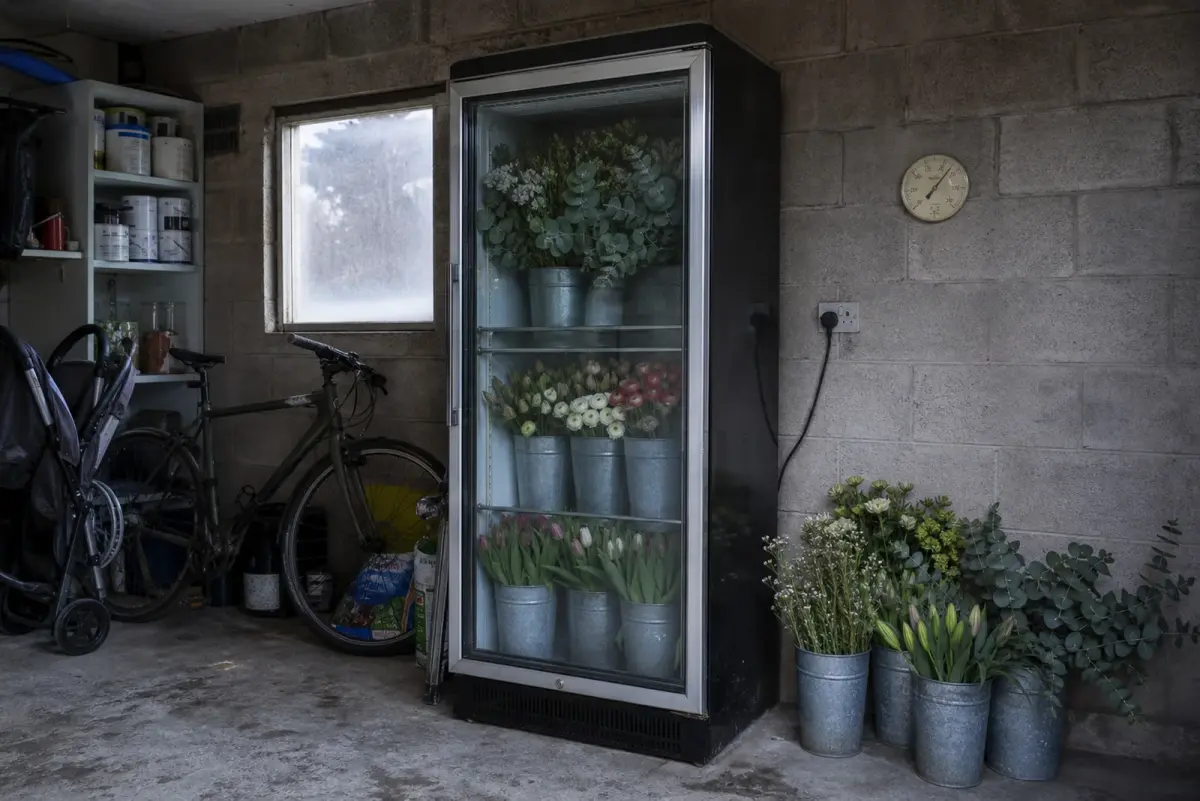
A garage doing the job of a cold room, sharing the space with everything else.
Cold is the first constraint, and the underestimated one. Flowers keep in the cold; British houses are built to be warm. A north facing garage copes in February and struggles in a July heatwave, which is when the wedding work lands.
Space is the second, and the bench is not the half of it. Buckets are the problem: wet stems need floor, water and a drain, and they cannot be tidied away for supper. Count your floor in buckets rather than square metres, because buckets are the unit a wedding is actually measured in.
Imagine a garage that holds eight buckets with room to walk. That is a comfortable Saturday of hand tieds and a difficult wedding, because ceremony flowers, table arrangements and buttonholes all want conditioning at once.
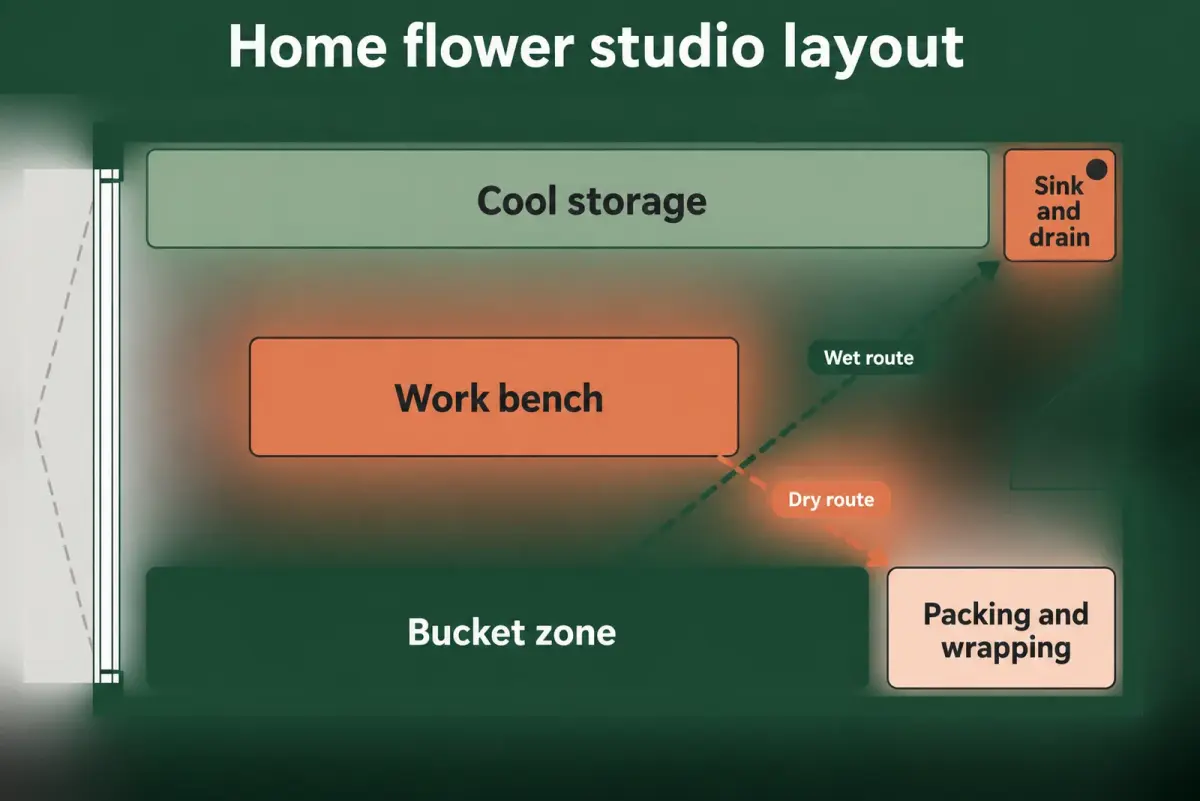
Four zones, one garage, and a route to a drain that does not cross the packing table.
Kit is the easy part: a wipeable bench, buckets, sharp snips, a bin within reach, water at working height, and somewhere to pack that is not where you build.
The third constraint has opinions. Everyone else in the house now lives in your workplace, and goodwill that was cheerful in March gets tested by a hallway of hydrangeas in June.
| Constraint | Cheap workaround | Where it stops |
|---|---|---|
| Cold | Used glass fronted fridge | A July heatwave |
| Floor space | Buckets near a drain | The weekend that needs three times the floor |
| Patience at home | Rooms and times agreed up front | Peak season |
Related: Florist Startup Costs
Is a florist business profitable from home?
Home improves your odds, though not for the reason the internet gives. Rent you never pay lowers your overhead, which helps, but it is not margin you earned, and it leaves the number underneath untouched: the gap between what you pay for stems and what you charge for the finished thing. A florist who prices badly from a spare room loses money more slowly than one who prices badly on a high street, which is not the same as making money.
Where home actually helps is upstream. With no window that needs filling, you can sell the work before you buy the flowers. Buy against orders you already hold and very little goes in the bin, which is the advantage the absent rent usually gets the credit for, and the arithmetic sits in our guide to florist profit margins. The ceiling is just as real: buckets, fridge space and one pair of hands cap a wedding weekend, and demand alone does not lift that cap.
Frequently asked questions
Do I need a licence to sell flowers from home?
People asking about a licence are usually asking about permission, and permission is a planning question. Planning guidance for England says permission is not normally required to run a business from home provided the use stays incidental to the use as a dwellinghouse, and is required where it results in a material change of use. Put the question to your local planning authority.
What is the 3-5-8 rule for florists?
The 3-5-8 rule is a design habit, not a business rule. Ask around and you will be told it means grouping stems in threes, fives and eights instead of matched pairs, the idea being that uneven groups look less arranged. Use it if it helps your hands decide faster. It says nothing about whether you may trade from your kitchen, what to charge, or whether the work pays.
How much does a self employed florist earn?
There is no honest single number to hand you. Researching this guide we found no reliable published figure for self employed florist earnings in the UK, and the amount swings with what you buy, what you charge and how many weeks you work. Build the figure from your own prices and stem costs, using our guide to how much florists make as the frame.
Do these rules work the same in Scotland, Wales and Northern Ireland?
Registering with HMRC and the consumer rules for distance selling apply across the UK. Planning and business rates do not, because planning is devolved and rates are administered separately in Scotland and Northern Ireland. The guidance quoted here is written for England, so treat it as the shape of the question and confirm the detail with your own council.
Can I convert my garage into a flower studio?
You can, but know what the conversion changes. GOV.UK lists making changes to your home for your business, its example being a converted garage, among the circumstances where business rates may be due as well as Council Tax. A garage full of buckets is not a conversion. A garage rebuilt as a workroom might be, so ask before the plasterer arrives.
What florist work suits a home business best?
Anything ordered before it is made. Weddings, events, funeral tributes, subscriptions and online orders all let you buy stems against a booking you already hold. Walk in trade is the awkward one, because it needs someone passing your door and a display worth stopping for, and a house on a residential street supplies neither.
Where to start this week
Key Takeaway
Half an hour is enough for all four of these:
- Count how many buckets fit on the floor of your space, not the bench.
- Read what your mortgage or tenancy says about running a business at the address, because nobody else can check that contract for you.
- Write your cancellation notice in plain words and say which items it covers.
- Note the date you first take money, so the tax year question answers itself later.
Treat the half hour as a starting experiment and stretch it if the garage needs emptying first. Once the flowers are ready, the harder job is being findable, and LocalBrandHub's free visibility check gives you one number for how easy it is for nearby customers to find you online: see how it works.
So ask yourself the question that actually decides this. Not whether a home florist counts as a real business, but whether your house can hold February and July at once. The rest is paperwork.
Guide reviewed and last updated August 2026.
For restaurants, salons, and local businesses
Need help with your marketing?
We help UK businesses turn social media into real results, not busywork.
Start freeSources
Get More Marketing Tips
Practical marketing tips for UK business owners, straight to your inbox. No spam, unsubscribe anytime.
About the Author
Local Brand Hub
Empowering UK Businesses
Local Brand Hub provides comprehensive business management tools designed specifically for UK local businesses to streamline operations, automate marketing, and grow revenue.
More articlesRelated Articles
 Tutorials
How to Start an Online Florist Business in the UK
How to start an online florist business in the UK: the six setup steps, the business rates trap at your own front door, and the refund rule flowers escape.
 Tutorials
How to Become a Florist in the UK: Routes and Training
How to become a florist in the UK: the four routes in, what each one costs or pays you, and the first legal step to earning money from flowers.
 Tutorials
How to Set Up a Florist Online Shop: A UK Guide
How to set up a florist online shop in the UK: a step-by-step guide to products, payments, delivery zones and same-day cut-offs that win local orders.