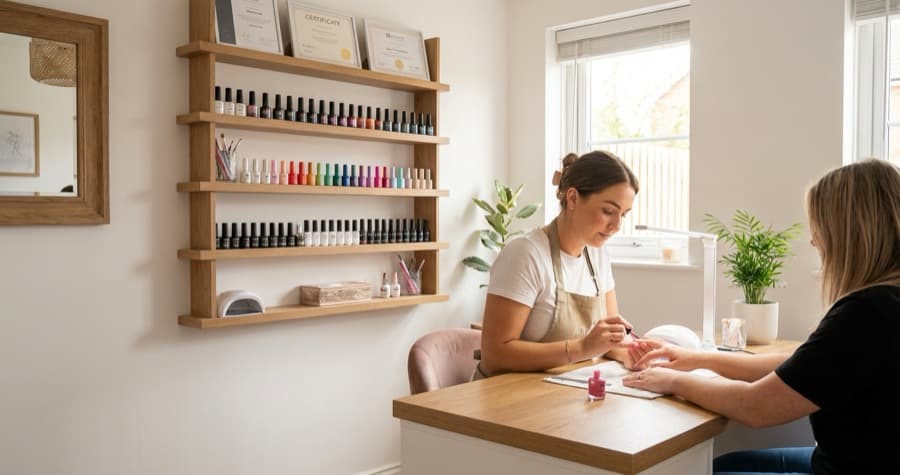
Running a nail business in the UK? Compare salon, mobile, home-based and chair rental models with realistic revenue, challenges and growth paths.
A nail business is any commercial operation where a qualified nail technician offers nail treatments (manicures, gel polish, acrylics, BIAB, nail art) as a paid service. In the UK, that covers everything from a two-chair nail bar on the high street to a solo technician visiting clients at home.
You qualified, you built a client list, and you're now doing back-to-back appointments. But you're not sure whether to keep working mobile, rent a chair somewhere, or eventually open your own space. Meanwhile someone from your training cohort has just opened a studio and another is pulling £500 days working from home. The question isn't whether it can work: the UK nail salon market is projected to grow from £759 million to over £1.1 billion by 2030 (Grand View Research, 2025). The question is which model works for you.
This guide covers the four main models in the UK, what you can realistically earn, the challenges nobody warns you about, and how technicians grow from solo to multi-technician operations.
What You'll Learn About Running a Nail Business
- The four main UK business models and what each costs to start
- Realistic earning ranges for nail technicians at different stages
- The challenges that catch most nail techs off guard
- What growing from solo to salon actually looks like in practice
- Technology that saves time and reduces no-shows
1. Nail Business Models in the UK
Before you can plan revenue or timelines, you need to understand which business structure you're actually building. There is no single template here: the right model depends on your budget, lifestyle, and growth ambitions, and many technicians move between models as their business evolves.
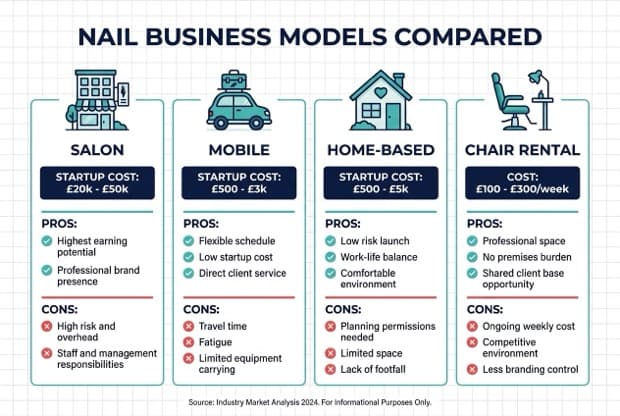
The four main UK nail business models compared
| Model | Startup Cost | Typical Earning Trajectory | Best For |
|---|---|---|---|
| High-street salon | £20,000-£50,000 | Often the highest ceiling | Capital-ready techs with growth goals |
| Mobile | £500-£3,000 | Often moderate, flexible | Flexible lifestyle, low overheads |
| Home-based | £500-£5,000 | Typically good solo income | Low-risk launch |
| Chair rental | £100-£300/week | Typically variable by capacity | Professional space, no premises burden |
The cost ranges above are UK estimates. Your actual startup costs will depend on location, equipment choices, and whether you already have professional-grade tools.
High-street or standalone salon
The highest-investment model. You take on premises, hire staff, and manage overheads. Startup costs can run to tens of thousands of pounds (Sage, 2025). You earn from all the chairs, but you carry all the risk.
Mobile nail technician
You travel to clients. Low startup costs: quality kit, a vehicle, and public liability insurance. The trade-off is travel time and physical fatigue from working in non-ergonomic spaces.
Home-based nail business
You convert a room or build a garden studio. Before starting, check with your local council, mortgage provider or landlord, and home insurer. Some local authorities require a special treatments licence: in London, this can cover manicures specifically.
Chair rental
You rent a dedicated nail station within an existing salon. UK rates vary by location and what's included (Lyvi UK, 2025). Professional, ventilated space without the full overhead of running premises.
For example, a nail technician based in the Midlands might start home-based, build a 10-client regular base over six months, then move to chair rental to take on more volume, with a salon opening as a longer-term goal once revenue is consistent.
2. Revenue and Earning Potential
So you've picked your model. The next question, honestly the first question most people are asking, is: what will you actually earn?
Is it profitable? Yes, but earnings depend heavily on model, pricing, location, and client volume.
Baseline: Employed nail technicians typically earn £15,000 to £26,000/year (Indeed UK, 2025). That's the floor, not the target.
Self-employed nail technicians can earn considerably more. Most established solo technicians sit comfortably above that range once fully booked (Artistic Touch Nail Academy, 2025).
Two factors lift earnings further:
- Location. London commands significantly higher pricing than the rest of the UK: often 30 to 50% more for the same service (Nailicy, 2025).
- Specialist skills. Nail techs offering BIAB, e-file manicures, nail art, or acrylic extensions attract clients willing to pay premium prices.
For example, a nail technician in the East Midlands might charge £42 for a BIAB manicure working from a garden studio. Move that same technician to London pricing, and the same treatment is worth significantly more, without any additional skill, just location.
If you're reading this thinking "that sounds like a lot of work just to break even", you're not wrong about the early stages. The first six months are typically about filling the diary, not maximising profit.
Would you feel confident quoting your prices if a potential client asked right now? If the answer is "I'd probably undercut myself", that's usually a sign your pricing strategy needs attention before your booking system does.
Related: For guidance on setting and communicating prices, see Nail Salon Pricing: UK rate benchmarks and pricing strategy.
3. Key Challenges for Nail Technicians
Now that you understand the models and the earnings, it's worth being direct about what gets in the way. Working for yourself in this trade comes with pressures that go beyond perfecting your technique, and these are the ones that catch most technicians off guard.
No-shows and late cancellations
Without a cancellation policy and upfront deposits, a single no-show on a fully booked Saturday costs you real money you can't recover. Many nail techs don't enforce policies early enough, then struggle to introduce them once clients are established.
For example, a nail bar owner in Birmingham introduced a booking deposit requirement after chronic no-shows on Saturday mornings. Within a month, her Sunday evening messages asking "can you come tomorrow?" had dropped to almost zero. The deposit didn't lose her clients: it filtered the ones who weren't serious.
Health risks from the job itself
Carpal tunnel syndrome, back and neck pain from leaning over a nail desk for hours, and occupational contact dermatitis from acrylic monomers and gel chemicals are occupational hazards that can sideline you for weeks (HSE, 2025). If you're only treating your kit well and not your body, you'll always lose to technicians who take both seriously.
Rising business costs
The NHBF's Straightening Out the Costs report (2025) found that only 46% of salons and barbers surveyed made a profit, with 41% breaking even. Solo technicians are somewhat insulated from wage cost pressures, but product costs, insurance, and business rates add up quickly.
Pro tip: Keep product costs below 15 to 20% of revenue. Going above this is typically the first sign that your pricing needs reviewing, not your product selection.
Competition from unqualified operators
The UK has no national licensing requirement for nail technicians. Some local councils require special treatments licences (particularly in London), but enforcement is inconsistent. That's usually a sign of a market maturity issue: well-qualified technicians need to differentiate clearly on credentials, safety standards, and the quality of their results.
Insurance and compliance
Public liability insurance is essential. If you work with acrylic or gel systems, professional indemnity cover is strongly advisable. BABTAC and the NHBF both offer industry-relevant insurance and resources for self-employed technicians.
4. Growing From Solo to Salon
So you've seen the challenges. Here's the upside: once you understand each growth stage, the path forward becomes much more manageable. Most technicians start solo and stay solo, and that's a perfectly viable outcome. But for technicians who want to grow, the path typically follows a recognisable pattern.
Stage 1: Solo (mobile or home-based)
Build your client base, refine your service menu, and get consistent on pricing. The biggest risk at this stage is undercharging.
Stage 2: Chair rental
Move into a professional space: either renting a chair or taking a small studio. This adds overhead but creates separation between work and home life, lets you see more clients, and builds brand credibility.
Stage 3: Associate model
Bring in one or two other technicians who pay you a percentage or flat weekly rate to work from your space. Your income diversifies: you earn even when you're not at the desk.
Stage 4: Salon
Take on premises, hire staff, and take on full employer responsibilities. This is the highest-risk, highest-reward transition. Before committing to a lease, having at least six months of operating costs as a financial buffer is strongly advisable.
The default recommendation for most nail techs: Stages 2 and 3 offer the best balance of income, flexibility, and growth. A fully booked nail technician with one associate can generate combined revenue that supports progression without the full weight of salon overhead.
If you're thinking about this transition but feeling overwhelmed, the Nail Bar Business Plan guide covers the financial planning side in detail.
5. Technology for Modern Nail Businesses
So you've got the right model and a clear sense of where you want to go. The next practical step is making sure the operational side doesn't hold you back.
The nail techs pulling consistent revenue in 2026 are almost always using software to manage bookings, reduce no-shows, and handle payments.
Booking and client management: the main UK options:
- Fresha: Free for independents. No monthly fee, just a 20% commission on new clients via the Fresha marketplace (Fresha, 2025).
- Vagaro: Flat monthly rate. Includes loyalty programmes, POS, and marketing tools.
- Treatwell: 35% commission on first-time bookings, but high-traffic marketplace exposure.
For most UK nail techs starting out, Fresha is the default recommendation: zero upfront cost, strong UK market presence, and built-in automated reminders.
Automated reminders
Go out 24 to 48 hours before appointments via SMS or email. Reducing no-shows even modestly adds real income back each month.
Online deposits
Collected at the time of booking, they are the most effective way to reduce last-minute cancellations. Clients who have paid are far less likely to cancel without notice.
Social media scheduling
Tools like Later or Buffer let you plan a week's worth of posts in 30 minutes. For nail techs, Instagram remains the strongest platform for visual portfolio content and local discovery. If you'd rather plan and schedule those posts alongside the rest of your marketing, a social media calendar keeps a week of content organised in one place.
If you only have 30 minutes this week, do this:
- Day 1-2: Set up a free Fresha profile and add your core services with accurate pricing
- Day 3-4: Turn on automated appointment reminders
- Day 5-7: Add a deposit requirement to your most popular booking slot
If you're a beauty salon owner looking for broader marketing tools beyond booking systems, Local Brand Hub helps you manage social posts, track local SEO, and run seasonal promotions from one dashboard.
6. Assess Your Nail Business This Week
So you've seen the models, the numbers, and the challenges. Now what?
Running your own operation in the UK is viable at every scale: from a home studio seeing eight clients a week to a multi-technician nail bar. The demand is real.
These businesses don't fail because the nail work isn't good enough. They fail because the business behind the nail work wasn't built properly.
The gap between the techs who thrive and those who plateau is almost always operational, not technical.
For example, a nail technician in Leeds running a home-based business had been fully booked for three months but was still earning less than expected. A quick audit revealed her pricing hadn't been updated in 18 months, she had no deposit system, and she was spending 20% of revenue on products, twice the recommended rate. Adjusting those three factors alone transformed her margin without adding a single booking.
This week, run a five-point audit of your business:
- Compare your prices to at least three local nail salons or techs in your area
- Check whether your booking system has deposits enabled, if not, set one up
- Calculate what no-shows are actually costing you per month (count last month's)
- Review which business model you're currently in and whether it still fits your goals
- Confirm your public liability insurance is current and covers all services you offer
The models, earnings, and challenges covered here are the broad picture. For the full step-by-step launch process, see Starting a Nail or Lash Business, which covers everything from training and insurance through to your first paying client.
Frequently Asked Questions
Is nail work profitable in the UK? Yes. A self-employed nail technician who is consistently booked typically earns well above the employed average. Profitability depends on pricing correctly, managing no-shows, and keeping product costs under control (Artistic Touch Nail Academy, 2025). For example, a nail tech who reviews their pricing quarterly and uses booking deposits consistently tends to outperform peers with comparable skills who don't.
Which business model should I start with? Most UK nail technicians start home-based or mobile. Low startup costs limit financial risk while you build a regular client base. Chair rental is the natural next step once you're consistently booked and capacity becomes the constraint rather than demand.
Do I need a licence to do nails from home in the UK? There is no national licence requirement to do nails in the UK, but some local councils, particularly in London, require a special treatments licence covering manicures. Check with your mortgage provider or landlord and update your home insurance before taking clients at home.
How do I reduce no-shows as a nail technician? Require an upfront deposit at the time of booking via platforms like Fresha, Vagaro, or Treatwell. Automated appointment reminders are also highly effective. The combination of both is the standard approach among well-run UK nail salons.
For restaurants, salons, and local businesses
Need help with your marketing?
We help UK businesses turn social media into real results, not busywork.
Start freeKey Takeaway
A nail business in the UK is profitable at every scale, but the model you choose, the prices you set, and how you handle operations matter more than your technical skills alone. Start with a low-risk model (home-based or mobile), build a consistent client base, enforce deposits and cancellation policies from day one, and keep product costs under 20% of revenue. The technicians who grow from solo to salon are the ones who treat their business as seriously as their craft. For the full launch roadmap, start with the Starting a Nail or Lash Business hub guide, or explore related topics like lash businesses, nail business names, and brow business names.
Get More Marketing Tips
Practical marketing tips for UK business owners, straight to your inbox. No spam, unsubscribe anytime.
About the Author
Local Brand Hub
Empowering UK Businesses
Local Brand Hub provides comprehensive business management tools designed specifically for UK local businesses to streamline operations, automate marketing, and grow revenue.
More articlesRelated Articles
 Tutorials
How to Start a Nail Business in the UK (2026)
How to start a nail business UK 2026: qualifications, insurance, equipment costs, pricing and your first clients. Step-by-step guide for nail techs.
 Business Growth
Brow Business Names: 30+ Ideas by Style
30+ brow business name ideas by style. Covers brow bar vs brow studio naming, threading bars, and UK name availability checks.
 Business Growth
Nail Business Names: 50+ Ideas + How to Pick the Right One
Need nail business name ideas? Discover 50+ creative options, punny, elegant, contemporary, personal, plus how to check availability in the UK.