How to run a nail technician business as a sole trader. Covers mobile vs chair rental vs home salon, HMRC self-employment and personal branding in the UK.
You're good at what you do. Your clients rebook without being asked. You've been thinking about going fully independent for months, but every time you sit down to work out how, there are too many questions and not enough clear answers.
Running a nail technician business as a sole trader means no commission splits, no minimum hours, and no asking permission to take a holiday. But doing it properly (registered, insured, and set up with the right model) takes more than buying a kit and opening Instagram.
This guide covers the specific decisions you face running a nail technician business solo. Not a nail bar owner managing a team, but you, working independently. We'll cover the three business models to choose from, what HMRC self-employment requires, how to build a personal brand that keeps your diary full, and the financial basics you can't afford to ignore.
Info
Related: Starting a Nail or Lash Business: the complete overview for anyone setting up in the nail and lash sector.
What You'll Learn
- The difference between running a nail technician business and owning a nail bar, and why it matters
- Mobile, chair rental, and home salon: how to choose your setup
- What HMRC self-assessment means for you
- How to build a personal brand that clients follow, not just a business
- A practical week-one checklist to get started
Nail Technician vs Nail Bar Owner: Different Paths
Here's a distinction the industry doesn't always make clearly, and it leads to expensive mistakes.
Info
The short version: A nail bar owner manages a business. A solo nail technician is the business.
A nail bar owner runs a premises. They manage staff (or associates), handle lease agreements, deal with business rates, and take on the full operational risk of a salon.
Running a nail technician business as a solo practitioner is fundamentally different. Success here isn't about managing a business. It's about building a reputation.
The goal isn't "how do I run the salon well?": it's "how do I keep my personal clients coming back?"
What sets each path apart:
| Nail Bar Owner | Solo Nail Technician | |
|---|---|---|
| Overhead | High (rent, staff, rates) | Low (kit, insurance, platform) |
| Risk | Operational | Reputational |
| Income ceiling | Higher, but shared | Lower, but fully yours |
| Flexibility | Limited | High |
Rule of thumb: solo practitioners trade income ceiling for autonomy. Neither path is inherently better; it depends on your goals.
Pro Tip
For comparison, look at how the same dynamic plays out in hairdressing. The self-employed hairdresser model shares many of the same structures and regulatory requirements as nail tech self-employment.
The key question isn't "should I own a salon?" It's "which solo operating model fits my life, my clients, and my income goals?"
Self-Employment for Nail Technicians
Now that you understand the distinction, here's the legal foundation every nail technician business needs to operate properly in the UK.
If you work for yourself in the UK (whether mobile, renting a chair, or from home), you're likely a sole trader. That means registering with HMRC and filing a Self Assessment tax return each year.
The basics of self-employment for nail technicians:
- Register as self-employed with HMRC as soon as you start trading: you can do this directly at gov.uk/set-up-sole-trader
- Keep records of all income and business expenses: products, travel, training, insurance
- Pay Income Tax and Class 4 National Insurance contributions on your profits
- If your turnover exceeds £90,000 (2026/27 threshold), you'll need to register for VAT
Most nail technicians starting out earn well below the VAT threshold, but keeping clean records from day one saves significant stress when your first tax return arrives.
Register Early
Register as self-employed before your first paying client, not after.
Insurance is not optional. You need professional indemnity and public liability insurance before working on a single client. BABTAC (British Association of Beauty Therapy and Cosmetology) and the NHBF (National Hair & Beauty Federation) both offer insurance packages designed specifically for self-employed beauty professionals. Expect to pay approximately £100 to £200 per year depending on coverage level and your specific treatments.
Qualifications matter for insurance. Most insurers require a Level 2 or Level 3 qualification in nail technology before they'll cover you. If you're using enhancement products like acrylics or gel extensions, check that your specific treatments are listed in your policy.
If you're thinking "I've been doing this for months without registering": that's a very common situation. The fix is straightforward: register now, keep your records going forward, and don't panic about the past.
Info
Our Nail Business guide covers the broader compliance and setup requirements in more detail.
Mobile vs Chair Rental vs Home-Based: Choosing Your Setup
When it comes to choosing a working model, this is the most consequential decision you'll make as a solo nail technician.
Info
Each model has a different cost profile, income ceiling, and lifestyle trade-off. There's no universally correct answer, only the one that fits your clients, your life, and your goals right now.
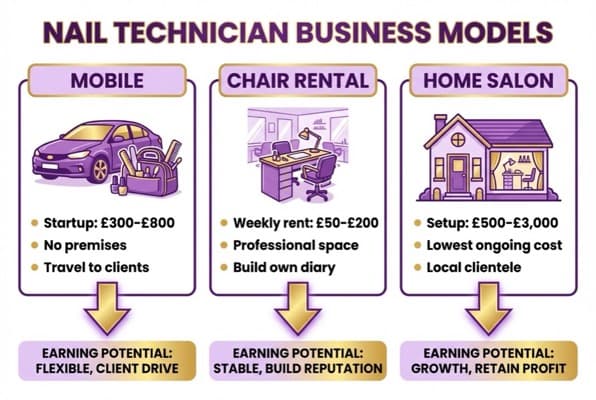
Nail technician business models compared: mobile, chair rental, and home-based salon
| Model | Startup Cost | Ongoing Cost | Best For |
|---|---|---|---|
| Mobile | £300-£800 | Travel + products | Flexible hours, existing clients |
| Chair rental | Low upfront | £50-£200/week rent | Professional environment, no premises risk |
| Home-based | £500-£3,000 | Products + insurance | Regular local clientele, back-to-back bookings |
Costs are indicative ranges. Actual figures vary by location and setup. Use as a starting point, not a fixed budget.
Mobile Nail Technician
You go to the client. This is the lowest-cost way to start: no premises overheads, no rent, no rates.
What you need:
- A professional portable kit (lamp, gel/acrylic products, nail prep essentials, proper carry case)
- Good, reliable transport
- The discipline to maintain a clean, professional setup in someone else's home
Budget roughly £300 to £800 to get properly equipped.
The reality: You spend significant time in transit. Parking, traffic, and carrying equipment are daily friction points. You're also dependent on clients being genuinely home-ready: clear space, decent lighting, no unexpected distractions mid-appointment.
For example, a mobile nail technician working four days a week, fully booked, can build a strong income, but only if she prices in her travel time. That's the piece many new mobile techs underestimate.
Chair Rental
You rent a workstation inside an existing salon. This is the middle-ground model: you get a professional environment without running the whole salon.
What you pay: Chair rental typically costs between £50 and £200 per week in the UK, depending on location, salon profile, and what's included (reception support, booking system, consumables). Some salons charge daily rates instead.
What you keep: Everything you charge clients, minus your rent. The salon is not your employer; you're self-employed, working from their space.
The reality: Your income depends entirely on filling your own diary. Unlike an employed position where the salon manages bookings, chair rental puts client acquisition squarely on you. A well-developed personal following makes chair rental very profitable. Starting from scratch with no existing client base makes it expensive from day one.
Pro Tip
For a detailed look at how chair rental agreements work, including what to look for in a contract, see our guide to Chair Rental in Hair Salon, the same principles apply in nail salons.
Home-Based Salon
You convert part of your home into a treatment space. Lower overhead than renting, more professional than most mobile setups.
Setup costs: Expect to spend £500 to £3,000 depending on how much you invest in the space: dedicated room, specialist lighting, a proper nail desk, ventilation for enhancement products. You'll also need to check your home insurance policy covers commercial use, and potentially notify your mortgage provider or landlord.
The reality: Your address becomes your business address. Consider whether you're comfortable with that, particularly for new clients. Local authority guidance on home-based businesses varies: check with your council before setting up.
Many home-based nail technicians build loyal local client bases that fill their diary weeks in advance. The setup cost is higher than mobile, but the day-to-day friction is much lower.
Building Your Personal Brand as a Nail Technician
However you choose to work (mobile, rented chair, or home-based), your nail technician business success isn't about your setup. It's about your reputation. The nail techs who stay booked aren't necessarily the most skilled. They're the most recognisable.
Running a nail technician business isn't about having the best kit. It's about being the person clients think of first.
The question isn't "am I skilled enough?" It's "do the right people know I exist?"
Here's the difference: a nail technician with a brand is someone clients look for. A nail technician without one is whoever has availability. Your personal brand isn't your logo. It's the reason a specific client chooses you over the seven other nail technicians within 10 minutes of her house.
Four things that make a nail technician business brand stick:
1. A specific style or speciality. Gel with clean minimalist finishes. Intricate nail art for events. Extensions for clients who ruin their nails. Picking a lane, and being known for it, makes you easier to recommend. "You should go to [name], she does incredible floral gel art" is a specific, shareable recommendation. "She does nails" is forgettable.
2. Consistent social media. Instagram remains the primary discovery channel for nail technicians in the UK. Your grid is your portfolio. Post finished nails on a neutral background, in good light, with consistent editing. Stories are where personality builds. For example, a nail technician specialising in bridal nails might post: a before-and-after from a bride's trial set, a reel of her preparation routine, and a testimonial the week before her client's wedding. Staying that consistent while your diary is full is the hard part: a social post planner takes the weekly guesswork out of what to post.
3. A professional booking page. Whatever system you use (Fresha, Treatwell, your own website), it should show your best work, list your treatments and prices clearly, and make booking genuinely easy. A bio photo, your style, your location, and instant booking are the minimum.
4. Google reviews. Ask every client after their appointment. A nail technician with 40 Google reviews converts significantly better from local search than one with 3. Most clients won't leave one unless you ask directly, so ask.
Info
If you're working on a more detailed business identity (name, positioning, visual style), our guide to How to Start a Nail Business covers branding decisions alongside setup.
Managing Your Finances as a Solo Nail Tech
Finally, the part most nail technicians put off the longest: the numbers.
Info
If you're thinking "I didn't train to be an accountant": you're not alone. But the financial side of a nail technician business doesn't need to be complicated. It just needs a basic system.
Separate your money. Open a business bank account: many UK banks offer free accounts for sole traders. Every client payment goes in, every business expense comes out. This separation makes your tax return significantly easier and gives you a clear picture of actual profit.
Pro Tip
For guidance on setting treatment prices that actually reflect your costs, see our Nail Salon Pricing guide.
Know your numbers before you set prices. A nail technician charging £40 for a gel manicure and doing 5 clients a day isn't earning £200 a day. After products (roughly £4 to £8 per service), rent or travel costs, insurance, training, and tax set-aside, your take-home is considerably lower. Running numbers before setting prices, not after, is the difference between a sustainable nail technician business and one that feels busy but never grows.
Set aside tax from day one. A very common mistake for newly self-employed nail technicians is spending all their income and then scrambling when the HMRC payment deadline arrives. Set aside approximately 25% of every payment into a savings account and treat it as untouchable.
Track deductible expenses. As a self-employed nail technician, you can deduct legitimate business costs from your taxable income:
- Products and tools
- Training courses and CPD
- Insurance premiums
- A proportion of phone costs
- Travel (mileage for mobile techs)
- Work clothing specific to your job
Keep receipts or use a simple accounting app from day one. FreeAgent and Xero both have UK sole trader plans, or a spreadsheet works fine at the start.
Info
Our Nail Bar Business Plan guide includes financial planning templates that work equally well for solo practitioners setting out their income and cost projections.
Review Your Nail Technician Business Setup This Week
So you've got the framework: the models, the legal basics, the brand principles, and the finances. Here's how to actually start.
If you're currently working for a salon, renting a chair informally, or doing nails as a side income without a formal nail technician business structure, this week is a good moment to audit where you stand.
If you only have 30 minutes this week, do this:
- Day 1 to 2: Check your employment status. If you're working independently, even part-time, and keeping your own income, you're likely self-employed. Register at gov.uk/set-up-sole-trader if you haven't already.
- Day 3 to 4: Review your insurance. Check it covers your actual treatments, your setup (mobile/home/rented chair), and that it's from a recognised professional body like BABTAC or NHBF.
- Day 5 to 7: Audit your social media and booking presence. Does your Instagram reflect your best current work? Is your booking link easy to find in your bio? Are prices listed clearly?
The bigger question to ask yourself: If you looked at your online presence as a new potential client, would you book?
If the honest answer is "probably not," that's usually a sign your personal brand needs attention before you focus on anything else.
A nail technician business that's properly registered, insured, and clearly positioned doesn't just survive the quiet weeks. It builds something that grows beyond word of mouth.
Whether you're a mobile nail technician, renting a chair, or working from home, Local Brand Hub for beauty salons can help you manage your marketing and build your online presence.
Frequently Asked Questions
Do you need a licence to do nails in the UK?
There's no single government-issued licence required specifically to work as a nail technician in the UK. However, most insurers require a Level 2 or Level 3 qualification in nail technology before they'll cover you. Some local authorities also require registration for certain treatments, particularly those involving chemicals. Check your local council requirements and your insurance terms before trading.
BABTAC Credentials
BABTAC members get access to insurance and can use BABTAC-logo credentials on their booking pages, useful for new clients choosing between technicians.
How much do mobile nail technicians make?
Earnings vary significantly by location, treatment mix, and how fully booked you are. Mobile nail technicians in the UK typically earn between £20,000 and £45,000 before tax. Those specialising in higher-value treatments (extensions, nail art, bridal) and working in higher-cost areas tend to sit towards the upper end.
How much does it cost to start a nail technician business?
Starting costs depend on your model. Mobile can begin for £300 to £800; home-based typically costs £500 to £3,000+ to set up properly. Chair rental has lower upfront costs but ongoing weekly rent to budget for. Add insurance and product costs, and most nail technicians can launch for under £2,000.
What's the difference between a nail technician and a nail bar owner?
A nail bar owner runs a premises: managing staff, lease agreements, business rates, and operational risk. A nail technician running their own business works solo. Your overhead is lower, your decisions are faster, and your success depends on your own skill and client base rather than how well a whole salon operates.
Want to understand how the wider nail and lash business landscape fits together? Start with our pillar guide: Starting a Nail or Lash Business.
For restaurants, salons, and local businesses
Need help with your marketing?
We help UK businesses turn social media into real results, not busywork.
Start freeKey Takeaway
Running a nail technician business solo means choosing between mobile, chair rental, and home-based setups: each with different costs and trade-offs. Register as self-employed with HMRC before your first paying client, get proper insurance, build a recognisable personal brand on Instagram and Google, and separate your finances from day one. The nail techs who stay booked aren't always the most skilled; they're the most visible and the easiest to recommend.
Get More Marketing Tips
Practical marketing tips for UK business owners, straight to your inbox. No spam, unsubscribe anytime.
About the Author
Local Brand Hub
Empowering UK Businesses
Local Brand Hub provides comprehensive business management tools designed specifically for UK local businesses to streamline operations, automate marketing, and grow revenue.
More articlesRelated Articles
 Tutorials
Self Employed Hairdresser: UK Tax and Setup Guide
How to become a self employed hairdresser in the UK. HMRC registration, tax rates, insurance costs, pricing, and building your client base.
 Business Growth
Chair Rental in Hair Salon: A Renter's Guide
Chair rental in hair salon explained: UK costs by region, what to check before you sign, contract must-haves and how to build your brand as a renter.
 Business Growth
Hairdressing Chair Rental: UK Pricing and Legal Guide (2026)
Hairdressing chair rental in the UK: 2026 regional pricing, HMRC employment status rules, contract requirements and insurance obligations fully explained.