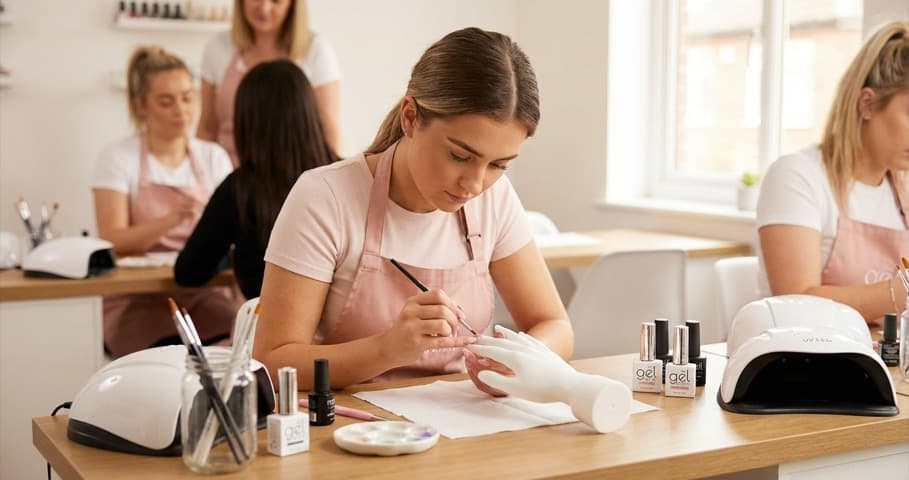
How to start a nail business UK 2026: qualifications, insurance, equipment costs, pricing and your first clients. Step-by-step guide for nail techs.
You're learning fast and your practice work is improving, but something keeps stopping you from taking that first paying client. The insurance question. The qualification worry. The "do I need a licence?" anxiety. Most people who want to start a nail business know how to do nails. What they don't know is what comes first.
Ready to start a nail business in the UK? Here's what the process actually involves: get qualified, get insured, choose your working model (home, mobile, or salon chair), source your equipment and products, set prices that cover your costs, and secure your first paying clients, in that order, not the other way round.
Your practice hand looks good. Your Instagram has a few hundred followers. You've sat through the courses. But the jump from training to trading, from practising on a friend to charging a real client, has a specific set of steps that nobody lays out clearly. This guide does exactly that.
This guide walks you through exactly how to start a nail business in the UK, step by step, no detours. Use it as your checklist from your first qualification decision to your first paying client.
What You'll Learn
- What qualifications UK insurers and clients actually require before you can trade
- Whether you need a licence to work from home
- How to choose between home salon, mobile, and chair rental
- What a realistic starter kit costs, and what you can skip
- How to price without undervaluing your work
- How to find your first paying clients
How to start a nail business: pre-launch checklist
- Completed VTCT or CIBTAC accredited Level 2 or Level 3 nail qualification
- Professional insurance in place (public liability + treatment liability)
- Business model chosen and costed (home, mobile, or chair rental)
- Starter kit sourced from professional supplier
- Service menu and prices set at a profitable rate
- Google Business Profile created before first client
- Social media profiles active with portfolio images
Step 1: Get Qualified
The first thing to understand when learning how to start a nail business is this: the UK has no single mandatory government licence for nail services, but this doesn't mean qualifications are optional. Reputable insurers require them. Professional clients ask. Starting a nail business without recognised training is a shortcut that closes more doors than it opens.
The qualifications that matter
The most widely recognised route to start a nail business properly is a Level 2 or Level 3 qualification in Nail Technology accredited by VTCT or CIBTAC. These are the standards professional insurers use as their baseline, and what clients mean when they ask if you're "properly trained." Qualifications typically take between 6 and 18 months, depending on whether you study full-time, part-time, or online with practical assessments.
What about shorter courses?
Shorter courses exist, weekend gel courses, self-paced online programmes, and some nail technicians start with these. The honest view: shorter courses are fine for learning a specific skill, but they are often insufficient for insurance purposes and may restrict what treatments you can offer safely. If you're only using short courses you'll always lose to the qualified technician down the road when it comes to insurance options and client confidence. Full accredited qualifications are what set serious nail businesses apart.
Choosing the Right Qualification
When searching for how to start a nail business qualification routes, look specifically for VTCT or CIBTAC-accredited programmes. These are the credentials insurers name on their policies, and they're what sets professional nail businesses apart from hobbyist setups.
A nail technician in Birmingham started with a one-day gel course, found she couldn't get adequate insurance cover, and had to return to a longer accredited programme six months later. The full qualification was the right starting point all along.
Do you need a licence to do nails at home in the UK?
No government licence is required for nail services in England. Scotland, Wales, and Northern Ireland have separate local authority licensing schemes: always check with your council. Working from home may require you to notify your mortgage lender or landlord. Your insurer will need your home address on the policy. Requirements vary by area, so verify locally before you take your first client at home.
Can you charge for nails without a licence in the UK?
Technically yes, in England. But you almost certainly cannot get professional insurance without recognised qualifications, and working uninsured is not worth the risk when allergic reactions, skin damage, and accidents are all real possibilities in nail work.
Would you book a nail appointment with a technician who couldn't tell you what qualification they hold? That's the question your future clients are quietly asking. Your certificate is your answer.
Related: Starting a Nail or Lash Business, the complete overview of launching any nail or lash service in the UK.
Step 2: Get Insured
With your qualification confirmed, insurance is your immediate next step, and the one with no flexibility at all.
Professional beauty insurance covers two things every nail technician needs immediately: public liability (if a client has a reaction, injury, or accident during or after treatment) and treatment liability (if something goes wrong with the service itself: lifting gel damaging the natural nail, for instance).
What you'll need:
- Public liability insurance: most specialist policies start at £2 million cover
- Treatment liability / professional indemnity: covering the specific treatments listed on your policy
- Confirm your insurer covers the exact treatments you plan to offer (gel, acrylics, extensions, nail art, etc.)
Specialist beauty insurance providers include Salon Gold, Insync Insurance, and NHBF (National Hair & Beauty Federation): policies for newly qualified nail technicians typically start from around £60 to £90 per year (Salon Gold, 2026). Your premium increases as you add treatments or employ staff.
Before you book your first paying client, your insurance must be in place. Not sorted next week. Not sorted in a month. This is the one step with no workaround in any how to start a nail business guide, and the mistake that catches out the most eager-to-launch technicians.
Warning
A significant number of beauty professionals operate without adequate insurance in their first year of trading (NHBF, 2025). Don't be one of them. The policy cost is low; the uninsured risk is not.
Related: Nail Business, covering ongoing running costs and professional requirements once you're trading.
Step 3: Choose Your Business Model
Now that qualification and insurance are sorted, you decide how you'll actually work. This is the choice that shapes your startup costs, your daily routine, and your income ceiling, at least for the first year.
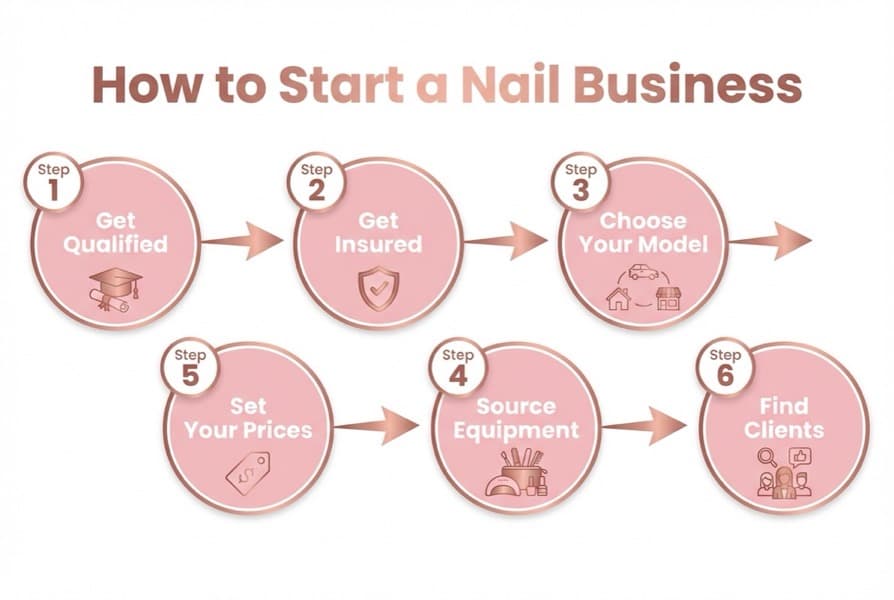
The six steps to starting a nail business in the UK
Option 1: Home Salon
Working from a dedicated room in your home. Lower overheads than renting a chair. Requires a clean, professional space: clients arriving at a chaotic spare bedroom is not the impression you want. Check with your insurer that your home address is covered.
Option 2: Mobile Nail Technician
You travel to the client. No premises costs. Flexible hours. The trade-off: travel time eats into your hourly rate, you carry all equipment, and working in unfamiliar spaces (kitchen tables, poor lighting) makes consistency harder. Mobile nail technicians typically charge a travel fee or set a minimum booking value.
Option 3: Renting a Chair or Room in a Salon
You pay a daily or weekly rate to use space in an established salon. Immediate access to walk-in clients. More professional setting. Higher upfront cost, but often the fastest route to a full book once you're ready to invest.
Which model should you start with?
For most people learning how to start a nail business with limited capital, home or mobile is the practical starting point. It keeps costs low while you build your client base. Salon chair rental makes more sense once you have consistent demand and want to grow.
A nail technician in Leeds started mobile while converting her spare room into a dedicated treatment space. Within four months she had enough rebooking clients to switch entirely to home appointments, saving two hours of travel per day.
If you can't tell whether your current setup is costing you clients or costing you money, that's usually a sign it's time to reassess your model.
Step 4: Source Equipment and Products
Once your model is chosen, buy equipment that fits how you'll actually work, not a wish list based on what successful nail technicians have after three years. When people ask how to start a nail business, the equipment question is often one of the first things they get wrong by spending too much, too early.
Core items for a gel nail setup:
- Professional LED/UV lamp (professional-grade)
- Gel polish starter collection
- Nail prep kit (primer, base, top coat, dehydrator)
- Files, buffers, and cuticle tools
- Disposables: wipes, foils, clips, gloves, sanitiser
- Nail desk or portable table
Budget to spend: A complete home-based starter kit including initial stock runs to approximately £300 to £600 total (Professional Beauty, 2025). Mobile setups add a carry case. Acrylics or extension systems each add roughly £60 to £120 on top.
A new nail technician in Cardiff started with a basic gel kit and two colours of nail art gel rather than buying a full polish collection. She built her colour range from client tips over the first three months, keeping her launch costs under £350 total.
Buy Professional From the Start
Buy professional-grade products from the start. Cheaper consumer lamps and gels mean more lifting, more unhappy clients, and repeat costs that quickly exceed what you saved.
Related: Nail Bar Business Plan, for detailed equipment budgets and startup cost projections.
Step 5: Set Your Prices
With your kit ready, the final question before you start taking clients is: what do you charge? Pricing is one of the most important decisions you'll make when you start a nail business, and the area where most people lose confidence, and often money.
What a realistic price structure looks like:
| Service | Typical Suggested Starting Price |
|---|---|
| Gel polish manicure | £25-£30 |
| Gel nail extensions (full set) | £40-£50 |
| Infill | £28-£35 |
| Nail art (per nail) | £3-£5 |
| Removal | £12-£15 |
Based on UK market pricing surveys (Salon Business, 2025). Adjust upward for London and South East: rates in those areas are typically higher than the national average.
The real calculation
Work out your target hourly rate (what you'd need per hour to cover your costs and pay yourself fairly). Add your product cost per client: gel manicure materials typically cost a few pounds per set. Add a share of your fixed costs: insurance, kit depreciation, platform fees. That total is your floor. Price below it and you are paying clients to sit in your chair.
If you're thinking "I can't charge that yet", you're not alone in that feeling. But it's usually a confidence gap, not a pricing gap. Clients who pay professional prices expect professional results. If your work is professional, your prices should say so.
Starting a nail business on underpriced services is starting it on a ceiling, not a foundation. The price you set today tells clients what your work is worth, so set it deliberately.
A nail technician in Manchester underpriced her gel services in her first month. After calculating what she was actually earning per hour after products and time, she raised her prices significantly. She lost two price-sensitive clients and kept twelve who rebooked consistently.
A very common how to start a nail business mistake is treating low prices as a growth strategy. They're not. They filter in the wrong clients from day one.
How would you feel explaining your prices if a client compared them to someone charging less? If the answer is confident, your prices are right. If you'd feel embarrassed, that's a sign to revisit your value, not drop your rate.
Step 6: Find Your First Clients
You've sorted qualifications, insurance, business model, equipment, and pricing. Now comes the part that feels like the real test in any how to start a nail business journey: you need people in the chair.
The fastest routes to your first paying clients:
1. Friends, family, and colleagues
Not glamorous, but your fastest path to bookings and testimonials. Offer a launch rate, not a permanent discount, in exchange for honest reviews and social media tags.
2. Instagram and TikTok
Document the work. Show the process, the prep, the finished result. You don't need a large audience. You need a local one. Location tags, local hashtags, and before-and-after content drive local discovery, and our AI social post generator can turn each finished set into a ready-to-post caption in seconds. New nail technicians who post consistently from training often have a warm audience ready when they launch.
3. Google Business Profile
Set this up before your first paying client. A complete Google Business Profile with accurate location, opening hours, and early reviews is the highest-converting free tool available when you start a nail business. It puts you in front of people actively searching for nail services nearby.
4. Local Facebook groups
Most UK towns have active community recommendation groups. A clear introduction post, qualifications, treatments, prices, portfolio photos, regularly generates enquiries for home and mobile nail technicians.
5. Referral incentives
Once you have your first handful of clients, give them a reason to bring friends. A £5 discount for them and their friend on the next booking is cheap, trackable, and builds your book with people similar to your best clients.
A home nail technician in Sheffield launched with six friends as model clients, asking each to bring one friend at a reduced rate. By week three she had 18 people who'd experienced her work. Her first full-price Saturday was fully booked before she'd spent a penny on advertising.
Minimum Viable First-Week Client Plan
- Day 1-2: Set up Google Business Profile with photos, location, and opening hours
- Day 3-4: Post one before-and-after photo on Instagram or TikTok with your location tagged
- Day 5-7: Message five people you know personally and offer them a launch appointment
Those three actions, done in your first week of trading, do more for early client acquisition than any paid advertising.
Related: How to Start a Lash Business, a parallel guide for those also considering lash services alongside nails.
Take Your First Step This Week
How to start a nail business in the UK comes down to six steps in the right sequence. You don't need to do them all at once. You just need to do them in order.
Your first-week action plan:
- Day 1-2: Confirm your qualification is VTCT or CIBTAC accredited. If not, identify accredited courses nearby.
- Day 3-4: Get insurance quotes from two specialist providers (Salon Gold and NHBF are good starting points).
- Day 5-7: Choose your starting model, home, mobile, or salon chair, and cost it using the figures in this guide.
Once those three decisions are made, everything else follows.
A nail technician in Bristol completed this exact checklist in five days: confirmed her VTCT qualification, got her insurance in place, and decided on a home salon setup. She took her first paying client in week two. The planning wasn't what held her back. It was not having a clear list of what to do first.
The nail technicians who struggle to start a nail business are usually waiting for the perfect kit, the perfect confidence, or the perfect moment. None of those arrive first. They come after you start.
The question isn't whether you'll succeed. It's whether you'll start.
Starting a nail business isn't about being ready. It's about being qualified, insured, and willing to learn the rest by doing it.
For a complete view of everything involved in launching a nail or lash service, see Starting a Nail or Lash Business. For names and business identity, see Nail Business Names. For a full financial plan, see Nail Bar Business Plan.
Frequently Asked Questions
Do you need a licence to do nails at home in the UK?
This is typically one of the first legal questions that comes up when researching how to start a nail business at home. No government licence is required for nail services in England. Scotland, Wales, and Northern Ireland have some local authority requirements: check with your council. You do need qualifications to get insurance, and you may need to notify your landlord or mortgage lender if working from home.
How much does it cost when you start a nail business?
A home-based gel nail starter kit typically costs between £300 and £600 for equipment and initial product stock (Professional Beauty, 2025). Insurance for newly qualified nail technicians is typically under £100 per year. Factor in qualification costs separately: a full accredited course varies widely in price depending on provider and format.
Is a nail business profitable?
Yes. Full-time nail technicians charging professional prices can earn a solid full-time income in the UK. Profitability depends on how full your booking calendar is, what you charge, and keeping product and overhead costs under control. Most nail technicians who treat their practice as a proper business, with professional pricing, insurance, and consistent marketing, do make it work.
How do I find my first clients when I start a nail business?
Start with friends and family at a launch rate, set up a Google Business Profile, post before-and-after photos on Instagram and TikTok with location tags, and introduce yourself in local Facebook community groups. Referral incentives accelerate growth once you have your first five to ten clients.
How long does it take to go from qualified to trading?
Most nail technicians start taking paying clients within two to four weeks of completing their accredited qualification, once insurance is confirmed and their kit is ready. Building a full client book typically takes three to six months of consistent service and marketing.
Once you're trading, LocalBrandHub helps independent nail technicians and beauty businesses build consistent local marketing, so your client book keeps growing without the guesswork.
For UK nail technicians and beauty professionals
Ready to Grow Your Nail Business?
LocalBrandHub helps nail technicians and beauty professionals build a consistent local marketing presence, so your client book fills itself.
Start FreeKey Takeaway
Starting a nail business in the UK follows six clear steps: get qualified (VTCT or CIBTAC accredited), get insured (public liability + treatment liability), choose your business model (home, mobile, or salon chair), source professional equipment (£300 to £600 starter kit), set profitable prices, and find your first clients through Google Business Profile, social media, and local community groups. Do them in order, and you'll be trading within weeks, not months.
Get More Marketing Tips
Practical marketing tips for UK business owners, straight to your inbox. No spam, unsubscribe anytime.
About the Author
Local Brand Hub
Empowering UK Businesses
Local Brand Hub provides comprehensive business management tools designed specifically for UK local businesses to streamline operations, automate marketing, and grow revenue.
More articlesRelated Articles
 Industry Insights
Nail Business UK: Models, Revenue and Growth
Running a nail business in the UK? Compare salon, mobile, home-based and chair rental models with realistic revenue, challenges and growth paths.
 Tutorials
Nail Technician Business: Mobile, Chair Rental & Going Solo
How to run a nail technician business as a sole trader. Covers mobile vs chair rental vs home salon, HMRC self-employment and personal branding in the UK.
 Business Growth
Brow Business Names: 30+ Ideas by Style
30+ brow business name ideas by style. Covers brow bar vs brow studio naming, threading bars, and UK name availability checks.