
Write a nail bar business plan that works. UK startup costs, financial projections, location analysis, staffing and a template to start this week.
What you'll learn in this guide:
- The six essential sections every nail bar business plan needs
- Realistic UK startup costs and financial projections
- How to analyse a location before signing a lease
- Staffing structure: sole trader versus employer
- How to write your executive summary this week
You've done the training. Your treatment table is set. You know the vibe, the pricing, the clientele you want. Then someone (a bank manager, a commercial landlord, a business adviser) asks to see your nail bar business plan. And you realise you don't have one.
Most nail technicians are in exactly that position. Not because they aren't capable, but because nobody teaches the business side when you're learning the treatments. A nail bar business plan isn't just paperwork for lenders. It's the document that forces you to work out whether your idea actually makes financial sense before you've signed a lease and spent your savings.
Related: Starting a Nail or Lash Business: the full guide to launching your nail or beauty business in the UK
Why You Need a Nail Bar Business Plan
Most nail bars don't fail because the owner was bad at nails. They fail because the numbers were never properly worked out.
A quiet Tuesday in February costs money whether you have clients or not. A nail bar business plan is what tells you: can I survive a quiet February? For example, a solo nail technician with modest monthly overheads needs to hit a minimum daily target just to break even, and that calculation only becomes obvious when you write it down.
A nail bar business plan isn't about predicting the future. It's about catching the mistakes you'd otherwise make in real time.
Beyond survival, a well-written plan is the one document lenders, landlords, and commercial property agents actually want to see. Your plan covers:
- Location decisions: which street, which demographic, what footfall you need
- Financial viability: monthly breakeven, seasonal dips, working capital buffer
- Staffing costs: sole trader versus employing or renting chairs
- Marketing strategy: how you'll attract clients from day one
If you're reading this thinking "I don't have time to write a business plan", you're not alone. Most nail technicians skip it and regret it around month four. The guide on how to start a nail business covers the operational setup that sits alongside this planning work.
Essential Sections to Include
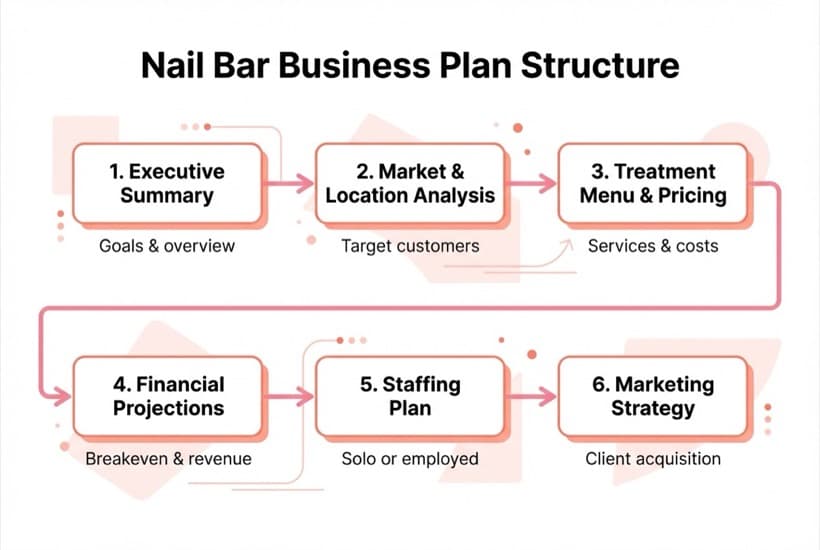
The six sections every nail bar business plan needs
A complete nail bar business plan covers six sections. You don't need to write 40 pages: most effective plans are 8 to 15 pages of clear, honest thinking.
| Section | What It Covers |
|---|---|
| Executive Summary | Who you are, what the nail bar does, headline financials |
| Market & Location Analysis | Target customer, local demand, competitor landscape |
| Treatment Menu & Pricing | Services offered, price positioning, upsell logic |
| Financial Projections | Startup costs, monthly overheads, breakeven, year 1 to 3 revenue |
| Staffing Plan | Structure, employment type, costs, legal requirements |
| Marketing Strategy | How you'll attract and keep clients |
For example, a nail bar targeting young professionals in a city-centre parade might anchor its marketing section around Instagram and rebooking incentives, completely different to a suburban treatment room relying on word-of-mouth and local search. Either way, a slice of your marketing budget should go on getting found in local search, since both models depend on nearby clients discovering you.
Most nail bar business plans fall flat in one of two places: the financials (numbers pulled from optimism rather than research) or the market analysis (skipped because it feels like homework). Both are the sections lenders read first.
For guidance on positioning in the beauty market, nail business names covers how branding decisions in your plan feed into real-world customer perception.
Financial Projections: Realistic Numbers
This is the section most people dread, and the one that matters most.
UK Nail Bar Startup Costs (2025/26)
Startup costs vary significantly based on whether you're renting a chair, taking a small unit, or launching a high-street nail bar. Here's a realistic three-tier summary:
| Model | What's Included | Total Estimate |
|---|---|---|
| Chair / Home | Equipment, supplies, insurance, basic setup | £4,000 to £12,000 |
| Small Unit (300 to 500 sq ft) | Fit-out, equipment, 3 months working capital | £15,000 to £45,000 |
| High-Street Nail Bar | Full fit-out, multiple stations, larger capital reserve | £50,000 to £130,000 |
Indicative UK ranges for 2025/26. Always obtain your own quotes from local suppliers and contractors.
Key line items to budget separately:
- Fit-out and refurbishment (biggest variable cost, get three quotes)
- Opening stock and consumables
- Insurance: public liability and professional indemnity (required)
- Booking and POS software
- Three months' working capital above your fit-out budget
Revenue and Breakeven
A nail technician completing five to eight clients per day at an average spend of around £35 can generate a meaningful gross income from a single chair. After consumables and overheads, well-run small beauty businesses typically achieve profit margins between 15% and 35% (National Hair & Beauty Federation, nhbf.co.uk).
Are nail bars profitable? Yes, but profit depends on chair utilisation. A nail bar running at 70%+ capacity consistently turns a meaningful income. Below 50%, most nail bars are covering costs but not building financial security. The difference is nearly always marketing and rebooking culture, not the quality of the work.
Build your breakeven calculation first
Build your breakeven calculation before you commit to premises. If your monthly fixed costs are around £4,000 and your average treatment brings in £35, you need roughly 115 bookings per month just to cover overheads. Does your location support that volume?
Location Analysis for a Nail Bar
Location kills more nail bars than poor nail work ever does. The wrong street, the wrong demographic, the wrong footfall pattern: none of this is fixable with a great Instagram account.
Before committing to any premises, work through these questions:
Footfall and demographics:
- What is the daytime population within a 1-mile radius?
- Does the local demographic align with your target client?
- Is there commuter traffic, or primarily weekend footfall?
Competitive proximity:
- How many nail bars are within a 10-minute walk?
- Are competitors busy (good, there's demand) or quiet (bad, possibly oversaturated)?
- Is there a quality gap, lots of value nail bars but no premium option?
Practical requirements:
- Does the space have adequate ventilation? Nail treatments require good airflow.
- Does the lease permit the use type (beauty services)?
- Do you qualify for Small Business Rates Relief? Check via gov.uk.
For example, a nail bar in a busy parade near a supermarket gets consistent passing trade and impulse bookings. One in a quiet residential side street relies almost entirely on repeat clients and word-of-mouth. Both models can work, but they demand completely different marketing strategies and pricing anchors from day one.
If you can't tell whether a location has genuine passing trade or just occasional footfall, that's usually a sign you need to stand outside and count for an afternoon before signing anything.
If you're exploring the beauty salon industry, understanding how location intersects with your services is one of the most important decisions you'll make.
Staffing: Solo vs Hiring
The staffing structure you choose affects your costs, flexibility, and legal obligations.
Sole Trader (Just You)
The simplest structure. You do all the treatments, admin, and cleaning. Lower overheads, complete control, all the profit. The risk: if you're ill or on holiday, there's no income. Burnout is real, doing nails at high quality across a full day of rebookings is physically demanding.
Employed Staff
Hiring employees brings PAYE, employer's National Insurance contributions, holiday pay, and potentially auto-enrolment pension obligations. The total cost of employing a full-time nail technician is typically 15 to 20% higher than their headline salary once employer NI and statutory entitlements are factored in (HMRC, gov.uk). Budget for this from the start, it's one of the most common financial surprises for new salon owners.
Chair Rental (Self-Employed Technicians)
You rent stations to self-employed nail technicians who pay you a fixed weekly rate. Lower risk, predictable rental income, but less control over quality. The self-employed status must be genuine: HMRC scrutinises arrangements that function more like employment (gov.uk/employment-status).
If you can only pick one model to start with: begin as a sole trader. Build your client base to near capacity before you think about hiring or renting out a chair. It's tempting to grow quickly, but hiring too early is one of the most reliable ways to create financial pressure in year one. Most successful nail bar owners started solo, got fully booked, then expanded.
Do you need a licence to do nails in the UK? There is no single mandatory national licence for nail technicians at present. However, some local authorities require registration for certain cosmetic procedures, and most treatments require public liability and professional indemnity insurance. BABTAC and the NHBF both publish up-to-date guidance for nail businesses.
Write Your Executive Summary This Week
The executive summary is the last section of your nail bar business plan that you write, but the first thing anyone reads. It's a one-page snapshot of the whole document, and the page that determines whether a lender or landlord reads the rest.
What to include (keep it to 300 to 400 words):
- The concept: What type of nail bar, where, targeting which customer
- The market opportunity: Why there's demand in your location
- The offer: Your core services and price positioning
- The financials: Total startup investment, monthly breakeven, projected year 1 revenue
- What you're asking for: Funding, premises approval, or simply a record of intent
A nail bar targeting professional women in a city-centre location might open an executive summary like this:
"The Nail Edit will be a four-station premium nail bar in [Town Centre], targeting professional women aged 25 to 45. The local market currently has several budget nail bars but no dedicated premium option. Based on an average treatment spend of £45 and an existing client database, the bar is projected to reach breakeven within the first three months. Total startup investment required: £28,000."
Specific. Honest. Clear on the opportunity and the numbers. That's all an executive summary needs to be.
Weekly Action
If you only have 30 minutes this week, do this:
- Day 1 to 2: Write your concept paragraph: what type of nail bar, where, who for
- Day 3 to 4: List your top 5 treatments and prices; research 3 local competitors
- Day 5 to 7: Fill in the startup cost table with your own quotes and estimates
You won't have a finished nail bar business plan by the weekend. But you'll have the core thinking done, enough to have a real conversation with a bank or landlord.
For related reading, see our guides on how to start a lash business, nail technician business, lash business, lash business names, and brow business names.
Frequently Asked Questions
How much does it cost to set up a nail bar in the UK? Startup costs for a small nail bar unit typically range from around £15,000 to £45,000, depending on location, fit-out standard, and equipment. A home-based or chair-rental setup can cost significantly less. Always build in three months' working capital above your initial fit-out budget.
Do I need a licence to do nails in the UK? There is no single mandatory national licence for nail technicians in the UK. However, some local authorities require registration for certain cosmetic procedures, and you should carry public liability and professional indemnity insurance. Check with your local council and consult BABTAC (babtac.com) for up-to-date guidance.
Are nail bars profitable? Well-run nail bars with good chair utilisation typically achieve profit margins between 15% and 35%, according to NHBF data. Profitability depends most heavily on utilisation rate, treatment pricing, and client retention.
For restaurants, salons, and local businesses
Need help with your marketing?
We help UK businesses turn social media into real results, not busywork.
Start freeKey Takeaway
A nail bar business plan forces you to stress-test your numbers before they cost you real money. Startup model matters: chair rental, small unit, and high-street nail bar are three completely different financial plans. Use conservative utilisation rates in projections, analyse your location before signing anything, begin as a sole trader, and write your executive summary last but share it first.
Get More Marketing Tips
Practical marketing tips for UK business owners, straight to your inbox. No spam, unsubscribe anytime.
About the Author
Local Brand Hub
Empowering UK Businesses
Local Brand Hub provides comprehensive business management tools designed specifically for UK local businesses to streamline operations, automate marketing, and grow revenue.
More articlesRelated Articles
 Business Growth
Brow Business Names: 30+ Ideas by Style
30+ brow business name ideas by style. Covers brow bar vs brow studio naming, threading bars, and UK name availability checks.
 Business Growth
Nail Business Names: 50+ Ideas + How to Pick the Right One
Need nail business name ideas? Discover 50+ creative options, punny, elegant, contemporary, personal, plus how to check availability in the UK.
 Business Growth
Starting a Nail or Lash Business: UK Guide
How to start a nail or lash business in the UK. Covers qualifications, startup costs, insurance, pricing, and building a full client base from scratch.