Run a lash business in the UK: classic, hybrid, volume and lash lift explained, realistic earning potential, infill cycles, and client retention.
You're starting a lash business, or you're already running one. What should you charge? Which services should you offer first? How do you keep clients coming back every two to three weeks without constantly chasing them? If you've found the business side harder than the hands-on training, you're not alone.
Running a lash business well takes more than steady hands. This guide covers what you need to know about the UK lash market, the services worth building your menu around, realistic earning potential, and the infill cycle that keeps a sustainable lash business full. 12 min read.
Related: Starting a Nail or Lash Business: our full guide to getting set up from scratch.
What you'll learn:
- Which lash services to offer and how to price them
- What UK lash technicians realistically earn
- How the infill cycle creates repeat revenue
- Practical steps for growing your client base this week
The UK Lash Business Landscape
Here's the landscape you're entering: a market that has shifted from city-centre specialists to a distributed network of independent technicians working from home studios, mobile setups, and rented salon chairs.
A lash technician working from a treatment room at home in Leeds or Bristol now competes for the same clients as a high-street salon, and often wins on price, personal service, and the ongoing relationship they build. That's the nature of the lash market in the UK: competitive, distributed, and driven by client experience as much as technical skill.
Three Business Models to Choose From
- Home studio: Lower overhead, full control, limited walk-in footfall
- Mobile: Higher flexibility, travel costs and logistics to manage
- Salon chair rental: Access to walk-in trade, weekly or monthly chair fee
According to the National Hair & Beauty Federation (NHBF), beauty therapy is one of the fastest-growing areas of self-employment in the UK, with a significant proportion of lash technicians (qualified professionals operating under insurance and training requirements) choosing to work independently. Understanding which model fits your situation before you start helps you price correctly from day one.
Would you genuinely book your own lash business based on how it looks online right now: booking page, Instagram, Google listing? If the answer is uncertain, that's where to start.
So the landscape is clear. Next, let's look at what you should actually offer.
Lash Services to Offer
Your service offering is one of the key decisions in your lash business. A clear offer helps clients self-select, sets expectations upfront, and signals your level of expertise. The four core services in the UK market are classic, hybrid, volume, and lash lift.
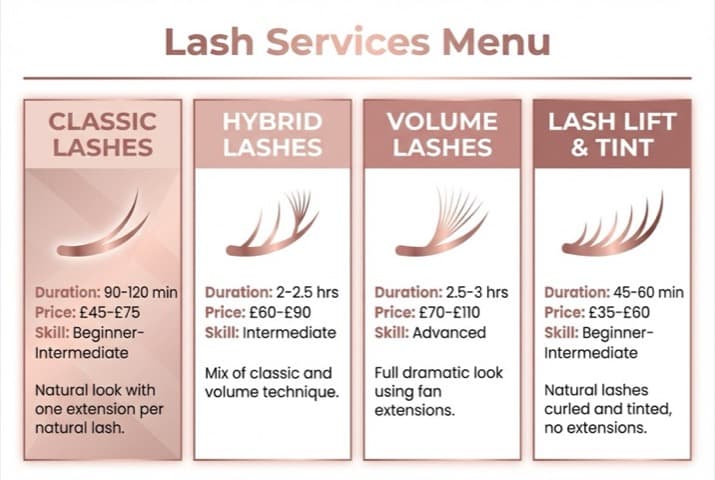
The four core lash services and their typical UK pricing
| Service | Duration | Typical UK Price Range | Skill Level |
|---|---|---|---|
| Classic Lashes | 90-120 min | £45-£75 | Beginner-Intermediate |
| Hybrid Lashes | 2-2.5 hrs | £60-£90 | Intermediate |
| Volume Lashes | 2.5-3 hrs | £70-£110 | Advanced |
| Lash Lift & Tint | 45-60 min | £35-£60 | Beginner-Intermediate |
If you only pick one service to start: Classic lashes are the right choice for new technicians. Classic work builds the isolation technique that underpins everything else. Master that, and hybrid and volume follow more naturally.
Classic and Hybrid: Building Your Core Menu
Classic lashes apply one extension to each natural lash, producing a clean, natural result. For clients who have never had extensions, classic sets are typically the entry point.
Hybrid lashes blend classic and volume techniques: single extensions mixed with small pre-made fans. The result sits between natural and dramatic, which is why hybrids have become one of the sought-after styles in the UK market. Expect to price them slightly above your classic rate.
A lash technician might offer classic at £55, hybrid at £68, and volume at £85, a clear progression that lets clients move up as their preference develops, and that rewards your growing skill level with proportionately higher rates.
Volume and Lash Lift: Higher Earning, Different Clientele
Volume lashes use fans of two to six ultra-fine extensions per natural lash. More dramatic, more time-intensive, and priced accordingly. Volume clients tend to rebook more frequently than classic clients, which affects how you fill your schedule.
Lash lift and tint requires no extensions: it curls and colours the natural lashes. Treatment time is shorter, supply costs are low, and clients who find extensions too high-maintenance often choose lifts instead. Combined with brow lamination, a combined lash and brow appointment can earn significantly more revenue per hour than a standard extension set.
Now that the menu is clear, the question becomes: what does a lash business actually pay?
Earning Potential for Lash Technicians
How profitable is a lash business? Honestly: it varies, but the ceiling is genuinely good for a skill-based, self-employed service in the UK.
A fully booked lash technician working a five-day week might complete several full sets and multiple infill appointments weekly. At UK market rates, gross annual revenue of £25,000 to £40,000+ is achievable for a consistently full schedule (London Lash Pro, 2025). Technicians in London and major cities typically charge more; smaller towns are often more competitive on price.
Thinking in Revenue Per Hour
Understanding revenue per hour, not just per appointment, helps you build a smarter schedule:
- A classic set over two hours at standard rates = approximately £30/hr
- A volume infill at a typical rate over 75 minutes = approximately £44/hr
- A lash lift over 50 minutes at a competitive rate = approximately £54/hr
Pro tip: Lash lifts often generate more revenue per hour than full extension sets. If you're building a service menu, treat them as a core revenue line, not a secondary add-on.
For example, a lash technician who splits the working week between classic full sets, hybrid infills, and lash lifts will frequently earn more per hour from the shorter appointments than from lengthy full sets.
Startup and Running Costs
Startup costs for training and a basic kit typically run to around £500 to £800 (London Lash Pro, 2025). Home-based technicians often spend modestly on monthly consumables, while chair renters pay a regular fee before supplies. Factor those numbers into your rates before you set them.
The realistic path to higher earnings isn't simply more appointments, it's smarter ones: developing hybrid and volume skills, reviewing your pricing periodically against local competitors, and building a schedule where infills make up the bulk of your weekly work.
In practice, many lash technicians find that shifting from one business model to another, say, from mobile to home studio, changes their earning ceiling more than any other single decision. It's worth thinking through before you're fully established.
For a detailed look at pricing strategy, see beauty salon pricing.
Client Retention: The Infill Cycle
Earnings are only half the picture. The other half is keeping clients. Here's the mechanism that makes a sustainable lash business work.
If you're only focused on getting new clients, you'll always lose ground to lash technicians who've built a retention system. New clients are expensive to acquire. Retained clients tend to book themselves.
Why the Infill Cycle Matters
Natural lashes shed on roughly a six-to-eight week cycle, and extensions go with them. However, clients who wait that long between infills often need a full removal and new set, which costs them more and takes longer. Therefore, most clients need infills every two to three weeks:
- Classic clients: typically every three weeks
- Volume clients: often every two weeks
- A retained client can book 17 to 26 appointments in a single year
A classic client booking regular infills is worth several hundred pounds annually. A regular volume client, booking more frequently, is worth considerably more. The maths of retention is straightforward. The execution is where many lash businesses lose revenue.
Where Clients Drop Off
- After the first full set: the client doesn't yet understand the infill model
- After several months: the ongoing cost starts to feel significant
- When you're unavailable: the client books elsewhere and doesn't return
How to Plug Each Drop-Off Point
After the first set: Walk new clients through the infill cycle at consultation, before the appointment. "Your lashes will shed naturally, I'd recommend booking around three weeks from today" is aftercare information, not a sales pitch.
After a few months: Loyalty matters more than many technicians expect. A text reminder the day before, a complimentary tint every fifth infill, or a referral discount keeps clients feeling valued without requiring expensive systems. If you're thinking you don't have time for any of that, that's usually a sign that a simple rebooking prompt in your aftercare message could do most of the work.
When you're unavailable: Build a waiting list. Additionally, consider a trusted referral partner who can look after your clients during holidays, so they don't drift to whoever has an available slot.
Growing Your Lash Business
Once you've got consistent client retention, growth comes from three directions: higher prices, more services, or more capacity.
Raise Prices Regularly
Many lash technicians undercharge in their first year and are reluctant to increase rates once clients are settled in. A modest price increase with reasonable notice rarely loses established clients who genuinely value your work. If you're consistently losing clients every time you raise prices, that's often a sign they were price-shopping rather than loyalty-booking, and those clients tend to be among the hardest to retain regardless.
A lash technician who increases prices annually in line with their growing skill and reputation will typically earn meaningfully more within two years than one who holds rates flat.
Add Complementary Services
Brow lamination, tinting, and lash lifts extend your revenue without adding chair hours. A combined lash and brow appointment earns more per hour than a lash set alone. It also reduces no-shows: clients booked for multiple treatments are less likely to cancel.
Build Capacity Beyond Yourself
An associate, a second room, or a trainee technician is the point at which a lash business truly scales. It requires more management, but it creates earning potential beyond your own two hands.
Marketing a lash business is a topic in its own right. LocalBrandHub's guide to beauty salon marketing covers Instagram, Google Business Profile, and referral systems built specifically for independent beauty businesses. If getting found on Google is where you want to start, work through our local SEO checklist to cover the essentials in order.
Weekly Action
This week, use this checklist to audit your lash business:
- Review your service menu and pricing against a few local competitors: are you positioned where you want to be?
- Check your rebooking rate: of your last twenty clients, how many have a future appointment booked? Below sixty per cent is a signal worth acting on
- Add a rebooking prompt to your aftercare message: make scheduling the next infill the natural next step
- Check your Google Business Profile is complete and has been updated with a recent post
Assess Your Lash Business This Week
Running a sustainable lash business comes down to two things: a service menu that positions your expertise, and a retention system that keeps the clients you've already won.
For example, a lash technician with classic, hybrid, and lash lift on their menu, plus a simple aftercare message that prompts rebooking, is often better positioned than one offering a wider service range without a reliable system for keeping clients. The range matters less than the follow-through.
Most lash technicians aren't short of skill. They're short of a plan for the business side: how to price, how to retain, and when to grow.
The technicians building thriving lash businesses aren't always those with the strongest technical skills in their area. They're the ones treating client retention as a system, not an afterthought. Lash extensions aren't just a treatment. They're a relationship.
Your next step: Add a single rebooking line to your aftercare message this week. One sentence. It takes two minutes and it's typically the highest-leverage change available to a lash business with existing clients.
If you're just starting out: Read our complete guide to starting a nail or lash business and how to start a lash business. For naming your business, see lash business names. You might also find our guides to nail businesses, how to start a nail business, nail bar business plans, nail technician businesses, nail business names, and brow business names useful.
Frequently Asked Questions
How profitable is a lash business in the UK?
A consistently booked UK lash technician can earn £25,000 to £40,000+ annually in gross revenue, depending on location, services offered, and schedule efficiency. Volume and hybrid specialists often earn more per hour than classic-only technicians. Overhead varies significantly by business model.
Do you need a licence to do lashes in the UK?
There is no single national licence for lash extensions in England, but many local councils require a special treatments licence for beauty businesses. BABTAC or NHBF-recognised training qualifications are expected by insurers and clients. You can check your local council's licensing requirements on Gov.uk before you start trading.
How long does an infill appointment take?
Classic infills typically take 45 to 60 minutes; volume infills 60 to 90 minutes, depending on how much natural lash shedding has occurred. Clients who leave it longer than four weeks often need a full removal and new set rather than an infill.
What is the best first lash service to offer?
Classic lashes are the recommended starting point for new technicians. They develop the isolation technique that underpins all extension work and are consistently in demand across the UK market. Add hybrid once your classic work is confident, and volume when you're ready to invest time in fan-making practice.
For restaurants, salons, and local businesses
Need help with your marketing?
We help UK businesses turn social media into real results, not busywork.
Start freeKey Takeaway
A sustainable lash business rests on two pillars: a clear service menu priced to reflect your skill level, and a retention system built around the infill cycle. Classic lashes are the best starting point for new technicians. Lash lifts often generate higher revenue per hour than full sets. The infill cycle, every two to three weeks, is the engine of repeat revenue. Focus on rebooking, raise prices regularly, and add complementary services as you grow.
Get More Marketing Tips
Practical marketing tips for UK business owners, straight to your inbox. No spam, unsubscribe anytime.
About the Author
Local Brand Hub
Empowering UK Businesses
Local Brand Hub provides comprehensive business management tools designed specifically for UK local businesses to streamline operations, automate marketing, and grow revenue.
More articlesRelated Articles
 Business Growth
Brow Business Names: 30+ Ideas by Style
30+ brow business name ideas by style. Covers brow bar vs brow studio naming, threading bars, and UK name availability checks.
 Business Growth
Lash Business Names: 40+ UK Ideas by Style
Browse 40+ lash business names by style: glamorous, minimalist, quirky, and location-based. UK availability checks and trademark costs included.
 Business Growth
Starting a Nail or Lash Business: UK Guide
How to start a nail or lash business in the UK. Covers qualifications, startup costs, insurance, pricing, and building a full client base from scratch.