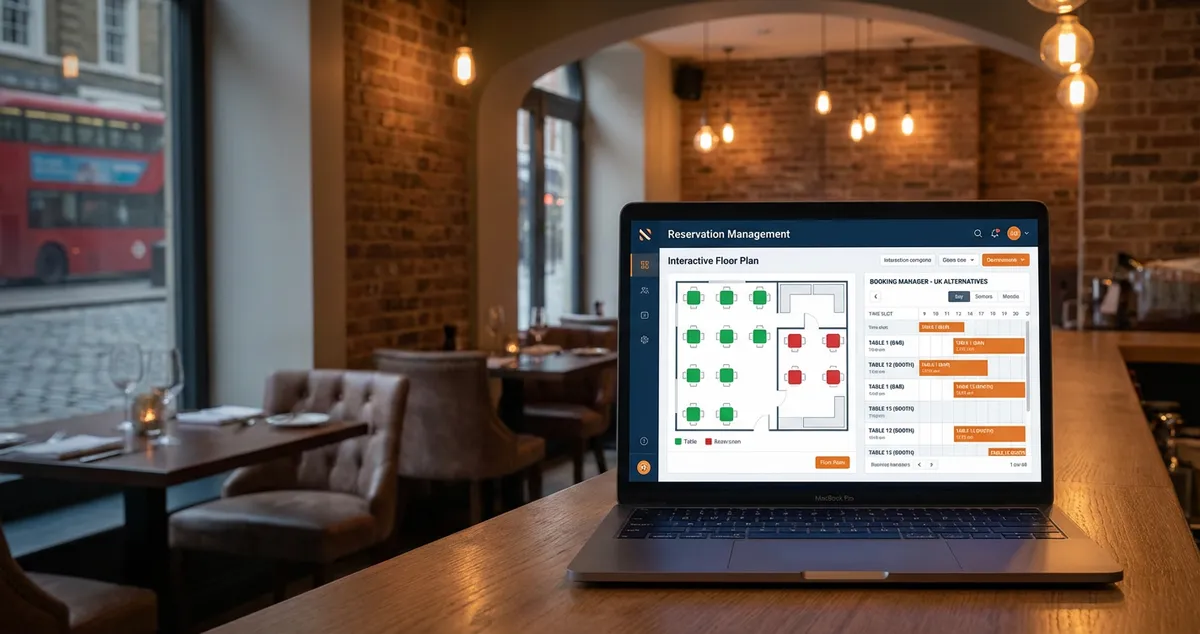
OpenTable alternatives UK restaurants can compare: which covers each platform charges for, which have left the UK, and how to make two quotes match.
The right OpenTable alternative is the one whose fee rules match where your bookings actually come from. Most vendors quote rather than publish a price, which leaves your own booking mix as the only stable input to the comparison, alongside one blunt check: is this platform still trading in the UK?
Every list ranking for this search hands you seven platforms, a monthly price for each and a verdict. The prices are copied from rate cards several vendors withdrew, and at least one of the seven has already left the country. A price table you were never quoted is a rumour with a currency symbol in front of it.
Related: Restaurant Online Ordering, our hub guide to the wider digital setup.
So this guide does the part a table cannot. It shows you which covers you are actually paying for, how to count yours before you ring anybody, and what to ask so that two quotes end up describing the same thing.
What are the real OpenTable alternatives for UK restaurants?
The honest UK shortlist is shorter than the listicles suggest, and it has changed shape rather than grown. Here is where each of the usual names stands, and the one thing worth checking about it.
| Platform | Model | UK status |
|---|---|---|
| ResDiary | Monthly fee, no commission | Trading. Price on request |
| TheFork | Marketplace, per cover sent | Trading. No UK rate card |
| SevenRooms | Guest CRM first, diary second | Trading. Quote only |
| Tablein | Subscription with an allowance | Trading. Prices published |
| SimpleERB | Plain diary, few extras | Trading. Check plan price |
| Quandoo | Closing down | Winding down |
| Resy | Withdrawn | Gone from the UK |
Two rows in that table are the whole reason this piece needed rewriting. Guides still recommending Quandoo for European reach, or Resy for your London wine bar, are recommending doors that are closing or closed.
The rest of the shortlist splits into two camps rather than seven positions: platforms that sell you software to run your own diary, and platforms that sell you diners. Almost every argument you will have with a salesperson comes back to that line.
Why can you not just compare the prices?
Most booking vendors will not quote a UK restaurant a price until that restaurant tells them its covers.
ResDiary names its plans by booking volume and leads on zero commission rather than a monthly figure. SevenRooms publishes plan names and features but no numbers. OpenTable's plans page describes the plans without printing a price beside them. Ring three vendors and you will get three quotes shaped by your volume and how the call goes, which is precisely why the tidy comparison tables you have been reading are fiction.
This is annoying, and it is also the opening. A quoted price is negotiable in a way a published one is not. What you need before that call is not a competitor's price list. It is your own numbers.
Which covers are you actually paying for?
Every booking contract turns on one distinction: the covers the platform sourced for you, and the covers you sourced yourself.
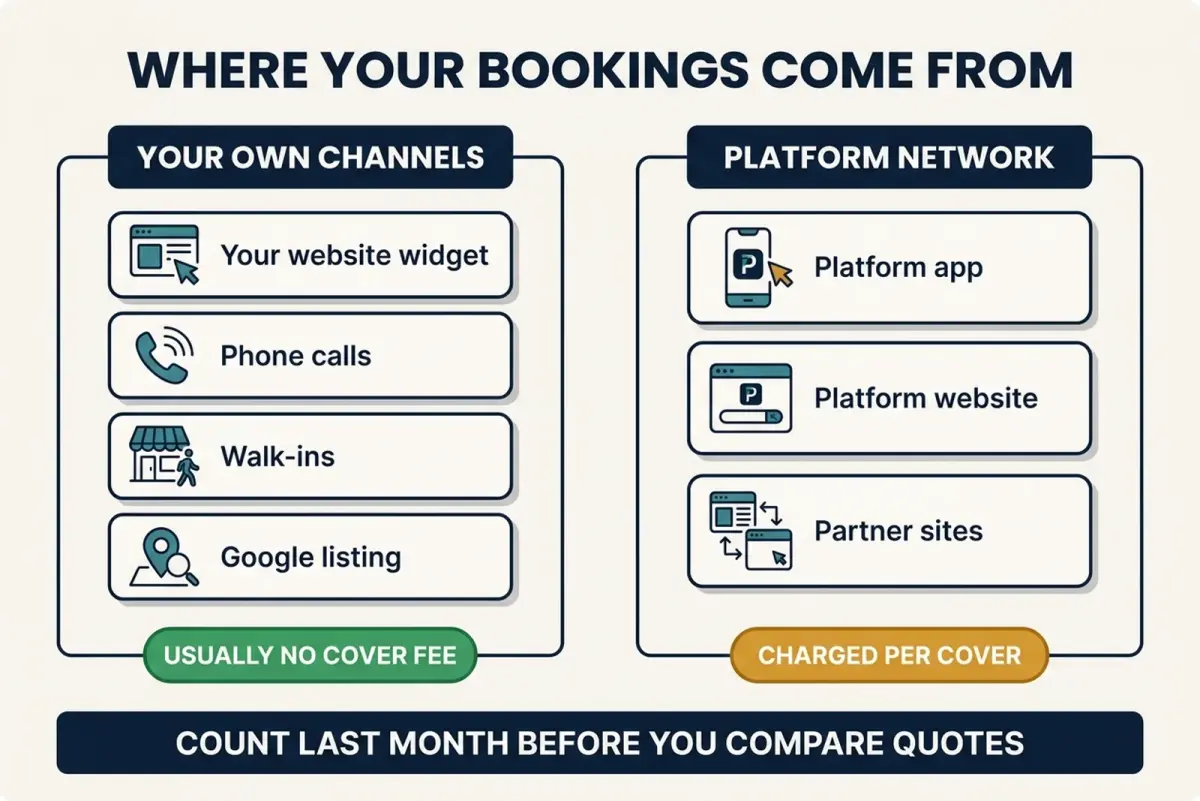
Your own channels versus the platform's. The fee usually lives on the right hand side.
Where each platform draws the fee line
OpenTable's own plans page draws the line clearly: on its Core and Pro plans it charges cover fees only for diners who discover you on OpenTable's website, app or affiliate network, and a diner who books directly through your website or by ringing the restaurant costs you nothing (OpenTable). ResDiary comes at the same problem from the other end, telling restaurants it takes no commission on a booking whatever channel produced it (ResDiary).
Read those two together and the real comparison appears. You are not shopping for the lowest fee per cover. You are shopping for the arrangement that charges you least for the bookings you were going to get anyway.
Why this matters: two venues can be quoted the same rate and pay wildly different bills, because the rate is applied to different halves of the diary. The rate is the vendor's number. The mix is yours.
Split last month's covers into two piles
The number that decides your answer is sitting in last month's diary rather than on anybody's pricing page.
- Yours: the widget on your own site, the phone, walk-ins you keyed in, your Google listing, the regular who messages you on Instagram.
- Theirs: the platform's app, the platform's website, its partner and affiliate sites.
Picture a fifty cover neighbourhood bistro doing 900 covers a month, 700 of them from its own website, phone and regulars, and 200 arriving through the platform's app. Under a network-only fee, this venue pays on 200 covers, not 900. A rival with the same total but the mix reversed pays on 700. Same covers, same town, entirely different platform decision.
That split is an hour of admin most owners have never done, and it settles more than the shortlist does. It also tells you something no vendor will: how much of your business the platform is genuinely bringing you, as opposed to processing.
What should you ask on the quote call?
Two vendors only become comparable when you ask them the same five questions in the same order. Get the answers in writing, because a demo is a performance and an email is a record.

The hour before the sales call is worth more than the call.
1. Which covers do you charge for, and which do you not? Name your channels back to them: my website widget, my Google listing, phone bookings, your app. Ask them to confirm each one separately. Vague answers here are expensive later.
2. What happens to this price when my volume changes? Fees banded by covers or reservations are common. Find the ceiling of your band and how far you are from it in December.
3. What is the contract length, the notice period and the renewal date? Annual terms are normal. Annual terms that roll over silently are how a venue ends up paying for two diaries at once.
4. When I leave, what can I take and in what format? Ask specifically about diner records and forward bookings. A vendor confident about retention is relaxed about this question.
5. What is not in the headline number? Setup, SMS, card capture, deposits, payment processing, integration with your till. The gap between a quote and an invoice is nearly always here.
Ask question five and the shape of a quote usually changes. Picture two quotes that both open at £99 a month: one includes SMS reminders and card capture, the other adds £25 for SMS and charges separately for deposits, which is a £40 difference that never appeared in either headline.
Ask all five of both and you end up holding the only comparison table that matters, the one about your restaurant. The same five questions work almost word for word on takeaway platforms.
Related: Restaurant Commission Free Ordering, the same fee logic applied to takeaway orders
Will the platform still be here next year?
Platform continuity is an unglamorous selection criterion that has just cost a lot of UK restaurants a fortnight of admin.
Quandoo told its restaurant partners it is closing down, with most services running until 30 September 2026 (Quandoo). Resy, the American Express owned platform that London's newer dining rooms adopted enthusiastically, announced it was shutting its UK operation back in January 2024 (Time Out London). Neither exit was caused by anything a restaurant did or could have foreseen from the product itself.
What those exits do and do not tell you
Nothing about those two exits predicts which vendor goes next, and anybody claiming otherwise is guessing. The point is narrower: a booking system is not a subscription you swap on a quiet Tuesday. It holds your diner records, it sits behind the reserve button on your website, your staff have muscle memory for it, and your regulars have its app on their phones. The cost of being wrong is a fortnight. The check is ten minutes.
The ten minute version of due diligence
Spend the ten minutes. How long has the vendor operated in the UK, who supports you when the diary freezes at half seven on a Friday, and has the company withdrawn from any market in the past two years? Ask the second one especially. UK support hours are the difference between an inconvenience and a ruined service.
How do you switch without losing bookings?
A booking migration takes four moves, and the one most people skip is the overlap in the middle.
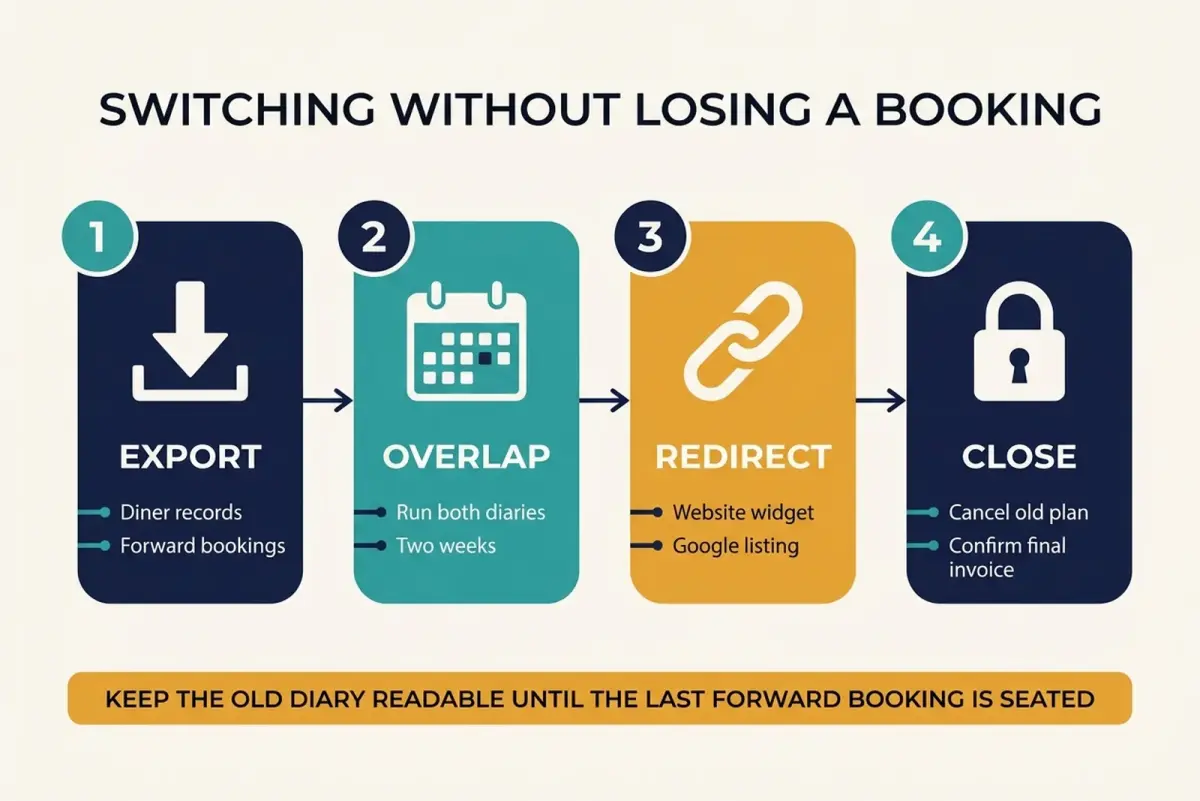
Nobody remembers the migration that overlapped. Everybody remembers the one that did not.
Export first, decide second. Before you cancel anything, pull your diner records and every forward booking out of the old system and check the file actually opens. A migration promise is worth what the export file is worth.
Run both diaries for a fortnight. Take new bookings in the new system, keep the old one readable until the last forward booking has been seated. Yes, it is duplicated effort. It is also the only version of this that never loses a table.
Redirect the front doors. The reserve button on your website, your Google listing, your Instagram link and anything printed. Bookings arrive through channels you forgot you had, which is the same lesson as the counting exercise.
Close it properly. Cancel in writing, confirm the final invoice and note the date the old diary becomes unreadable.
Moving the diner list
One caution about the data itself. That diner list is personal information about real people, so move only the fields the new diary needs to do its job: name, contact details, booking history, and any access or allergy notes the new system stores in a proper field rather than free text. Card details should travel through the payment provider, never a spreadsheet. Before you upload anything, read the incoming platform's data terms and check what the account settings do with your customer list by default, because "imported" and "added to a marketing database" are not the same event.
Once the diary is settled, the other half of the job is whether people find you at all. That is a different question from bookings, and it is the one LocalBrandHub's visibility score is built to answer. See what it covers.
Cost: the four parts of a booking quote
Vendors build a price out of the same four parts, and the headline number rarely contains all of them. Ask which of these apply to you before you compare anything:
- The subscription: a monthly or annual fee, often banded by covers or table count.
- The cover or commission element: charged on some booking sources and not others, which is the split you counted earlier.
- One off costs: setup, floor plan build, data migration, staff training.
- The extras: SMS reminders, card capture, deposits, payment processing, till integration.
Your first hour this week
- Pull last month's covers and split them into yours and theirs.
- Total what you actually paid your current platform over the last three months, including the extras.
- Shortlist two vendors, one from each camp: software for your own diary, and a marketplace.
- Book both calls for the same week and ask the five questions in the same order.
- Give yourself a decision date before either demo starts.
Frequently asked questions
What is the cheapest OpenTable alternative for a UK restaurant?
There is no single cheapest, because the cheapest depends on your booking mix. A platform charging only for covers it sends you is cheap if you source most of your own bookings and expensive if you do not. Count your split first, then ask two vendors to quote against those numbers.
Is ResDiary better than OpenTable?
They are built for different jobs. ResDiary sells you software to run your own diary and says it takes no commission on a booking wherever it came from. OpenTable also sells you access to its diner network and, on its Core and Pro plans, charges for the covers that network sends. If you already fill your tables, you are paying for a marketplace you may not need.
Can I keep taking bookings on my own website if I leave OpenTable?
Yes. Every serious booking platform gives you a widget for your own site, and that is the channel worth protecting, because bookings you source yourself are the ones least likely to carry a fee. Rebuilding that widget and your Google reserve link is a job for switch day, not the week after.
Is Quandoo still worth considering in 2026?
No. Quandoo has said it is closing down, with most services available only until 30 September 2026. Any guide still recommending it for European reach has not been checked in a long time, which is a fair signal about the rest of that guide.
Can I run two booking systems at once?
For a short overlap during a switch, yes, and you should. As a permanent arrangement it is risky, because two diaries holding the same tables need somebody to reconcile availability every day. If you do it deliberately, keep one system as the master diary and the other strictly for the covers it sources.
How long does switching booking systems take?
Plan for two to four weeks from decision to switch day: exporting and checking your data, loading tables and shifts, training staff, then the overlap fortnight. The technical part is quick. Getting the whole team confident on a Friday night is the bit worth the time.
Do booking platforms affect my delivery apps?
No. Reservations and delivery are separate systems with separate contracts, and changing your diary does not touch Deliveroo or Just Eat. The only overlap worth checking is whether both feed the same customer database, because most of the time they do not.
Key takeaways
Key Takeaway
- Count last month's covers into yours and theirs before you speak to a single salesperson.
- The fee that matters is the one charged on bookings you would have won anyway.
- Published price tables for this category are mostly withdrawn rate cards, wherever you read them.
- Continuity is a selection criterion, not paranoia. Quandoo and Resy proved it.
- Ask both vendors the same five questions in the same order, and get the answers by email.
The comparison that decides this is not between seven platforms. It is between the covers you win yourself and the covers somebody sells you, and only you can count those.
Guide reviewed and last updated 13/08/2026. Platform positions and fee rules were checked against each vendor's own pages on that date and change without notice; the cover arithmetic is illustrative, not a quote.
For restaurants, salons, and local businesses
Need help with your marketing?
We help UK businesses turn social media into real results, not busywork.
Start freeSources
Get More Marketing Tips
Practical marketing tips for UK business owners, straight to your inbox. No spam, unsubscribe anytime.
About the Author
Local Brand Hub
Empowering UK Businesses
Local Brand Hub provides comprehensive business management tools designed specifically for UK local businesses to streamline operations, automate marketing, and grow revenue.
More articlesRelated Articles
 Operations
OpenTable vs Resy: Which Is Best for UK Restaurants?
OpenTable vs Resy for UK restaurants: compare pricing and features, why Resy left Britain in 2024, and the best UK alternatives to switch to.
 Operations
Best Online Ordering System for Restaurant: UK Prices
Compare the best online ordering system for restaurant use in the UK on the prices Square, storekit and GloriaFood publish, plus the checks first.
 Operations
Online Ordering for Small Restaurants: UK Setup Guide
Set up online ordering for your small restaurant without paying 30% commission. Compare free UK platforms, understand costs, and start taking orders today.