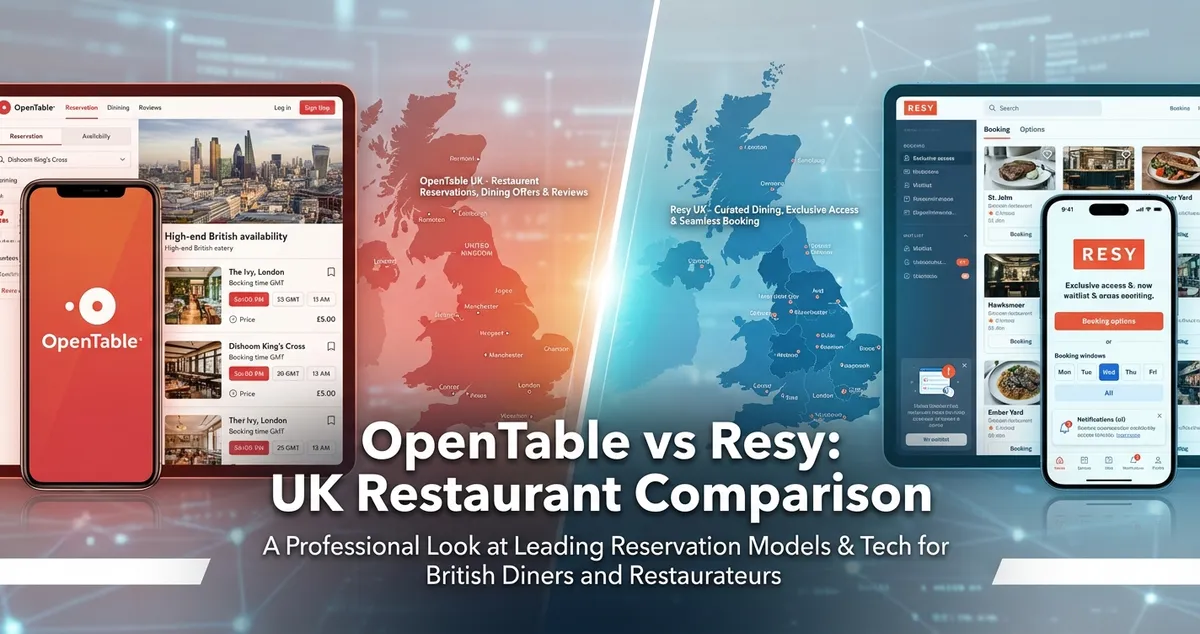
OpenTable vs Resy for UK restaurants: compare pricing and features, why Resy left Britain in 2024, and the best UK alternatives to switch to.
You have three browser tabs open, one spreadsheet half-filled with numbers, and you still can not figure out whether OpenTable or Resy makes sense for your restaurant. Your feet hurt after a 12-hour shift. The numbers blur together. And the answer keeps slipping away.
Here is the problem: if you are searching for OpenTable vs Resy in the UK, you have likely missed some critical news. Resy left the UK market entirely in August 2024. But understanding why, and what both platforms offer, helps you make a smarter choice about your reservation system.
What You'll Learn
- Why Resy is no longer available in the UK (and what happened)
- How OpenTable's pricing actually works (including hidden costs)
- The key differences between OpenTable and Resy
- Which UK alternatives are worth considering
- How to calculate whether OpenTable is right for your venue
Quick Verdict: Choose OpenTable If You Need UK Coverage
Let's start with the short answer before digging into the details.
Choose OpenTable if: You need a reservation system that works in the UK right now, want access to the largest diner network, and can manage per-cover fees.
Consider alternatives if: You want flat-fee pricing without per-cover charges, or you are looking for newer platforms with lower costs.
Resy is no longer available in the UK. The platform ceased all UK operations on 31 August 2024, according to Time Out London. If you were hoping to use Resy for your London restaurant, you will need to look elsewhere.
Is Resy or OpenTable Bigger?
With the quick verdict out of the way, let's look at the numbers behind each platform.
OpenTable is much larger than Resy globally. OpenTable serves over 55,000 restaurants, about 46% of US restaurants using reservation software, according to BistroChat's market analysis. Resy operates with around 7,000 to 8,000 restaurants in the US, capturing about 12% of the online reservations market.
In the UK, the comparison is straightforward: OpenTable operates here, and Resy does not. OpenTable remains the dominant platform for UK restaurants, with thousands of venues across London, Manchester, Birmingham, and beyond.
| Platform | Global Restaurants | US Market Share | UK Availability |
|---|---|---|---|
| OpenTable | 60,000+ | ~46% | Yes |
| Resy | 7,000-8,000 | ~12% | No (exited August 2024) |
Note: Market share figures are estimates based on available industry research. Actual numbers vary by source.
The global restaurant booking software market was worth USD 6.6 billion in 2024 and is set to reach USD 16.4 billion by 2032, according to Credence Research. OpenTable holds the larger slice of that market.
Is Resy No Longer in London?
So you have the size comparison. But what about availability? This brings us to the question many UK restaurateurs are asking.
Resy is no longer available in London or anywhere in the UK. The platform announced its UK exit in January 2024 and officially ceased operations on 31 August 2024, as reported by The Caterer.
Resy operated in the UK for about seven years after launching in 2017. At its peak, more than 300 restaurants across Britain used the platform, ranging from local bistros to Michelin-starred establishments, according to The Drinks Business.
The decision to leave was planned. American Express, which bought Resy in 2019, chose to focus on the US and Canadian markets. UK restaurants were given time to download their guest data and switch to other systems.
If you were a Resy user in London, you have likely already migrated. A Shoreditch cocktail bar owner told us switching platforms mid-stream was frustrating, especially after building up guest data over years. For new restaurants, OpenTable or UK-focused options like resOS or SevenRooms are your best bets.
Related: OpenTable Alternatives UK
Is OpenTable Owned by Resy?
With Resy's UK exit fresh in mind, you might wonder whether these platforms are connected.
No. OpenTable and Resy are separate companies with different ownership:
- OpenTable: Owned by Booking Holdings (same company as Booking.com, Kayak, Priceline)
- Resy: Owned by American Express (acquired in 2019)
This means the two platforms are rivals, not partners. They compete for restaurant sign-ups and diner attention. American Express's purchase of Resy, and later Tock (another premium booking platform), has made US market rivalry fiercer.
For UK restaurants, this ownership structure matters less since Resy has exited the market. However, American Express cardholders in the US receive benefits through Resy, which could influence their dining choices when visiting from abroad. A Mayfair fine dining spot, for instance, might see American tourists asking about Resy compatibility.
What Are the Disadvantages of OpenTable?
Now that you know the ownership structure, let's look at the downsides. Understanding the drawbacks helps you make a better decision.
OpenTable's main disadvantage is its fee structure. The platform charges both a monthly subscription and per-cover fees that add up quickly for busy venues.
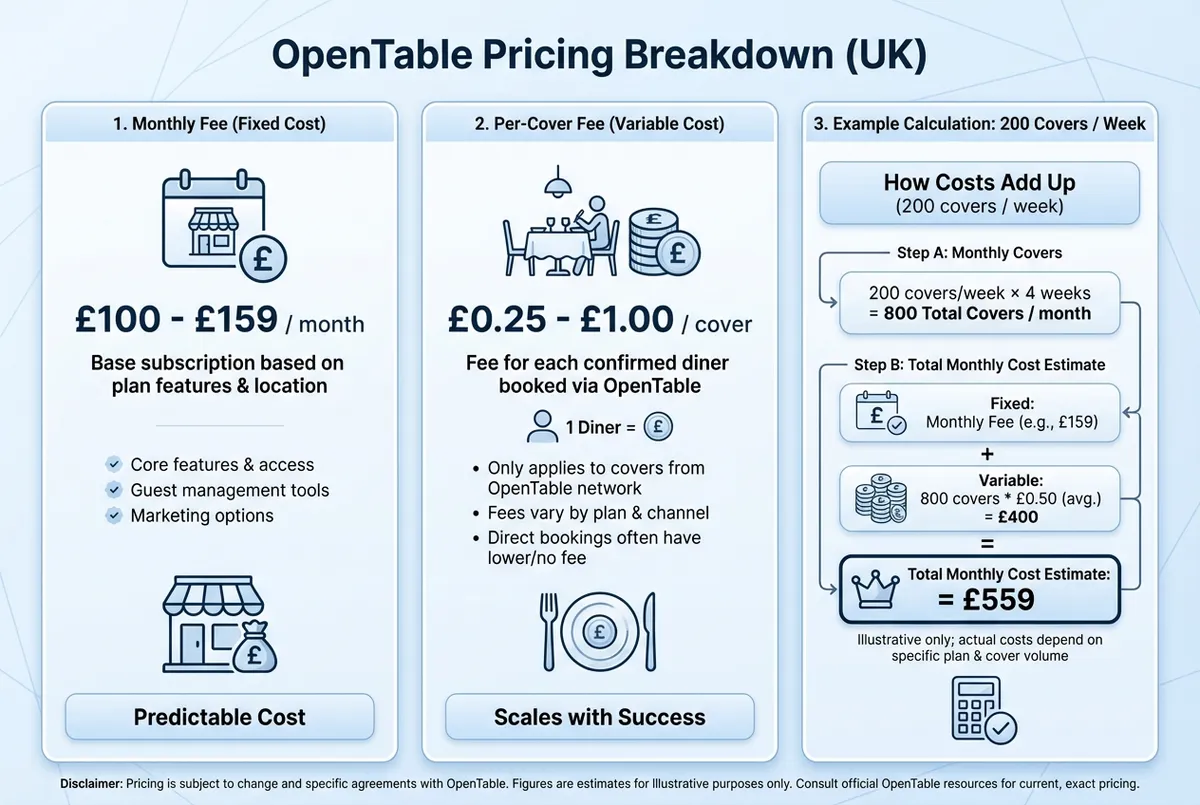
OpenTable pricing breakdown for UK restaurants
OpenTable Pricing Breakdown
- Monthly platform fee: £100-£159 depending on your plan
- Per-cover fee: £0.25-£1 per diner booked through OpenTable's network
- Higher fees for premium placements and marketing features
For a busy restaurant doing 200 covers per week through OpenTable, per-cover fees alone could reach £200-£800 monthly on top of your subscription.
Pro Tip: Before signing with any reservation platform, ask for a three-month trial to calculate your true cost per booking. Many restaurants discover their per-cover costs are higher than expected once they track the numbers properly.
Other OpenTable Disadvantages
- Commission creep: Fees can increase without warning
- Diner loyalty to platform: Customers build relationships with OpenTable, not your restaurant
- Limited customisation: Less flexibility in how your booking system looks and works
- Competition for attention: Your listing sits alongside competitors
If you're thinking "I don't have time to work out complicated fee structures," you are not alone. Many restaurant owners find OpenTable's pricing confusing, especially when comparing it to flat-fee alternatives. The reality for most independent restaurants is that margins are already tight.
If you're only looking at your monthly bill and not tracking per-cover costs separately you'll always lose to competitors who understand their true acquisition costs. That's usually a sign you need a simpler system, or an easy way to work out what each booking actually costs you.
Is Resy More Popular Than OpenTable?
With the cost picture clear, you might wonder: which platform do diners actually prefer?
In the US, OpenTable remains more popular overall, but Resy has carved out a strong position in premium dining. Among high-end restaurants, particularly in New York City, Resy is often the preferred choice.
However, Resy's market share has dropped from roughly 16% to about 12% in recent years. Several top restaurants have switched back to OpenTable, showing OpenTable's revival in the premium segment.
For UK diners and restaurants, popularity is irrelevant since Resy exited the British market. OpenTable dominates the UK market for formal reservation systems.
What About Tock?
Tock is another reservation platform popular with fine dining spots. American Express acquired Tock and is integrating it with Resy to strengthen its position against OpenTable. Tock operates on a prepaid ticket model, which works well for tasting menus but less so for casual dining.
OpenTable vs Resy: Feature Comparison
Now that you understand popularity and pricing, here is how the platforms compare on features. Even though Resy left Britain, knowing what each platform offers helps you evaluate alternatives. The difference between Resy and OpenTable is a matter of pricing model and market focus.
| Feature | OpenTable | Resy |
|---|---|---|
| Pricing model | Monthly + per-cover | Flat monthly fee |
| Diner network | Largest globally | Strong in US urban areas |
| Loyalty programme | Points toward free meals | AmEx cardholder perks |
| UK availability | Yes | No (exited 2024) |
| Typical fit | Broad reach, casual to fine dining | Premium dining, urban US |
| Waitlist management | Yes | Yes |
| Guest data ownership | Limited | Better data access |
Features and pricing may vary. Contact platforms directly for current offerings.
The Fundamental Difference
The core difference is pricing philosophy:
- OpenTable: Charges for success (more covers means more fees)
- Resy: Charged a predictable flat rate regardless of volume
Alternatives for UK Restaurants
Now that you understand the platforms, what are your actual options? Given that Resy has exited, here are the practical alternatives UK restaurants should consider:
OpenTable
The default choice for broad reach and name recognition. Works well if you can absorb per-cover fees. If you're only signing up because everyone else uses it without calculating your actual costs that never works long-term.
resOS
A user-friendly alternative highlighted as a leading Resy replacement for UK restaurants, according to resOS. Offers flexible pricing and strong customer support.
SevenRooms
Popular with restaurant groups wanting deeper guest data and marketing tools.
ResDiary
UK-based platform with strong hospitality industry support.
Quandoo
European-focused platform with good UK coverage.
For many UK restaurants, OpenTable typically offers a strong combination of diner reach and brand recognition, but it comes at a cost. If you are feeling overwhelmed by the options, you are not alone. Many restaurant owners spend weeks comparing platforms only to feel more confused than when they started. Ask yourself: would I recommend my current booking system to another restaurant owner? If the answer is no, or if you hesitate, that's usually a sign it's time to switch.
If You Only Have 30 Minutes This Week
Start by calculating your current OpenTable costs:
- Find your monthly statement from OpenTable
- Count how many covers came through their network last month
- Multiply covers by your per-cover fee
- Add your monthly subscription
- Divide by covers to get your true cost per booking
That number will tell you whether exploring alternatives is worth your time. If you are paying more than £2 per cover all-in, you have negotiating power or a reason to switch.
Weekly Action
- Day 1-2: Pull your last OpenTable invoice and calculate your true cost per cover
- Day 3-5: Compare that number to at least one alternative platform's pricing
- Ongoing: Set a calendar reminder every 90 days to review your reservation costs
If you're never reviewing your tech stack costs you'll always lose to competitors who treat their reservation system as an ongoing business decision rather than a set-and-forget tool.
Key Takeaways: OpenTable vs Resy
If you run a restaurant and want to see how Local Brand Hub can support your marketing, explore our restaurant marketing tools.
Key Takeaways: OpenTable vs Resy
With all the details covered, here is what you need to remember:
- Resy exited the UK market in August 2024. If you need a reservation system now, Resy is not an option.
- OpenTable is the larger platform globally, serving 60,000+ restaurants versus Resy's 8,000.
- OpenTable charges per-cover fees on top of monthly subscriptions, while Resy used flat-rate pricing.
- They are owned by different companies. OpenTable belongs to Booking Holdings; Resy belongs to American Express.
- OpenTable's main disadvantage is its complex fee structure that can penalise high-volume venues.
- For UK restaurants, OpenTable, resOS, SevenRooms, or ResDiary are your primary options.
The right choice depends on your volume, budget, and how much you value predictable monthly costs versus maximum diner exposure. If your feet hurt after a 12-hour shift and you just want someone to tell you what to do: start with OpenTable's basic plan, track your per-cover costs for three months, then decide if the reach justifies the fees.
A reservation system is not just about taking bookings. It is about knowing who your customers are and bringing them back. The platform that helps you do that, at a price you can afford, is the right one.
Need help choosing the right tech stack for your restaurant? LocalBrandHub helps independent restaurants build their online presence without the guesswork.
Related: Restaurant Online Ordering
FAQ: OpenTable vs Resy
With all the key points covered, here are the most common questions we get from restaurant owners.
How expensive is Resy?
Resy charged a flat monthly fee without per-cover charges, making it more predictable than OpenTable for busy venues. However, Resy ceased UK operations in August 2024, so pricing is now irrelevant for British restaurants.
Is Resy used in the UK?
No. Resy ceased UK operations on 31 August 2024 after seven years in the market. UK restaurants must use alternatives like OpenTable, resOS, or SevenRooms.
What is the difference between Resy and OpenTable?
The difference between Resy and OpenTable is a framework that centres on pricing models and market focus. OpenTable uses a hybrid model with monthly fees plus per-cover fees, while Resy used flat monthly rates. OpenTable has a larger global network, while Resy focused on premium dining in US urban markets.
What is the point of Resy?
Resy is a reservation platform that offered flat-rate pricing for restaurants. The Resy model is a framework that prioritises predictable costs: unlike OpenTable's per-cover model, Resy charged a fixed monthly fee regardless of how many diners booked. This pricing structure made it popular with trendy and upscale restaurants, particularly in New York City, where high volume could otherwise mean high fees.
Get More Marketing Tips
Practical marketing tips for UK business owners, straight to your inbox. No spam, unsubscribe anytime.
About the Author
Local Brand Hub
Empowering UK Businesses
Local Brand Hub provides comprehensive business management tools designed specifically for UK local businesses to streamline operations, automate marketing, and grow revenue.
More articlesRelated Articles
 Operations
OpenTable Alternatives UK: How to Compare Without Prices
OpenTable alternatives UK restaurants can compare: which covers each platform charges for, which have left the UK, and how to make two quotes match.
 Operations
How to Price a Restaurant Menu: A Step-by-Step UK Guide
Calculate food costs, set healthy margins, and apply the 30/30/30 rule to price every dish on your restaurant menu correctly.
 Operations
Restaurant Food Cost Formula: A Step-by-Step Guide
Master the restaurant food cost formula to protect margins. Step-by-step COGS calculation, portion costing examples, and 28-35% benchmarks.