
Track your restaurant against UK industry benchmarks: food cost 28-35%, labour 25-35%, prime cost under 65%. Includes monthly tracking checklist.
You're three months into the year. Revenue's up but you're still barely breaking even. Your food cost percentage looks high, your labour costs are climbing, and you're wondering: is that normal? Without restaurant benchmarks, you're flying blind. You might be outperforming the industry or haemorrhaging profit without realising it.
Restaurant benchmarks are standardised metrics. They tell you whether your numbers are sustainable. Food cost typically runs between 28-35%. Labour runs between 25-35%. Your combined prime cost should stay under 65%.
This guide breaks down the key restaurant benchmarks used across the UK hospitality industry, from financial metrics to operational performance standards. Based on our experience working with hundreds of independent restaurants, you'll learn what successful restaurants track, what the industry averages look like, and where your numbers should sit if you want to stay competitive.
Info
Related: Restaurant KPIs
Let's start with what benchmarks actually are and which ones matter most.
What You'll Learn About Restaurant Benchmarks
Restaurant benchmarks are standardised metrics used to measure performance against industry averages and competitors. Key benchmarks for independent UK restaurants typically include:
- Food cost percentage: Target range of revenue
- Labour cost percentage: Target range of revenue
- Prime cost: Combined food + labour total
- Net profit margin: Varies by format
- Table turnover rate: Service efficiency metric
- Average check size: Tracked weekly to spot trends
These aren't arbitrary numbers. They represent what sustainable restaurants actually achieve, not theoretical ideals.
The value of benchmarks isn't just comparison: it's diagnosis. If your food cost significantly exceeds the benchmark, you've identified where profit is disappearing.
So what specific metrics should you actually track?
What are the KPIs for restaurants?
Now that you understand what benchmarks represent, let's explore the specific KPIs that drive restaurant success. Restaurant KPIs (Key Performance Indicators) are measurable values that track business health across financial, operational, and customer experience areas. Think of them as the vital signs of your restaurant: they tell you whether you're healthy, declining, or thriving before problems become critical.
The essential KPIs include food cost percentage, labour cost percentage, prime cost, table turnover rate, and net profit margin.
Most restaurants track dozens of metrics, but only a handful actually drive decisions. The core restaurant KPIs fall into three categories: financial (food cost, labour cost, prime cost, profit margin), operational (table turnover, service speed), and customer (review ratings, repeat visits). Table turnover in particular comes down to one number most owners never measure: restaurant dwell time.
Start with the "big three": food cost percentage, labour cost percentage, and prime cost. These three metrics tell you whether your restaurant is financially viable. If you're tracking revenue and ignoring costs you'll never understand why profitable months still leave you broke.
For example, a gastropub tracking these KPIs might discover their food cost percentage is above the benchmark. That single insight triggers a menu engineering review, revealing two high-cost dishes with low margins that account for the gap. They remove one dish, reprice the other, and within four weeks their prime cost drops below the target threshold: the difference between breaking even and turning profit.
Info
Related: Restaurant Performance Metrics
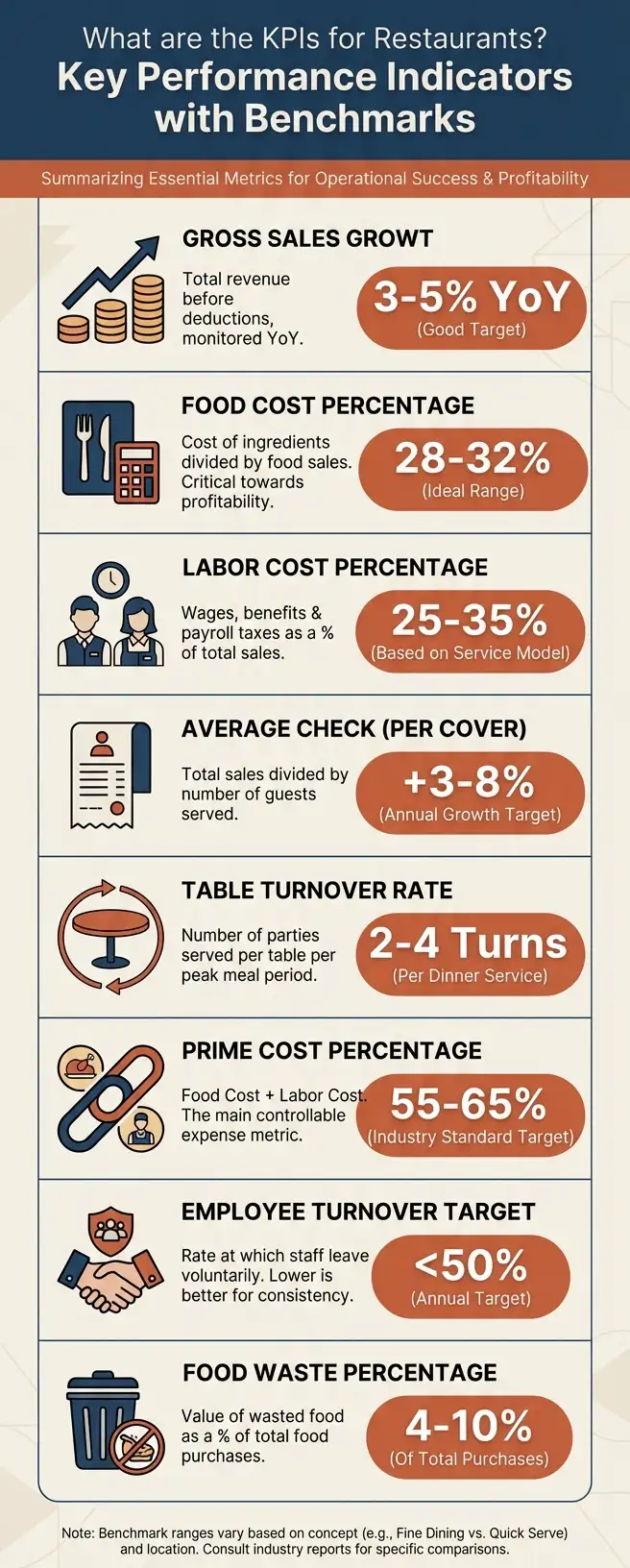
The key restaurant KPIs every owner should track
But tracking KPIs is one thing. Understanding whether your restaurant is actually generating a return on your investment is another.
What is a good ROI for a restaurant?
With the core KPIs covered, let's move on to the bigger picture: return on investment. ROI measures whether your investment makes financial sense.
A good ROI for a restaurant is a framework that measures annual return as a percentage of initial investment. For independent operations, target ROI typically ranges from mid-teens to mid-twenties annually, though this varies significantly by concept, location, and operational efficiency.
Fine dining typically achieves lower ROI due to higher upfront costs, whilst quick-service concepts often see higher returns with efficient operations.
ROI varies significantly by restaurant format:
- Fine Dining: Lower ROI (higher investment, longer payback)
- Casual Full-Service: Moderate ROI (balanced investment and volume)
- Quick-Service: Higher ROI (lower investment, faster payback)
However, most owners calculate ROI incorrectly. They look at net profit divided by initial investment, but that ignores the owner's unpaid labour. If the maths feels fiddly, run the numbers through an ROI calculator that factors in a market-rate salary for your own hours. If you can't tell whether your restaurant generates profit or just pays for your own labour that's usually a sign you're treating your time as worthless.
For example, if you're working long hours and your restaurant generated modest profit on a significant investment, your ROI might look positive. But if you paid yourself a market-rate salary for those hours, you'd actually be operating at a loss. That's not a sustainable business.
Calculate True ROI
Calculate ROI after paying yourself a realistic salary. If the business still generates positive ROI after that, it's sustainable. If not, you've built yourself a job, not a business.
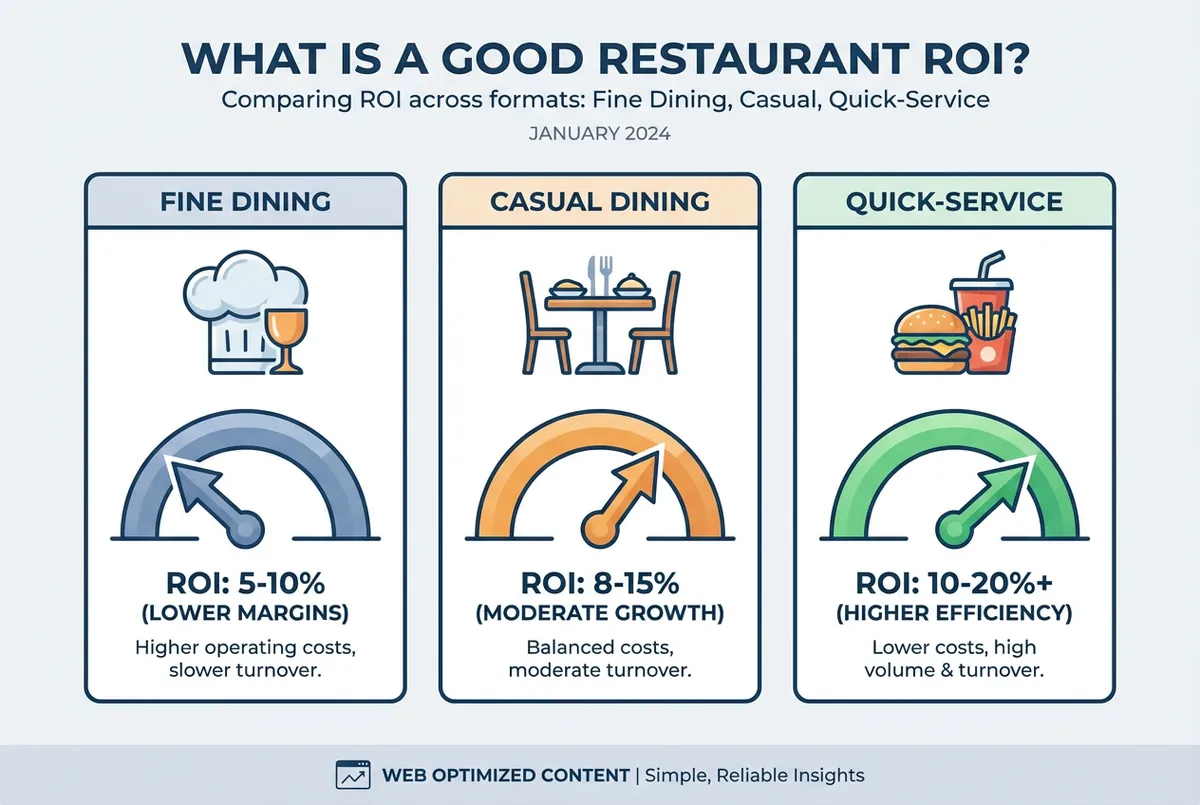
ROI varies significantly by restaurant format
ROI tells you whether your investment makes sense. But what separates good restaurants from benchmark performers?
What makes a restaurant a benchmark?
Now that you know how to measure ROI correctly, here's what separates top performers from the rest. So what does a benchmark restaurant actually look like?
A benchmark restaurant is an operation that consistently achieves or exceeds industry-standard financial and operational metrics across multiple categories. These establishments typically maintain costs well within target ranges.
What separates benchmark restaurants from average operations isn't one factor: it's consistent execution across financial discipline, operational efficiency, customer experience, and strategic adaptability. Industry professionals with years of experience consistently confirm this pattern.
Specifically, benchmark restaurants share four key characteristics:
Financial Discipline:
- Track metrics weekly, not monthly
- Menu engineering drives profitability
- Portion control is non-negotiable
Operational Efficiency:
- Staff scheduling matches demand
- Prep is standardised and costed
- Technology reduces admin time
Customer Experience:
- Consistent quality across services
- Staff training is ongoing
- Repeat customer rate exceeds 30%
Strategic Adaptability:
- Menu evolves with costs
- Marketing is planned, not reactive
- Data informs decisions
For instance, a benchmark restaurant in Manchester might maintain optimal cost percentages and turn tables efficiently per service. They've engineered their menu to feature high-margin dishes that customers actually order, trained their team to upsell naturally, and optimised their booking system to maximise covers during peak times. They're executing basics consistently and measuring what matters.
If you're reading this thinking "I don't have time for weekly tracking", that's the problem. Benchmark restaurants make time because they know ignoring metrics costs more than tracking them.
If you're only checking your benchmarks when profits feel wrong you'll always lose to competitors who track weekly and spot problems before they haemorrhage cash.
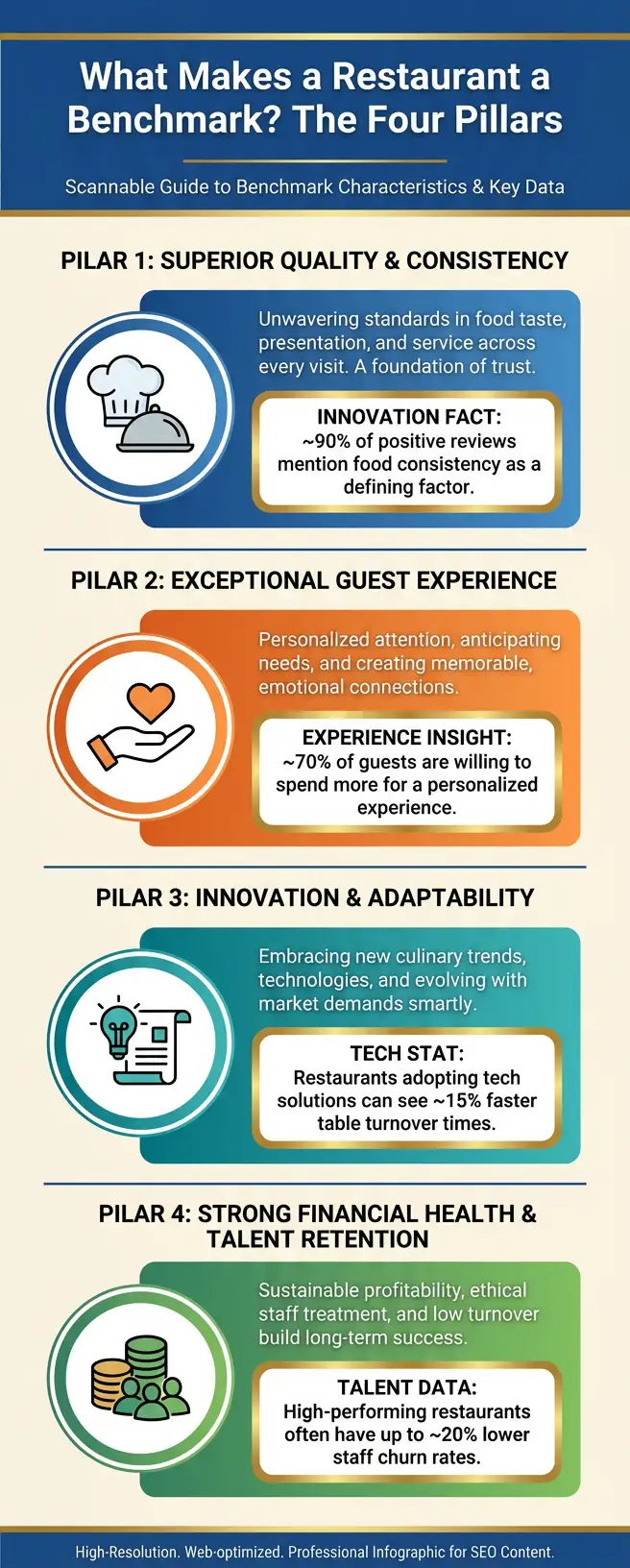
Characteristics of benchmark-performing restaurants
Understanding what makes a benchmark restaurant is valuable, but the real diagnostic tool is your P&L.
What is the standard P&L for restaurants?
Building on these characteristics, the next step is understanding your financials in detail. Your P&L tells you where your money goes and where it comes from.
The standard P&L for restaurants is a framework that structures your financial performance into clear categories: Revenue minus Cost of Goods Sold equals Gross Profit, minus Operating Expenses equals Operating Profit, minus fixed costs equals Net Profit.
Successful independent restaurants typically maintain healthy gross profit margins and single-digit net profit margins depending on format.
According to UKHospitality, the industry trade body, the standard P&L structure looks like this:
| Line Item | % of Revenue |
|---|---|
| Revenue | 100% |
| Cost of Goods Sold | 30-35% |
| Operating Expenses | Labour, occupancy, other |
| Net Profit | 3-9% |
The percentages matter more than the absolute numbers.
That said, where most independent restaurants go wrong is treating the P&L as a historical document instead of a diagnostic tool. If your food cost significantly exceeds the benchmark, that's not bad luck: it's a solvable problem.
For example, one London bistro discovered their P&L showed labour costs well above benchmark. They assumed they were overstaffed. The real problem? They were scheduling the same team for quiet Monday lunch as busy Friday dinner. Fixed scheduling, not headcount, was killing their labour efficiency. That insight came from comparing their P&L to benchmarks.
Info
Related: Restaurant KPI Dashboard
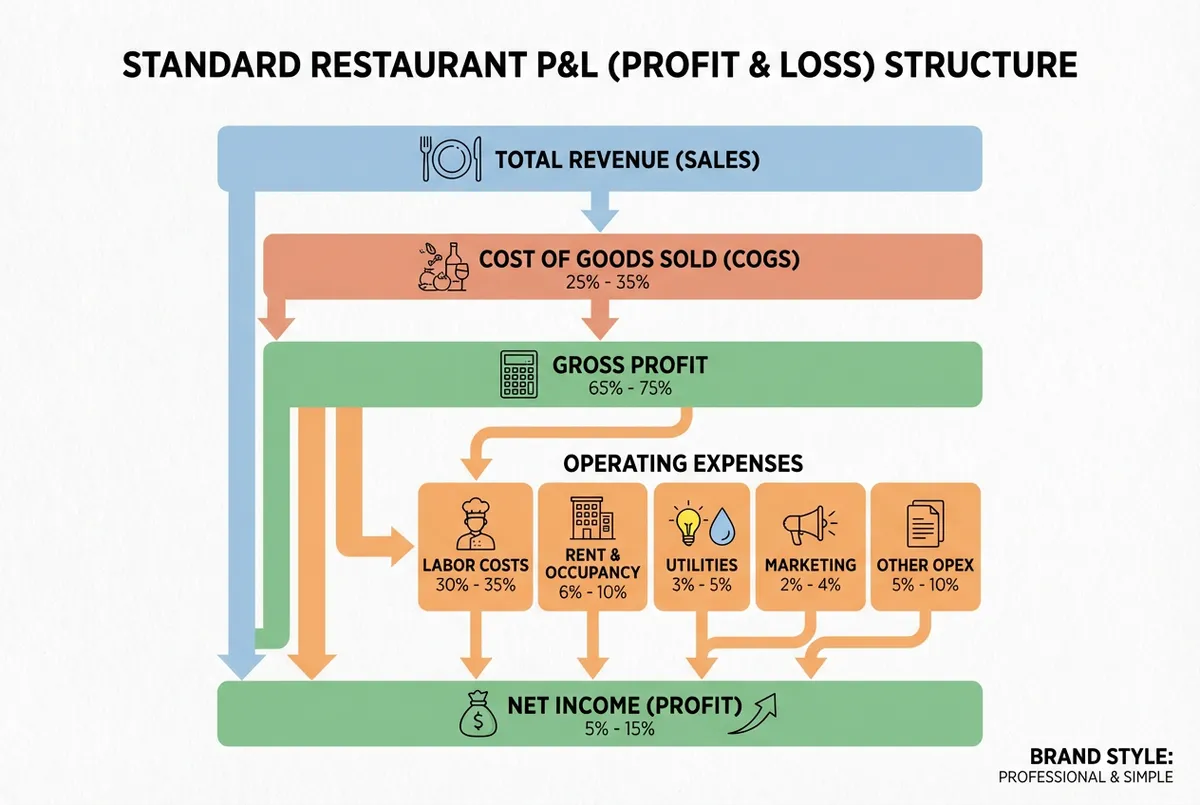
Standard P&L structure for UK restaurants
Beyond financial metrics, customer-facing ratings also impact your bottom line.
What is the restaurant rating system in Australia?
Moving beyond internal financials, let's look at how external ratings affect your business. Rating systems vary by country but serve the same purpose: building consumer trust.
The restaurant rating system in Australia is a framework that combines hygiene ratings, editorial awards, and platform reviews to measure restaurant quality. Australia uses the "Good Food Guide" Hat Awards and a hygiene rating system similar to the UK's Food Hygiene Rating Scheme.
In the UK, the Food Standards Agency's rating system is mandatory display, and achieving top ratings is the baseline benchmark for consumer confidence.
So what should UK restaurants actually target? The key rating benchmarks are:
Food Hygiene Rating (FSA):
- Target: 5 (Very Good)
Online Review Ratings:
- Google: Target high rating
- TripAdvisor: Target strong ranking
Industry Recognition:
- AA Rosettes: Fine dining benchmark
- Michelin Guide: Top-tier recognition
In practice, the reality for most independent restaurants is that Food Hygiene Rating and Google Reviews matter far more than industry accolades. A top FSA rating and strong Google reviews signal trust. That drives bookings.
If you're operating below the top hygiene rating, fixing it isn't optional: it's the highest-ROI action you can take. For instance, a London restaurant improved from a low rating to top rating by implementing proper temperature logging, staff hygiene training, and documented cleaning schedules. Bookings increased significantly within two months simply from the rating change displayed on Google.
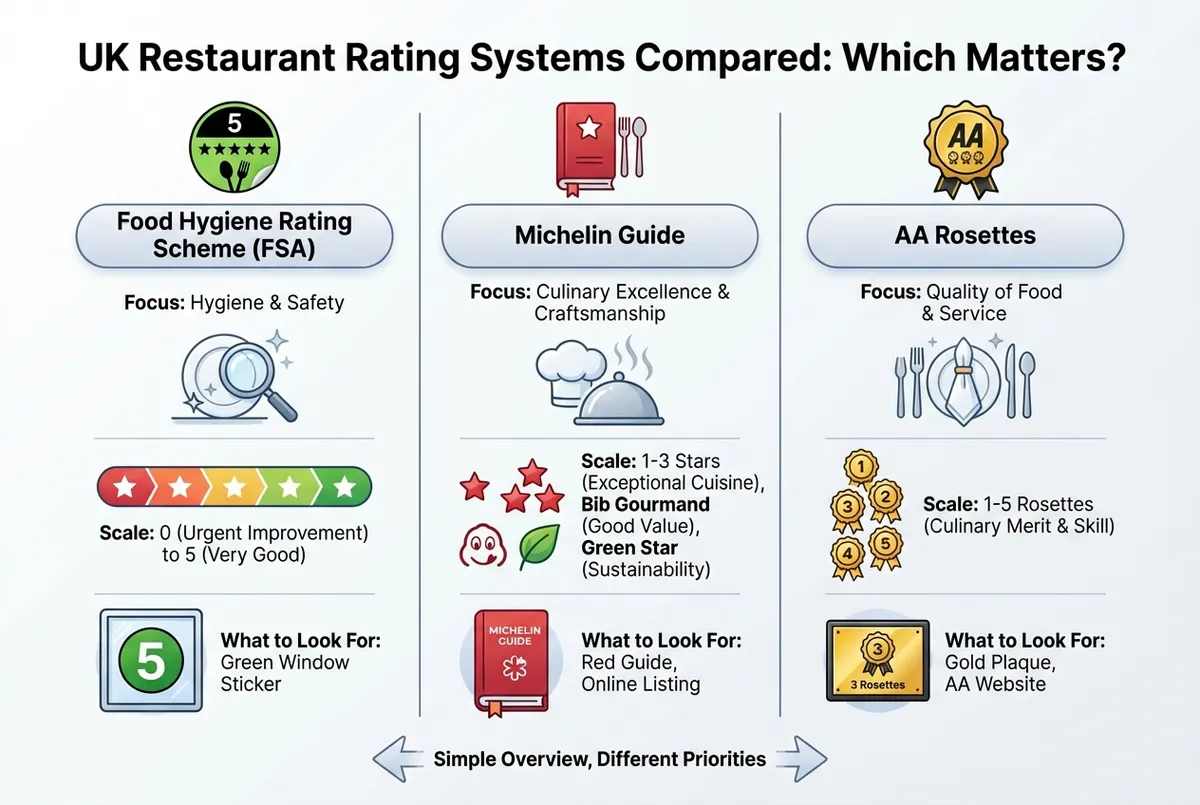
Key rating benchmarks for UK restaurants
If you're only checking benchmarks when something feels wrong, you'll always be playing catch-up to competitors who track weekly. Reactive measurement doesn't fix problems: it just makes them visible after they've cost you money.
Ask yourself: If someone handed you your P&L from six months ago, could you explain why your food cost percentage changed? If not, you're not tracking: you're guessing.
Let's address some common questions about restaurant benchmarks.
FAQ: Restaurant Benchmarks
Here's what restaurant owners frequently ask about benchmarks:
What's the difference between gross profit and net profit in restaurants?
Simply put, gross profit is revenue minus cost of goods sold (food and beverage costs). Net profit is what remains after deducting all operating expenses including labour, rent, utilities, and marketing.
How often should I calculate my restaurant benchmarks?
In short, calculate your big three (food cost, labour cost, prime cost) weekly. Monthly calculations are too slow: if food cost spikes in week one, you'll haemorrhage profit for three more weeks before you notice.
What's a realistic timeline to improve my benchmarks?
Generally speaking, food cost improvements can show within a few weeks through better portioning. Labour cost requires several weeks to adjust scheduling patterns. Prime cost improvements typically take consistent tracking and adjustment over several months.
Are benchmark percentages the same for all restaurant types?
Not at all. Fine dining typically runs higher food costs due to premium ingredients. Quick-service runs lower food costs with higher volume. Always use benchmarks from similar restaurant formats and locations.
Key Takeaways: Restaurant Benchmarks
If you run a restaurant and want to see how Local Brand Hub can support your marketing, explore our restaurant marketing tools.
Key Takeaways: Restaurant Benchmarks
Finally, let's summarise what matters most. Now that you understand what benchmarks are and how they work, here's what matters most.
Restaurant benchmarks aren't aspirational targets: they're diagnostic tools. They tell you where profit is leaking, where you're outperforming competitors, and which numbers actually matter when you're making decisions at 11pm on a Saturday.
Key Points to Remember
- Track the "big three" first: Food cost, labour cost, and prime cost tell you whether your restaurant is financially sustainable
- ROI should be calculated after paying yourself: If your restaurant only makes money because you work unpaid hours, your ROI is likely negative
- Benchmark restaurants aren't lucky; they measure consistently: Weekly tracking, not monthly retrospectives, is what separates sustainable operations from closures
- Your P&L percentages matter more than absolute revenue: A smaller restaurant with healthy margins is better off than a high-revenue restaurant with poor cost control
- UK Food Hygiene Rating of 5 is non-negotiable: Research shows most customers check ratings before choosing where to eat
The mistake most restaurant owners make isn't ignorance of these numbers. It's treating them as optional. You wouldn't run a kitchen without checking food temperatures. Don't run a business without checking benchmarks.
Restaurant Benchmark Tracking Checklist
- Calculate food cost percentage weekly
- Calculate labour cost percentage weekly
- Combine food + labour to get prime cost
- Review P&L monthly to spot trends
- Check average check size and table turnover
- Monitor Google review rating regularly
- Verify FSA Food Hygiene Rating is maintained
- Calculate true ROI after paying yourself market salary
- Compare your percentages against benchmarks
- Identify your biggest gap and possible causes
For UK restaurant owners
Track Your Restaurant Benchmarks Automatically
LocalBrandHub tracks these metrics automatically as part of your restaurant dashboard. Your food cost trends, labour efficiency, and customer rating movements: monitored weekly, flagged when they drift from benchmarks, and presented in plain English you can act on.
Start freeWeekly Action
This week, calculate your current prime cost:
- Day 1-2: Pull last month's P&L and calculate food cost percentage (food cost divided by revenue) and labour cost percentage (total wages plus tax divided by revenue)
- Day 3-4: Add food cost and labour cost together to get prime cost. If it exceeds the benchmark, you've identified where profit is disappearing
- Day 5-7: Compare your percentages to the benchmarks outlined earlier. Identify your biggest gap and list three possible causes (e.g., inconsistent portioning, fixed scheduling, supplier pricing)
If your prime cost significantly exceeds benchmark, that's not a small problem: it's the reason you're not profitable. Fixing it isn't one task. It's a system. Start with the biggest gap: if food cost is the issue, fix that first.
Info
Get More Marketing Tips
Practical marketing tips for UK business owners, straight to your inbox. No spam, unsubscribe anytime.
About the Author
Local Brand Hub
Empowering UK Businesses
Local Brand Hub provides comprehensive business management tools designed specifically for UK local businesses to streamline operations, automate marketing, and grow revenue.
More articlesRelated Articles
 Marketing Tips
Four Quadrants of Menu Engineering: A Complete UK Guide
Master the four quadrants of menu engineering to boost restaurant profits. Learn how Stars, Plough Horses, Puzzles and Dogs increase your margins.
 Marketing Tips
Menu Design Principles: 7 Rules That Drive Sales
Master menu design principles that guide customer choices. Learn golden triangle placement and strategic pricing layouts that boost restaurant profits.
 Marketing Tips
Menu Engineering: Complete UK Restaurant Guide
Master the four quadrants matrix: Stars, Plough Horses, Puzzles and Dogs. Learn how menu engineering boosts UK restaurant profits by 15% or more.