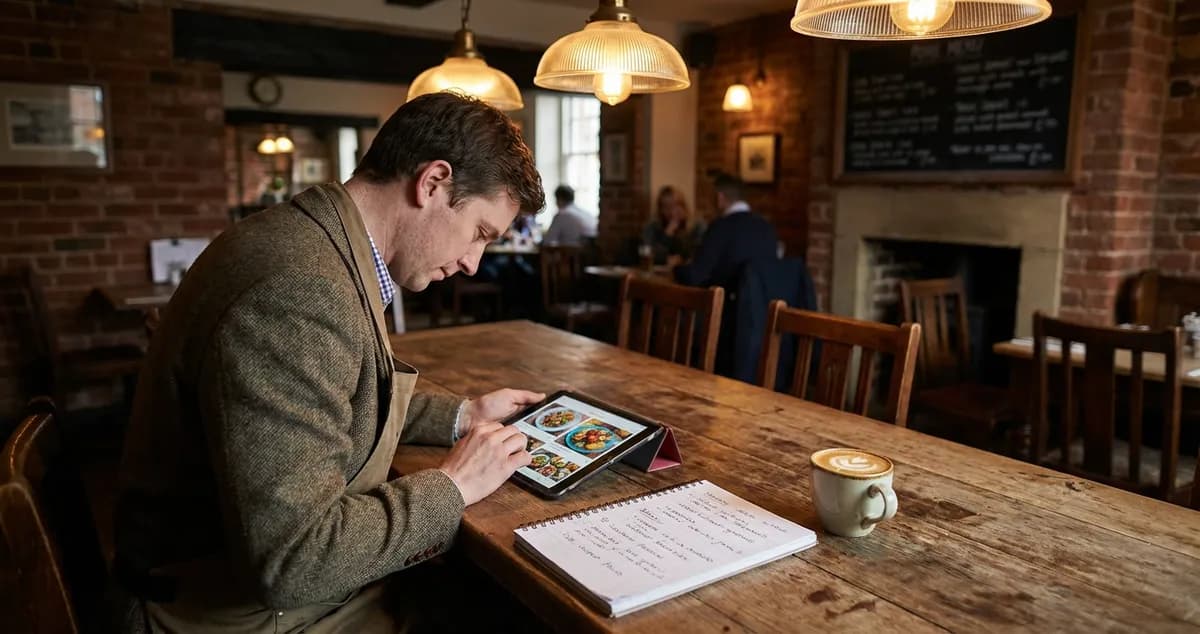
Restaurant blog ideas a rival two streets away could not copy: the test that kills weak topics, where the material sits, and a twenty minute method.
Your chef rejected a box of turbot on Tuesday because the gills were wrong. That is a blog post, and nobody else in Britain can publish it. Most restaurant blog ideas fail the only test that matters: could the place two streets away run this word for word? If yes, skip it and go back to the delivery note.
That question does more work than any list of fifty topics, and it explains why most restaurant blogs stall at two posts: the ideas that come to mind first are the ones everyone else has published. This is the practical end of your restaurant content strategy, for someone with forty minutes between lunch and dinner and no marketing team.
Related: Restaurant Content Marketing
What Makes a Restaurant Blog Post Worth Writing?
A post is worth writing when it carries something only your restaurant can supply. In practice that means one of four things:
- a named supplier, and why you chose them
- a dated decision, with the reason behind it
- a dish that failed, and what replaced it
- a question your front of house answers ten times a week
Most of the rest is filler a search engine can summarise without sending anyone to you.
For example, say you changed the crab you buy in February. That one decision carries a date, a reason and a price, and no other kitchen made it.
Count the competition. As at March 2025 the UK had 105,140 restaurant and mobile food service businesses registered for VAT or PAYE, and almost every one of them could publish "five tips for hosting the perfect dinner party". Almost none could publish the morning your walk in failed, what you binned, and what changed about your delivery window afterwards.
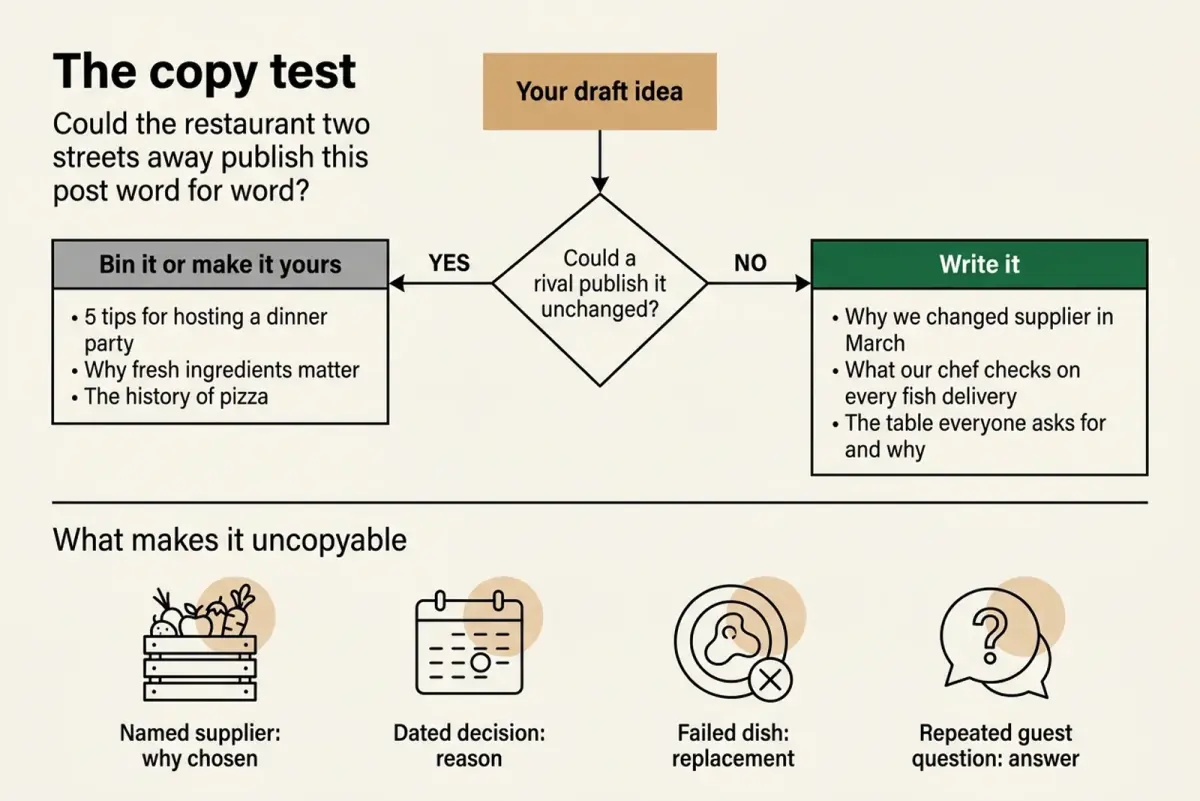
The copy test: if a rival could publish your draft unchanged, it was never your post.
Pro tip: keep a notepad on the pass. Every question a guest asks twice goes on it. That list is your editorial calendar.
The test is unkind to the ideas that feel safest, which is the point. "Why fresh ingredients matter" sounds responsible. It was also written by people who never stood at a pass. Swap it for "why we pay more for the Cornish crab, and what happens to the price in February" and you have something with your fingerprints on it.
How Do You Start a Restaurant Blog?
Start with one post, published, before you think about a schedule. Most restaurant blogs die at the planning stage, killed by a spreadsheet nobody opens. The order that works is boring.
- Check whether you already have a blog. Most website builders include one, usually switched off rather than missing.
- Pick a single idea from this shift. Not the best idea, the nearest one.
- Write it as you would explain it to a regular at the bar. Two hundred words is a post.
- Add one photograph you took yourself. A phone in daylight beats a stock image, and photographing your own food repays an hour of practice.
- Publish it and tell three people. Your team, your regulars, your supplier.
Imagine writing 180 words about Tuesday's turbot on the Wednesday, publishing it and sending it to your list. That is a complete first post.
Only after the second post does a rhythm make sense, because by then you know how long a post takes you. A restaurant content calendar stops being homework and starts protecting time you have proved you can find.
What Are Some Good Restaurant Blog Ideas?
Good restaurant blog ideas are the ones whose raw material is already in the building on a normal shift. Sort them by where the material lives rather than by theme, and the writing stops feeling like an extra job.
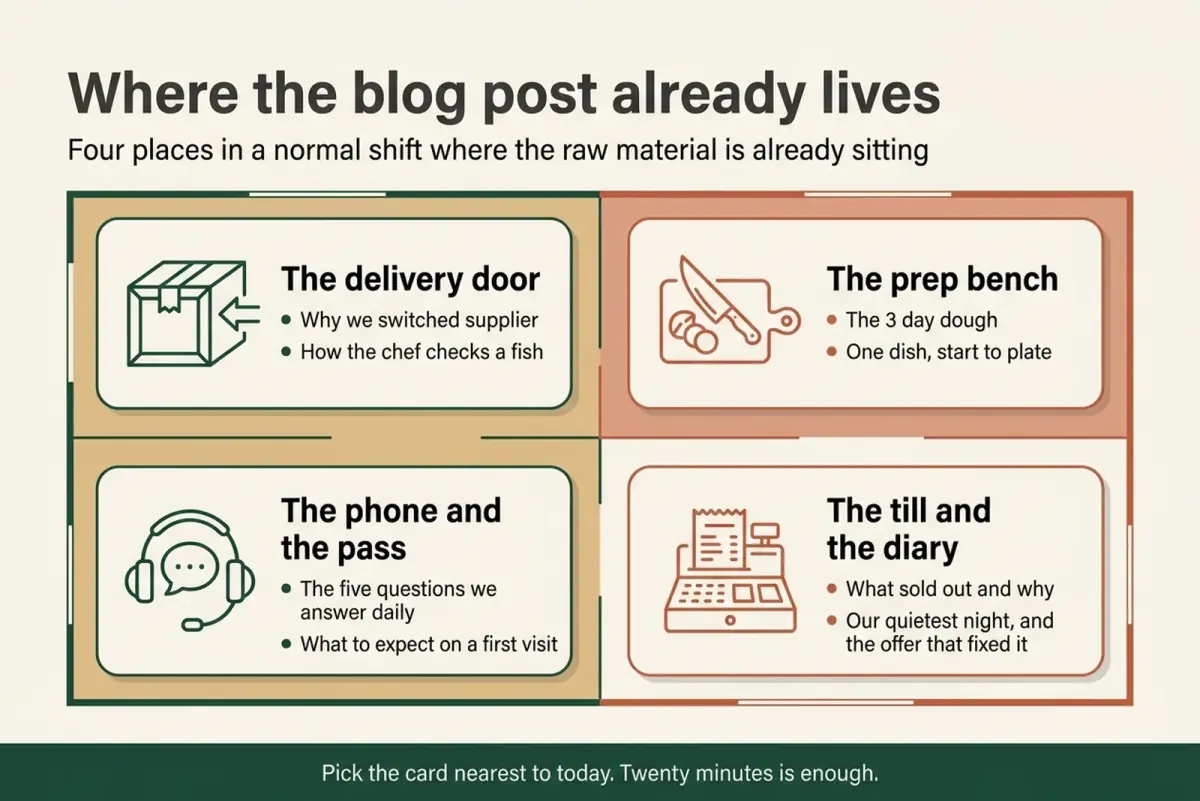
Four places in a normal shift where the post has already written half of itself.
At the delivery door, the posts name real people and real dates: why you changed supplier, what your chef checks before signing for fish, the week a crop failed. At the prep bench, one dish start to plate with the slow bit explained honestly. That is the material that makes you worth trusting with someone's anniversary.
At the pass and on the phone, the questions your team answers daily are worth writing down somewhere, though most belong on a permanent page. At the till and in the diary, the numbers you read every Monday are a story nobody outside the building can tell.
Imagine a twelve cover bistro that notes every question a guest asks twice. By March the list has nine on it: nine posts, already researched, in the words customers used.
Eleven that survive the copy test, sorted by what they are for. Anything you name gets checked before it goes live: a supplier, a price, an allergen, an award. Never invent a specific to make a post read better, because a wrong detail about your own kitchen is the error your regulars will catch.
| Post | Where it belongs | What you need | Ask the reader to | Signal to watch |
|---|---|---|---|---|
| Why we changed supplier | Blog | Delivery note, 10 min with the chef | Book a table | Booking page clicks |
| What the chef checks before signing for fish | Blog | One delivery, a photo | Book a table | Shares and saves |
| The week a crop failed | Blog | Menu change, a date | See this week's menu | Menu page clicks |
| One dish, start to plate | Blog | 30 min at the bench | Book a table | Menu page clicks |
| Allergen handling and what we adapt | Website/FAQ | Your actual procedure | Ring us | Repeat questions |
| Parking, corkage, walk ins | Website/FAQ | Ten minutes and honesty | Book a table | Repeat questions |
| Does the tasting menu suit a vegetarian | Website/FAQ | The kitchen's real answer | Book a table | Repeat questions |
| Meet the person who runs the pass | Blog | One proper quote | Follow us | Shares and new follows |
| Your quietest night and what fixed it | Blog | The diary, a number you already read | Book that night | Midweek covers vs normal |
| What sold out and why | Social, then blog | This week's till report | Come early | Tagged booking link clicks |
| A first visit guide | Website/FAQ | What you assume people know | Book a table | Covers vs a normal period |
Four of those are not blog posts. Parking, corkage, allergens and the first visit guide never change, so they earn a permanent page.
For a broader monthly content mix, see the 30/30/30 guide.
What Should I Write in a Food Blog?
A food blog and a restaurant blog want different things. The food blog sells the writer's taste, and recipes, techniques and reviews are its currency. Yours wants to fill a table on Thursday, so most posts should end somewhere near a booking.
That is why recipes are usually the wrong instinct: a recipe competes with every food writer in the country, and gets bookmarked by people who will now cook your dish at home.
How Do You Get Anyone to Read It?
Publishing is not distribution. The post has to go where your people are, on the day and again a fortnight later.
Attention is not going spare. UK online adults spent an average of 3 hours 41 minutes a day online in May 2023, eight minutes more than the year before. You compete less with other restaurants than with everything else on the phone, which is why a post about your turbot beats one about seasonal eating.
Four moves, easiest first:
- Send it to your mailing list.
- Put the first two lines on your Google Business Profile.
- Cut one paragraph into a social post. Our guide to restaurant social media ideas turns one post into a fortnight of material.
- Print the good ones for the bar. Your best readers are already sitting in the room.
For instance, one turbot post can go to the mailing list on the Wednesday, the Google Business Profile on the Thursday, and a social clip a fortnight later.
How Do You Know If It Worked?
Most restaurant blogs are abandoned because nobody could tell whether they were working. Check monthly, not daily, and read these in order.
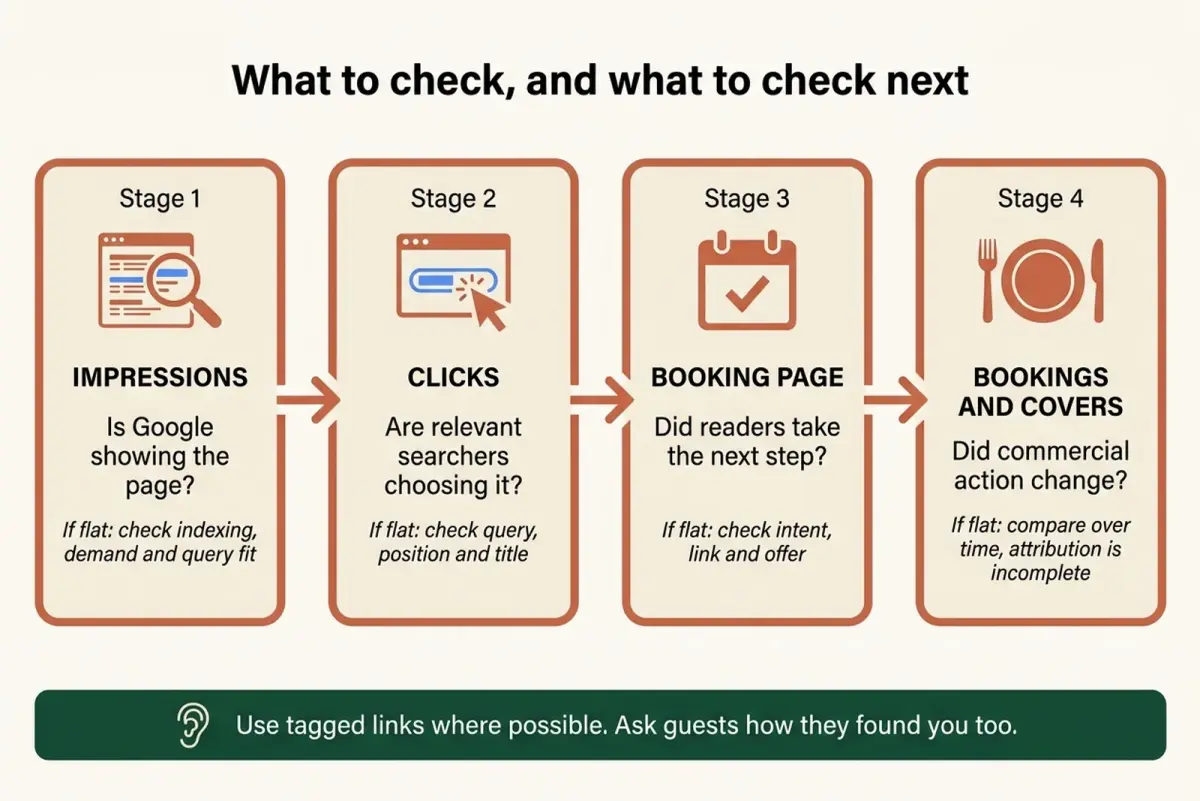
Four checks, in order, and what to look at before you conclude anything from a flat one.
Impressions say whether Google is showing the page. Flat after a month: check it is indexed, that anyone searches for the topic, and that you have given it time. Clicks say whether searchers chose it, so before blaming the title, look at which queries you appeared for and how far down you sat. Booking page visits say whether readers took the next step; if few did, check the post attracts the right reader and the link is there to click. Bookings and covers are the point, read against your normal week rather than as proof.
Imagine a crab post with 400 impressions and six clicks. That is not yet a title problem. If the impressions came from "crab recipes" you are showing for the wrong search; if they came from your own town and you sat eleventh, position explains the clicks.
Attribution is imperfect, and pretending otherwise wastes your time. Someone reads your turbot post on Tuesday, remembers you on Friday and books by phone, and no tool will join those up. Use tagged links where your booking system allows, watch the direction over a quarter, and keep asking new guests how they found you. None of it is proof alone.
Frequently Asked Questions
How often should a restaurant blog?
Once a month, published without fail, is a rhythm most kitchens can hold, and it beats four posts in January and silence until August. That gives you twelve searchable pages a year and one task small enough to protect during service. Weekly is lovely and harder to sustain than it looks.
Do restaurant blogs help with Google rankings?
Indirectly, yes. A blog gives your site pages that answer specific questions a menu page cannot. Treat rankings as a side effect of being useful, or you will write for a crawler and bore your customers.
Should I write the restaurant blog myself or pay someone?
Write it yourself when the post depends on knowledge only you hold, then pay someone to tidy and publish it. A freelancer with no access to your kitchen produces exactly the post the copy test exists to catch.
How long should a restaurant blog post be?
Long enough to answer the question and no longer. Two hundred words about this week's fish is a real post. A thousand words of padding around the same fact is worse: most readers will not finish it, and the effort puts you off the next one.
What to Do in the Next Twenty Minutes
Pick the zone nearest to where you are standing. Delivery door, prep bench, pass, till. Write two hundred words about the last real thing that happened there.
The twenty minutes is the writing. Checking the details, choosing a photograph and getting it live take longer the first time and less every time after. Do not let that stop you starting.
Imagine it is Tuesday and the walk in failed on Sunday. That is your post, the delivery note is your research, and the whole thing is done before the first table sits.
The restaurants whose blogs work are rarely the ones with the best ideas. They are usually the ones who stopped saving the good stuff for a post they never wrote.
Weekly Action
Key Takeaway
Take one question off the pass notepad and answer it before Sunday. One photograph, two hundred words. Next week, take the next one.
If the writing is not your bottleneck but the posting is, LocalBrandHub has a free social post generator and a social media calendar: see how it works.
For restaurants, salons, and local businesses
Need help with your marketing?
We help UK businesses turn social media into real results, not busywork.
Start freeSources
Get More Marketing Tips
Practical marketing tips for UK business owners, straight to your inbox. No spam, unsubscribe anytime.
About the Author
Local Brand Hub
Empowering UK Businesses
Local Brand Hub provides comprehensive business management tools designed specifically for UK local businesses to streamline operations, automate marketing, and grow revenue.
More articlesRelated Articles
 Marketing Tips
Content Marketing for Restaurants: A Practical Guide
Master content marketing for restaurants using the 5 C's framework and the 30/30/30 rule. Actionable ideas that bring more diners through your door weekly.
 Marketing Tips
Restaurant Content Calendar: A Free UK Template for 2026
A restaurant content calendar that survives service. Copy the seven column UK template, plan what you shoot before what you say, and start this week.
 Marketing Tips
Restaurant Content Marketing: A Guide for UK Owners
Learn restaurant content marketing strategies that attract customers. This UK guide covers the 7 P's, 4 P's, 3-3-3 rule, and the 30/30/30 budget framework.