Build a restaurant content strategy that brings customers in. A 4-pillar framework for busy owners who want results without daily posting.
90% of diners check restaurants online before deciding where to eat. You're posting three times a week. Lighting's decent, food looks good. Three likes, two from staff. Meanwhile, the chain down the road has a queue out the door and their photos look like they were taken with a potato. The difference isn't their camera. It's their restaurant content strategy.
What You'll Learn
- The 4-pillar restaurant content strategy framework that works for independent restaurants
- How to choose the right platforms without spreading yourself too thin
- A minimum viable content plan you can run in 30 minutes a week
- Which metrics actually matter (and which to ignore)
A restaurant content strategy is a structured plan that determines what content you create, where you share it, and how it connects to your business goals. It transforms random posting into purposeful marketing that actually brings customers through your doors. And here's the reality: 90% of diners check restaurants online before deciding where to eat (MenuTiger, 2025). Without a strategy, you're leaving that decision to chance.
This guide gives you a practical framework you can implement this week, even if you're running on empty after a 12-hour shift.
Why Most Restaurant Content Fails (And What Actually Works)
If you're reading this thinking "I've tried posting more and nothing happened", you're not alone. Many independent restaurants make the same mistakes:
- Posting only when business is slow (reactive, not strategic)
- Sharing food photos without context or story
- Treating all platforms the same way
- No connection between posts and business outcomes
The restaurants winning at content marketing aren't posting more. They're posting with purpose.
Consider this: restaurants that engage with their followers on social media see a 40% or more increase in customer spending (Cropink, 2025). That's not about volume. It's about connection.
Info
The 4-Pillar Restaurant Content Framework
Rather than copying what chains do with their marketing budgets, build your strategy around four pillars that work for independent restaurants.
Pillar 1: Discovery Content
This is content that helps new customers find you. Think local SEO, Google Business Profile posts, and searchable social content.
What works: Posts that answer questions people are actually searching for. "Best Sunday roast in [your area]" performs better than "Our delicious roast is waiting for you!"
62% of consumers check a restaurant's social media page before deciding to dine there (ProfileTree, 2025). Your discovery content is often their first impression.
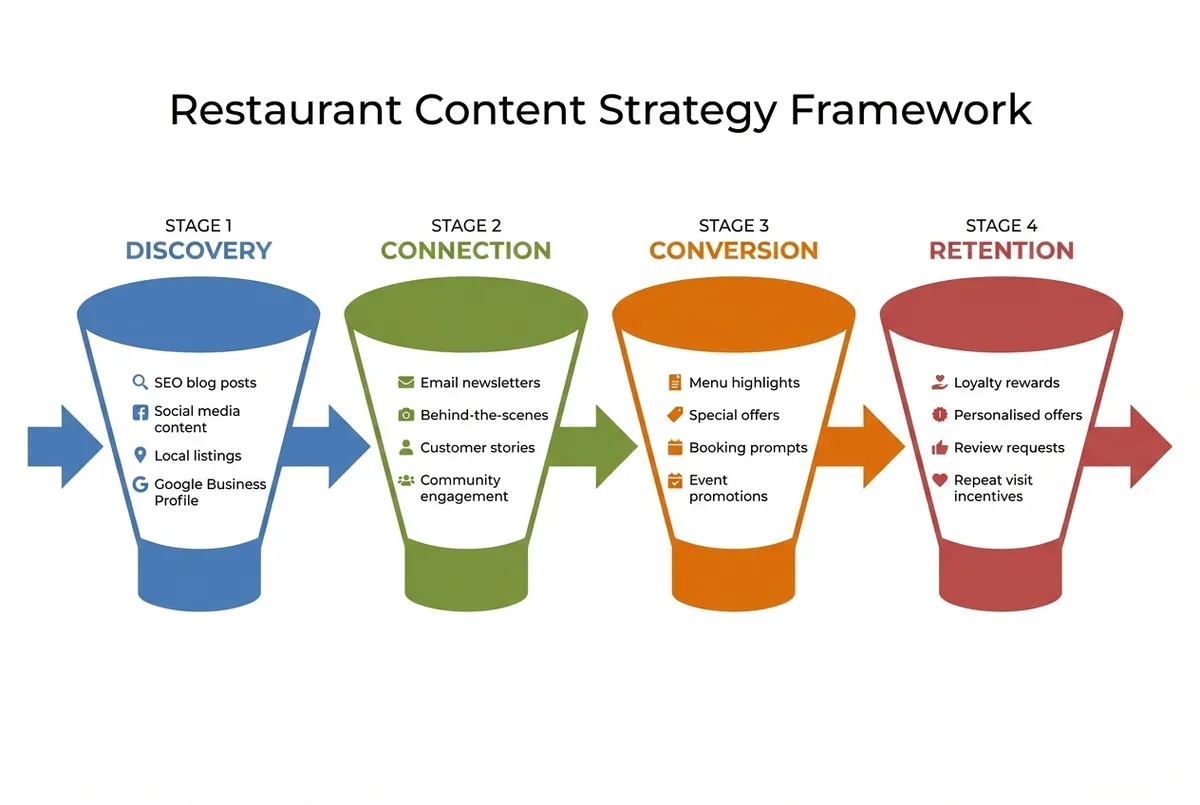
The 4-pillar restaurant content strategy framework
Pillar 2: Connection Content
This builds relationships with people who already know you exist. Behind-the-scenes content, staff spotlights, and your restaurant's story.
What works: Photos featuring people typically perform 44% better than food-only posts (Marketing LTB, 2025). Your team, your regulars (with permission), your suppliers: these are often content gold.
A gastropub using this approach might post:
- The chef checking deliveries at 6am from the local farm
- A server celebrating their one-year anniversary
- Regulars at their "usual" table on a Sunday
Pillar 3: Conversion Content
Direct calls to action. Special offers, event promotion, booking reminders.
What works: Keep this to roughly 20% of your content. The 80/20 rule (or 70/20/10 if you prefer more structure) prevents your feed from feeling like a constant sales pitch.
Pillar 4: Retention Content
Content that brings customers back. Loyalty updates, exclusive offers for followers, "member" moments.
What works: 65% of restaurant revenue typically comes from repeat customers (Restroworks, 2025). Content that makes existing customers feel valued costs almost nothing and often drives the bulk of your business.
Info
Related: Content Marketing for Restaurants
Choosing Your Platforms (You Don't Need All of Them)
Here's what many guides won't tell you: being everywhere is often a strategy for failure when you're running a restaurant.
Platform breakdown for UK restaurants:
| Platform | Best For | Time Investment | Typical Engagement |
|---|---|---|---|
| Visual discovery, younger diners | 3-4 hours/week | High | |
| Local community, events, older demographics | 2-3 hours/week | Medium | |
| TikTok | Viral potential, Gen Z/Millennial reach | 4-5 hours/week | Variable but high when it works |
| Google Business Profile | Local search, reviews | 1 hour/week | Critical for discovery |
If you only pick one platform to start with: Choose Instagram + Google Business Profile. This combination typically offers the best return for UK independent restaurants, visual discovery plus local search. Add Facebook if your audience skews 35+. Add TikTok only if you have the capacity and your target customer is under 40.
55% of TikTok users visit a restaurant after seeing its menu, and 61% say a positive review on social media makes them more likely to try a restaurant (Restroworks, 2025). But that doesn't mean it's right for your restaurant right now.
For example, a neighbourhood Italian trattoria with regulars aged 40-65 would likely see better results focusing on Facebook and Google Business Profile than chasing TikTok trends.
Info
Related: Restaurant Blog Ideas
Building Your Content Calendar
A content calendar sounds corporate. But it's really just answering: "What am I posting this week?" A social media calendar keeps that plan and your scheduled posts in one place.
The Minimum Viable Content Week
If you only have 30 minutes a week, do this:
- Monday (5 min): Plan the week's 3 posts using the pillar framework
- Wednesday (10 min): Create 1 discovery post + 1 connection post
- Friday (10 min): Create 1 conversion or retention post + respond to comments
- Ongoing (5 min): Check and respond to any Google reviews
That's it. Three posts. Thirty minutes. Consistent presence without burning out.
Scaling When You Have More Time
| Weekly Time | Posts | Platform Focus |
|---|---|---|
| 30 min | 3 | Instagram + Google |
| 1 hour | 5 | Instagram + Google + Facebook |
| 2 hours | 7-10 | All platforms + Stories |
| 3+ hours | 10-15 | Add TikTok or video content |
Brands using interactive stickers in Stories see 15-21% higher interaction rates (Social Insider, 2025) , but let's be realistic: daily posting is unrealistic for most independent restaurants and often unnecessary. In fact, inconsistent attempts at daily posting are often worse than consistent three-times-weekly posting.
For example, a busy gastropub might schedule their three weekly posts as: Monday (this week's specials), Wednesday (behind-the-scenes prep), and Friday (weekend booking reminder).
Batch Your Content
Spend 30 minutes on your quiet day taking photos of multiple dishes. You'll have a bank of content ready for weeks.
Info
Related: Restaurant Content Calendar
Content Ideas for Your Restaurant Content Strategy
Stop staring at a blank phone screen. Here's a rotating bank of ideas organised by pillar. For instance, a cafe owner might cycle through a "supplier story" one week, a "seasonal special" the next, then a "staff spotlight", all without repeating the same format.
Discovery Content Ideas
- "Best [dish type] in [your town]" posts
- Answer FAQs: parking, vegetarian options, private dining
- Seasonal menu highlights with location tags
- "Open late tonight" or "Walk-ins welcome" posts
Connection Content Ideas
- Staff introductions (keep it genuine, not corporate)
- Supplier stories: where your ingredients come from
- "Quiet Wednesday night, so we tried a new recipe"
- Responding to (and resharing) customer photos
Conversion Content Ideas
- Limited-time offers with clear expiry
- Event promotion (quiz nights, live music, special menus)
- Booking reminders before busy periods
- Gift voucher pushes before occasions
Retention Content Ideas
- Loyalty programme updates
- "Thank you to our regulars" posts
- First-look access to new menus
- Anniversary celebrations (yours and theirs)
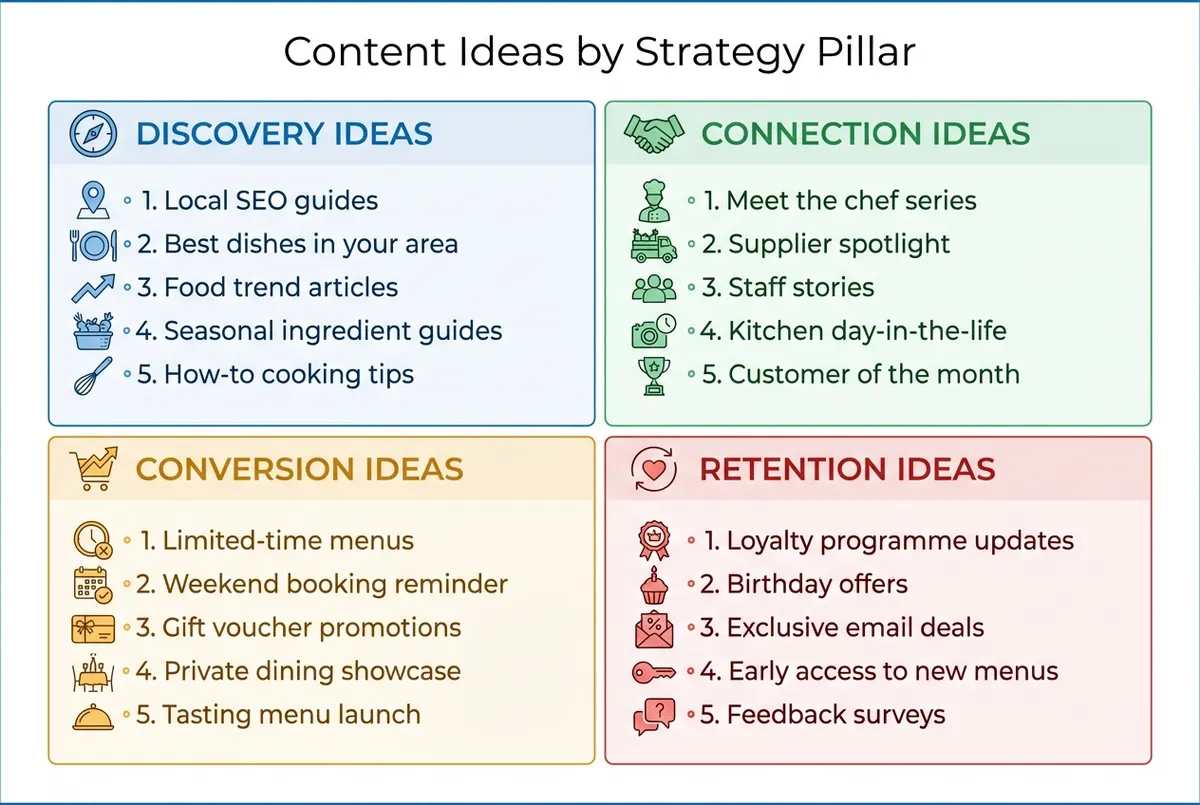
Content ideas organised by the four strategy pillars
Measuring What Matters
If you're thinking "I don't have time for analytics", fair. But you need to know if this is working.
If you can't tell whether your restaurant content strategy is bringing customers in or just generating likes, that's usually a sign you're measuring the wrong things.
Three Metrics That Actually Matter
- Engagement rate (likes + comments + saves / followers): Aim for 1-5% on Instagram, with 3%+ considered excellent (Rival IQ, 2025)
- Profile visits and website clicks: Are people taking the next step?
- Booking/order attribution: Ask customers how they found you
Ignore follower count. A restaurant with 500 engaged local followers often outperforms one with 5,000 random accounts.
For instance, a seafood restaurant might track how many people mention "saw your post" when booking their Friday fish special. That's the metric that matters, not whether your last reel got 1,000 views.
The average restaurant ROI on social media marketing is 9.9% revenue increase when done strategically (Deloitte Digital, 2024). That's measurable growth without massive budget.
Common Restaurant Content Strategy Mistakes to Avoid
Mistake 1: Posting only food photos People want to know the story behind the food. A plate tells them nothing about why they should choose you.
Mistake 2: Ignoring comments and messages 73% of diners will choose a competitor if a restaurant doesn't respond online (MenuTiger, 2025). Every unanswered comment is a missed connection.
Mistake 3: Treating content as "marketing" instead of "communication" If you're only posting when you want something from customers, they'll feel it. Content strategy is about building relationships, not just broadcasting.
Mistake 4: Copying what chains do They have dedicated marketing teams. You have a busy Tuesday night. Different approaches for different realities.
For example, a family-run curry house doesn't need perfectly branded graphics. An honest photo of today's special, taken quickly before service, often performs better than polished but generic stock imagery.
If You're Starting From Zero
This sounds like a lot. In practice, when you're down two staff and Saturday rush is looming, marketing drops off the list.
Here's your absolute minimum starting point for a restaurant content strategy:
- Claim and complete your Google Business Profile (often the highest ROI for local discovery)
- Post once a week minimum (consistency beats frequency)
- Respond to every review (positive and negative)
- Save your best food photos in a folder (build a bank for later)
22% of diners return to a restaurant because of its social media presence (Cropink, 2025). Even a minimal content presence keeps you visible.
Key Takeaway
Key Takeaway
A restaurant content strategy isn't about posting more. It's about posting with purpose. Use the 4-pillar framework (Discovery, Connection, Conversion, Retention) to ensure every post serves a goal. Choose platforms based on your capacity, not what's trending. Thirty minutes a week is often enough if you're strategic about it. Measure engagement and actions, not follower counts. And respond to every comment and review: 73% of diners typically choose competitors when ignored.
If you run a restaurant and want to see how Local Brand Hub can support your marketing, explore our restaurant marketing tools.
This Week's Action Plan
Day 1-2: Check your Google Business Profile is complete: hours, photos, menu, booking link all accurate.
Day 3-4: Review your last 9 Instagram posts: how many are food-only vs. story-driven?
Day 5-7: Plan next week's 3 posts using one discovery, one connection, and one conversion/retention topic.
If you're short on time, focus only on Google Business Profile. It's where 90% of potential customers are looking before they even think about Instagram.
For UK restaurant owners
Make Your Content Strategy Simple
LocalBrandHub helps UK restaurant owners plan, create, and schedule content in less time than you'd spend staring at a blank screen. Our tools fit your reality, not the other way around.
Start FreeGet More Marketing Tips
Practical marketing tips for UK business owners, straight to your inbox. No spam, unsubscribe anytime.
About the Author
Local Brand Hub
Empowering UK Businesses
Local Brand Hub provides comprehensive business management tools designed specifically for UK local businesses to streamline operations, automate marketing, and grow revenue.
More articlesRelated Articles
 Marketing Tips
Content Marketing for Restaurants: A Practical Guide
Master content marketing for restaurants using the 5 C's framework and the 30/30/30 rule. Actionable ideas that bring more diners through your door weekly.
 Marketing Tips
Restaurant Blog Ideas Only Your Kitchen Could Write
Restaurant blog ideas a rival two streets away could not copy: the test that kills weak topics, where the material sits, and a twenty minute method.
 Marketing Tips
Restaurant Content Calendar: A Free UK Template for 2026
A restaurant content calendar that survives service. Copy the seven column UK template, plan what you shoot before what you say, and start this week.