Learn restaurant content marketing strategies that attract customers. This UK guide covers the 7 P's, 4 P's, 3-3-3 rule, and the 30/30/30 budget framework.
You post a photo of your best dish. Lighting is decent, presentation is spot-on. Eight likes. Meanwhile, the chain across the road has a queue out the door posting the same burger every week. You're working 12-hour shifts wondering if restaurant content marketing is worth your time.
So what is restaurant content marketing exactly? It's the practice of creating valuable content that attracts customers, builds trust, and keeps your restaurant top of mind when people decide where to eat. It includes blog posts, social media, videos, emails, and any digital material that tells your story and showcases your food. When done consistently, it creates a steady flow of customers.
Info
Related: Restaurant Social Media Marketing for social media specifics.
What You'll Learn
- The 7 P's and 4 P's of restaurant marketing frameworks
- The 30/30/30 budget rule for allocating resources
- The 3-3-3 content planning rule for balanced posting
- Practical content ideas you can implement this week
What Are the 7 P's of Service Marketing in Restaurants?
The 7 P's of service marketing are Product, Price, Place, Promotion, People, Process, and Physical Evidence. These seven elements create a complete framework for marketing your restaurant as a service business, not just a place that sells food. Here is how each P applies:
| P | What It Means | Restaurant Example |
|---|---|---|
| Product | Your food and dining experience | Menu variety, signature dishes, dietary options |
| Price | What customers pay and perceive | Menu pricing, deals, perceived worth |
| Place | Where customers find you | Location, delivery apps, website ordering |
| Promotion | How you reach customers | Social media, email, local SEO |
| People | Your team | Kitchen staff, servers, hosts, managers |
| Process | How you deliver service | Booking systems, order flow, payment |
| Physical Evidence | Tangible proof | Interior design, uniforms, reviews |
Applying the 7 P's in Practice
For example, a gastropub might focus on:
- Product: locally-sourced Sunday roast
- Price: premium but fair at around £20
- Place: village location with beer garden
- Promotion: Instagram showcasing seasonal ingredients
- People: trained front-of-house staff who know the menu
- Process: efficient weekend booking system
- Physical Evidence: rustic interior with visible open kitchen
If you're reading this thinking "I don't have time for frameworks," you're not alone. Most restaurant owners work 12-hour shifts and just want something that works.
The 7 P's give you a checklist to spot where you are losing customers before they even walk through the door.
If you're only focusing on food quality but ignoring Process or Physical Evidence you'll always lose to competitors who think about the whole experience.
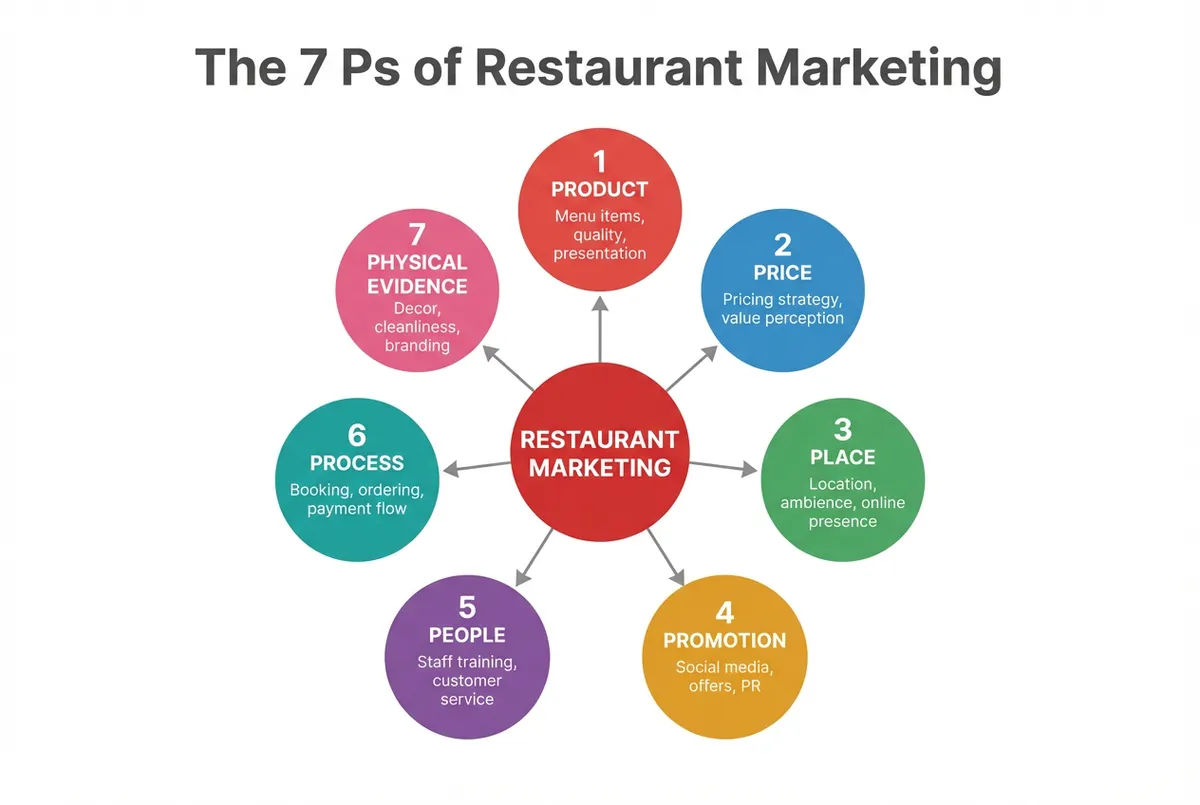
The 7 P's of service marketing applied to restaurants
What Should I Include in Content Marketing?
Now that you understand the 7 P's framework, let's look at what content actually works. Restaurant content marketing should include three core elements: educational content that helps your audience, inspirational content that builds emotional connection, and promotional content that drives bookings. Research suggests balancing these elements creates sustainable engagement rather than burning out your audience with constant sales messages.
The Content Types That Work
Educational content answers questions your customers actually have. This includes recipes, cooking tips, ingredient spotlights, and behind-the-scenes looks at how your kitchen operates.
For instance, a seafood restaurant might share: "Here's why we source our mussels from the Scottish coast" with a short video of the delivery arriving that morning.
Inspirational content shows what the dining experience feels like. This means food photography that makes people hungry, atmosphere shots during the Saturday rush, and stories about your team and suppliers.
Promotional content includes special offers, event announcements, and booking reminders. The key is keeping this to roughly one-third of what you post. According to social media best practices, posting primarily promotional content leads to unfollows and disengagement.
Practical Content Ideas
Now let's turn theory into action. Start with what you already have, then let our AI social post generator turn each idea into a caption:
- Your menu: Turn each dish into a post explaining what makes it special
- Your team: Introduce your chef, share their background, show them in action
- Your suppliers: Where do your ingredients come from? Customers care about this
- Your customers: With permission, share photos of birthday celebrations
For example, a family-run Italian restaurant might post a story about Nonna's original recipe that has been on the menu for forty years. That single piece of content builds more connection than ten percent-off vouchers ever could.
What Is the 3-3-3 Rule in Marketing?
Now that you know what content to create, let's look at how to structure it. The 3-3-3 rule in restaurant content marketing is a framework that divides your strategy into three content types, three distribution channels, and three audience engagement stages. It helps restaurant owners avoid random posting by creating a structured approach that covers all the bases without overcomplicating things.
Breaking Down the Rule
Three Content Types:
- Educational: Teach something useful
- Inspirational: Create emotion and connection
- Entertaining: Give people a reason to smile
Three Distribution Channels:
- Owned media: Your website, blog, email list
- Earned media: Customer reviews, word-of-mouth, press mentions
- Paid media: Social ads, Google ads, sponsored content
Three Audience Stages:
- Awareness: People who don't know you exist yet
- Consideration: People comparing options
- Decision: People ready to book
For example, a Thai restaurant applying this rule might create educational content about authentic Thai ingredients for Instagram (awareness), encourage customer reviews on Google (earned media for consideration), and use targeted local Facebook ads with a booking link (paid media for decision).
The 3-3-3 rule forces you to think beyond just posting pretty food photos. It ensures your restaurant content marketing strategy reaches people at every stage of their decision-making process.
What Are the 4 P's of Marketing for Restaurants?
Building on the 3-3-3 framework, let's now look at the marketing fundamentals behind it. The 4 P's of marketing are Product, Price, Place, and Promotion. This classic framework, created by E. Jerome McCarthy in 1960 based on Neil Borden's earlier marketing mix concept, remains the foundation of restaurant marketing strategy (American Marketing Association).
Product
Your product extends beyond the food on the plate. It includes the entire experience: the ambiance, the service quality, dietary accommodations, and how the food makes customers feel.
For example, a brunch spot might define their Product as: great eggs Benedict (the food), plus Instagram-worthy presentation (the experience), plus vegan and gluten-free alternatives (accessibility).
Questions to ask:
- What makes your dishes different from competitors?
- Do you cater to dietary requirements like vegan, gluten-free, or halal?
- What experience are customers actually paying for?
Price
Your pricing communicates market positioning and shapes customer expectations. Food costs need to sit within a sustainable share of menu prices, with the exact target varying by restaurant type.
If you're thinking "I can't compete on price with the chains," you're right. Independent restaurants typically compete on value and experience instead of rock-bottom prices. That's your advantage, not your weakness.
Place
Place covers your physical location, delivery presence, and digital accessibility. Diners increasingly use search engines and apps to discover restaurants, which means your Google Business Profile matters as much as your front door sign.
Consider whether customers can find you through:
- Local Google searches
- Delivery platforms
- Your own website with online booking
- Walking past your location
Promotion
Promotion includes every way you communicate with potential customers. Most restaurants now use social media for marketing, but effectiveness varies dramatically based on approach.
Social media works for restaurants because diners actively use platforms like Instagram, TikTok, and Facebook when deciding where to eat. According to a 2019 MGH study, 74% of people who follow restaurant brands on social media say they're more likely to visit those establishments (Marketing Dive). But you don't need to be everywhere. You get more impact being great on one platform than being mediocre on several.
Track Your Impact
If you can't tell whether your Instagram brings bookings or just likes, that's usually a sign you need better tracking. Add a specific booking link to your bio and monitor clicks.
What Is the 30/30/30 Rule for Restaurants?
Moving on to budgets, how does restaurant content marketing fit into your finances? The 30/30/30 rule is a financial budgeting framework suggesting restaurants should allocate approximately 30% of revenue to food costs, 30% to labour, and 30% to overheads including rent, utilities, marketing, and other operating expenses. The complete version, known as the 30/30/30/10 rule, adds a 10% target for profit (Restaurant Accounting).
| Category | Target % | What It Includes |
|---|---|---|
| Food Costs | ~30% | Ingredients, beverages, supplies |
| Labour | ~30% | Wages, salaries, staff benefits |
| Overheads | ~30% | Rent, utilities, marketing, insurance |
| Profit | ~10% | Growth and reserves |
Why This Matters for Restaurant Content Marketing
Your marketing budget sits within that 30% overhead allocation. This means content marketing needs to deliver results without breaking the bank.
The good news: content marketing is often more cost-effective than paid advertising for restaurants. Creating a social media post costs time, not money. Building an email list and sending regular updates can generate significant return.
For example, a bistro owner might allocate five hours per week to their restaurant content marketing within that overhead budget. That time delivers better long-term results than sporadic paid advertising.
Realistic Budget Expectations
That said, the reality for most independent restaurants is that these percentages fluctuate. Labour costs in particular have risen significantly in recent years. Use the rule as a benchmark, not a rigid constraint.
Info
Related: The 30/30/30 Rule for Restaurants
Creating Your Restaurant Content Strategy
With the frameworks covered, let's put restaurant content marketing into practice. If you only have 30 minutes this week, do this:
Day 1-2: Take five quality photos of your best dishes with natural lighting. No professional equipment needed, just clean plates and a window.
Day 3-4: Write a brief post about one dish, explaining what makes it special. Not fancy words, just honest information about ingredients or preparation.
Day 5-7: Post one photo with your description. Respond to any comments within 24 hours. Check your Google Business Profile is up to date.
- Take 5 dish photos with natural light
- Write one honest dish description
- Post to your main platform
- Respond to all comments within 24 hours
- Check Google Business Profile is accurate
That's a starting point for restaurant content marketing.
If you're only posting during slow periods you'll always lose to competitors who treat content as part of daily operations. Building from there means gradually adding more content types, testing what resonates, and staying consistent even during the Saturday rush.
Content Pillars for Restaurants
When building your restaurant content marketing, consider organising your content around three to four pillars. A recommended split might look like:
- Food stories (roughly a third): Dish spotlights, ingredient journeys, recipe origins
- People stories (roughly a third): Team introductions, supplier relationships
- Experience stories (roughly a fifth): Atmosphere, events, seasonal changes
- Value stories (roughly a fifth): Special offers, loyalty rewards, booking incentives
For most UK restaurants, starting with Food stories and People stories delivers the best restaurant content marketing results before expanding to other pillars.
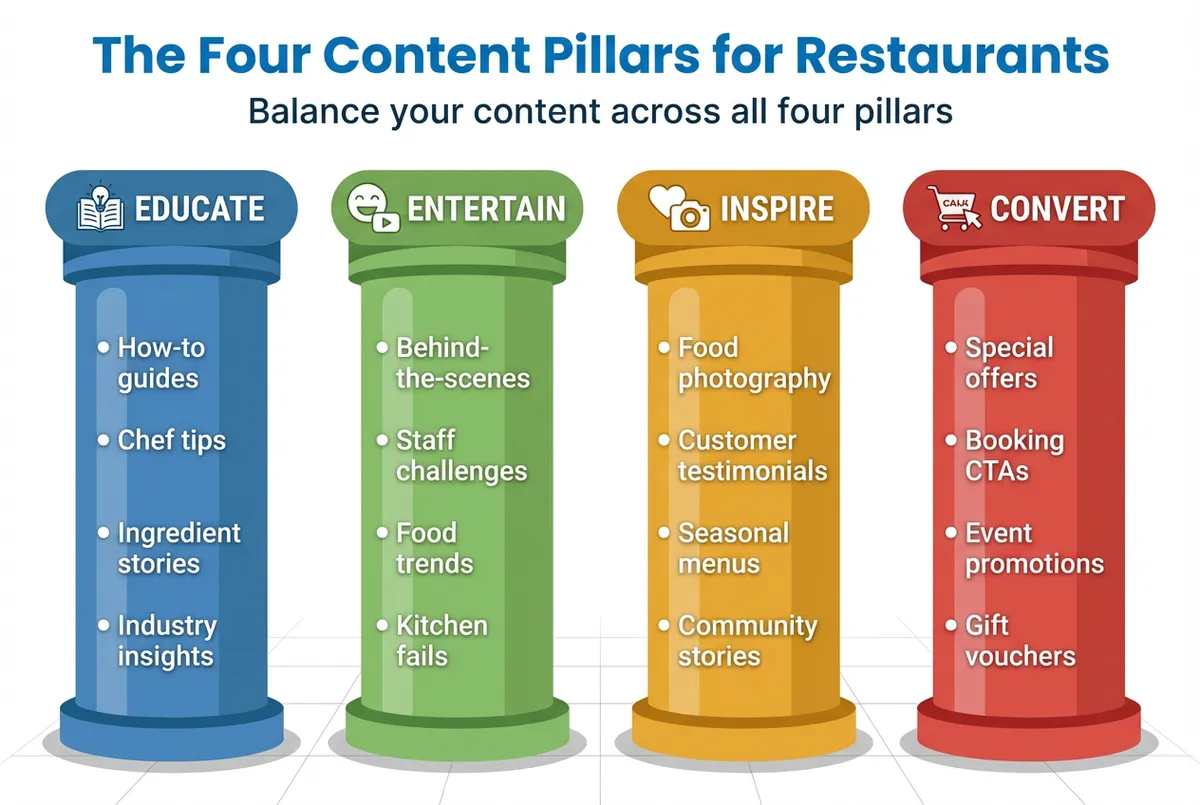
The four content pillars for restaurant marketing
Key Takeaway
Key Takeaway
Effective restaurant content marketing doesn't require a marketing degree or a big budget. It requires consistency, authenticity, and understanding what makes your restaurant worth talking about. Use the 7 P's to audit your marketing presence, apply the 3-3-3 rule to balance content types and channels, and keep the 30/30/30 budget rule in mind when allocating resources. Diners who follow restaurants on social media are significantly more likely to visit. Your best marketing asset is the authentic story only your restaurant can tell.
If you run a restaurant and want to see how Local Brand Hub can support your marketing, explore our restaurant marketing tools.
This Week's Action Plan
Monday-Tuesday: Audit your 7 P's: which one needs the most attention?
Wednesday-Thursday: Plan three posts using the 3-3-3 framework.
Friday-Sunday: Post and engage. Respond to every comment within 24 hours.
For deeper guidance, explore our guides on content marketing for restaurants, restaurant blog ideas, creating a restaurant content calendar, and understanding the 30/30/30 rule for restaurants.
For UK restaurant owners
Simplify Your Restaurant Marketing
LocalBrandHub helps UK restaurant owners manage social media, content planning, and local SEO from one simple dashboard, so your marketing runs even during the Saturday rush.
Start FreeGet More Marketing Tips
Practical marketing tips for UK business owners, straight to your inbox. No spam, unsubscribe anytime.
About the Author
Local Brand Hub
Empowering UK Businesses
Local Brand Hub provides comprehensive business management tools designed specifically for UK local businesses to streamline operations, automate marketing, and grow revenue.
More articlesRelated Articles
 Marketing Tips
Content Marketing for Restaurants: A Practical Guide
Master content marketing for restaurants using the 5 C's framework and the 30/30/30 rule. Actionable ideas that bring more diners through your door weekly.
 Marketing Tips
Restaurant Blog Ideas Only Your Kitchen Could Write
Restaurant blog ideas a rival two streets away could not copy: the test that kills weak topics, where the material sits, and a twenty minute method.
 Marketing Tips
Restaurant Content Calendar: A Free UK Template for 2026
A restaurant content calendar that survives service. Copy the seven column UK template, plan what you shoot before what you say, and start this week.