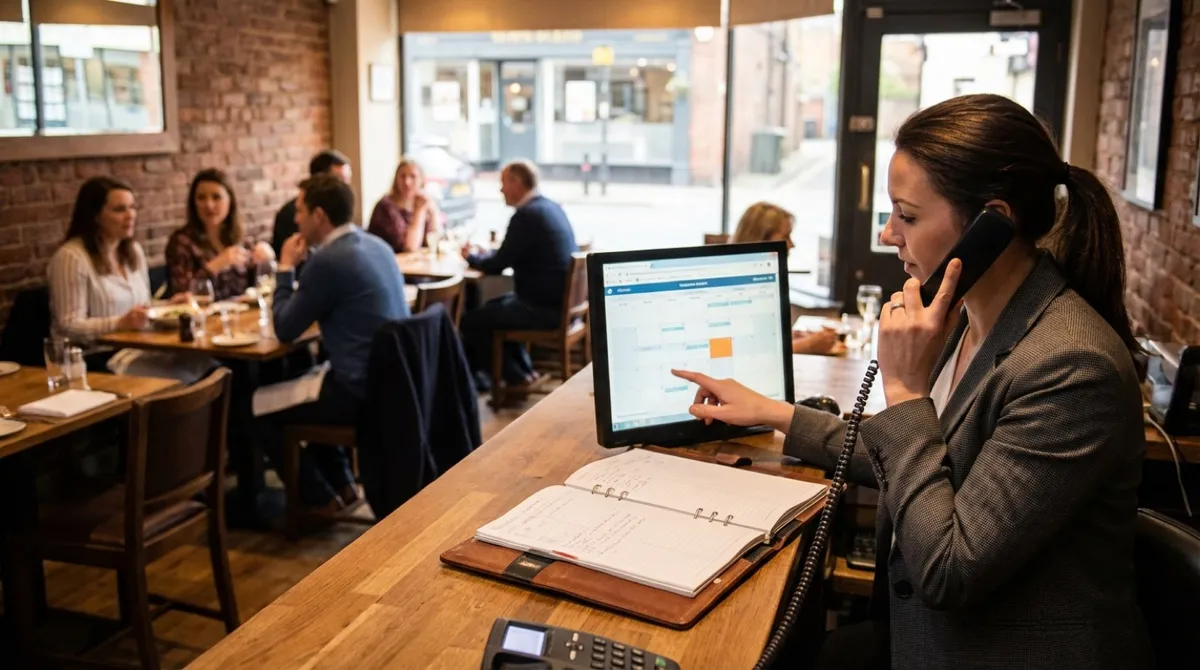
Manage restaurant group bookings with deposit policies, pre-ordering systems, and no-show prevention. A UK guide to turning large parties into real profit.
Friday night, 18-top booked for 7pm. By 7:30 only 11 have shown up. You turned away walk-ins, staffed an extra server, and prepped food for people who are not coming. Restaurant group bookings are often your biggest revenue opportunity and your biggest operational headache.
Info
Related: Restaurant Group Dining Marketing, the complete guide to marketing your venue for groups
Group dining bookings for parties of six or more grew by 5% year-on-year in 2025, and 36% of UK diners want more group and private dining options in 2026 (OpenTable, 2025). The demand is growing. The question is whether your operation can handle it without losing money on no-shows, kitchen chaos, and underspending tables.
What You'll Learn
- Why group bookings need different management from standard reservations
- How to structure deposit policies that prevent no-shows without deterring customers
- Pre-ordering systems that protect your kitchen and improve guest experience
- A communication workflow from initial booking to post-event follow-up
- Minimum spend strategies that increase per-head revenue on group nights
Why Group Bookings Need Different Management
First, understand the core problem. A two-top no-show costs you one table. An 18-top no-show costs you an entire section, wasted prep, and idle staff. Yet most restaurants handle both with the same confirmation text.
Group booking management is a framework that treats large-party reservations as mini events rather than standard table bookings. It covers:
- Deposit collection and cancellation policies
- Pre-ordering to protect the kitchen
- Communication workflows from enquiry to follow-up
- Minimum spend policies to guard revenue
If you run your restaurant events the same way you run your Tuesday evening walk-ins, you are setting yourself up for trouble. Group bookings bring dietary needs from a dozen guests, split bills, and organisers who ghost after the first enquiry.
For example, a neighbourhood bistro seating 60 covers might accept a booking for 14 on a Friday. That group takes up nearly a quarter of the restaurant. If four do not show, the kitchen has prepped food it cannot sell, the server covering that section is underutilised, and you have turned away walk-ins who would have filled those seats.
If you can't tell what your group booking no-show rate is, that's usually a sign you're not tracking it. Start recording no-shows as a percentage of group bookings this month. Without that number, every policy you create is guesswork.
Why this matters
A well-managed group of 12 spending £50 per head generates £600 in a single sitting. That is more than most restaurants take from an entire section of two-tops during the same service window. But only if all 12 actually turn up and the kitchen is ready.
What Makes Group Bookings Different
These figures are general industry guidelines and will vary by venue type, location, and cuisine.
| Factor | Standard Booking | Group Booking (8+) |
|---|---|---|
| Financial risk per no-show | Low (1-2 covers) | High (entire section) |
| Dietary coordination | Minimal | Multiple requirements |
| Kitchen prep impact | Standard mise en place | Extra prep, set menus |
| Staffing requirements | Normal rota | Additional server needed |
| Revenue per booking | £40-£80 | £400-£1,200+ |
Ask yourself: would I trust a single confirmation text to secure a booking worth £600 or more? If the answer is no, you already understand why group bookings need their own process.
Deposit Policies That Actually Work
Now that you understand why group bookings need a different approach, the first system to put in place is a deposit policy.
UK restaurants typically charge around £10 per person for group bookings, with the deposit applied to the final bill (Langlands Brasserie, 2025). Larger parties often face higher fixed deposits or a percentage of the set menu price.
Deposit Structure by Group Size
These are common UK benchmarks. Adjust based on your average spend and venue tier.
| Group Size | Recommended Deposit | Collection Method |
|---|---|---|
| 6-8 guests | £5-£10 per person | Card details on file |
| 9-15 guests | £10-£15 per person | Upfront payment |
| 16+ guests | Higher fixed deposit | Upfront or staged payments |
If you're thinking "but taking deposits puts people off," consider the alternative. A group that will not put down £10 per head is far more likely to cancel on the day. The deposit filters out casual enquiries and locks in committed bookings.
Deposits prevent time-wasters
A curry house in Manchester introduced a per-head deposit for restaurant group bookings after losing three Friday-night parties in a single month. Within weeks, their no-show rate dropped to near zero. The deposit did not reduce enquiries; it reduced time-wasters.
If you're only taking card details and never actually charging them, that never works. Guests learn quickly that deposits without enforcement are just a suggestion.
Cancellation Policy That Protects Both Sides
Your cancellation policy needs to be clear, fair, and communicated at the point of booking. Not buried in terms and conditions nobody reads.
- 72+ hours' notice: Full deposit refund
- 24-72 hours' notice: 50% deposit refund
- Under 24 hours or no-show: Deposit forfeited
Nicholson's Restaurant retains deposits when final numbers reduce significantly without advance warning (Nicholson's, 2025). That accounts for the reality that one or two dropouts are normal, but losing a quarter of the table is a material loss.
Warning
Under UK consumer law, deposits must be "reasonable" relative to the booking value. Keep deposits proportionate so they would not be challenged.
If you're only sending a single confirmation email, you'll always lose to competitors who follow up with dietary forms and pre-order links. Build a multi-touchpoint confirmation process that reinforces commitment at every stage.
Pre-Ordering: Streamlining Kitchen Operations
With that deposit secured, next protect your kitchen from the chaos of 16 people all ordering from the full menu at 7:15pm on a Saturday.
Pre-ordering restaurant group bookings is not about limiting choice. A set menu or pre-order system means your head chef knows the exact number of each dish to prepare. No over-ordering from suppliers, no waste, no bottleneck on the pass.
Three Pre-Ordering Models
1. Fixed Set Menu (Most Common)
Two or three courses at a fixed price per head. You offer a few options per course. The organiser collects choices in advance.
- Works well for: Celebrations, corporate dinners, larger parties
- Advantage: Maximum kitchen control, predictable food cost
2. Limited A La Carte
Guests choose from a reduced version of your main menu. Fewer dishes, but still individual choice on the night.
- Works well for: Casual groups who want flexibility
- Advantage: Feels less restrictive for guests
3. Shared Platters or Family Style
Large platters placed in the centre for guests to share. Works brilliantly for certain cuisines and informal occasions.
- Works well for: Mediterranean, Middle Eastern, or tapas-style venues
- Advantage: Creates a social atmosphere, reduces individual ordering time
For example, a gastropub might offer a two-course set menu at £35 per head for groups of 10 or more. The organiser receives a simple online form listing starter, main, and dessert options. Guests fill in their choices and dietary requirements. The kitchen gets a consolidated order 48 hours before the event. No surprises, no scrambling.
When building your restaurant party packages, consider bundling pre-order menus with drinks packages for a complete group offering. Managing these as set products and offers keeps your pricing consistent across every group enquiry.
Communication Workflow: Booking to Follow-Up
Additionally, you need a clear communication process. Deposits and pre-orders are sorted, but what happens between the initial enquiry and the night itself? That gap is where many restaurant group bookings fall apart.
The difference between restaurant group bookings that run smoothly and ones that fall apart is often communication. Not food quality. Not service speed. Communication.
For example, a seafood restaurant in Edinburgh templates four emails for every group booking: confirmation, dietary form, final check, and post-event thank-you. The entire sequence takes 15 minutes to set up once. After that, every group booking follows the same path regardless of which staff member handles it.
Stage 1: Enquiry to Confirmation (Day 0-3)
- Acknowledge the enquiry within 2 hours (automated email or text)
- Send group booking information pack: menus, deposit policy, T&Cs
- Collect deposit and confirm the booking
- Send confirmation with booking reference, date, time, and organiser contact
Stage 2: Pre-Event Coordination (2 Weeks Before)
- Send dietary requirements form to the organiser (online form, not email)
- Confirm final guest numbers (set a deadline, typically 72 hours before)
- Send pre-order menu choices if using set menu
- Collect completed pre-orders and dietary information
Stage 3: Final Confirmation (48-24 Hours Before)
- Confirm final numbers and any last-minute changes
- Brief kitchen on the order breakdown
- Brief front-of-house team on table layout, timing, and any special requests
- Send the organiser a final confirmation with arrival instructions
Stage 4: Post-Event Follow-Up (24-48 Hours After)
- Send a thank-you message to the organiser
- Ask for a Google review (include a direct link)
- Offer a return booking incentive for the next group event
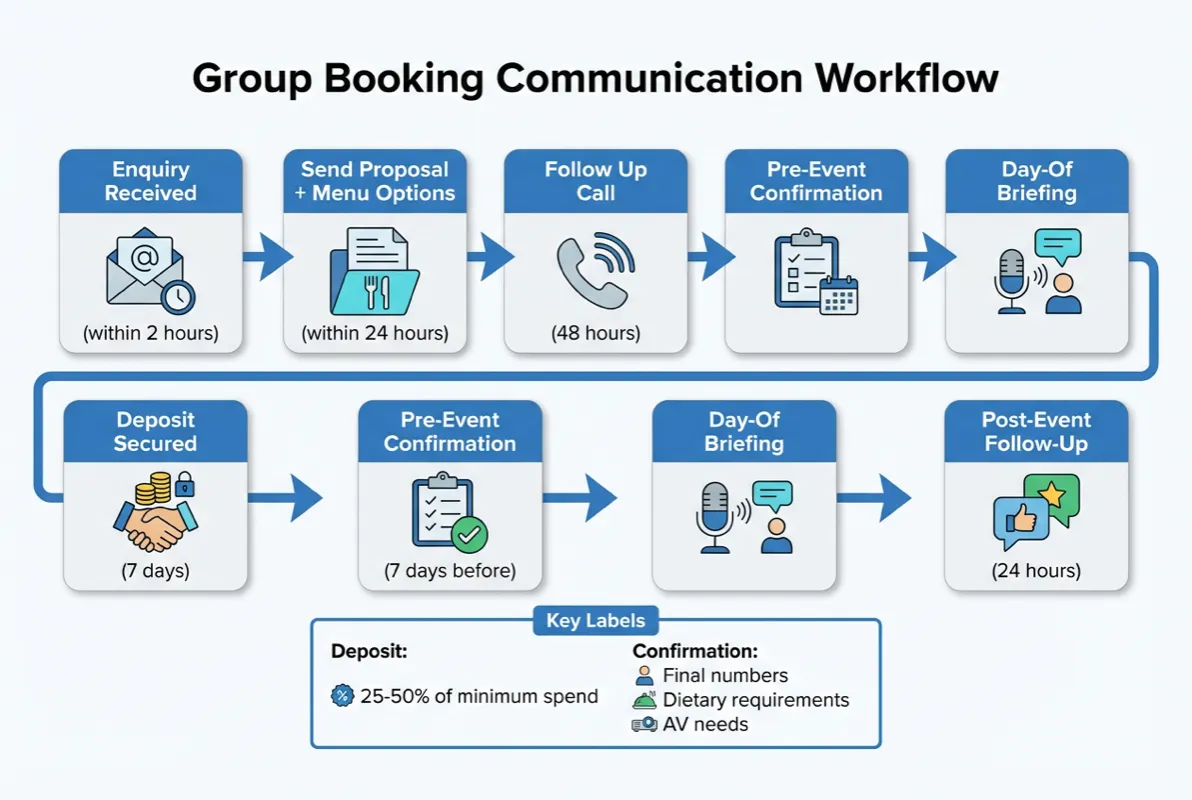
Group Booking Communication Workflow
This sounds like a lot of work. It is not. Most of this can be templated:
- One confirmation email template
- One dietary requirements form (online)
- One pre-order collection form
- One post-event thank-you message
If you're reading this thinking "I don't have time for all of this," you are not alone. The reality for most independent restaurants is that group bookings get managed during the 3pm lull or after a 12-hour shift. But consider what happens without a process. The organiser forgets to collect dietary needs, two guests have allergies you discover on the night, and your kitchen scrambles. That is more stressful than sending a form link.
Short on staff?
If you're down two staff and still getting group booking enquiries by phone, set up an email auto-responder with your group booking pack attached. It buys you time without losing the enquiry.
Minimum Spend and Pricing Strategy
Furthermore, you need to protect the revenue side. What about the group that turns up, orders tap water, and splits three starters between 12 people?
Info
A minimum spend policy for restaurant group bookings exists because that scenario is worse than the table sitting empty. You could have filled those seats with full-paying walk-ins.
The right minimum spend protects your revenue without feeling punitive to guests.
Setting Your Minimum Spend
Calculate your average revenue per cover, then multiply by the group size and apply a slight discount. A simple formula:
Minimum spend = Average spend per cover x Group size x 0.8
The 0.8 multiplier sets the minimum slightly below your average. This makes it feel achievable for guests while still protecting your revenue floor. Round the result to a clean number for easy communication.
Minimum Spend vs Per-Head Pricing
These are general rules of thumb. The right approach depends on your venue style and average covers.
| Approach | Suited For | Advantage | Risk |
|---|---|---|---|
| Minimum spend | Groups of 8-15 | Flexibility for guests | Some guests may underspend |
| Per-head pricing | Groups of 16+ | Predictable revenue | Feels restrictive |
| Set menu + drinks package | Corporate events | Highest per-head value | Limits spontaneous spending |
For example, a restaurant running special offers might create a group-specific package: three courses plus a welcome drink at £55 per head. That is clear, easy to communicate, and locks in your revenue without needing a separate minimum spend conversation.
Drinks Packages That Increase Revenue
Drinks often represent your highest-margin opportunity on restaurant group bookings. Offer tiered packages:
- Basic: Arrival drink only (prosecco or soft drink)
- Standard: Arrival drink plus wine with meal
- Premium: Arrival drink, wine pairings, and after-dinner drinks
Many groups choose the middle option. If you can't tell whether your group bookings are generating strong drinks revenue or mostly tap water orders, that's usually a sign you need structured packages rather than hoping guests will spend.
Pre-booked events with drinks packages typically drive more than 20% higher repeat bookings compared to walk-in focused venues (Zonal, 2025). Packages simplify the guest experience and increase your take.
Frequently Asked Questions
How much deposit should I charge for restaurant group bookings?
Most UK restaurants charge around £10 per person for groups of 8 or more, applied to the final bill. For larger parties, consider a fixed deposit or a percentage of the set menu price. Keep deposits proportionate to the booking value so they feel fair to guests while still securing commitment.
What is the best way to prevent restaurant group booking no-shows?
The no-show prevention approach is a framework that combines deposits with multi-touchpoint communication. Confirm at booking, follow up two weeks before, and send a final confirmation 48 hours prior. Groups that have paid a deposit and received multiple confirmations are typically much less likely to cancel without notice.
Should I offer a set menu or a la carte for group bookings?
For groups of 15 or more, set menus give your kitchen predictability and reduce service time. For groups of 8-14, a limited a la carte menu offers flexibility while still narrowing the kitchen's workload. Match the format to your venue style: formal restaurants suit set menus; casual venues suit shared platters or limited menus.
How do I handle dietary requirements for large group bookings?
Send the organiser a digital form (Google Forms or similar) at least two weeks before the event. Ask for each guest's name, dietary requirements, and allergy information. Under the Food Standards Agency's allergen guidance, UK restaurants must provide accurate allergen information for all dishes. Collecting this data in advance protects both your guests and your kitchen team.
What minimum spend should I set for group bookings?
Calculate your average spend per cover, multiply by the group size, and apply a 0.8 multiplier. This sets a floor that feels achievable for guests while protecting your revenue. Communicate the minimum clearly at the enquiry stage so there are no surprises on the night.
If you run a restaurant and want to see how Local Brand Hub can support your marketing, explore our restaurant marketing tools.
Key Takeaway
Key Takeaway
Restaurant group bookings are not harder than regular service. They are different. And different requires different systems. Here is what to implement:
- Deposit policies protect you from no-shows: charge per person with clear cancellation terms
- Pre-ordering saves your kitchen: set menus or limited a la carte with a 48-hour collection deadline
- Communication workflows prevent chaos: four touchpoints from booking to follow-up, mostly templated
- Minimum spend guards your revenue floor: set it at 80% of your average per-head spend multiplied by group size
- Drinks packages are your margin multiplier: three tiers, and most groups choose the middle one
Group bookings don't need more effort. They need better systems. The restaurants that profit from groups are not the ones with the best food. They are the ones with the best process.
For restaurants, salons, and local businesses
Need help with your marketing?
We help UK businesses turn social media into real results, not busywork.
Start freeGet More Marketing Tips
Practical marketing tips for UK business owners, straight to your inbox. No spam, unsubscribe anytime.
About the Author
Local Brand Hub
Empowering UK Businesses
Local Brand Hub provides comprehensive business management tools designed specifically for UK local businesses to streamline operations, automate marketing, and grow revenue.
More articlesRelated Articles
 Industry Insights
Private Dining Rooms: UK Design and Conversion Guide
Plan your restaurant's private dining rooms with this UK guide to layout, AV equipment, acoustics, conversion costs, and ROI.
 Industry Insights
Private Dining: Set Up, Price, and Market Your Room
Turn your underused back room into steady revenue. A UK guide to private dining setup, pricing models, and marketing for restaurant owners.
 Operations
Restaurant Corporate Events: The UK Venue Guide 2026
Guide to hosting profitable restaurant corporate events in the UK. Pricing, packages, marketing, and planning tips for venue success.