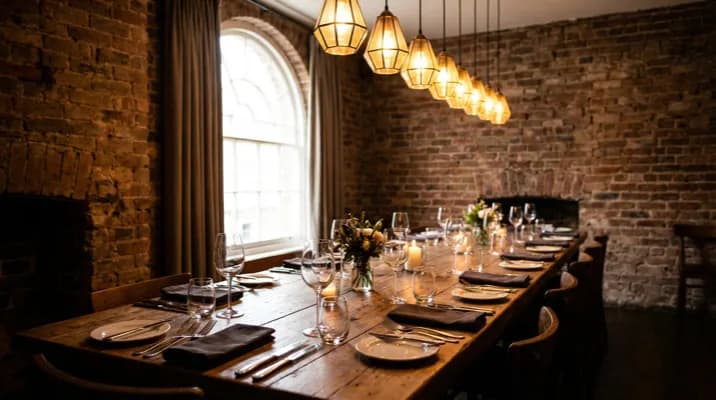
Proven group dining marketing strategies for UK restaurants. Boost private dining revenue with pricing, corporate outreach, and seasonal campaigns.
Your private dining room sits empty three nights a week. Meanwhile, corporate teams two streets away are booking competitors because they found them on Google first. Restaurant group dining marketing is how you change that, and it starts with treating group bookings as a revenue channel, not an afterthought.
Info
Related: Restaurant Marketing Guide: foundational strategies for every channel
If this sounds painfully familiar, you are not alone. Most independent restaurants undermarket their group dining spaces, leaving significant revenue on the table while chains with dedicated events teams hoover up corporate accounts and celebration bookings.
What You'll Learn
- Why group dining is one of the highest-margin revenue opportunities for UK restaurants
- How to set up and market a private dining offering, even without a dedicated room
- Pricing strategies including minimum spend, set menus, and deposit policies
- How to attract corporate clients and event planners consistently
- Managing group bookings from initial enquiry through to post-event feedback
- A seasonal marketing calendar so your group dining spaces never sit empty
Why Group Dining Revenue Matters for UK Restaurants
Let's start with the basics: group dining is not a niche. It is a core revenue opportunity that most independent restaurants fail to exploit properly. While you are focused on filling individual covers, groups of six or more represent disproportionately higher spend per head and better margin per table.
According to OpenTable (2025), dining for parties of six or more grew by 8%, with the strongest increases at the early evening time slot. That is not a blip; it reflects a sustained shift towards social and experiential dining heading into 2026.
Here is why that matters for your bottom line. Group diners consistently spend more per head than individuals: pre-set menus, shared starters, extra bottles of wine, and celebration surcharges all push average spend higher. For Christmas parties specifically, businesses consistently overspend their budgets, according to SquareMeal (2025): actual spend per head often exceeds plans by over 20%.
If you are reading this after another empty Friday in your private dining room, you are not alone. The problem is rarely the demand. It is the visibility.
Info
Related: Restaurant Events Guide: comprehensive planning for group celebrations
Group diners pay more
Guests are often willing to pay more for unique dining experiences, including group offerings. That is revenue waiting for whoever markets to it first.
Restaurant group dining marketing is not about filling tables. It is about making your restaurant the first name that comes up when someone says "where should we go?"
How to Set Up and Market a Private Dining Offering
Now that you understand the revenue opportunity, here's the next question: what if you do not have a traditional private dining room? That does not matter as much as you think. Many successful group dining operations start with a semi-private area, a screen or curtain, and a dedicated menu.
Defining Your Group Dining Product
Before you spend a penny on marketing, define exactly what you are selling. Don't just add "groups welcome" to your website and hope for the best; that never works. A vague "we can do groups" is not a product. A specific "private dining for 8-20 guests with a bespoke three-course menu from £45 per head" is.
For example, a neighbourhood Italian might create three tiers:
- Semi-private area (smaller groups): Curtained section, shared menu, lower price point
- Full buyout (larger groups): Exclusive use on quieter evenings, minimum spend model
- Chef's table (intimate groups): Kitchen-adjacent experience, premium pricing
Getting Your Group Dining Offering Online
According to OpenTable (2025), the majority of restaurant reservations are now booked online. If your group dining offering is not visible online, it effectively does not exist.
Essential digital foundations:
- Google Business Profile: Add "private dining" and "group bookings" to your services. Upload photos of your private space. Include it in your business description.
- Dedicated website page: Create a standalone page for group dining with menus, capacity, photos, and a clear enquiry form. This single page will work harder than any social post.
- Online booking integration: Make it possible to request group bookings through your website, even if you confirm manually.
If you're only relying on walk-ins you'll always lose to competitors who actively market their group dining spaces online.
Rank for local private dining searches
Many diners use Google Search to discover restaurants. A dedicated group dining page that ranks for "[your area] private dining" is worth more than a month of social media posts.
Info
Related: Restaurant Private Dining: what diners look for when booking group spaces
Pricing Strategies: Minimum Spend, Set Menus, and Deposits
Now that your group dining offering is defined and visible online, the next challenge is pricing. This is the question that trips up most restaurant owners. Pricing group dining packages wrong is one of the fastest ways to either leave money on the table or scare off bookings entirely.
Minimum Spend vs Per-Head Pricing
The minimum spend approach is a framework that sets a total floor for the group's bill, regardless of individual orders. Per-head set menus charge a fixed rate per guest instead.
| Approach | Works Well For | Key Advantage |
|---|---|---|
| Minimum spend | Larger groups, premium venues | Flexibility for guests |
| Per-head set menu | Celebrations, mid-range venues | Simple to understand |
| Hybrid | Corporate events | Clarity with flexibility |
For most UK restaurants, a per-head set menu with optional drink packages often offers the clearest value proposition for group bookers.
Setting Your Minimum Spend
Calculate it by working backwards:
- Opportunity cost: What would you earn from individual covers in that space?
- Service cost: Dedicated staff, any special setup, cleaning
- Target margin: Aim for at least 65-70% gross margin on set menus
For example, if your private area seats 12 and you would normally turn those covers twice at a typical spend per head, calculate that baseline total. Your minimum spend should sit above this to make the group booking more profitable than regular service.
The Deposit Question
If you are reading this thinking "deposits will put people off", that is a valid concern, but only half the picture. According to Zonal (2025), a significant proportion of UK diners fail to show up for bookings. For group bookings, a no-show for a party of 12 is not a lost table; it is a lost evening for an entire section of your restaurant.
Recommended deposit approach for groups:
- Require deposits for parties of 8+: Non-negotiable for protecting your revenue
- Set a reasonable deposit per person: The majority of UK restaurants now use deposit schemes, according to Zonal (2025)
- Make deposits redeemable against the bill: This removes the objection: it is not a fee, it is a pre-payment
- Send automated reminders: Before the booking to confirm attendance
This sounds great in theory. In practice, when you are down two staff and dealing with a full Saturday service, the last thing you want is to chase deposits manually. Automate everything you can through your booking system.
Info
Related: Restaurant Special Offers Guide: structuring promotions that protect margin
Attracting Corporate Clients and Event Planners
Now that your pricing is sorted, here's where the real revenue growth happens. Corporate group dining is often the highest-value segment you can target. Business diners spend more, book further in advance, and repeat quarterly if the experience is good.

Group dining marketing strategy overview
The Corporate Christmas Opportunity
According to SquareMeal (2025), Christmas party bookings surged over 50% compared to the prior season. The Christmas party market also saw a significant increase in total spend.
For example, a city-centre bistro might generate a substantial chunk of its entire annual private dining revenue in December alone. One restaurant owner shared that their private room was booked solid every December evening, all from corporate clients who first found them through Google and venue platforms.
Building Corporate Relationships
The reality for most independent restaurants is that corporate clients feel out of reach. They are not. Cold outreach still works when done properly. Here is how to approach it:
- Identify targets: List 20-30 businesses within a 10-minute walk. Offices, co-working spaces, professional services firms
- Create a corporate pack: PDF with photos, sample menus, pricing, AV capabilities, and a named contact
- Offer a tasting: Invite decision-makers for a complimentary lunch. One meal costing you £30 could generate thousands in repeat bookings
- Follow up seasonally: September for Christmas, January for Q1 team events, March for financial year-end
Reaching Event Planners
Event planners and PAs are professional bookers. They value reliability, responsiveness, and clear information above all else.
- List on venue-finding platforms: SquareMeal, Tagvenue, VenueScanner, Headbox; these are where PAs search first
- Respond to enquiries fast: Speed wins. A PA sending enquiries to five venues typically books the first one that replies with clear information
- Provide instant quotes: Have templated quotes ready for common group sizes so you can respond quickly
If you can't tell whether your group dining marketing is actually reaching corporate clients, that's usually a sign you need better tracking on where enquiries originate.
Info
Related: Restaurant Party Packages: creating packages that appeal to corporate and social bookers
Managing Group Bookings: From Enquiry to Feedback
Here's where many restaurants drop the ball. Once enquiries start arriving, the real work begins. The sale does not end when someone confirms: in fact, most of the revenue in restaurant group dining marketing comes from how well you manage the booking between confirmation and the event itself.
The Enquiry-to-Booking Pipeline
Speed matters. If you're responding to enquiries days later you'll always lose to competitors who reply within hours. A group organiser typically contacts 3-5 venues. The first restaurant to respond with clear, helpful information wins the booking more often than the cheapest option.
Your response should include:
- Available dates and times
- Menu options with pricing
- Room capacity and layout photos
- Deposit requirements and cancellation terms
- A named point of contact for follow-up questions
Pre-Ordering: Your Secret Margin Booster
Pre-ordering is where group dining margins become genuinely impressive. When guests choose from a set menu a few days before the event, you gain:
- Reduced food waste: You order exactly what you need
- Faster kitchen throughput: The kitchen preps with certainty
- Better dietary management: Allergies and restrictions handled in advance, as required by the Food Standards Agency
- Upsell opportunity: Add drink packages, canape receptions, or dessert upgrades at the pre-order stage
For example, a gastropub running pre-ordered group menus might see food costs drop significantly compared to a la carte service, because there is zero waste and portion control is exact.
Reducing No-Shows
No-shows are a persistent challenge across UK hospitality, according to Zonal (2025). Group no-shows are particularly devastating: a single cancelled party of 12 can wipe out an entire evening's revenue for that section.
No-show prevention for groups:
- Take deposits (non-negotiable for parties of 8+)
- Send confirmation emails with full booking details
- Call two days before to confirm final numbers
- Send a "looking forward to welcoming you" message the day before
- Have a clear cancellation policy communicated at booking
Post-Event Follow-Up
This is where repeat bookings are born. Within 24 hours of the event:
- Send a thank-you email with a direct line for future bookings
- Ask for a Google review: group organisers write detailed, credible reviews
- Offer a return incentive: A discount on their next group booking
- Add them to your events mailing list (with permission)
If you are thinking "I do not have time for all this follow-up", you are not alone. But one corporate client who books quarterly is worth thousands per year. A single thank-you email is worth that effort.
If you're only sending one follow-up email after a group event you'll always lose to competitors who build ongoing relationships with their group bookers.
Seasonal Restaurant Group Dining Marketing Calendar
Finally, let's look at timing. Your restaurant group dining marketing needs a seasonal rhythm. Group dining demand is highly seasonal, so mapping your promotions to ready-made seasonal campaigns months ahead beats scrambling to fill gaps. If you only market when bookings are quiet, you are already too late.
For example, a seafood restaurant in a coastal town might see group dining enquiries peak in June for hen parties and summer celebrations, then again in November for corporate Christmas bookings. Knowing your seasonal pattern lets you market three months ahead instead of scrambling to fill gaps.
| Season | Key Opportunities | Action Timing |
|---|---|---|
| Jan-Feb | New Year team lunches, Galentine's | Market in November |
| Mar-May | Easter, Mother's Day, graduations | Market in January |
| Jun-Aug | Summer parties, hen/stag events | Market in April |
| Sep-Dec | Christmas parties, year-end corporate | Market from September |
Start Christmas marketing early
According to SquareMeal (2025), Christmas bookings were already surging by June, with a 40% year-on-year increase recorded at that point. By October, the best dates are gone.
The September Rule
The single most impactful thing you can do for your group dining revenue is send a Christmas menu to every corporate contact and past group booker in September. Not October. September.
The restaurants that filled December did not wait for enquiries; they created demand three months early. If you're only starting to think about Christmas bookings in November you'll always lose to competitors who planned their December in September. If you are not actively promoting your group dining packages by September, you are leaving money for competitors.
Info
Related: Restaurant Group Bookings Guide: deposits, communication, and no-show prevention
If you run a restaurant and want to see how Local Brand Hub can support your marketing, explore our restaurant marketing tools.
Key Takeaway
Key Takeaway
Restaurant group dining marketing is one of the most under-utilised revenue streams in UK restaurants. Here is what to act on:
- Define your product: Create specific group dining packages with clear pricing; "we do groups" is not a product
- Get found online: A dedicated website page, optimised Google Business Profile, and listings on venue platforms are non-negotiable
- Price for profit: Use minimum spend or per-head set menus with at least 65-70% gross margin
- Require deposits for 8+ guests: The majority of UK restaurants now use deposit schemes; you should too
- Target corporate clients: Build a list of local businesses, create a corporate pack, and follow up seasonally
- Start Christmas marketing in September: By December, the best dates are already gone
- Automate booking management: Confirmations, reminders, pre-ordering, and follow-up should run without you chasing manually
Weekly Action
If you only have 30 minutes a week to improve your restaurant group dining marketing:
- Day 1-2: Audit your online presence: can someone searching "[your area] private dining" find you? Check your Google Business Profile, website, and any venue platform listings
- Day 3-4: Create or update one group dining menu with clear per-head pricing. Photograph your private or semi-private space
- Day 5-7: Email 5 local businesses with your group dining information and a named contact. Include a PDF attachment they can forward to their team
This minimum viable approach gets real results. One corporate client who books quarterly is worth more than dozens of individual walk-ins over the same period.
Frequently Asked Questions
How far in advance should I start marketing Christmas group dining?
Start in September. According to SquareMeal (2025), Christmas party bookings were already surging 40% year-on-year by June. Corporate event planners and PAs often start looking in early autumn, and the most popular dates, particularly the second Saturday in December, sell out months ahead.
What is a reasonable minimum spend for private dining?
The minimum spend concept is a framework that sets a total pricing floor covering your opportunity cost plus target margin. Calculate it by estimating what the space would normally generate in individual covers, then add 20-30%. Most mid-range UK restaurants set minimums well above individual cover revenue, varying by group size, location, and day of the week.
Should I charge deposits for group bookings?
Yes, for parties of eight or more, deposits are essential. According to Zonal (2025), a significant number of UK diners fail to honour bookings, and group no-shows are far more costly than individual ones. Set deposits per head and make them redeemable against the final bill to reduce friction.
How do I attract corporate clients for group dining?
Build a shortlist of 20-30 businesses within walking distance. Create a professional PDF with photos, menus, pricing, and AV details. Offer a complimentary tasting lunch to key decision-makers. Follow up seasonally: September for Christmas, January for Q1 events, March for year-end celebrations. List on corporate venue platforms like SquareMeal and Tagvenue.
Do I need a separate room for private dining?
No. Many restaurants successfully offer group dining with semi-private areas created using screens, curtains, or architectural features. What matters is the perception of exclusivity: a defined space, dedicated service, and a distinct menu. Market the experience, not just the room.
For restaurants, salons, and local businesses
Need help with your marketing?
We help UK businesses turn social media into real results, not busywork.
Start freeGet More Marketing Tips
Practical marketing tips for UK business owners, straight to your inbox. No spam, unsubscribe anytime.
About the Author
Local Brand Hub
Empowering UK Businesses
Local Brand Hub provides comprehensive business management tools designed specifically for UK local businesses to streamline operations, automate marketing, and grow revenue.
More articlesRelated Articles
 Marketing Tips
Private Dining Restaurant Marketing Ideas: 9 That Work
Nine private dining marketing ideas for UK restaurants: what to put on your room page, where to list it, and how to answer an enquiry before rivals do.
 Marketing Tips
Private Dining Marketing Strategy: 12-Month Plan
Build a private dining marketing strategy that fills your room year-round with seasonal campaigns, corporate pipelines, and rebooking systems.
 Marketing Tips
Restaurant Grand Opening Marketing Strategy: The Timeline
A restaurant grand opening marketing strategy works backwards from the dates you cannot move: the three phases, the budget split, what each week owes.