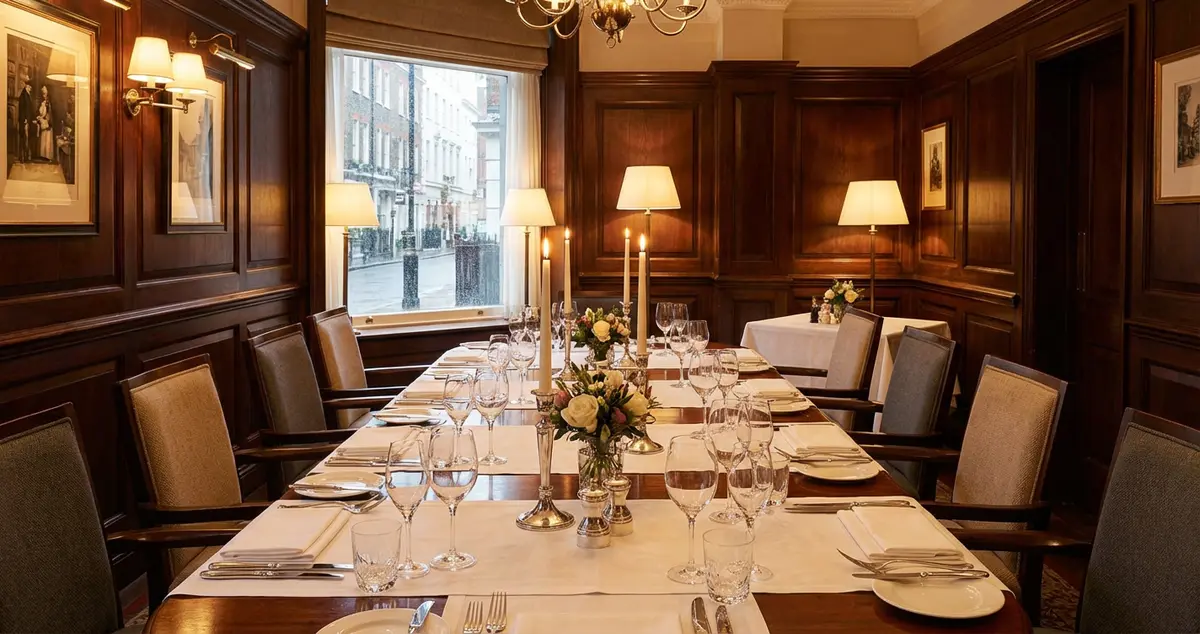
Plan a private dining event at a UK restaurant. Covers costs from £30 to £200 per head, room types, menu options, and booking tips for any group size.
You're organising a birthday dinner for 15 people. Every restaurant either can't fit you together or wants to scatter your group across three separate tables, killing conversation. Restaurant private dining rooms exist precisely to solve this problem, giving your party an enclosed space with dedicated service and privacy.
Info
Related: See our restaurant events guide for comprehensive planning for group celebrations.
If this scenario sounds painfully familiar, you're not alone. Finding the right restaurant private dining space can feel overwhelming, but it doesn't need to be.
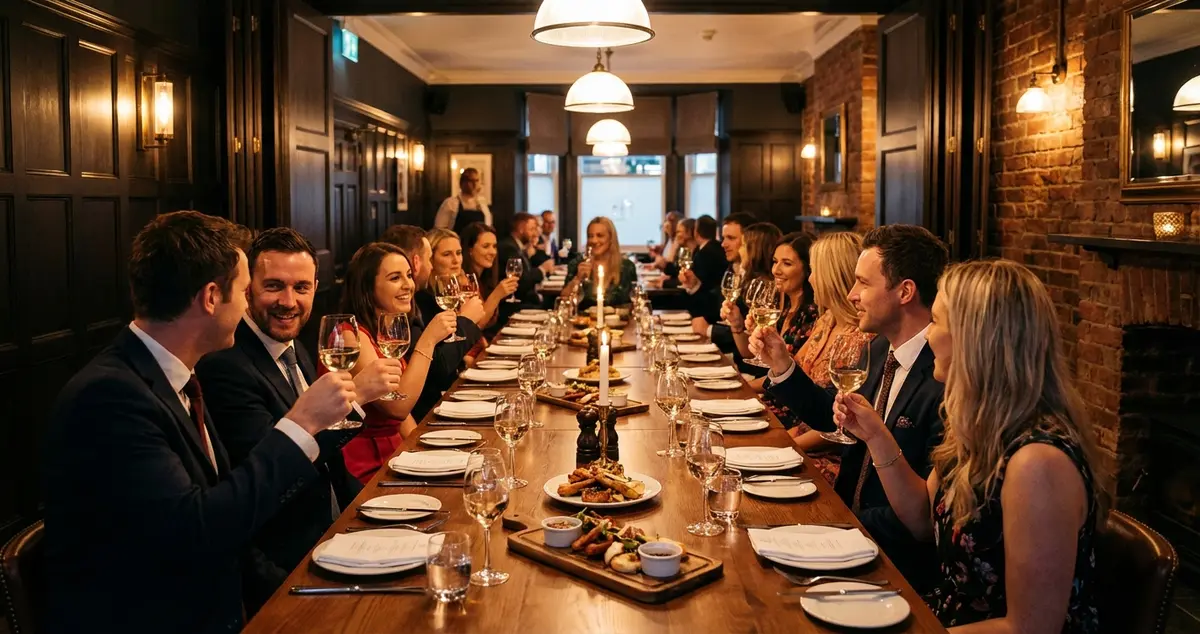
A private dining room is a dedicated, enclosed space within a restaurant reserved exclusively for your party. Unlike booking a regular table, you get your own room. You get personalised service, set menus, and the ability to actually hear your guests. No competing with background noise.
According to Tagvenue's research, private dining rooms in London average a minimum spend of £1,000 per event. Options range from £200 for budget venues to over £6,000 for luxury experiences.
What You'll Learn
- What private dining actually means and how it differs from group bookings
- Typical costs and minimum spend requirements across UK venues
- What secret restaurants and supper clubs offer as alternatives
- Private dining options at well-known restaurants including Gordon Ramsay venues
- How to choose the right space for your group size and occasion
What Does a Private Dining Room Mean?
Now that you understand why restaurant private dining matters, let's clarify what you're actually booking.
A private dining room is a self-contained space within a restaurant. It's separated from the main dining area and reserved exclusively for one party. The key difference from standard group booking is exclusivity. You're not sharing the space with other diners. This means dedicated service, customised menus, and complete privacy for your event.
Most private dining rooms accommodate 8-30 guests comfortably. This is the sweet spot for both pricing and venue availability. Smaller groups of 2-10 can find options. However, many venues prefer larger bookings due to minimum spend requirements.
For example, a gastropub might offer a semi-private area behind a partition for 8-12 guests. A fine-dining restaurant might have a completely separate room. It could have its own entrance, dedicated waiting staff, and full customisation from lighting to music.
If you're thinking "I don't need anything fancy, just somewhere we can all sit together." That's still private dining. It's not about luxury; it's about having a contained space where your group isn't interrupted and your conversations stay private.
What Private Dining Typically Includes
- Exclusive space: Your group has the room to yourselves
- Set menus: Pre-selected options that streamline service
- Dedicated staff: Waiters assigned specifically to your party
- Flexible timings: Often more flexibility on arrival and departure
- Audio-visual options: Many rooms include screens for presentations
How Much Does Private Dining Cost in the UK?
So you've decided restaurant private dining is worth exploring. The next question everyone asks: what's this actually going to cost?
Private dining costs vary significantly based on venue tier, location, and group size. Here's what you can typically expect in London and across the UK.
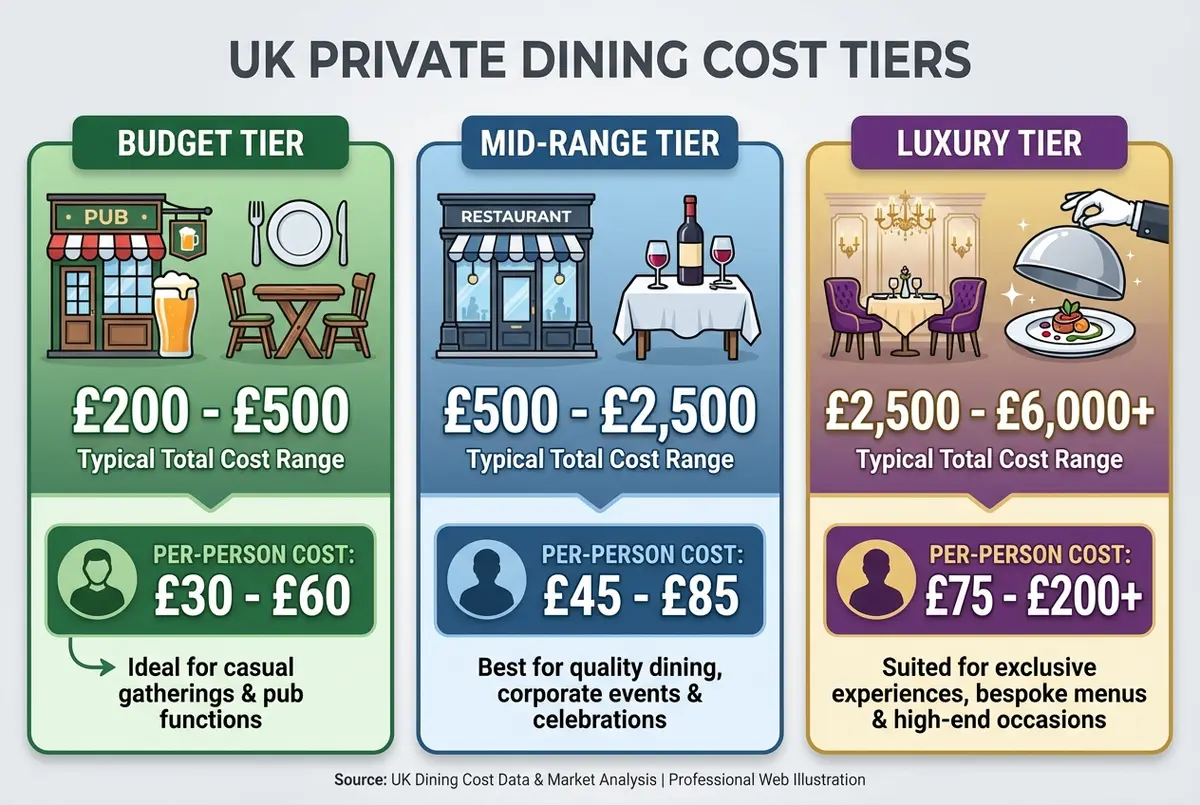
Private dining costs vary by venue tier and location
Cost Breakdown by Venue Tier
Budget venues (£200-£500 minimum spend)
- Typically pubs, casual restaurants, or community spaces
- Per-person cost: £30-£60
- Often include room hire with minimum spend
Mid-range venues (£500-£2,500 minimum spend)
- Quality restaurants with dedicated private rooms
- Per-person cost: £45-£85
- Usually no separate room hire if minimum spend is met
Luxury venues (£2,500-£6,000+ minimum spend)
- Fine dining establishments, hotel restaurants
- Per-person cost: £75-£200+
- Premium service, exclusive menus, sommelier attention
Understanding Minimum Spend
Minimum spend is where you commit to spending a set amount on food and drinks. You don't pay a separate room hire fee. If your group spends less than the minimum, you pay the difference. According to Tagvenue, this model has become standard across UK private dining venues. Restaurants face increasing pressure from no-shows and rising operational costs.
Real examples from London:
- The Wolseley: From £350 minimum spend (no room hire)
- Bob Bob Ricard: £1,000 lunch / £1,500 dinner minimum
- Small venues (up to 18 guests): £500-£1,000 minimum
If you're reading this after getting quoted prices that seem steep, here's the reality: restaurant private dining isn't cheap, but it eliminates the chaos of managing a large group in a busy restaurant. You're paying for certainty and a contained experience.
The Most Important Question
Would I book a venue without asking about their minimum spend policy upfront? Never. It's the single most important question that determines whether you're in budget.
What Is a Secret Restaurant Called?
Beyond traditional restaurant private dining, you might have heard about alternative dining experiences. Here's what they actually are.
A secret restaurant is also known as a supper club, underground restaurant, or pop-up dining experience. The supper club concept is a framework that brings together strangers for communal dining in non-traditional venues. These are unlicensed dining events typically held in someone's home or a temporary venue. According to Wikipedia's definition, these emerged from Cuban "paladares". They've grown significantly in the UK since the 2020s.
How Supper Clubs Differ from Private Dining
The supper club concept is a framework for communal dining that operates outside traditional restaurant structures. Here's how they compare:
| Feature | Private Dining Room | Supper Club |
|---|---|---|
| Location | Licensed restaurant | Home or temporary venue |
| Booking | Direct with venue | Ticket purchase, often secretive |
| Menu | Set or customised | Chef's choice, fixed |
| Atmosphere | Professional service | Informal, communal |
| Group type | Your own party | Mix of strangers |
Why This Matters
Understanding these differences prevents booking disappointment. Many people expect private dining at supper clubs, only to find themselves seated with strangers.
Supper clubs are a cross between a dinner party and a restaurant. You get the informality of a domestic setting. You also get the benefit of restaurant-quality food. But you'll typically dine with strangers rather than your own group.
Unlike restaurant private dining where you control the guest list, supper clubs embrace the communal experience.
For example, The Secret Supper Society operates across the UK. They reveal locations only after ticket purchase. Guests attend expecting to meet new people over a shared meal. This makes it ideal for solo diners or couples seeking a social experience.
If you're looking for a private celebration with just your guests, traditional private dining rooms are the better choice. Supper clubs suit adventurous diners who want a unique experience and don't mind communal seating.
Does Gordon Ramsay Do Private Dinners?
If you're considering a celebrity chef restaurant for your private dining experience, here's what Gordon Ramsay's group offers.
Yes. Gordon Ramsay Restaurants, one of the UK's largest privately-owned restaurant groups with 34 UK venues, offers restaurant private dining across multiple London locations, ranging from intimate chef's tables to larger event spaces.
Gordon Ramsay Private Dining Options
According to the Gordon Ramsay Restaurants website, private dining is available at these London venues:
- Restaurant Gordon Ramsay High (22 Bishopsgate): 12-seat chef's table on the 60th floor: Europe's highest restaurant, opened February 2025
- The Savoy Grill: Private room seating up to 16 guests
- Bread Street Kitchen (Stratford): Two rooms for 10 or 14 guests
- Heddon Street Kitchen: Private room for up to 12 guests
- Lucky Cat (Mayfair): Semi-private dining for up to 14 guests
The flagship Chelsea restaurant (Restaurant Gordon Ramsay) holds three Michelin stars and has maintained them for 24 consecutive years. While the main restaurant focuses on intimate fine dining, private events are available across the wider group.
If you can't tell whether a celebrity chef restaurant offers real private dining or just semi-private seating, that's usually a sign you need to call and ask specifically about enclosed rooms.
That's the reality for most celebrity chef restaurants: the flagship location often doesn't offer restaurant private dining due to limited space, but sister venues within the group do.
What Is the Dining Room in a Restaurant Called?
When discussing restaurant private dining options with venue managers, understanding industry terminology helps you communicate effectively.
In restaurant terminology, the customer-facing dining area is called the front of house (FOH). The FOH concept is a framework that describes all customer-facing areas in a restaurant. According to Restaurant 365, FOH encompasses all public areas. This includes where guests are received, seated, and served.
For example, when you ask to view a private dining room, the manager will walk you through the FOH areas first, then show you the private space itself.
Front of House Areas
- Main dining room: The primary seating area
- Private dining room(s): Enclosed spaces for exclusive use
- Bar area: Drink service, often with food options
- Waiting area: Where guests wait for tables
- Host station: Greeting and seating coordination
- Outdoor seating: Patios, terraces, or pavement tables
The back of house (BOH) covers everything guests don't see: the kitchen, prep areas, storage, dishwashing stations, and staff facilities.
Don't just rely on photos when evaluating a private dining room, because what looks great online often feels very different in person. The biggest mistake is booking without visiting first.
When visiting to discuss private dining options, you'll likely be shown the FOH areas by a manager or events coordinator. Understanding this terminology helps when discussing your requirements.
Does Dishoom Have a Private Dining Room?
One of the most-searched questions about restaurant private dining involves popular chains. Here's the answer for Dishoom.
Dishoom offers semi-private spaces and group dining options rather than fully enclosed private rooms. According to Dishoom's website, their cafés have some semi-private areas, though larger groups may be spread across nearby tables.
Group Dining at Dishoom
- Group feasts: Available for birthdays, work events, celebrations
- Breakfast feasts: Group bookings with bottomless chai until 11:45am
- Semi-private areas: Partial separation from main dining room
- Locations: King's Cross, Shoreditch, Covent Garden, Kensington, and more
For fully private events with complete enclosure, Dishoom's Permit Room in Brighton offers their rooftop "Aunty Bar" for private hire. If true restaurant private dining matters to you, ask specifically about enclosed rooms when contacting a venue.
If you only have 30 minutes this week to explore private dining options, Dishoom's group feast menus are worth checking. They handle the menu selection. This makes it simpler for organisers. Just note that you won't have a completely enclosed room at most locations.
Choosing the Right Private Dining Space
With so many restaurant private dining options available, how do you actually choose? Match your priorities to the space's strengths. Here's a quick framework:
For Business Dinners
Prioritise: AV equipment, central location, professional service Consider: Claridge's, The Wolseley, City restaurants Avoid: Venues with shared walls or loud background music
For Celebrations
Prioritise: Atmosphere, menu flexibility, space for speeches Consider: Mid-range restaurants with character, hotel dining rooms Avoid: Overly formal venues that restrict movement
For Intimate Gatherings
Prioritise: Comfort, quality food, personal service Consider: Chef's tables, smaller private rooms, gastropubs Avoid: Large spaces that feel empty with small groups
For most UK groups of 10-20 people looking for good food without excessive formality, mid-range restaurants with dedicated private rooms often offer the best balance of cost, service, and atmosphere.
Private Dining Booking Checklist
Use this checklist before confirming any restaurant private dining booking:
- Confirmed minimum spend and what's included
- Asked about room hire fees vs minimum spend model
- Checked if the room is fully enclosed or semi-private
- Requested set menu options and customisation possibilities
- Confirmed AV equipment availability if needed for presentations
- Asked about dietary accommodation process
- Checked cancellation policy and deposit requirements
- Confirmed maximum and minimum guest numbers
Info
Related: See our guide on restaurant group bookings for more planning tips.
For example, a marketing agency booking a quarterly client dinner might choose The Wolseley for its central location and professional atmosphere, while a family celebrating a 60th birthday might prefer a gastropub's private room where guests can move around and the atmosphere feels relaxed.
If you're only researching online you'll always lose to organisers who make time for site visits. A 15-minute venue walkthrough reveals issues that photos never show. Things like awkward room layouts, noisy air conditioning, or tables that can't be rearranged.
Key Takeaways
If you run a restaurant and want to see how Local Brand Hub can support your marketing, explore our restaurant marketing tools, including an AI social post generator to promote your private dining spaces.
Key Takeaways
Private dining transforms group meals from logistical nightmares into enjoyable experiences. Here's what to remember:
- Definition: Restaurant private dining is an exclusive, enclosed space within a restaurant reserved for your party alone
- Costs: Budget £30-£60 per head for casual venues, £75-£200+ for luxury; minimum spends typically £500-£2,500
- Alternatives: Supper clubs offer communal dining experiences in informal settings, but you'll dine with strangers
- Gordon Ramsay: Private dining available across the restaurant group, with the new 60th-floor chef's table at 22 Bishopsgate as the standout option
- Dishoom: Semi-private areas available; fully enclosed rooms only at select locations
Whether you're planning a milestone birthday, a corporate dinner, or a family celebration, restaurant private dining gives you control. Start by identifying your group size, budget per head, and the atmosphere you want. Then reach out to venues with specific questions about minimum spend, menu options, and room features.
If you can't tell whether your usual venue choices consistently deliver good group experiences, that's usually a sign you need to expand your shortlist. Most groups settle for "good enough" when better options exist within the same budget.
Weekly Action
This Week: Start Your Venue Search
- Day 1-2: List your top 3 priorities (budget, location, atmosphere)
- Day 3-4: Search for 5-7 venues matching your criteria on Tagvenue or OpenTable
- Day 5-7: Email 3 venues requesting availability, minimum spend, and menu samples
This minimum viable approach gets you real options without overwhelming research. Would I book a private dining room without comparing at least three venues? Never.
Info
Explore our detailed guides:
- Restaurant Events - Complete UK planning guide
- Restaurant Corporate Events - Business booking strategies
- Restaurant Event Ideas - Creative concepts for every venue type
For UK restaurants
Need Help Planning Your Private Dining Offering?
Local Brand Hub helps UK restaurants market their private dining spaces to corporate clients and celebration seekers.
Start freeGet More Marketing Tips
Practical marketing tips for UK business owners, straight to your inbox. No spam, unsubscribe anytime.
About the Author
Local Brand Hub
Empowering UK Businesses
Local Brand Hub provides comprehensive business management tools designed specifically for UK local businesses to streamline operations, automate marketing, and grow revenue.
More articlesRelated Articles
 Operations
Restaurant Corporate Events: The UK Venue Guide 2026
Guide to hosting profitable restaurant corporate events in the UK. Pricing, packages, marketing, and planning tips for venue success.
 Operations
Restaurant Event Planning: Complete UK Checklist for 2026
Plan profitable restaurant events with this UK checklist. Covers budgets, pricing tiers, promotion timelines, and staffing requirements.
 Operations
Restaurant Events: Complete UK Planning Guide
Plan restaurant events that fill tables and build loyalty. From private dining to themed nights, with budgets, timelines, and promotion tactics.