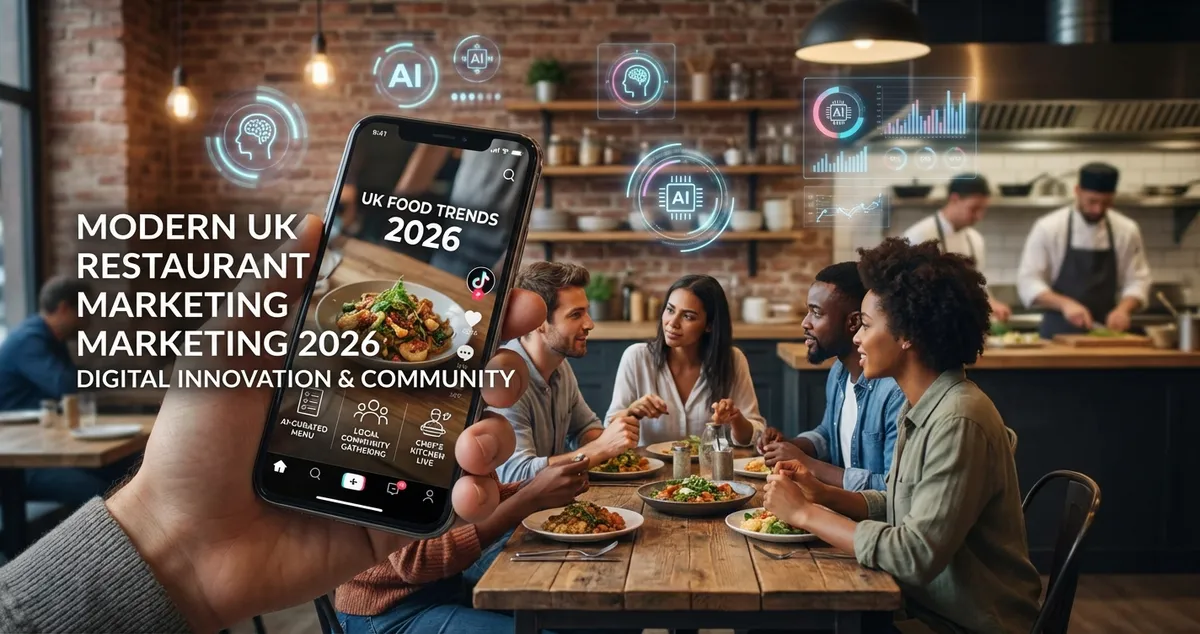
Restaurant marketing trends UK businesses need. Short-form video, AI tools, community focus: what's working for independent restaurants.
You're posting on Instagram, updating your Google listing, maybe even trying TikTok, but you're not sure what's actually working. If that sounds familiar, you're not alone. Restaurant marketing trends UK focus on short-form video, AI tools, local ties, and real content over polish, rather than chasing every platform. UK independents winning combine new tools with solid basics.
Short on time? Here's the quick version
- Short-form video is essential: Start simple, authenticity beats production value
- AI helps efficiency, not strategy: Use for drafts and automation, keep humans in control
- Authenticity beats polish: Your independence is a marketing advantage
- Community trumps reach: Local connection matters more than follower counts
- Reviews remain critical: Make systematic collection a priority
- Own your audience: Email and first-party data protect against platform changes
Full breakdown of 7 trends below
Every year brings new marketing buzzwords. But restaurants that thrive aren't chasing every trend, they understand which ones actually matter for their business.
Info
Why This Matters: The top restaurant marketing trends UK businesses adopt can make a real difference to bookings. But chasing the wrong trends wastes time you don't have. Pick 2-3 that fit your audience, master them, and ignore the rest.
Per UK Hospitality research, independents that focus on 2-3 key trends beat those who chase too many.
This guide covers the restaurant marketing trends UK independents need, with honest takes on what's worth your time and what's hype.
Related: Restaurant marketing: the fundamentals that never change.
What You'll Learn
- The 7 most important restaurant marketing trends for UK restaurants
- Which trends are worth investing in, and which to ignore
- How to adapt trends for independent restaurant budgets
- What's changing in social media, AI, and local marketing
- Practical action steps for each trend
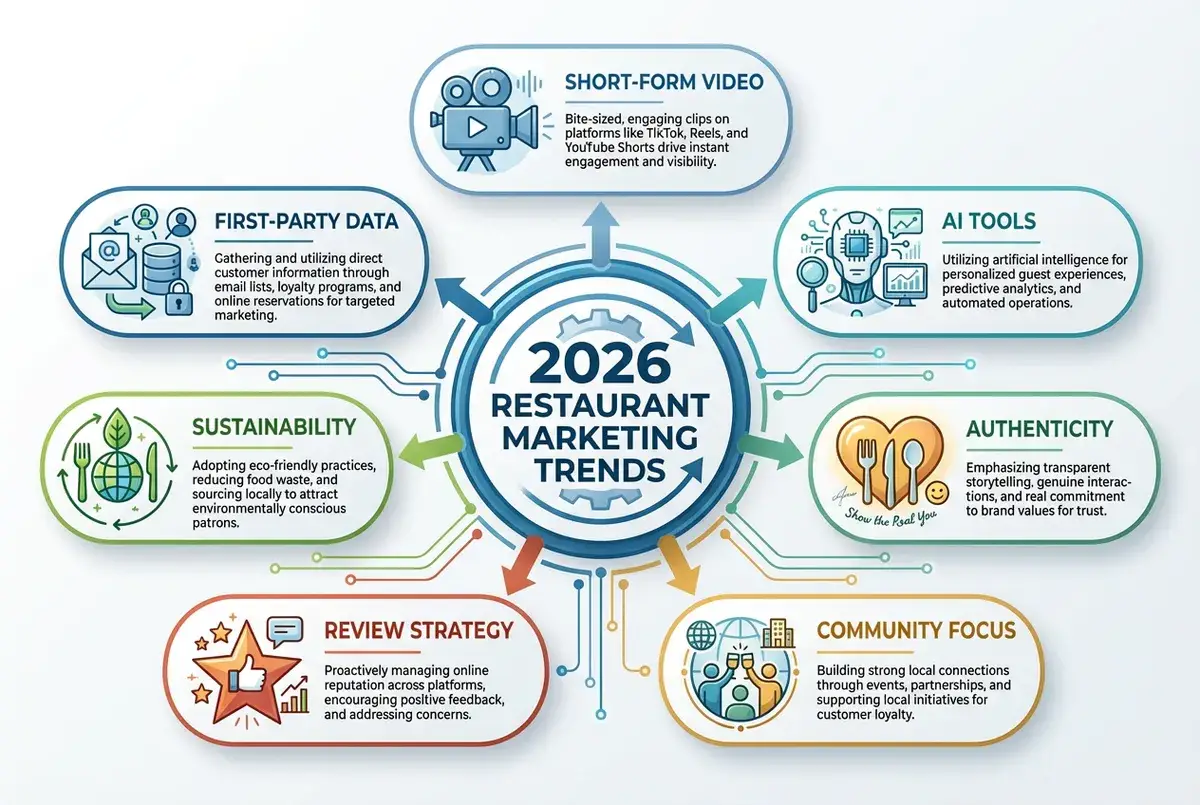
Trend 1: Short-Form Video Dominates
First, let's start with the biggest shift. Short-form video has moved from "nice to have" to essential for restaurant marketing.
Why It Matters
TikTok, Instagram Reels, and YouTube Shorts have changed how people discover restaurants. UK users aged 18-35 find more restaurants through video content than through traditional search.
Key statistics:
- 67% of UK diners have discovered a restaurant through social video
- Short-form video receives 2-3x the engagement of static posts
- Video content drives higher booking intent than photos
What's Working
Content that performs:
- Behind-the-scenes kitchen clips (15-30 seconds)
- Dish reveals and plating videos
- Staff personality and humour
- "Day in the life" content
- Customer reactions (with permission)
Real-world example
A Bristol pizza restaurant posts simple 20-second videos of dough stretching and pizza coming out of the oven. No editing, no music, just satisfying food content. Average views: 15,000. Their professional photos? 200 likes.
How to Start
Here's how to begin with minimal effort:
- Film on your phone during service
- Keep videos under 30 seconds
- Post 2-3 times weekly
- Don't overthink: authenticity beats production value
Trend 2: AI Tools for Efficiency
Video gets attention. But AI helps you work smarter, not harder.
Where AI Actually Helps
Here's where AI makes a real difference:
- Content creation assistance (captions, descriptions)
- Review response drafting
- Social media scheduling and optimisation
- Email personalisation at scale
- Menu description writing
Where AI Falls Short
But AI has limits. Don't rely on it for:
- Brand voice and personality
- Customer relationship building
- Strategic marketing decisions
- Crisis communications
- Anything requiring genuine emotion
Practical AI Usage
So how should you use AI? Here's what works:
- Use AI to draft, then edit with your voice
- Automate repetitive tasks (response templates)
- Generate content ideas, not final content
- Keep humans in the loop for anything customer-facing
For that first draft, an AI social post generator turns a few details about a dish into a caption in seconds, leaving you free to add the personal touch.
Real-world example
A Leeds gastro-pub owner uses AI to draft weekly emails, cutting writing time from 2 hours to 30 minutes. She edits to add personal stories. The result sounds like her, not a robot.
Related: Restaurant marketing on a budget: AI tools that save time.
Trend 3: Authenticity Over Perfection
Here's a trend that favours independents. AI tools help, but don't let them make you sound robotic. Authentic content beats polished content.
The Shift
Polished content is seen as inauthentic. Audiences prefer:
- Real moments over staged shoots
- Staff personalities over corporate messaging
- Behind-the-scenes reality over highlight reels
- Honest communication over marketing speak
Why This Matters for Independents
This plays to your strengths. Big chains struggle to seem authentic. You already are. Here's what works:
- Show the real people behind your restaurant
- Share genuine stories: successes and challenges
- Respond to feedback honestly
- Let personality shine through
Real-world example
A York family restaurant posts weekly "honesty updates," sharing what went wrong and how they fixed it. Engagement is 5x higher on these posts.
Warning
If you can't tell which posts get genuine engagement versus likes from friends, that's a sign your content strategy needs work.
Trend 4: Hyper-Local Community Focus
Additionally, authenticity extends to your community. The best UK restaurant marketing emphasises local ties over broad reach.
Community Marketing Tactics
What's working for restaurants that nail community marketing?
- Active participation in local Facebook groups (helpful, not promotional)
- Partnerships with nearby businesses
- Supporting local causes and events
- Creating community meeting spaces
- Featuring local suppliers and producers
Building Local Presence
Ready to build your local presence? Here are practical steps:
- Join and genuinely participate in neighbourhood groups
- Partner with 3-5 complementary local businesses
- Host community events (quiz nights, charity evenings)
- Feature local ingredients and name your suppliers
- Become known as "the local" not just "a restaurant"
Real-world example
A Sheffield curry house partnered with four local businesses for a cross-promotion. Each offered 10% off with receipts from the others. Result: 40 new customers in the first month, most becoming regulars.
Trend 5: Review and Reputation Focus
However, community ties only matter if people can find you online. Google reviews influence restaurant choice more than ever.
Review Landscape Changes
What's changed in the review landscape?
- Google reviews weighted more heavily in local search
- Review quantity and recency both matter
- Response rate affects perception and ranking
- Photos in reviews increase impact
Review Strategy
What should you prioritise for reviews?
- Systematic review requests (every satisfied customer)
- 24-hour response target for all reviews
- Photo encouragement with review requests
- Regular monitoring across platforms
Review generation targets:
- 5+ new Google reviews per week
- Response to 100% of reviews
- Aim for 4.5+ average rating
Real-world example
A Birmingham café trained staff to ask for reviews naturally: "If you enjoyed your visit, we'd love a Google review." In three months, they went from 80 to 220 reviews and jumped from page 2 to page 1.
Trend 6: Sustainability Messaging
Furthermore, diners want to know what you stand for. Sustainability has moved from differentiator to expectation.
Consumer Expectations
What do diners expect? Research shows:
- 65% of UK diners consider sustainability when choosing restaurants
- Younger diners (18-35) especially value environmental credentials
- Greenwashing is quickly identified and punished
- Specific claims outperform generic "eco-friendly" messaging
Authentic Sustainability Marketing
So how do you market sustainability without greenwashing? Here's what works:
- Specific, verifiable claims ("zero food waste" not "eco-friendly")
- Transparency about challenges and progress
- Local sourcing stories with named suppliers
- Visible actions (compostable packaging, recycling stations)
- Avoiding over-promising or greenwashing
Real-world example
An Edinburgh restaurant publishes monthly food waste figures, including when they go up. This honesty builds more trust than vague claims.
Trend 7: First-Party Data Collection
While you build your brand, don't forget the basics. Privacy changes make owned customer data more important than ever.
Why This Matters
Why should you care about first-party data? Here's what's changing:
- Cookie restrictions limit retargeting effectiveness
- Social media algorithm changes reduce organic reach
- Platform changes can devastate overnight
- Email remains the only truly owned channel
Building Your Own Audience
What data should you prioritise collecting?
- Email list building (aggressive collection)
- Booking system customer database
- Loyalty programme member data
- Direct customer relationships
Collection tactics:
- WiFi login email capture
- Booking confirmation with marketing opt-in
- Table cards offering signup incentives
- Receipt-based email collection
Related: Restaurant marketing ROI: measuring your owned channel performance.
Trends to Ignore (or Approach Carefully)
You've seen the trends worth following. Here's what to skip, because knowing what to ignore saves as much time as knowing what to do.
Skip or Deprioritise
The Metaverse/VR: Overhyped, no practical restaurant application yet.
NFTs and Crypto: The hype has passed; no clear restaurant use case.
Excessive platform expansion: Better to excel on 1-2 platforms than exist poorly on 5.
Voice search optimisation: Nice in theory, minimal practical impact for restaurants.
Approach Carefully
Influencer marketing: Works when targeted locally and authentically; often wasteful at scale.
Paid TikTok/Reels: Emerging but still developing; start with organic first.
AI-generated content: Useful for drafts and ideas, risky if published unedited.
Real-world example
A Newcastle restaurant spent £2,000 on a London influencer with 500K followers. Result: 3 bookings. Five local food bloggers invited for a free tasting? 50+ bookings.
Warning
If you're chasing every new platform because competitors seem to be everywhere, you're probably falling behind. The restaurants winning at marketing aren't doing more, they're doing less, better.
How to Prioritise Restaurant Marketing Trends UK Businesses Can Use (Rule of Thumb)
With these trends in mind, here's how to choose which ones matter for you.
Your actual priorities depend on your specific audience and location.
| Restaurant Type | Top Trends to Focus | Deprioritise |
|---|---|---|
| Young, urban audience | Short-form video, authenticity | Print, traditional advertising |
| Family/suburban | Community focus, reviews | TikTok, cutting-edge tech |
| Fine dining | Sustainability, first-party data | TikTok, casual video |
| Quick service | Convenience tech, local SEO | Long-form content |
For most UK restaurants, start with reviews and community. These deliver results regardless of your restaurant type.
Warning
Never chase trends just because competitors seem to be everywhere, you'll spread yourself thin and lose to those who focus.
Key Takeaways
If you run a restaurant and want to see how Local Brand Hub can support your marketing, explore our restaurant marketing tools.
Key Takeaways
With that in mind, ask yourself: Are you chasing every restaurant marketing trend UK businesses try, or focusing on the 2-3 that fit your restaurant? Success means picking well, not spreading thin.
- Short-form video is essential: Start simple, authenticity beats production value
- AI helps efficiency, not strategy: Use for drafts and automation, keep humans in control
- Authenticity beats polish: Your independence is a marketing advantage
- Community trumps reach: Local connection matters more than follower counts
- Reviews remain critical: Make systematic collection a priority
- Own your audience: Email and first-party data protect against platform changes
Your next step
Pick one trend from this list that fits your restaurant. Commit to testing it for 90 days before adding anything else.
Weekly Action
Finally, this week, evaluate your trend alignment:
- Day 1-2: Audit which trends you're using (video, AI, community, etc.)
- Day 3-4: Identify the one trend most relevant to your audience that you're not doing
- Day 5-7: Create a simple 90-day plan to test that one trend
Quick Trend Checklist:
- Short-form video: Are you posting at least 2x weekly?
- AI tools: Are you using AI for drafts and automation?
- Authenticity: Does your content show real staff and moments?
- Community: Are you active in local groups and partnerships?
- Reviews: Are you systematically requesting reviews?
- Sustainability: Can you back up any environmental claims?
- First-party data: Are you building an email list?
Frequently Asked Questions
What's the biggest restaurant marketing trend right now?
Short-form video (TikTok, Reels, Shorts) has become the dominant trend. For many independents, authentic, community-focused marketing may matter even more: it plays to their natural strengths.
Should UK restaurants be on TikTok?
If your target audience includes anyone under 40, TikTok or Instagram Reels should be part of your strategy. You don't need a TikTok account, posting Reels on Instagram often reaches TikTok users through cross-platform sharing.
How is AI changing restaurant marketing?
AI helps with efficiency: drafting content, generating ideas, and personalising email at scale. It's not replacing human creativity. The restaurants using AI well treat it as an assistant, not a replacement.
What restaurant marketing trends should I ignore?
Ignore trends without clear, practical use for your restaurant. For most independents, skip metaverse/VR, NFTs, and voice search. Focus on fundamentals plus 1-2 emerging trends that fit your audience.
For UK restaurant owners
Stay Ahead of Marketing Trends
LocalBrandHub helps independent restaurants keep up with marketing trends. If you're struggling to know which trends matter for your restaurant, our tools adapt to what's working while keeping focus on fundamentals.
Start freeGet More Marketing Tips
Practical marketing tips for UK business owners, straight to your inbox. No spam, unsubscribe anytime.
About the Author
Local Brand Hub
Empowering UK Businesses
Local Brand Hub provides comprehensive business management tools designed specifically for UK local businesses to streamline operations, automate marketing, and grow revenue.
More articlesRelated Articles
 Marketing Tips
Content Marketing for Restaurants: A Practical Guide
Master content marketing for restaurants using the 5 C's framework and the 30/30/30 rule. Actionable ideas that bring more diners through your door weekly.
 Marketing Tips
Restaurant Blog Ideas Only Your Kitchen Could Write
Restaurant blog ideas a rival two streets away could not copy: the test that kills weak topics, where the material sits, and a twenty minute method.
 Marketing Tips
Restaurant Content Calendar: A Free UK Template for 2026
A restaurant content calendar that survives service. Copy the seven column UK template, plan what you shoot before what you say, and start this week.