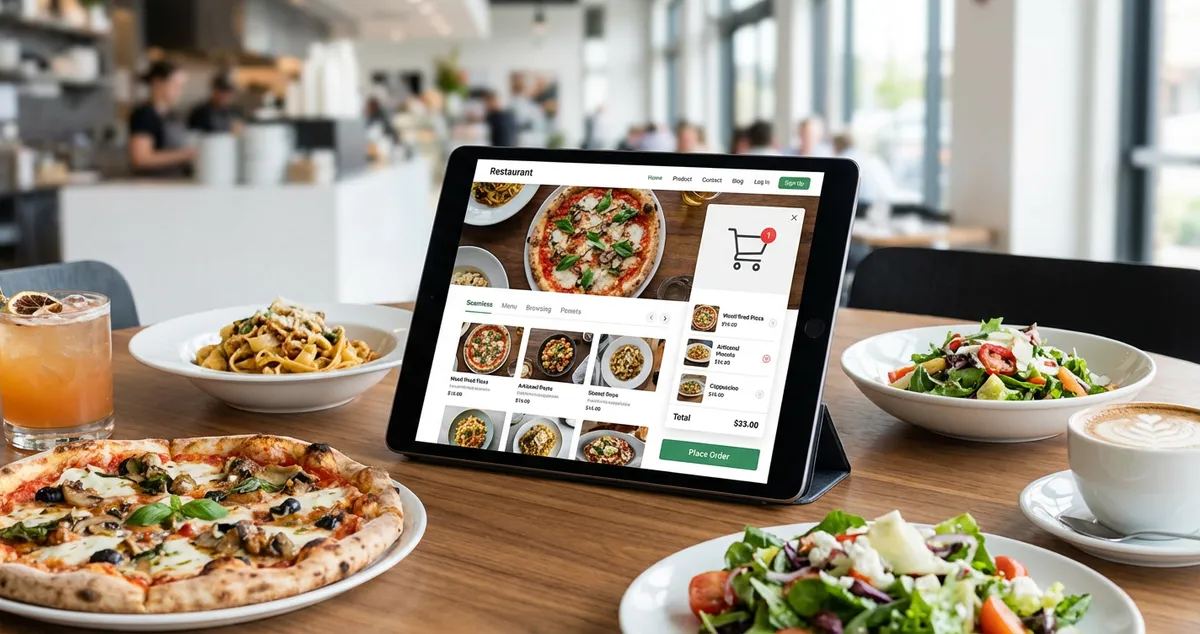
Market your restaurant online with proven strategies that fit your schedule. From the 70/20/10 rule to minimum viable marketing for busy owners.
You've just finished a 12-hour shift. The kitchen's clean, the last table's paid up, and you're wondering why the restaurant down the road always seems busier. With 74% of diners using social media to decide where to eat, the answer often comes down to restaurant online marketing. They're just better at showing up online, and it's costing you covers.
So what exactly is restaurant online marketing? It's the practice of using digital channels (social media, email, local search, and your website) to attract customers to your venue. A successful strategy combines consistent posting, local SEO optimisation, and email marketing to keep tables full without requiring hours of daily effort from the owner.
The good news? Based on our experience working with UK hospitality clients, you don't need a marketing degree or a full-time social media manager. Effective restaurant online marketing just needs a simple system you can actually stick to. If you're only spending money on ads without fixing your Google listing, that's usually a sign you're skipping the basics. This guide breaks down the essential strategies, explained in plain English, designed for UK independent owners, and built around the reality that you don't have spare hours to burn.
What you'll learn:
- The top marketing strategies for restaurants (and which to skip)
- How the 70/20/10 rule makes content planning simple
- Practical restaurant online marketing tactics you can implement this week
- A minimum viable marketing plan for owners with no time
- How to choose between social platforms without wasting effort
Info
Related: For a broader look at how online marketing fits into your overall restaurant digital marketing strategy, check out our complete guide.
What Marketing Strategy Works for Restaurants?
Building on the fundamentals of restaurant online marketing, a strong marketing strategy often combines local SEO, consistent social media presence, and email marketing, tailored to your specific venue, audience, and available time. In practical terms, this means showing up where your customers search, posting content they want to see, and staying in touch after they've visited.
There's no universal "best" approach, only the right approach for your restaurant. That said, certain strategies often outperform others for many UK independents:
| Strategy | Works Well For | Time Investment | Cost |
|---|---|---|---|
| Google Business Profile | Most restaurants | 30 mins/week | Free |
| Visual menus, ambience | 2-3 hrs/week | Free | |
| Email marketing | Repeat customers, events | 1 hr/week | £10-30/month |
| Local community, events | 1-2 hrs/week | Free | |
| TikTok | Younger audience, viral content | 2-4 hrs/week | Free |
For many UK restaurants, starting with Google Business Profile and Instagram tends to work well. These two platforms often deliver strong returns for time invested. Google handles the "near me" searches that often drive walk-ins, while Instagram showcases your food and atmosphere to people actively looking for somewhere to eat.
For example, a family-run Italian in Manchester might focus 80% of their effort on Google (responding to reviews, updating seasonal menu photos) and 20% on Instagram (weekly pasta-making videos). That simple split often outperforms trying to be active on five platforms poorly.
If you're reading this thinking "I don't have 5+ hours a week for marketing", you're not alone. That's why the minimum viable restaurant online marketing approach matters (more on this below).
So what about all those restaurant online marketing frameworks you keep hearing about? The next section breaks down the common ones and when they actually apply.
What Is the 3-3-3 Rule in Marketing?
With the restaurant online marketing basics covered, let's look at specific frameworks. The 3-3-3 rule is a content framework suggesting you need three pieces of content, across three platforms, three times per week to maintain visibility. It's designed to prevent the feast-or-famine posting pattern that often kills restaurant social accounts.
Here's the reality: the 3-3-3 rule often works better for businesses with dedicated marketing staff. For a restaurant owner managing everything themselves, it can quickly feel overwhelming.
If you're trying to post across three platforms daily while running service you'll always lose to competitors who focus on one platform properly.
A gastropub using this framework might post:
- Platform 1 (Instagram): Food photo, behind-the-scenes kitchen shot, customer review screenshot
- Platform 2 (Facebook): Event announcement, local news share, weekly special
- Platform 3 (Google): Photo update, reply to reviews, post about opening hours
If that sounds like too much, it probably is. Avoid managing multiple platforms because that approach tends to burn you out. That's why many restaurant owners prefer the 70/20/10 rule instead: it focuses on content types rather than rigid posting schedules.
The 3-3-3 rule has its place, but for time-strapped owners, the next framework usually works better.
What Is the 70/20/10 Rule in Digital Marketing?
Moving from theory to practice, the 70/20/10 rule divides your content into three categories: 70% value-driven content, 20% shared or curated content, and 10% promotional content. This framework prevents the common mistake of turning your social feed into a constant sales pitch.
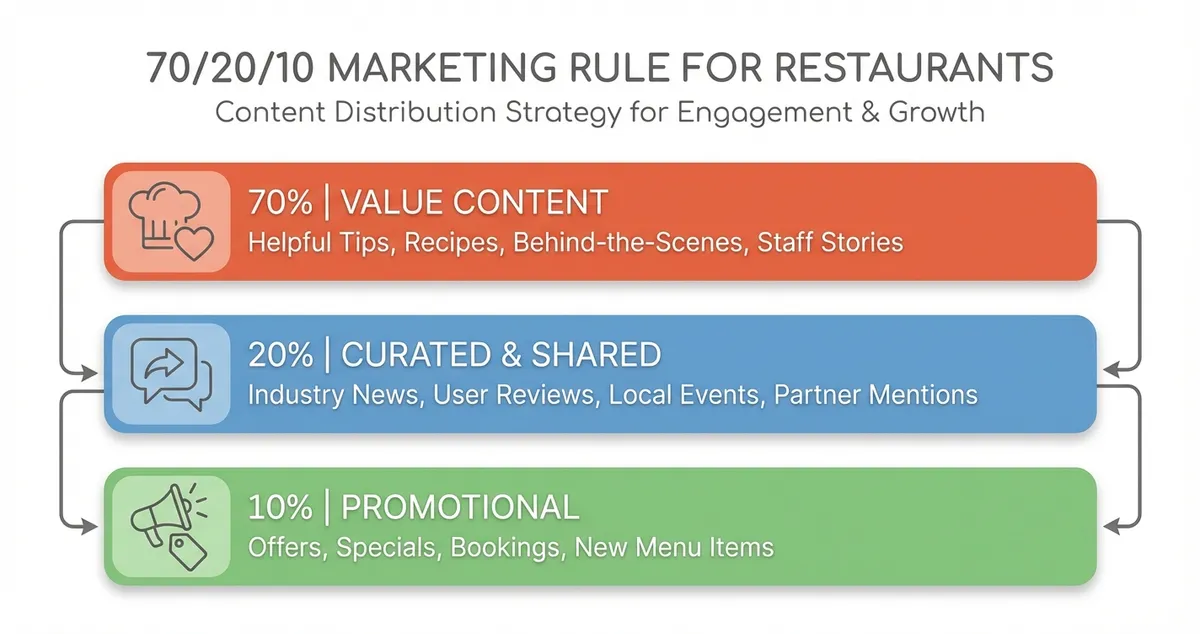
Balance your content for engagement, not just promotion
What each category looks like for restaurants:
- 70% Value content: Behind-the-scenes kitchen footage, cooking tips, "how we make our signature dish," staff introductions, local supplier spotlights
- 20% Curated content: Sharing local events, reposting customer photos (with permission), food industry news relevant to your area
- 10% Promotional: "Book for Valentine's Day," "New menu launching Friday," "20% off midweek"
A fish and chip shop on a quiet Wednesday night might post a video of fresh fish arriving from the supplier (value), share a post from the local fishing boat they buy from (curated), and once a fortnight mention their loyalty card (promotional).
The 70/20/10 rule typically works because people don't open Instagram to see adverts. They want content that entertains or informs. When you do promote something, it stands out because you've earned their attention.
If you're treating your social feed like a billboard you'll always lose to competitors who give followers a reason to stick around.
Content Balance Check
The 70/20/10 split isn't a strict formula, it's a guide to stop you becoming "that restaurant" that only posts offers. If your feed is more than 20% promotional content, you're probably losing followers.
Now that you understand the 70/20/10 framework, the next step is choosing which channels to apply it on.
What Are Some Online Marketing Strategies?
Now that you understand the frameworks, let's look at specific channels. Beyond content frameworks, effective restaurant online marketing strategies include social media marketing, local SEO, email marketing, paid advertising, and review management. Each serves a different purpose, and you don't need to do them all at once.
The essentials for restaurant online marketing (do these first):
- Google Business Profile: Keep your hours, photos, and menu updated. Respond to every review within 48 hours. This is often the difference between a Google searcher choosing you or your competitor.
- Instagram: Post 3-5 times per week using the 70/20/10 split. Stories disappear after 24 hours: use them for casual, low-effort content.
- Email list: Even a simple monthly newsletter keeps past customers thinking about you. Collect emails from reservations and WiFi logins.
Worth considering later:
- Facebook: Often strong for local community groups and event promotion, particularly for pubs and family restaurants
- TikTok: High effort, potentially high reward, but only if your content can be entertaining, not just promotional
- Paid ads: Google Ads for "near me" searches can work, but get your organic presence right first
If you're thinking about which platforms deserve your time, ask yourself: "Where are my actual customers?" A wine bar targeting professionals might prioritise LinkedIn and email. A burger joint targeting students would likely benefit from TikTok and Instagram.
According to Sprout Social research, 74% of consumers use social media to guide purchasing decisions, including where to eat. Meta for Business reports that restaurants with complete Instagram profiles tend to see higher engagement than those with incomplete listings. UKHospitality emphasises that digital presence has become essential for independent venues competing against chains with larger marketing budgets. These are compelling reasons to take restaurant online marketing seriously.
Understanding which channels matter is half the battle. The following section shows exactly how to implement them week by week.
How to Market a Restaurant Online
Now that you understand the core restaurant online marketing strategies, here's how to put them into action. Marketing a restaurant online requires a systematic approach: optimise your Google listing, establish a consistent social presence, build an email list, and encourage reviews. Here's a practical checklist you can work through:
Your Online Marketing Action Checklist
Week 1: Foundation
- Claim and verify Google Business Profile
- Upload 10+ high-quality photos (food, interior, team)
- Ensure name, address, phone match across all platforms
- Set up Instagram business account
- Create content calendar using 70/20/10 rule
Week 2: Content System
- Batch-create one week of social content (takes 1-2 hours)
- Schedule posts using a free tool like Later or Meta Business Suite, or plan them in our own social media calendar
- Write templates for review responses (positive and negative)
- Set up email capture on your website
Week 3: Engagement
- Respond to all Google and TripAdvisor reviews
- Reply to every comment and DM on social media
- Share one piece of user-generated content (with permission)
- Send first email newsletter to existing contacts
Ongoing (30 mins daily):
- Check and respond to reviews
- Post to Instagram Stories
- Engage with local accounts and hashtags
Research shows that a café implementing just weeks 1-2 of this checklist (claiming their Google profile and scheduling one week of posts) often sees measurable improvements in "how did you find us?" responses mentioning Google within a month. For instance, a seaside fish restaurant might focus on Google reviews during tourist season, while a city-centre lunch spot might prioritise Instagram Stories showing daily specials.
If you can't tell whether your online marketing is bringing in bookings or just likes, that's usually a sign the strategy needs tightening. Track where reservations come from: most booking systems show this data.
That's the full system, but what if you genuinely don't have time for all of it? The next section offers a stripped-down version that still delivers results.
Minimum Viable Marketing: If You Only Have 30 Minutes a Week
Here's the reality for most restaurant owners: you don't have hours to spare. If you're short on time, start smaller than the full strategy. A minimum viable approach typically beats random posting. For example, a family-run curry house might commit to just replying to reviews on Monday and posting one photo on Thursday: that consistency builds more trust than sporadic bursts of activity.
This Week: Set Up Your Foundation
- Day 1-2: Audit your Google Business Profile: check photos, hours, and reply to any unanswered reviews
- Day 3-4: Take 3 photos of your best dishes and save them for posting
- Day 5-7: Post one photo with a simple caption, respond to any social comments
Your ongoing 30-minute weekly routine:
- Monday: Reply to all reviews from the previous week (10 mins)
- Wednesday: Post one piece of content, photo, short video, or story (10 mins)
- Friday: Check Google Business insights and note any trends (10 mins)
This is enough for restaurant online marketing success. Consistency beats volume. Posting once every two days using the 70/20/10 framework beats random posting twice a day for a week then nothing for a month.
If you're only posting when it's quiet in the restaurant your social media will always lose to competitors who treat it as part of operations, not an afterthought. Don't post randomly because it rarely delivers results.
With the basics covered, here are some common questions owners have about marketing their restaurant online.
Frequently Asked Questions
Finally, here are the restaurant online marketing questions that come up regularly from UK owners.
What is the 30/30/30 rule for restaurants?
The 30/30/30 rule is a cost management guideline suggesting restaurants typically allocate roughly 30% of revenue to food costs, 30% to labour costs, and 30% to other operating expenses, leaving around 10% as profit. It's primarily a financial framework rather than a marketing rule, though it highlights why efficient restaurant online marketing (that doesn't eat into the 10% profit margin) matters for independents.
How much should a restaurant spend on online marketing?
UK restaurants typically spend between 3-6% of revenue on marketing, with smaller independents often at the lower end. For example, a restaurant turning over £500,000 annually might allocate £15,000-30,000 per year. However, many effective strategies (Google Business Profile, organic social, email) cost nothing but time. For instance, a neighbourhood bistro might spend zero on ads and still fill tables through consistent Instagram posting and review responses. Start with free channels before investing in paid advertising.
Which social media platform works well for restaurant marketing?
For many UK restaurants, Instagram often offers a strong combination of visual appeal and local discovery features. However, the right platform depends on your specific customers. Pubs with an older clientele may find Facebook more effective, while venues targeting under-25s should consider TikTok. Focus on one platform properly before spreading thin across several.
Weekly Action
Your Next Steps
- Audit your Google Business Profile: Check photos, hours, and respond to every unanswered review. For example, a neighbourhood Italian might discover three unanswered 4-star reviews, responding to those builds trust faster than any ad spend.
- Take one new photo of your most popular dish: Save it for next week's Instagram post.
Key Takeaways
If you run a restaurant and want to see how Local Brand Hub can support your marketing, explore our restaurant marketing tools.
Key Takeaways
In conclusion, effective restaurant online marketing doesn't require a degree or dedicated staff: it requires consistency and the right priorities. The restaurants that tend to fill tables aren't necessarily the ones posting frequently; they're the ones who show up regularly, respond to customers, and make it easy to find them online.
Here's what matters: you don't need to be everywhere. You need to be consistent somewhere your customers actually look.
Your next steps for restaurant online marketing:
- Audit your Google Business Profile this week (it takes 30 minutes)
- Choose one social platform and commit to the 70/20/10 content split
- Set a weekly 30-minute marketing slot in your calendar and treat it like a shift
Avoid copying what chain restaurants do with dedicated marketing teams, that approach rarely works for independents without their resources.
You don't need to do everything. You need to do the basics well, consistently. That's the difference between a restaurant with an online presence and a restaurant that actually gets customers from it.
Restaurant online marketing isn't about being everywhere: it's about being consistent somewhere. And that's something any owner can manage, even after a Saturday rush.
Info
Explore our detailed guides:
- Restaurant Digital Marketing - Complete marketing overview
- Restaurant Social Media Marketing - Platform strategies
- Restaurant Online Visibility - Getting found online
For UK restaurants
Need Help With Your Online Marketing?
Local Brand Hub helps UK restaurants master online marketing without the complexity, from Google Business Profile to social media scheduling.
Start freeGet More Marketing Tips
Practical marketing tips for UK business owners, straight to your inbox. No spam, unsubscribe anytime.
About the Author
Local Brand Hub
Empowering UK Businesses
Local Brand Hub provides comprehensive business management tools designed specifically for UK local businesses to streamline operations, automate marketing, and grow revenue.
More articlesRelated Articles
 Marketing Tips
Digital Marketing for Restaurants: A Practical UK Guide
Learn how digital marketing helps UK restaurants attract more customers. Covers the 4 P's, 70/20/10 rule, and practical strategies you can start this week.
 Marketing Tips
Restaurant Digital Marketing: A Guide for UK Restaurants
Build a digital marketing plan for your UK restaurant with budget-friendly tactics, proven frameworks, and realistic cost breakdowns.
 Marketing Tips
Restaurant Digital Marketing Strategy: Complete UK Guide
Build a restaurant digital marketing strategy that fits your schedule. Learn the 70/20/10 rule, core strategies, and realistic weekly plan for UK owners.