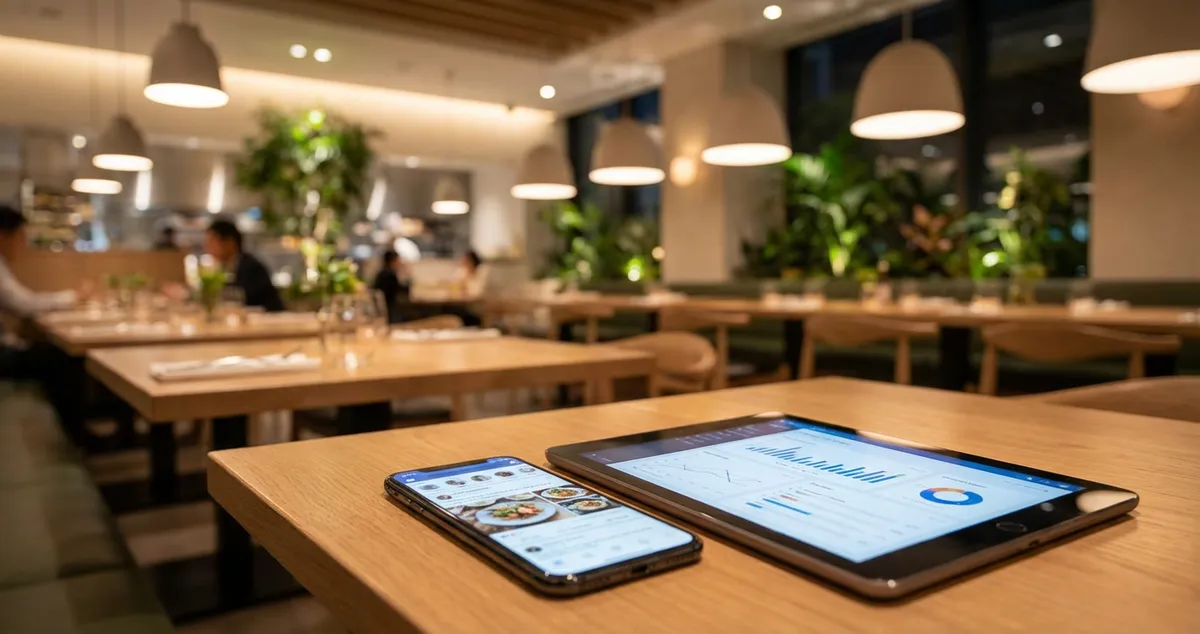
Build a digital marketing plan for your UK restaurant with budget-friendly tactics, proven frameworks, and realistic cost breakdowns.
You're posting on Instagram twice a week. Your Google Business Profile exists. You even tried running a Facebook ad once. Yet the tables stay half-empty on Tuesday nights, and you're not entirely sure what's working and what's wasting your time. Sound familiar?
What is restaurant digital marketing? It's the use of online channels (social media, search engines, email, and websites) to attract and retain customers for your restaurant. When done well, it creates a steady flow of bookings without requiring you to become a full-time marketer.
This guide covers the essential frameworks, realistic costs, and practical strategies that actually work for independent UK restaurants. Whether you're starting from scratch or refining an existing approach, you'll find actionable guidance for every budget.
What you'll learn in this guide:
- The key frameworks for allocating your marketing budget and content mix
- How much UK restaurants actually spend on digital marketing
- Which strategies often deliver the strongest return on your limited time
- When to DIY and when to consider hiring an agency
- A minimum viable approach if you only have 30 minutes a week
Info
Related: See our restaurant marketing ideas guide for creative campaign inspiration.
What is the 30/30/30 Rule for Restaurants?
The 30/30/30 rule is a framework that divides restaurant revenue into thirds: approximately 30% for food costs, 30% for labour, and 30% for overheads, leaving roughly 10% for profit. While this relates to general operations rather than marketing specifically, it helps explain why restaurant owners need cost-effective digital marketing solutions.
For many independent restaurants, marketing budgets typically fall within that overhead category. The good news is that effective digital marketing for restaurants doesn't require massive spending. It requires consistency and smart strategy.
Track Marketing as a Percentage
Track your marketing as a percentage of revenue, not as a fixed number. When revenue dips, your marketing percentage stays healthy even if the absolute amount drops.
For instance, a gastropub using this framework might allocate a few hundred pounds monthly from overheads toward marketing, focusing on high-return activities like Google Business Profile optimisation and targeted social media rather than expensive traditional advertising. A neighbourhood Italian might spend even less and still see results by prioritising Google reviews and Instagram.
So you understand where marketing fits in the bigger picture. Moving on from budget allocation, how should you split your actual content?
What is the 70/20/10 Rule in Digital Marketing?
Now that you understand where marketing fits financially, let's look at content. The 70/20/10 rule is a framework that divides your marketing output: 70% valuable and engaging content, 20% shared from other sources, and 10% promotional.
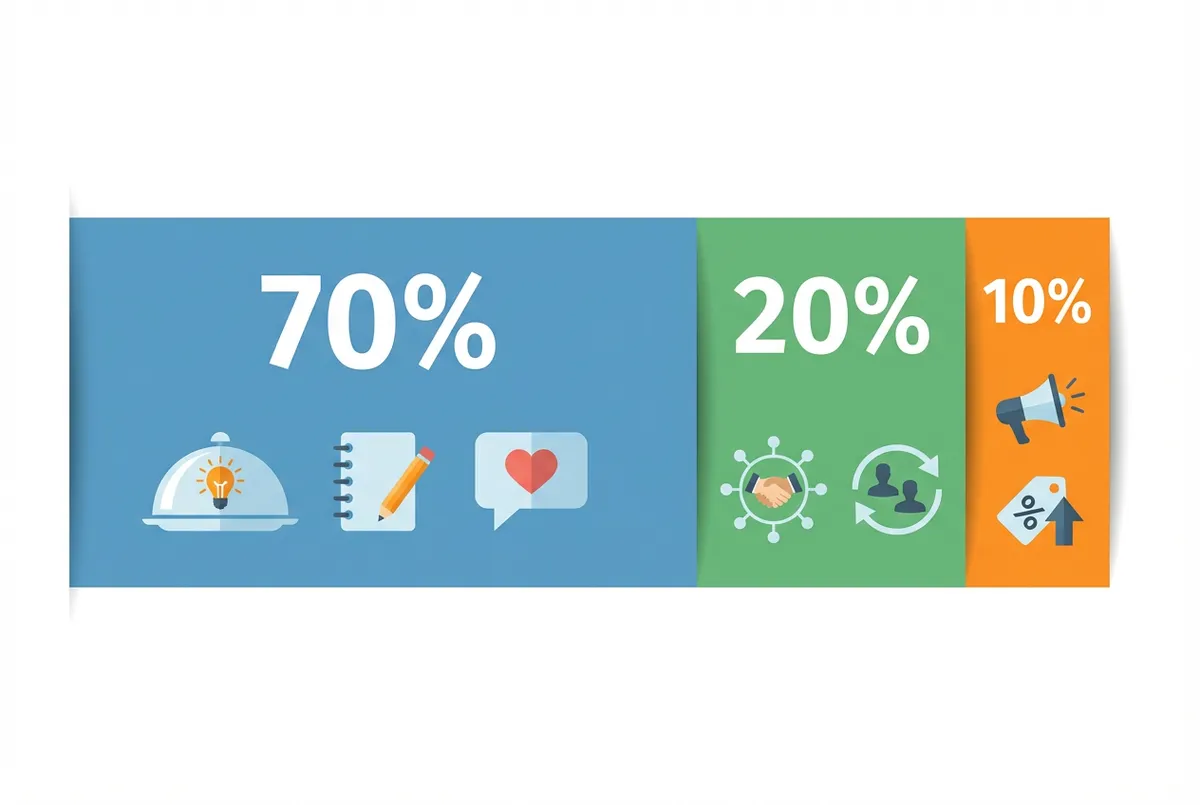
Structure your content for engagement, not just promotion
For restaurants, this translates to:
- 70% valuable content: Behind-the-scenes kitchen videos, chef tips, ingredient spotlights, local supplier stories
- 20% shared content: Food photography from customers (with permission), local event announcements, industry news
- 10% promotional: Special offers, booking reminders, new menu launches
For instance, a curry house could share a Reel of their chef preparing a signature dish (valuable), repost a customer's photo of their lamb biryani (shared), and once a week mention their Thursday early-bird discount (promotional).
If you're only posting when you have a promotion to announce your social media will typically feel like advertising. Followers notice, and engagement often drops accordingly.
Learn more about applying this framework in our restaurant online marketing guide.
That covers what to post. Building on that foundation, let's look at where to focus your overall digital marketing efforts.
What Are the 5 Main Strategies of Digital Marketing?
The five core strategies for restaurant digital marketing are social media marketing, local SEO, email marketing, paid advertising, and website optimisation. Here's how each applies to restaurants:
| Strategy | Works Well For | Typical Monthly Time |
|---|---|---|
| Social media | Building community, showcasing food | 3-5 hours |
| Local SEO | Appearing in "near me" searches | 2-3 hours |
| Email marketing | Repeat customers, special events | 2-4 hours |
| Paid advertising | Quick visibility, specific promotions | 1-2 hours |
| Website optimisation | Converting visitors to bookings | 1 hour (ongoing) |
For many UK restaurants, local SEO and social media often deliver the strongest return on time invested, as supported by Google's guidance on local business visibility. Start there before expanding to paid advertising, and our local SEO tools handle the Google Business Profile and citation side of that work.
For example, a neighbourhood Thai restaurant might spend two hours weekly on Google Business Profile updates and review responses, one hour on Instagram, and nothing on paid ads, yet often outperform competitors who spread themselves thin across every platform.
If you're thinking "I don't have 10 hours a week for marketing", you're not alone. The reality for many independent restaurants is that marketing happens in stolen moments between services. That's why our restaurant digital marketing tips focus on high-impact, low-time tactics.
Would I follow my own account? Would I book a table at my own restaurant based on our online presence? If either question gives you pause, you've identified your starting point.
Knowing where to focus is one thing. However, making sure your content actually lands is another challenge entirely.
What is the 3-3-3 Rule in Marketing?
The 3-3-3 rule is a framework that structures your messaging for maximum impact: capture attention in 3 seconds, deliver value in 30 seconds, and inspire action in 3 minutes. For example, a pizzeria might lead with a close-up of stretching mozzarella (3 seconds), explain their wood-fired oven and same-day booking availability (30 seconds), then link straight to their online ordering page (3 minutes). For restaurant digital marketing, this means:
- 3 seconds: Your post image or headline grabs attention
- 30 seconds: The viewer understands what you're offering and why it matters
- 3 minutes: They've clicked through to book, visit your menu, or save your post
A gastropub might apply this by leading with a striking photo of their Sunday roast (3 seconds), adding a caption about their locally-sourced beef and booking availability (30 seconds), then linking directly to their reservation page (3 minutes).
A quick self-assessment: look at your last five social posts. Could someone scrolling quickly understand your value in 3 seconds? If not, that's usually a sign the visual or headline needs work.
This principle particularly applies to:
- Instagram feed posts (strong food photography, minimal text)
- Google Business Profile updates (clear offers with booking links)
- Facebook event promotions (date, dish highlight, and booking CTA visible immediately)
With those principles in mind, let's move on to the practical question: what should you actually budget?
What is the Average Marketing Cost for a Restaurant?
The average marketing cost is a method that helps restaurant owners calculate the percentage of revenue allocated to promotional activities. For UK restaurants, this typically ranges from 3-6% of revenue according to UKHospitality. That translates to a few hundred to a few thousand pounds monthly, depending on your turnover.
However, many successful independent restaurants spend far less by focusing on organic strategies. For example, a fish and chip shop might spend minimal amounts on just an email marketing platform while relying on free Google Business Profile updates and word-of-mouth.
Budget-Friendly Marketing Breakdown:
- Google Business Profile optimisation: Free (time investment only)
- Social media management: DIY or low-cost scheduling tools
- Email marketing platform: Most start under £50/month
- Occasional paid social: Start small and scale based on results
If You Only Have 30 Minutes a Week
- Responding to every Google review within 24 hours
- One strong food photo on Instagram with a booking link
- Updating your Google Business Profile hours and photos monthly
That's your floor: the minimum viable marketing that keeps your digital presence active without overwhelming your schedule.
For a complete breakdown, see our restaurant digital marketing strategy guide.
Choosing the Right Digital Marketing Agency
Now that we've covered DIY approaches, what if you don't have the time, even 30 minutes feels like a stretch after a 12-hour shift? That's when outsourcing makes sense.
If you're considering hiring a digital marketing agency for your restaurant, UK agencies typically charge:
- Freelancers: £300-800/month for basic social media management
- Small agencies: £800-2,000/month for comprehensive digital marketing
- Specialist hospitality agencies: £1,500-5,000/month for full-service support
If you're only responding to reviews when you remember you'll always lose to competitors who treat marketing as part of operations, not an afterthought. If you're only posting when it's quiet in the restaurant you'll always lose to competitors who schedule content in advance.
If you're only providing agencies with bare minimum content you'll always lose to competitors who engage actively with their marketing partners. Don't just hand over the keys and disappear. Agencies can only amplify what you give them. The restaurants that get results are the ones who stay engaged.
Before hiring an agency, ask:
- Do they have specific restaurant or hospitality experience?
- Can they show case studies with measurable results (bookings, not just followers)?
- Do they understand UK food regulations around advertising?
Quick Checklist: Is Your Restaurant Ready for Digital Marketing?
- Google Business Profile claimed and verified
- Website with mobile-friendly menu and booking option
- At least one active social media account
- Basic understanding of who your ideal customer is
- 2-4 hours weekly to dedicate to marketing (or budget to outsource)
With the foundations covered, let's turn to the questions restaurant owners ask most often.
Frequently Asked Questions
How much should a small restaurant spend on digital marketing?
Small UK restaurants typically spend 3-6% of revenue on marketing. For a restaurant with £300,000 annual turnover, budget £750-£1,500 monthly. However, effective organic strategies (Google Business Profile, social media, email) can deliver strong results with minimal spend: under £500 monthly if you're handling it yourself.
Which social media platform should restaurants use?
Choosing the best social media platform is a strategy that depends on where your target customers spend time. For many UK restaurants, Instagram and Facebook are often highly effective choices according to industry research and Meta for Business guidance. Instagram generally excels at showcasing food visually and reaching younger diners, while Facebook typically works well for events and community building. For instance, a trendy brunch spot might focus 80% of effort on Instagram, while a traditional carvery might see better results from Facebook.
How long does restaurant digital marketing take to show results?
Organic strategies like local SEO typically take 3-6 months to show significant results in search rankings. Social media engagement often improves within weeks of consistent posting. Paid advertising can deliver immediate visibility but requires ongoing spend. Plan for a 6-month commitment before fully evaluating your strategy's effectiveness.
Can I do restaurant digital marketing myself?
Yes. Many successful independent restaurants handle their own digital marketing with 3-5 hours weekly investment. According to Google Business Profile best practices, keeping your profile updated and responding to reviews are among the highly impactful actions for local visibility. Focus on Google Business Profile, one social platform, and email marketing first. Consider outsourcing only when you've established what works and need to scale, or when your time is genuinely worth more than agency fees.
Key Takeaways
Key Takeaways
Restaurant digital marketing doesn't require a massive budget or marketing degree. The foundations (a strong Google Business Profile, consistent social presence, and basic email marketing) are achievable for any restaurant willing to invest a few hours weekly.
Start with the 70/20/10 content rule to keep your social media engaging. Use the 3-3-3 principle to ensure your messages cut through the noise. And remember that the average restaurant spends 3-6% of revenue on marketing, but smart organic strategies can deliver results for far less.
Weekly Action
This Week: Audit Your Digital Presence
- Day 1-2: Check your Google Business Profile: are photos current? Hours accurate? Responding to reviews?
- Day 3-4: Review your last 10 social posts against the 70/20/10 rule
- Day 5-7: Set up or review your email list: even a simple monthly newsletter builds loyalty
The goal isn't to become a marketing expert. It's to create a consistent system that brings customers through your door while you focus on what you do well: running a great restaurant.
Info
Explore our detailed guides:
- Digital Marketing for Restaurants - Complete UK guide
- Restaurant Digital Marketing Strategy - Framework guide
- Restaurant Digital Marketing Tips - Practical tactics
For UK restaurants
Need Help With Your Digital Marketing?
Local Brand Hub helps UK restaurants implement effective digital marketing without the complexity: from Google Business Profile to social media scheduling.
Start freeGet More Marketing Tips
Practical marketing tips for UK business owners, straight to your inbox. No spam, unsubscribe anytime.
About the Author
Local Brand Hub
Empowering UK Businesses
Local Brand Hub provides comprehensive business management tools designed specifically for UK local businesses to streamline operations, automate marketing, and grow revenue.
More articlesRelated Articles
 Marketing Tips
Restaurant Digital Marketing Strategy: Complete UK Guide
Build a restaurant digital marketing strategy that fits your schedule. Learn the 70/20/10 rule, core strategies, and realistic weekly plan for UK owners.
 Marketing Tips
Digital Marketing for Restaurants: A Practical UK Guide
Learn how digital marketing helps UK restaurants attract more customers. Covers the 4 P's, 70/20/10 rule, and practical strategies you can start this week.
 Marketing Tips
Restaurant Digital Marketing Tips for UK Restaurants
Restaurant digital marketing tips for busy UK owners. Budget-friendly tactics, time-saving strategies, and a 30-minute weekly plan.