
Build a restaurant digital marketing strategy that fits your schedule. Learn the 70/20/10 rule, core strategies, and realistic weekly plan for UK owners.
You have been at this for months. Three posts a week, nice photos, the right hashtags. Your competitor down the road has half your food quality but a queue out the door every Friday. Meanwhile, you are staring at empty tables on a quiet Wednesday night wondering what they know that you do not.
Here is the reality: random acts of marketing rarely work. What you need is a restaurant digital marketing strategy that connects the dots between your online presence and actual bookings. This complete guide shows you how to build one that works for restaurants, even if you only have 30 minutes a week to spare.
What You'll Learn
- The 70/20/10 rule that structures your restaurant digital marketing strategy without overthinking
- Five digital marketing strategies that actually work for restaurants
- How to build a minimum viable marketing plan you can stick to
- Which channels deserve your time and which ones do not
Info
Related: See our restaurant digital marketing: the complete guide for comprehensive strategies.
What Is the 70/20/10 Rule in Digital Marketing?
The 70/20/10 rule is a content framework that divides your marketing output into three categories: 70% value-driven content, 20% shared or curated content, and 10% promotional posts. For restaurants, this means most of your posts should educate, entertain, or inspire rather than constantly push offers.
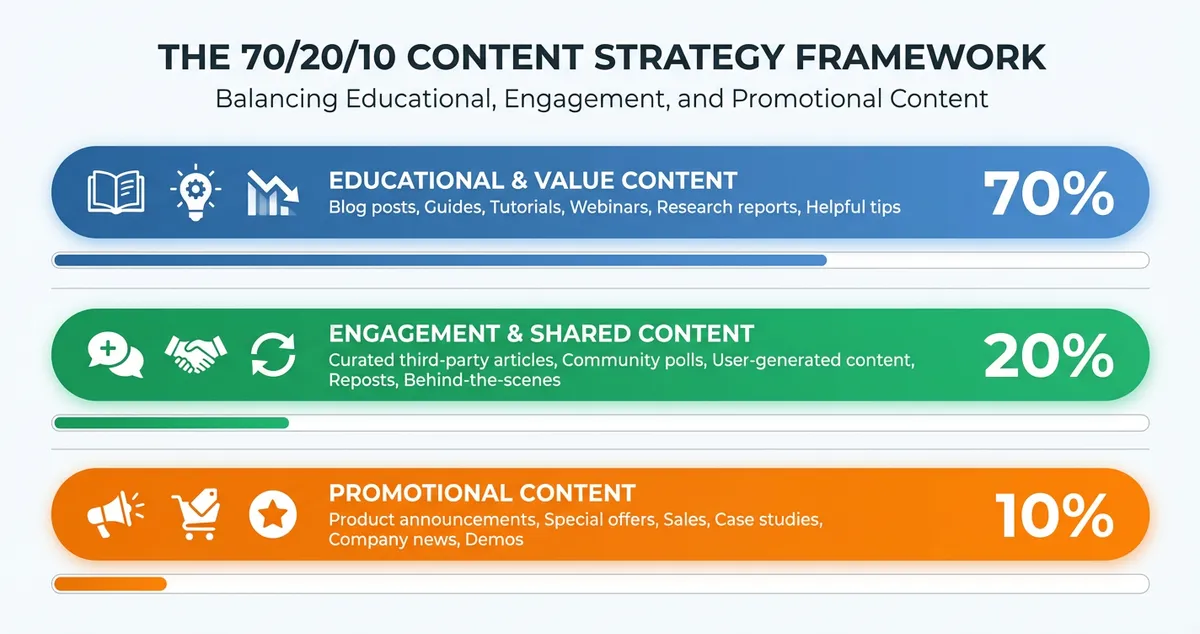
Structure your content for engagement, not just promotion
This framework originates from marketing research showing audiences engage more with brands that provide value before asking for sales. According to Sprout Social's research, 57% of consumers follow brands on social media to learn about new products or services, but they quickly unfollow accounts that feel too promotional.
How This Works in Practice
A gastropub in Manchester using this framework might structure their weekly content like this:
- 70% Value content: Behind-the-scenes kitchen prep, staff stories, local supplier spotlights, food tips, or a quick video showing how they prepare their signature dish
- 20% Curated content: Sharing local events, reposting customer photos, industry news relevant to their audience, or celebrating another local business
- 10% Promotional: Weekly specials, booking reminders, seasonal menu launches
If you are posting only when you have something to sell, your audience tunes out. The 70/20/10 rule ensures you are building a relationship, not just broadcasting deals.
If you're thinking "I don't have time to create all that content", you're not alone. Most restaurant owners feel the same way. The key is batching, not perfection.
Batch Your Content
Spend one hour on a quiet Wednesday afternoon taking photos and writing captions for the whole week. This single session replaces daily scrambling.
What Are the 5 Main Strategies of Digital Marketing?
That covers how to structure your content. But what channels should you actually focus on? A complete restaurant digital marketing strategy typically involves five core elements: social media marketing, search engine optimisation (SEO), email marketing, paid advertising, and reputation management. Each serves a different purpose in your overall plan.
Strategy Comparison Table
| Strategy | Works Well For | Time Required | Cost |
|---|---|---|---|
| Social Media | Brand awareness, engagement | 2-4 hrs/week | Free (organic) |
| Local SEO | Being found on Google Maps | 1-2 hrs/month | Free |
| Email Marketing | Repeat bookings, loyalty | 1-2 hrs/week | From £10/month |
| Paid Ads | Quick visibility, events | Ongoing management | From £5/day |
| Reputation Management | Trust, conversions | 30 mins/week | Free |
(Rule of Thumb: Your mileage may vary based on your location, cuisine type, and target audience.)
For most independent UK restaurants, local SEO and reputation management often deliver strong returns for minimal time investment. These two strategies help people find you and trust you, which is the foundation everything else builds on.
For example, a fish and chip shop in Brighton saw a 40% increase in midweek footfall after consistently responding to Google reviews and updating their Business Profile with seasonal specials. No ad spend required.
A Note on Paid Advertising
Paid ads can work, but they require ongoing attention and budget. If you are already stretched thin after a Saturday rush, focus on the organic strategies first. A restaurant with strong reviews and a complete Google Business Profile often outperforms one spending money on ads but ignoring their online reputation.
What Is the 30/30/30 Rule for Restaurants?
So you know the strategies. But how much can you actually afford to spend on them? Here is where digital strategy meets financial reality.
The 30/30/30 rule is a cost management framework suggesting restaurants allocate:
- 30% of revenue to food costs
- 30% to labour
- 30% to other operating expenses
- 10% remaining as profit margin
While this is primarily a financial guideline, it directly impacts your restaurant digital marketing strategy budget.
What This Means for Your Marketing
If you are operating on tight margins (and most independent restaurants are), your marketing strategy needs to be cost-effective. This is why organic digital marketing, like social media and local SEO, often makes more sense than expensive ad campaigns.
The reality for most independent restaurants is this: you cannot afford to throw money at marketing and hope something sticks. Every hour and every pound needs to count. According to UKHospitality, independent restaurants operate on average profit margins of just 3-9%, leaving little room for marketing experiments that do not deliver.
If you can't tell whether your restaurant digital marketing strategy brings bookings or just likes, that's usually a sign something needs to change.
What Is the 3 3 3 Rule in Marketing?
So you understand the budget constraints. Now let us talk about creating content that cuts through.
The 3-3-3 rule is a content engagement framework that structures audience attention into three time windows:
- 3 seconds: Capture attention
- 30 seconds: Deliver your core message
- 3 minutes: Leave a lasting brand impression
For your restaurant digital marketing strategy, this means your visuals need to stop the scroll, your captions need to communicate quickly, and your overall brand needs to be memorable.
Applying This to Restaurant Content
- 3 seconds: Use a striking food image or unexpected visual that makes someone pause. Steam rising from a dish, a chef's hands plating, or the golden crust of a pie typically work better than static menu shots.
- 30 seconds: Your caption should convey the key message, whether that is a special offer, a story, or a call to action. Front-load the important information.
- 3 minutes: Your overall feed, website, and presence should tell a consistent story about who you are. When someone lands on your page, they should immediately understand your restaurant's personality.
For example, a pizza restaurant might apply this framework by leading with a close-up of cheese stretching from a fresh slice (3-second hook), following with "Wood-fired since 1985. Book your table for tonight" (30-second message), and building a feed that consistently shows their heritage, craft, and neighbourhood character (3-minute impression).
For instance, an Indian restaurant in Birmingham could use a slow-motion video of naan being pulled from a tandoor oven (3-second hook), a caption reading "Fresh from our clay oven to your plate: book now for Friday" (30-second message), and a consistent feed showcasing family recipes, spice markets, and the team behind the kitchen (3-minute brand story).
If you're reading this after a 12-hour shift thinking "this sounds like a lot of work", here's the shortcut: focus on the 3-second hook. A genuinely good food photo often does most of the heavy lifting. You do not need fancy equipment. Natural light near a window and a clean background can often outperform professional shoots.
Building Your Restaurant Digital Marketing Strategy
That covers the theory. Here is where it gets practical.
Now that you understand the frameworks, let me show you how to put them together into a restaurant digital marketing strategy that actually fits your life.
Step 1: Audit Your Current Presence
Before adding anything new, check what you already have (our marketing scorecard runs through the same audit in a few minutes):
- Google Business Profile: Is it complete, accurate, and updated?
- Social media: Are your profiles consistent with your branding?
- Website: Does it load quickly on mobile? Can people book easily?
- Reviews: When did you last respond to a review?
If your Google Business Profile is incomplete, that is your first priority. It takes 30 minutes and often has more impact on local discovery than almost anything else.
According to Google's Business Profile documentation, businesses with complete profiles are more likely to be considered reputable by customers.
For example, a café owner in Leeds discovered their profile was missing opening hours and menu photos. After a 30-minute update, they saw a measurable increase in "Get Directions" clicks within the first month.
Step 2: Choose Your Channels
You cannot be everywhere. Pick 2-3 channels maximum and do them well.
| Channel | Good For | Skip If... |
|---|---|---|
| Visual food content, younger audience | You hate taking photos | |
| Local community, older demographic | Your audience is under 30 | |
| Google Business | Local search, reviews | Never skip this one |
| TikTok | Viral potential, personality-driven | You do not have time for video |
| Repeat customers, loyalty | You have no customer list |
(Rule of Thumb: These are general guidelines. Your mileage may vary depending on your specific audience and location.)
A curry house in Birmingham might focus entirely on Instagram and Google, while a traditional pub in the Cotswolds might find Facebook and Google a better fit.
Match your channels to where your customers actually spend time.
Step 3: Set a Realistic Posting Schedule
This is where most restaurant digital marketing strategy plans fall apart. Owners commit to posting every single day, manage it for two weeks, then disappear for a month.
Posting daily sounds impressive in theory. But for independent restaurants already stretched thin after a 12-hour shift, it is an unsustainable goal that typically causes more harm than good. Most restaurant owners simply cannot maintain that pace, and that is completely normal.
A sustainable schedule beats an ambitious one you cannot keep.
Two posts per week, every week, often builds more trust than seven posts one week and nothing for the next month. Consistency typically signals reliability to both algorithms and potential customers.
Minimum Viable Effort: Your Weekly Marketing Plan
So you have your audit complete and channels chosen. Now here is exactly what to do if you only have 30 minutes a week. This is your floor, not your ceiling.
This Week: Build Your Foundation
- Day 1-2: Spend 15 minutes updating your Google Business Profile. Add current opening hours, respond to any recent reviews, and upload one new photo.
- Day 3-4: Create one social media post. Use a good food photo, write a simple caption, and schedule it for a peak time (usually 11am-1pm or 5pm-7pm).
- Day 5-7: Spend 10 minutes checking for new reviews. Respond to all of them, positive or negative, with a genuine reply.
That is enough. You can expand later, but this baseline keeps your digital presence active without consuming your life.
For example, a Thai restaurant owner who had previously tried posting every day and quit after three weeks switched to this minimum viable approach. By consistently doing just these three things weekly, they maintained an active online presence for six months straight, longer than any of their previous attempts.
For instance, even during a busy bank holiday weekend, completing just the 15-minute Google update keeps your digital presence alive. You can catch up on the social post during that 3pm lull on Tuesday.
Scaling Up When You Have More Time
If you find yourself with an extra hour during that 3pm lull:
- Add a second weekly post using the 70/20/10 rule (value content, not promotional)
- Encourage reviews by mentioning them to happy customers after service
- Batch content by taking multiple photos during one service and saving them for later
- Reply to comments within 24 hours to boost engagement
- Track your results to see what content drives actual bookings
What Not to Do
Now that you have a plan, let us cover what to avoid. Here are the mistakes that can undermine even a well-planned restaurant digital marketing strategy.
The pattern that rarely works: If you're only posting when the restaurant is quiet you'll always lose to competitors who treat marketing as part of operations, not an afterthought.
Random posting is among the most common mistakes. The businesses that win at digital marketing build it into their weekly rhythm.
For example, a bistro owner who only posted when bookings were slow ended up with an inconsistent feed that signalled uncertainty to potential customers. Once they switched to a fixed two-post schedule regardless of how busy the week was, their engagement improved noticeably.
Other common mistakes:
- Ignoring negative reviews or responding defensively rather than constructively
- Posting only promotions without building relationship first
- Copying competitors without understanding your own brand's voice
- Chasing every new platform instead of mastering one or two
- Setting unrealistic goals, burning out, and abandoning everything
Key Takeaways
If you run a restaurant and want to see how Local Brand Hub can support your marketing, explore our restaurant marketing tools.
Key Takeaways
That covers the fundamentals. Building a restaurant digital marketing strategy does not require a marketing degree or hours of spare time. It requires choosing the right priorities and sticking to them consistently.
- Use the 70/20/10 rule to balance value and promotion in your content
- Focus on local SEO and reputation management first because they cost nothing and drive real results
- Start with 30 minutes a week and scale up only when you have capacity
- Pick 2-3 channels maximum and do them well rather than spreading yourself thin
Your restaurant digital marketing strategy does not need to be complicated. It needs to be consistent. Start with the fundamentals, measure what matters, and build from there.
Weekly Action
Spend 15 minutes this week completing your Google Business Profile. Add your current menu, update opening hours, and upload three recent photos. This single action can have more impact than a month of inconsistent social media posting.
Info
Explore our detailed guides:
- Digital Marketing for Restaurants - Complete UK guide
- Restaurant Social Media Marketing - Platform strategies
- Restaurant Digital Advertising - Paid promotion guide
For UK restaurants
Need Help With Your Marketing Strategy?
Local Brand Hub helps UK restaurants build consistent marketing strategies without the complexity, from planning to execution.
Start freeGet More Marketing Tips
Practical marketing tips for UK business owners, straight to your inbox. No spam, unsubscribe anytime.
About the Author
Local Brand Hub
Empowering UK Businesses
Local Brand Hub provides comprehensive business management tools designed specifically for UK local businesses to streamline operations, automate marketing, and grow revenue.
More articlesRelated Articles
 Marketing Tips
Restaurant Digital Marketing: A Guide for UK Restaurants
Build a digital marketing plan for your UK restaurant with budget-friendly tactics, proven frameworks, and realistic cost breakdowns.
 Marketing Tips
Digital Marketing for Restaurants: A Practical UK Guide
Learn how digital marketing helps UK restaurants attract more customers. Covers the 4 P's, 70/20/10 rule, and practical strategies you can start this week.
 Marketing Tips
Restaurant Digital Marketing Tips for UK Restaurants
Restaurant digital marketing tips for busy UK owners. Budget-friendly tactics, time-saving strategies, and a 30-minute weekly plan.