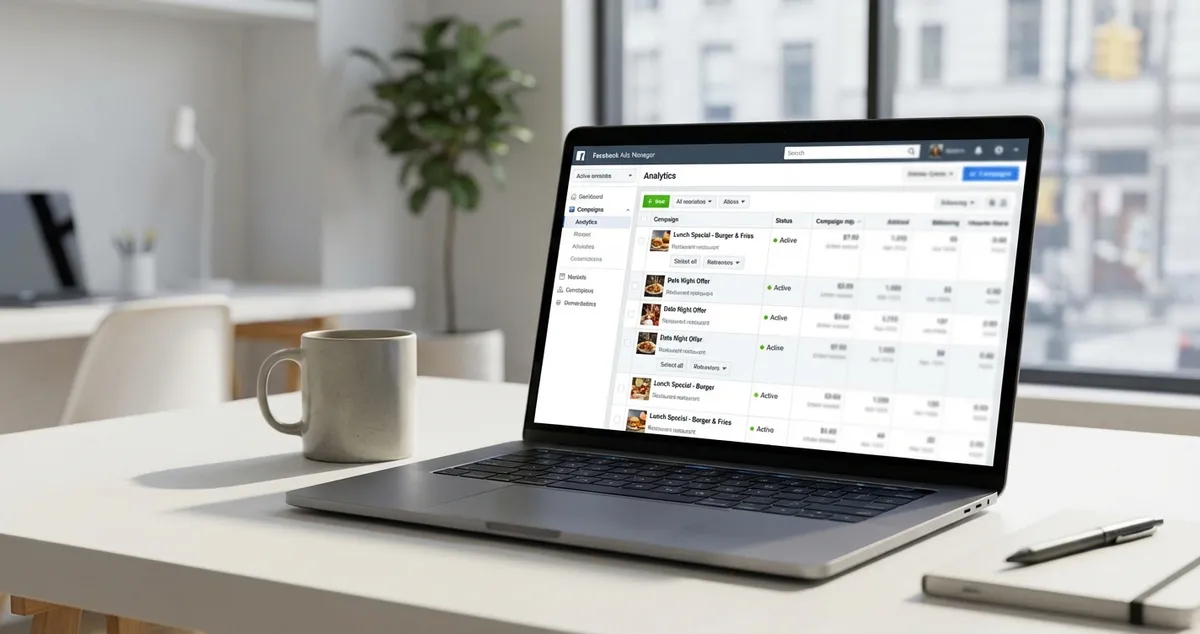
Run effective restaurant digital advertising on any budget. The 70/20/10 rule, ad types, and proven strategies for UK independents.
Info
Related: See our guides on restaurant digital marketing, restaurant social media marketing, and local SEO for restaurants.
You've been running ads on Facebook for three months. You've boosted posts, tried a few Instagram promotions, maybe even dabbled with Google Ads. Your budget's gone, you've got a spreadsheet full of impressions, and you still can't tell if a single customer came through the door because of it.
What is restaurant digital advertising? It's the use of paid online channels like social media ads, Google Ads, and display advertising to attract customers to your restaurant. When done right, it delivers measurable results. When done wrong, it drains your budget faster than a quiet Wednesday night drains your spirits.
This guide cuts through the noise. You'll learn the budget allocation rules that actually work, which ad types suit independent UK restaurants, and how to start seeing real returns without hiring an agency or spending hours you don't have.
What You'll Learn About Restaurant Digital Advertising
- How to split your ad budget using the 70/20/10 rule
- The four types of digital advertising and which work best for restaurants
- Practical frameworks like the 30/30/30 and 3-3-3 rules
- A minimum viable approach if you only have 30 minutes a week
- How to track whether your ads are actually bringing customers through the door
What Is the 70/20/10 Rule in Digital Marketing?
So you've got a budget. Now what? The 70/20/10 rule gives you a framework for splitting it sensibly.
The 70/20/10 rule is a framework that divides your restaurant digital advertising spend into three categories: 70% on proven tactics, 20% on promising experiments, and 10% on wild ideas.
For a restaurant, this might look like:
- 70% (Proven): Facebook and Instagram ads targeting your local area with your best-performing content
- 20% (Promising): Testing Google Ads for high-intent searches like "best Sunday roast near me"
- 10% (Experimental): Trying TikTok ads or influencer collaborations
The logic is straightforward. Most of your restaurant digital advertising budget goes to what already works. A smaller portion tests new channels that show promise. And a sliver explores genuinely new ideas that might fail spectacularly or become your next big winner.
A gastropub in Manchester, for instance, might put most of their budget into Instagram ads promoting their weekend specials (proven), set aside a portion for testing Google Ads for "private dining Manchester" (promising), and use a small amount for sponsoring a local food blogger's post (experimental).
If you're thinking "I don't have £1,000 a month for ads," you're not alone. The 70/20/10 rule works at any budget. Even £100 a month can be split £70/£20/£10.
What Is the 30/30/30 Rule for Restaurants?
Now that you understand budget allocation, let's look at where restaurant digital advertising fits in your overall finances.
The 30/30/30 rule is a cost management framework for restaurants, suggesting you allocate roughly 30% of revenue to food costs, 30% to labour costs, and 30% to other operating expenses (including marketing), leaving approximately 10% as profit.
This matters because it tells you where marketing sits in your budget. If your restaurant turns over £20,000 monthly, that 30% for operating expenses needs to cover rent, utilities, insurance, and marketing. Most independent restaurants typically allocate between 3-6% of revenue specifically to marketing.
Budget Reality
A neighbourhood bistro might set aside 4-5% of revenue for marketing. If half goes to digital ads, even a modest budget of £5-10 per day is plenty to run effective local campaigns.
The practical takeaway? Digital advertising shouldn't be an afterthought funded by whatever's left. It should be a planned line item within your operating costs, sized appropriately for your revenue, and our ROI calculator can help you sense-check what that marketing spend should return.
A fish and chip shop turning over £12,000 monthly, for instance, might allocate around £500 for total marketing. If they dedicate half to restaurant digital advertising, that's typically enough for a consistent local Facebook campaign targeting hungry locals within a few miles.
What Is the 3-3-3 Rule in Marketing?
With budget frameworks covered, let's talk about where to actually spend your money.
The 3-3-3 rule is a framework that suggests you create three types of content, post three times per week, and focus on three platforms maximum.
For your restaurant digital advertising, adapt this as:
- 3 Ad Types: One awareness ad (brand visibility), one engagement ad (driving interaction), one conversion ad (bookings or orders)
- 3 Times Weekly: Run active campaigns with at least three touchpoints per week to stay visible
- 3 Platforms Maximum: Focus your paid budget on no more than three channels
Spreading yourself across Facebook, Instagram, TikTok, Google, Yelp, and Tripadvisor ads simultaneously is a recipe for wasted spend. Pick the platforms where your customers actually are, then do those well.
For instance, a family-run curry house in Birmingham using this framework might run an awareness ad showcasing their signature dishes (Monday), an engagement ad asking followers to vote on a new special (Wednesday), and a conversion ad with a 10% off code for online orders (Friday), all on Meta platforms only.
That's the framework. Now, which platforms actually deserve your attention? For most UK independent restaurants, the three platforms worth considering are:
- Meta (Facebook/Instagram): Often best for visual content, local targeting, and reaching the 25-54 demographic. Restaurants can target customers within specific postcodes using location-based advertising.
- Google Ads: Typically best for capturing people actively searching for restaurants like yours. Search ads capture high-intent customers ready to make decisions.
- TikTok: Worth testing if your audience skews younger (18-34) and you can create video content
For many UK restaurants, Meta (Facebook and Instagram) often offers a strong combination of targeting precision and cost-effectiveness for local ads.
According to Meta's business resources, location-based advertising lets you reach people within specific postcodes or a radius around your restaurant.
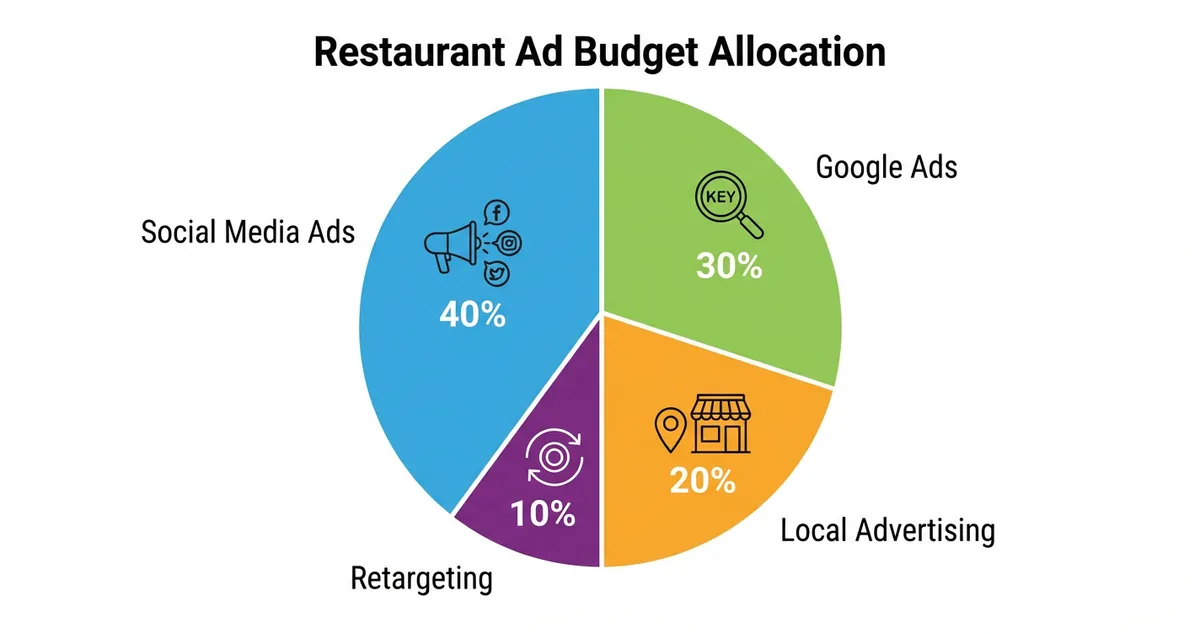
Allocate your ad budget strategically across proven, promising, and experimental
What Are the 4 Types of Digital Marketing?
Now that you know how to allocate budget and focus your efforts, here's what you're actually choosing between.
The four main types of restaurant digital advertising are paid social advertising, search engine advertising, display advertising, and video advertising.
Here's a quick comparison of each type (costs are approximate and vary by location):
| Type | Best For | Typical Cost |
|---|---|---|
| Paid Social | Brand awareness, local reach | £0.50-£2/click |
| Search Ads | High-intent customers | £1-£4/click |
| Display Ads | Retargeting visitors | £0.30-£1/click |
| Video Ads | Storytelling | £0.10-£0.30/view |
Each type serves a different purpose. Paid social typically builds awareness and keeps you visible in your local area - see our restaurant social media marketing guide for organic strategies. Search ads often capture people ready to make a booking decision. Display ads typically remind people who already know you. Video ads can help tell your story and build emotional connection.
You typically don't need all four types of restaurant digital advertising. If your budget is limited, start with paid social for awareness and search ads for capturing ready-to-book customers. Add display and video once you've got those working.
For instance, a pizzeria in Bristol might run £5/day on Instagram showcasing their wood-fired oven (paid social), while also running Google Ads for "pizza delivery Bristol" (search). The Instagram typically builds brand recognition locally. The Google Ads often capture people who've already decided they want pizza and are searching for options.
Restaurant Digital Advertising Strategy: Where to Start
That's the theory. Here's where it gets messy. How do you actually put this knowledge into practice?
Here's the approach for restaurants new to digital advertising or those who've tried without seeing results. For example, a neighbourhood café that's been boosting random posts might follow these steps to create a more structured campaign.
Step 1: Define Your Goal
Before spending anything, answer one question: what do you want the ad to achieve?
- More bookings: Track reservation requests directly from ads
- More foot traffic: Use location-based targeting and track redemption of ad-specific offers
- More delivery orders: Link directly to your ordering platform
If you can't measure it, don't run the ad. That's usually a sign the strategy needs tightening.
Step 2: Start With What You Know Works
Look at your organic social posts. Which ones got strong engagement? Those are often good candidates for paid promotion. Boosting a post that already performed well is typically lower risk than creating something new for ads.
Step 3: Target Ruthlessly Local
For independent restaurants, national reach is wasted spend. Set your targeting to a realistic radius, usually 5-15 miles depending on your location. A neighbourhood Italian in Leeds doesn't need to reach people in London.
Step 4: Test Small, Scale What Works
Start with £5-10 per day on a single restaurant digital advertising campaign. Run it for two weeks. If it's driving measurable results (clicks, bookings, redemptions), increase the budget. If not, try a different creative or audience before spending more.
A café in Edinburgh, for instance, might test a £7/day ad promoting their brunch menu for two weeks. If they see 50 clicks and 5 trackable bookings (a 10% conversion rate), they've found something worth scaling. If they see 50 clicks and zero bookings, it's time to try a different image, headline, or offer.
Would you book a table based on your own ad? If the answer is "maybe" or "probably not," that's usually a sign something needs improving before you spend more.
Minimum Viable Digital Advertising
So you understand the frameworks. But what if you barely have time to read this article?
If you're reading this after a 12-hour shift thinking "I don't have time for this," you're not alone. Running a restaurant means being down two staff, dealing with the Saturday rush, and having approximately zero spare hours for marketing.
Here's how to approach restaurant digital advertising if you only have 30 minutes a week. A busy fish and chip shop owner, for instance, might follow exactly this schedule:
Week 1: Set Up (30 minutes once)
- Create a Meta Business account if you don't have one
- Set up a £5/day budget for a single campaign
- Choose your best-performing Instagram post from the last month
- Boost it with a "Learn More" button linking to your booking page
Ongoing: 10 Minutes Weekly
- Check the ad's performance (reach, clicks, cost per click)
- If cost per click is under £1, let it run
- If cost per click is over £2, pause and try a different post
That's it. One campaign, one check per week, £35/week spend. It won't transform your business overnight, but it will keep you visible in your local area and drive some traffic to your booking page.
This is enough. You can always add more later when time allows. For help with your broader online presence, see our guide on restaurant website features.
Quick Wins: Your First Week Checklist
Here's a structured plan to get started this week:
Days 1-2: Audit Your Current Presence
- Check if you have Meta Business Suite set up
- Review your last 10 organic posts for engagement
- Identify your one best-performing post
Days 3-4: Set Up Your First Campaign
- Set a modest daily budget (£5-10)
- Target your local area (5-15 mile radius)
- Choose "Traffic" or "Engagement" as your objective
- Link to your booking or menu page
Days 5-7: Launch and Monitor
- Publish your first ad
- Set a calendar reminder to check results in one week
- Note your baseline: cost per click, reach, clicks
Common Mistakes to Avoid
With the basics of restaurant digital advertising covered, let's talk about what trips most restaurants up.
If you're only boosting posts when it's quiet in the restaurant, you'll always lose to competitors who treat advertising as part of operations. That never works. The restaurants that see results schedule their ads when the business is running smoothly, not as a last-minute reaction to empty tables.
Mistake 1: Targeting Too Broad Reaching 500,000 people sounds impressive until you realise most of them are too far away to visit. Tight local targeting typically beats broad reach for restaurants.
Mistake 2: No Clear Call to Action "Book Now," "View Menu," "Order Online" tell people what to do. A beautiful food photo with no direction is often just brand awareness, and you typically need conversion.
Mistake 3: Ignoring the Data If an ad isn't working after two weeks, don't just hope it improves. If you're only looking at reach and ignoring clicks and conversions, you'll always lose to competitors who optimise for bookings. Pause underperforming ads, try something different, and test again.
Mistake 4: Copying What Works for Chains Large restaurant chains often have budgets for awareness campaigns. Independent restaurants often need their budget to drive measurable action. Focus on conversion, not impressions.
Mistake 5: Set and Forget If you're setting up ads and not checking them for weeks, that rarely works. Algorithms change, audiences shift, and creative gets stale. Even 10 minutes weekly reviewing your numbers will typically outperform months of untouched campaigns.
Key Takeaways
If you run a restaurant and want to see how Local Brand Hub can support your marketing, explore our restaurant marketing tools.
Key Takeaways
You came here wondering how to make restaurant digital advertising work for your business. Here's what matters.
Successful restaurant digital advertising typically comes from approaching it strategically rather than sporadically. Remember:
- Use the 70/20/10 rule to balance proven tactics with experiments
- Focus on 3 platforms maximum for your restaurant digital advertising, with Meta as your likely starting point
- Target locally and specifically, not broadly and hopefully
- Start with £5-10/day, test for two weeks, then scale what works
- Measure actions, not impressions, to know what's actually driving customers
The gap between restaurants that succeed with restaurant digital advertising and those that waste money often isn't budget size. It's whether they treat it as a system to optimise or a box to tick.
If you can spare 30 minutes this week, set up one small campaign. Track what happens. Adjust and improve. That's how you build an ad strategy that actually brings customers through the door. For more on building your overall online presence, see our guide to restaurant online marketing.
Info
Explore our detailed guides:
- Digital Marketing for Restaurants - Complete UK guide
- Restaurant Social Media Marketing - Organic strategies
- Restaurant Online Marketing - Broader online presence
For UK restaurants
Need Help With Your Digital Advertising?
Local Brand Hub helps UK restaurants run effective digital advertising without the complexity: from campaign setup to performance tracking.
Start freeGet More Marketing Tips
Practical marketing tips for UK business owners, straight to your inbox. No spam, unsubscribe anytime.
About the Author
Local Brand Hub
Empowering UK Businesses
Local Brand Hub provides comprehensive business management tools designed specifically for UK local businesses to streamline operations, automate marketing, and grow revenue.
More articlesRelated Articles
 Marketing Tips
Restaurant Interior Signage: Menu Boards & Upselling
Plan your restaurant interior signage strategy. Compare menu boards, wayfinding signs, hygiene displays and upselling signage with UK costs and rules.
 Marketing Tips
Restaurant Outdoor Signage: A-Boards & More
Choose the right restaurant outdoor signage for your UK venue. Compare A-boards, projecting signs, fascia options, costs and planning permission rules.
 Marketing Tips
Restaurant Signage: Types, Costs and UK Regulations
Complete guide to restaurant signage for UK owners. Covers fascia signs, A-boards, LED lighting, menu boards, costs, materials and planning regulations.