Restaurant digital marketing tips for busy UK owners. Budget-friendly tactics, time-saving strategies, and a 30-minute weekly plan.
It's 10pm on a Tuesday. You've just finished service. Your competitor posted three hours ago and already has 47 comments. You posted last week and got two likes, one from your mum. You know your food is better, but somehow they've got a queue every Friday.
Restaurant digital marketing tips are practical, time-efficient strategies that help independent restaurants attract more customers online without a marketing degree. The right approach turns empty Tuesday nights into bookings.
Info
Related: See our restaurant digital marketing guide for the complete framework, then return for these specific tips.
This guide cuts through the noise to give you actionable restaurant digital marketing tips you can implement this week, whether you have two hours or twenty minutes to spare.
What you'll learn:
- Which restaurant digital marketing tips typically deliver strong return on your limited time
- How to create content that actually drives bookings, not just likes
- Budget-friendly tools that won't eat into your margins
- A minimum viable approach for when marketing feels impossible
- Common mistakes that waste time and money
Focus on Google Business Profile First
Before you worry about Instagram aesthetics or TikTok trends, your Google Business Profile should be your priority. According to BrightLocal research, 98% of consumers search for local businesses online, and restaurants rank among the top searched categories.
Your Google Business Profile is often the first thing potential customers see when they search for places to eat nearby. If it's incomplete, outdated, or filled with old photos, you're losing customers before they even consider walking through your door.
Quick wins for your Google Business Profile:
- Add 10-15 high-quality photos (food, interior, exterior, staff)
- Update your hours immediately after any change
- Respond to every review within 48 hours, positive or negative
- Post weekly updates about specials, events, or new menu items
- Add your menu directly to the profile
For example, a gastropub in Manchester increased their "directions clicked" by 34% simply by adding professional photos and responding to every review within 24 hours. That's zero advertising spend for measurable results.
If you're thinking "I don't have time to respond to reviews", consider this: ignoring reviews signals to potential customers that you don't care about feedback. It's a small investment that pays dividends.
For more detail on optimising your profile, see our guide to restaurant local SEO.
So you've got your Google profile sorted. But what happens when it's time to tackle social media?
Master One Social Platform Before Expanding
One of the biggest mistakes restaurant owners make with social media is trying to be everywhere at once. You end up with five half-maintained profiles instead of one strong presence. This approach typically fails in the long run.
Platform Comparison
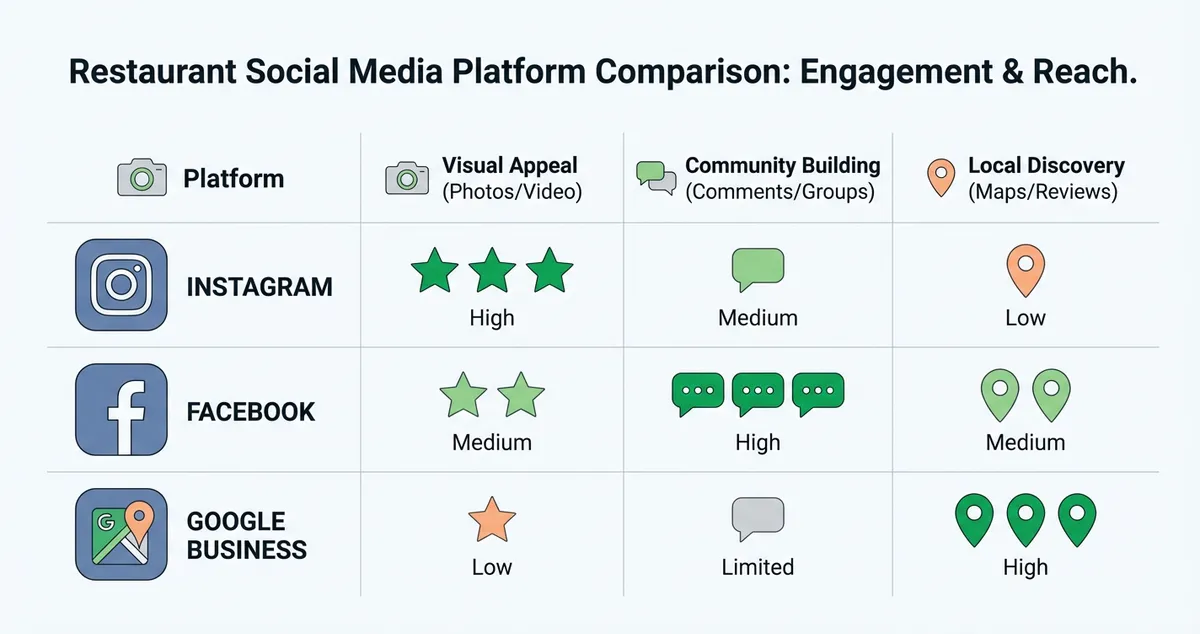
Choose platforms based on your customer demographics
| Platform | Works Well For | Time Needed | Typical Audience |
|---|---|---|---|
| Food photography, younger diners | 3-4 hours/week | 18-44 year olds | |
| Events, community, older diners | 2-3 hours/week | 35-65 year olds | |
| TikTok | Viral content, Gen Z | 4-5 hours/week | Under 30s |
| Google Business | Local search, all ages | 1-2 hours/week | Everyone searching nearby |
For many UK restaurants, Instagram often provides a strong combination of visual appeal and booking conversion. However, if your typical customer is over 45, Facebook often serves you better.
Matching Platform to Customer
The best social media platform for restaurants is a decision framework that matches your customer demographics to platform strengths, rather than chasing whatever's trending. For example, a fine dining restaurant with an older clientele might focus entirely on Facebook events and email, while a trendy brunch spot targeting millennials would prioritise Instagram Reels.
The 70/20/10 rule is a content framework that helps you balance what you post. For instance, a bistro might post:
- 70% valuable content: Behind-the-scenes videos, chef tips, ingredient stories
- 20% shared content: Customer photos (with permission), local events
- 10% promotional: Special offers, booking reminders
If you're only posting promotional content you'll always lose to competitors who treat social media as a conversation rather than a billboard. Your feed becomes an advertising board that people learn to ignore.
For more restaurant digital marketing tips on social media, see our restaurant social media marketing guide.
That's the theory. Here's where it gets messy.
Create a Content Calendar: Essential Restaurant Digital Marketing Tips
You've started strong before. Posted daily for two weeks. Then the Saturday rush happened, someone called in sick, and suddenly it's been three weeks since your last post. Sound familiar?
The solution isn't willpower. It's systems. If you're only posting when you remember, that's usually a sign you need a batching approach.
Batch your content creation:
- Pick one slow afternoon per week (many restaurants use Tuesday or Wednesday)
- Take 20-30 photos of dishes, prep work, and behind-the-scenes moments
- Write captions for the week in one sitting
- Schedule everything using a free tool like Meta Business Suite, or plan ahead in our social media calendar
For example, a family-run Italian restaurant might spend a quiet Wednesday afternoon photographing their pasta-making process, their fresh deliveries arriving, and the team prepping for service. Those 30 photos become two weeks of content.
A content calendar doesn't need to be complicated. A simple spreadsheet works:
| Day | Post Type | Caption Idea | Photo Needed |
|---|---|---|---|
| Monday | Behind-the-scenes | "Here's how we prep for the week" | Kitchen prep |
| Wednesday | Customer feature | Repost customer's photo | None needed |
| Friday | Weekend promo | "Bank holiday special" | Dish close-up |
The key insight is this: content created in batches during quiet moments is typically better than content created under pressure during service.
Now that you've got content sorted, let's talk about something many restaurants overlook.
Respond to Reviews Like Your Business Depends on It
One of the most underrated restaurant digital marketing tips: reviews matter more than you think. According to Sprout Social, online reviews significantly influence dining decisions, with many consumers avoiding restaurants with poor review responses.
Your response to a negative review often matters more than the negative review itself. Future customers read your replies to judge how you handle problems.
Review response framework:
- Thank them: Even for negative reviews, thank them for the feedback
- Acknowledge: Don't argue or make excuses; acknowledge their experience
- Offer resolution: Take the conversation offline if needed
- Keep it brief: Long defensive responses look worse than short professional ones
For instance, a curry house in Birmingham received a one-star review about slow service. Rather than arguing, they responded: "Thank you for your feedback, Sarah. We're sorry your experience didn't meet expectations. We'd love to make this right. Please email us at [email] so we can discuss this personally." The reviewer updated their rating to four stars after the owner reached out directly.
Never:
- Argue publicly with reviewers
- Blame staff by name
- Offer discounts in public responses (invites abuse)
- Ignore reviews for more than 48 hours
If you can't tell whether your reviews are helping or hurting your business, that's usually a sign your review management needs attention.
So reviews are sorted. Now what about keeping those customers coming back?
Use Email Marketing for Repeat Customers
Here's a marketing channel many restaurants overlook.
Social media gets the attention, but email quietly delivers results. Your email list is the one marketing channel you actually own. Algorithm changes can't take it away.
For restaurants, email often works well for:
- Announcing special events and themed nights
- Promoting midweek offers to fill slow periods
- Birthday and anniversary offers
- Menu launches and seasonal changes
Getting started with email marketing:
| Step | Action | Time |
|---|---|---|
| 1 | Choose platform (Mailchimp free tier) | 30 min |
| 2 | Add signup form to website | 20 min |
| 3 | Create table sign-up card | 15 min |
| 4 | Send monthly email | 1 hr/month |
For many restaurant owners, the biggest barrier isn't the technology: it's building the list.
Building Your Email List
- Train staff to mention the list when dropping bills (see our email marketing for restaurants guide for scripts)
- Offer a small incentive like a free coffee on their next visit
- Add a simple signup form to your website
Even a list of 200 local regulars can often be more valuable than 2,000 Instagram followers who never visit.
The good news is you don't need expensive software to make these strategies work.
Budget-Friendly Tools That Actually Help
Email sorted. Now let's cover practical restaurant digital marketing tips about tools, because you don't need expensive software to market your restaurant effectively. Here's what's worth your money:
Free tools:
- Google Business Profile: Manage your listing, post updates, respond to reviews
- Meta Business Suite: Schedule Instagram and Facebook posts
- Canva (free tier): Create basic graphics and menus
- Google Analytics: Track your website visitors
Worth paying for (under £50/month):
- Mailchimp: Email marketing (free up to 500 contacts)
- Later or Buffer: Social scheduling (from £15/month)
- Reservation system: Many include basic restaurant marketing features
Usually not worth it for small restaurants:
- Expensive social media management suites
- SEO tools with monthly subscriptions
- Marketing automation platforms
If you're paying for tools you barely use, you're typically just adding overhead. Keep your tech stack simple. The goal is to spend time on activities that bring customers in, not managing software.
All these restaurant digital marketing tips sound great in theory. In practice, when you're down two staff and it's 4pm on a Friday, even basic marketing feels impossible. That's why you need a floor.
Minimum Viable Marketing: The 30-Minute Weekly Plan
If you're reading this after a 12-hour shift and thinking "I don't have time for any of this", here's your floor, not your ceiling.
If You Only Have 30 Minutes a Week
- Day 1-2: Respond to all new Google reviews (10 minutes)
- Day 3-4: Post one strong food photo to Instagram with a booking link (10 minutes)
- Day 5-7: Update one thing on Google Business Profile: photo, post, or hours check (10 minutes)
That's it. These core restaurant digital marketing tips won't transform your marketing overnight, but they keep your digital presence active and professional. Consistent small efforts typically beat sporadic big pushes.
Real Results
A fish and chip shop owner in Leeds follows this exact 30-minute plan every Sunday evening. She responds to reviews while waiting for her roast to cook, posts one photo from Friday's busy service, and updates her Google hours for the coming week. After three months, her Google profile views increased by 40%, with no additional time investment.
Scale Up When Ready
Once this becomes habit, add:
- One Instagram Story per week (behind-the-scenes works)
- One monthly email to your list
- One response to a competitor's positive review (to learn what they're doing right)
Remember: One post every two days using a content framework beats random posting when you remember. You're building consistency, not perfection.
Would you follow your own restaurant's social media? If the honest answer is no, that's usually a sign the content needs work before you worry about algorithms.
Now let's turn these insights into a concrete action plan.
Actionable Checklist: This Week's Marketing Tasks
Use this checklist to audit and improve your restaurant marketing presence:
- Google Business Profile: Photos updated in the last 3 months
- Google Business Profile: Hours accurate including bank holidays
- Google Business Profile: All reviews from the last month have responses
- Website: Menu is current and mobile-friendly
- Website: Booking/contact information is obvious
- Social media: Posted at least twice in the last week
- Social media: Following the 70/20/10 content ratio
- Email: Have a way to collect customer emails
- Email: Sent at least one email in the last quarter
If more than three items are unchecked, start there before considering paid advertising or new platforms.
These restaurant digital marketing tips work, but only if you avoid the common pitfalls.
Common Restaurant Digital Marketing Mistakes to Avoid
You've got the fundamentals. Now let's make sure you don't sabotage your own progress.
Mistake 1: Ignoring analytics
Check which posts get engagement and which get bookings. For example, a wine bar discovered their sunset terrace photos got 200 likes but zero bookings, while their less pretty close-up pasta shots consistently drove reservations. Pretty doesn't always mean profitable.
Mistake 2: Inconsistent branding
Your Instagram shouldn't feel like a different restaurant than your website. A tapas restaurant might use warm oranges and rustic fonts across everything: website, social posts, and printed menus, so customers recognise them instantly.
Mistake 3: Chasing trends over fundamentals
TikTok trends come and go. A well-optimised Google Business Profile typically drives customers for years. For example, one restaurant owner spent 15 hours creating TikTok videos that flopped, when the same time spent on Google reviews would have delivered actual bookings.
Mistake 4: Forgetting the call to action
Your posts should include a next step: book now, see our menu, visit us this weekend. If you're only sharing pretty photos without telling people what to do next, that rarely works for driving actual bookings.
Mistake 5: Comparing yourself to chains
National chains have marketing teams and budgets. For instance, an independent bistro might highlight their locally-sourced ingredients and chef's personal story, something a chain could never replicate. Focus on what you can do authentically as an independent restaurant: that's often your competitive advantage.
For more on avoiding costly errors, read our guide on restaurant marketing mistakes.
Key Takeaways
If you run a restaurant and want to see how Local Brand Hub can support your marketing, explore our restaurant marketing tools.
Key Takeaways
These restaurant digital marketing tips don't need to be complicated or expensive. The fundamentals deliver results for restaurants of any size:
- A strong Google Business Profile
- A consistent social media presence
- Basic email marketing
Start with Google Business Profile. Master one social platform. Create systems that survive busy services. Respond to reviews. Consistency beats perfection.
Weekly Action
This Week: Take Three Actions
- Spend 20 minutes auditing your Google Business Profile (photos, hours, recent reviews)
- Schedule your next three social media posts in advance
- Create a simple way to collect customer emails (table card, website form, or QR code)
The restaurants that tend to win at digital marketing aren't necessarily the ones with the biggest budgets. They're often the ones who show up consistently, respond quickly, and make it easy for customers to find and book with them.
Info
Explore our detailed guides:
- Digital Marketing for Restaurants - Complete UK guide
- Restaurant Digital Marketing - Comprehensive strategies
- Restaurant Social Media Marketing - Platform tactics
For UK restaurants
Need Help With Your Digital Marketing?
Local Brand Hub helps UK restaurants implement these marketing tips without the complexity, from Google Business Profile to social media scheduling.
Start freeGet More Marketing Tips
Practical marketing tips for UK business owners, straight to your inbox. No spam, unsubscribe anytime.
About the Author
Local Brand Hub
Empowering UK Businesses
Local Brand Hub provides comprehensive business management tools designed specifically for UK local businesses to streamline operations, automate marketing, and grow revenue.
More articlesRelated Articles
 Marketing Tips
Digital Marketing for Restaurants: A Practical UK Guide
Learn how digital marketing helps UK restaurants attract more customers. Covers the 4 P's, 70/20/10 rule, and practical strategies you can start this week.
 Marketing Tips
Restaurant Digital Marketing: A Guide for UK Restaurants
Build a digital marketing plan for your UK restaurant with budget-friendly tactics, proven frameworks, and realistic cost breakdowns.
 Marketing Tips
Restaurant Digital Marketing Strategy: Complete UK Guide
Build a restaurant digital marketing strategy that fits your schedule. Learn the 70/20/10 rule, core strategies, and realistic weekly plan for UK owners.