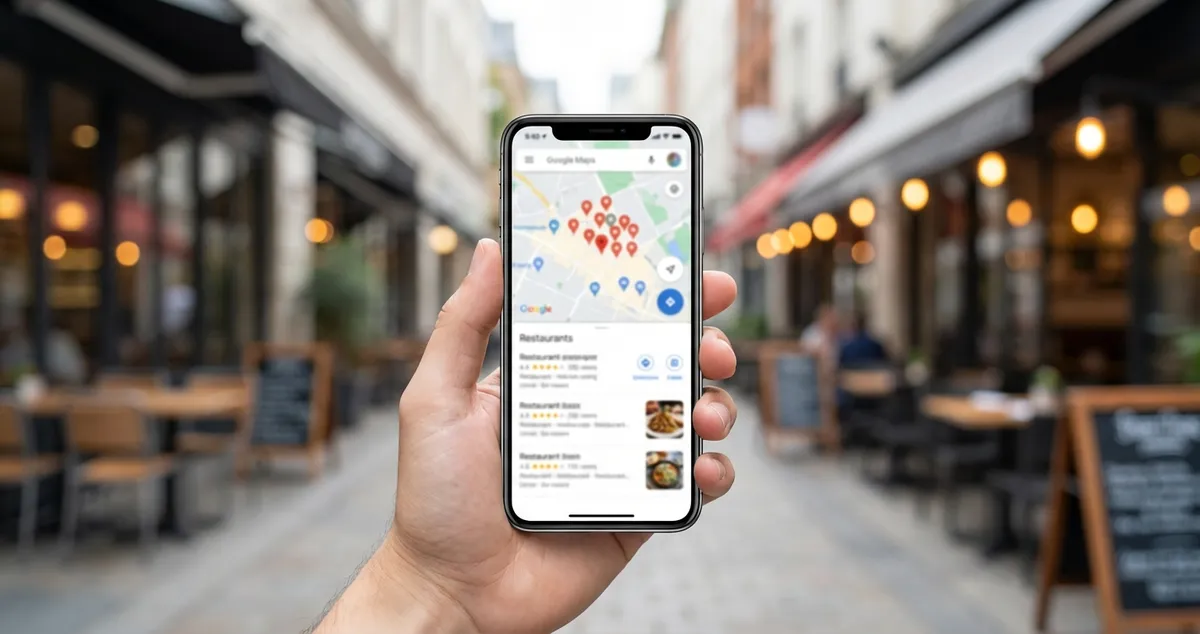
Improve your restaurant online visibility with practical steps. Get found by hungry customers via Google profiles, reviews, and local SEO.
Restaurant online visibility is how easily potential customers can find your restaurant when searching online through Google, social media, review sites, and food apps. With 76% of people who search for something nearby visiting a business within a day, visibility directly influences whether customers choose your restaurant or a competitor.
If you are reading this, you have probably typed your restaurant name into Google and been disappointed by what appeared, or did not appear.
Info
Related: See our restaurant digital marketing guide for a complete approach to building your digital presence.
You have run the Saturday service, sorted the Sunday prep, and finally sat down to check how the restaurant is performing online. Meanwhile, the place down the road with half your cooking skills shows up everywhere. Sound familiar?
Strong online visibility means appearing in local searches, map results, and social feeds where diners make decisions about where to eat.
This is the reality for many UK restaurant owners. Your food is excellent, your team works hard, and yet customers cannot find you online.
The gap between quality and visibility is frustrating because it directly affects bookings and revenue. This guide covers practical ways to improve your restaurant online visibility without needing a marketing degree or spending hours you do not have.
These are the same approaches that help independent restaurants compete with chains that have dedicated marketing teams. We have worked with dozens of UK restaurant owners on exactly these challenges.
What You'll Learn
- The four pillars of restaurant online visibility
- How to audit your current digital presence in 15 minutes
- How to track your competitors' visibility (and tools that help)
- Quick wins that improve restaurant visibility within days
- Common mistakes that make restaurants invisible online
What Is Restaurant Online Visibility?
Before diving into tactics, let's clarify what we're actually measuring.
Online visibility for restaurants is a framework that measures how easily potential customers can find you when they search online. It encompasses:
- Your Google Business Profile
- Website SEO
- Social media presence
- Review site listings
- Food delivery app profiles
All of these work together to determine whether diners discover you or your competitors.
Why it matters
Think of it as your digital shopfront. Just as location matters for foot traffic, online visibility matters for digital traffic.
According to Google, 76% of people who search for something nearby on their phone visit a business within a day.
If your restaurant is not visible in those searches, you are missing customers who are actively looking to eat out.
Online visibility differs from general marketing because it is about being findable, not just promotional.
For example, a family-run trattoria might have 5,000 Instagram followers, but if they do not appear when someone searches "Italian near me," those followers are not converting to new customers.
The Four Pillars of Restaurant Online Visibility
Now that you understand what online visibility means, let's break down how to actually achieve it. So what actually makes a restaurant visible online? Improving restaurant online visibility requires attention to four main areas. Neglect one, and the others typically cannot compensate. Get all four working together, and you create a presence that consistently attracts new customers.
For example, a pizza restaurant in Birmingham might have a stunning Instagram feed with thousands of followers, but if their Google Business Profile shows incorrect hours and no recent reviews, local searchers will choose the competitor who shows up in map results instead.
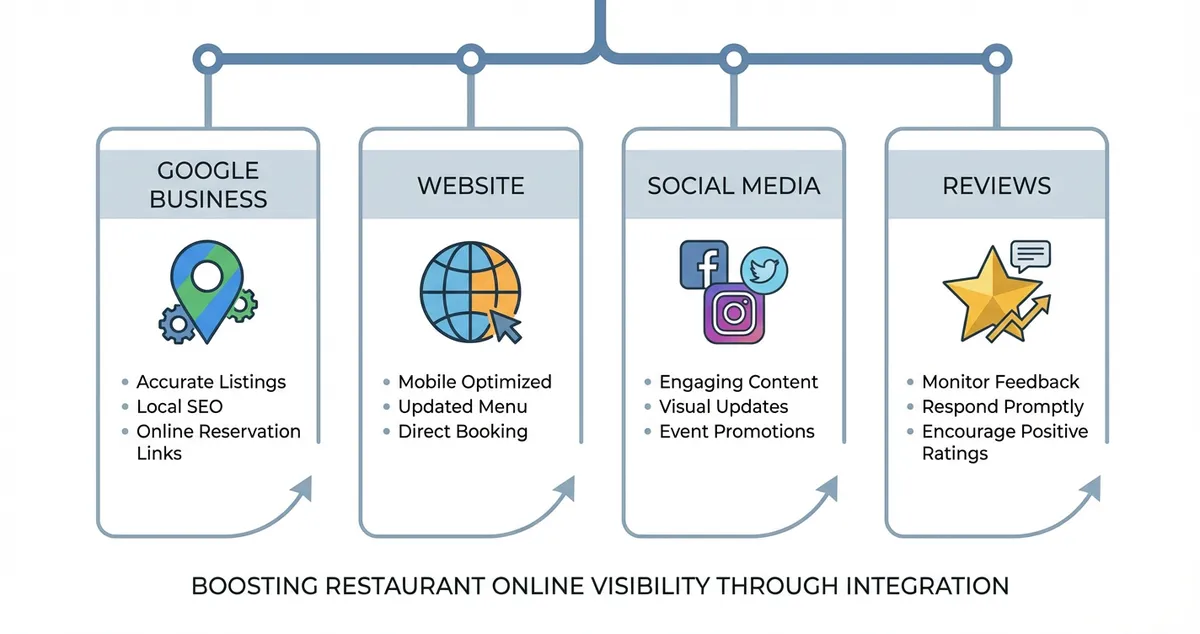
All four pillars work together to build visibility
1. Google Business Profile
Your Google Business Profile is typically a critical factor for local visibility. When someone searches "restaurants near me" or "[cuisine type] [location]," Google decides which restaurants to show based largely on Business Profile information.
What to optimise:
- Complete every section (name, address, hours, description, attributes)
- Add at least 10 quality photos showing food, interior, and exterior
- Keep hours accurate, especially for bank holidays
- Respond to every review, positive or negative
For instance, a gastropub using this approach might update their profile weekly with new dish photos, respond to reviews within 24 hours, and add seasonal menu items to their description. This signals to Google that the business is active and engaged.
Info
Learn more: See our restaurant Google Business Profile guide for the complete setup process.
2. Website Presence
Your website anchors your online visibility. Even if customers find you through Google or social media, many will visit your website before booking. A slow, outdated, or mobile-unfriendly website loses customers at this critical moment.
Essential elements:
- Mobile-responsive design (most searches happen on phones)
- Clear menu with prices
- Easy-to-find contact details and address
- Online booking or reservation link
- Fast loading speed (under 3 seconds)
If you are reading this after discovering your website takes 8 seconds to load on mobile, that is usually a sign the technical foundations need attention before anything else.
3. Social Media Presence
Social media builds visibility through discovery and engagement. While Google captures people actively searching, social media reaches people before they are hungry, building awareness that translates to visits later.
Platform priorities for UK restaurants:
- Instagram: Typically strong for visual food content and stories
- Facebook: Strong for local communities and events
- TikTok: Growing fast for behind-the-scenes content
For example, a fish and chip shop might focus entirely on Facebook where their local community is most active, while a cocktail bar targets Instagram for its visual appeal. Choose based on where your customers actually spend time, not where marketing articles say you "should" be.
Info
Related: See our restaurant social media marketing guide for strategies that work for independent restaurants.
4. Reviews and Reputation
Reviews and reputation is a framework that measures how customers perceive your restaurant based on their public feedback across Google, TripAdvisor, and other platforms.
Online reviews directly impact visibility. Google uses review quantity, quality, and recency as ranking factors. Beyond algorithms, 93% of consumers say online reviews influence their dining decisions according to ReviewTrackers.
Review sites to monitor:
- Google (typically the priority for search visibility)
- TripAdvisor (especially for tourist areas)
- OpenTable/Resy (if you use them for bookings)
- Facebook recommendations
Asking satisfied customers for reviews is not pushy: it is necessary. The challenge is making it easy. For instance, a QR code on receipts linking directly to your Google review page removes friction and increases response rates.
How to Audit Your Current Visibility
Now that you understand the four pillars, where do you actually stand?
Before improving anything, assess your current position.
Your 15-minute visibility audit
| Check | What to Do | Pass/Fail |
|---|---|---|
| Google search | Search restaurant name | First result is your site |
| Near me search | Search cuisine + location | In top 10 or map pack |
| GBP complete | Review Business Profile | All sections filled |
| Mobile speed | Load site on phone | Under 3 seconds |
| Recent review | Check latest Google review | Within past 30 days |
According to the UK Government Digital Service, ensuring your digital presence is accessible is essential.
What the audit reveals
For example, a curry house in Leeds ran this audit and discovered their Google Business Profile showed the wrong phone number.
They had been losing calls for months without knowing.
Focus Your Efforts
If you fail more than two checks, focus on those areas first. Fixing everything at once typically means fixing nothing well.
Prefer a quicker starting point? Run our free visibility check: five questions, thirty seconds, and you'll know which of these areas needs attention first.
How to Track Your Competitors' Online Visibility
Auditing yourself is only half the picture. The restaurants winning local searches are watching what their rivals do, too, and a quick competitor check tells you exactly where you're being out-ranked.
You can track a competitor's online visibility manually in about ten minutes:
- Search the way diners do. Type "[your cuisine] near me" and "[your area] restaurant" in an incognito window and note who appears above you in the map pack and the blue links.
- Compare Google Business Profiles. Look at their review count, average rating, photo freshness and how recently they posted. These are the signals Google weighs most heavily.
- Check their booking and social presence. Are they on a booking platform you're not? Posting more consistently? Running offers you can't see on your own channels?
- Log it monthly. Visibility is a moving target: a one-off snapshot tells you less than a simple month-on-month record of who's gaining ground.
If you'd rather not do this by hand, the best platforms to track competitor restaurant visibility pull these signals into one dashboard so you can see at a glance where rivals are pulling ahead. Local Brand Hub does exactly this for UK restaurants, tracking up to five competitors' rankings, reviews and profile activity so you know where to focus next.
Quick Wins for Better Visibility
With your audit complete, here is where to focus first.
Some changes improve visibility within days rather than months. Start here if you need results quickly.
Claim your Google Business Profile
Here is the first step. If you have not done this, stop reading and do it now.
This single action can increase visibility dramatically. According to Google, complete profiles are more likely to attract location visits.
Add fresh photos
Add 5 new photos to Google. Recent, quality photos signal an active business.
Include exterior shots (helps customers find you), interior shots, and your dishes.
Respond to reviews
Respond to your last 10 reviews. Google notices when businesses engage.
Thank positive reviewers specifically, and address negative feedback professionally. This shows customers you care.
Fix inconsistent information
Your business name, address, and phone number should match exactly across Google, your website, social media, and directories.
For example, a café chain discovered their phone number differed between Google (with a space) and their website (without). This small inconsistency was confusing Google's local algorithm and affecting their map pack rankings.
Info
Related: See our restaurant local SEO guide for a deeper dive into search engine optimisation for restaurants.
Common Mistakes That Hurt Visibility
You have got the fundamentals. But here is where many restaurants stumble. What should you avoid? These mistakes sabotage even well-intentioned visibility efforts.
Ignoring mobile experience
Over 60% of restaurant searches happen on mobile devices. If your website is not mobile-friendly, you are invisible to many searchers, not because Google does not show you, but because users bounce immediately.
For example, a seafood restaurant in Bristol discovered their booking page took 12 seconds to load on mobile. They were losing customers before the page even appeared. If you are only optimising for desktop you will always lose to competitors who design mobile-first.
Inconsistent posting on social media
Starting strong then disappearing for weeks looks worse than never starting. If you cannot commit to regular posting, reduce frequency to something sustainable.
Three quality posts per week beats daily posts for two weeks followed by silence. If you cannot tell whether your social media actually brings bookings or just likes, that's usually a sign the strategy needs tightening. Similarly, if your Google reviews have dried up while competitors keep growing theirs, that's usually a sign your review request process needs attention.
Not asking for reviews
Waiting for reviews to appear naturally means waiting forever. The restaurants with many reviews actively request them from satisfied customers.
For example, a Thai restaurant in Manchester added a simple card to their bill presenter with a QR code linking to Google reviews. Within two months, their review count increased from 47 to 120, and their visibility in local searches improved noticeably.
This is not manipulation: it is ensuring your online reputation reflects your actual customer experience.
Treating platforms separately
Your Google profile, website, and social media should reinforce each other. Link between them, use consistent branding, and ensure information matches.
Customers often discover you on one platform and visit another before deciding. Posting beautiful photos on Instagram while your Google profile shows a blurry exterior shot from years ago? That rarely works.
Self-Check
If a customer searched for your restaurant right now, would they find accurate information, appealing photos, and recent reviews? Or would they find outdated hours and a profile that looks abandoned?
Minimum Viable Effort: Where to Start
That is the theory. Here is where it gets messy for busy restaurant owners. If you are thinking "I do not have time for all of this," you are not alone. The reality for most independent restaurant owners is that marketing competes with a hundred other priorities.
If You Only Have 30 Minutes a Week
- Day 1-2: Claim your Google Business Profile and complete all sections
- Day 3-4: Respond to your most recent reviews (positive and negative)
- Day 5-7: Add 3 new photos to your Google profile
That is enough to start. A complete Google Business Profile with recent activity outperforms elaborate marketing strategies that never get implemented. Once this baseline is solid, you can expand to website improvements and social media.
The question is not "should I do everything perfectly?" It is "what will I actually do consistently?" Consistency beats intensity for restaurant online visibility.
Weekly Action Plan
Improving visibility is not a one-time task. Here is what to do each week:
Weekly Action
- Week 1: Log into Google Business Profile. Update hours if needed. Add 3 new food photos. Reply to any unanswered reviews.
- Week 2: Check your website loads under 3 seconds on mobile (use Google PageSpeed Insights). Fix any broken links.
- Week 3: Post one piece of content on your primary social platform. Ask 5 satisfied customers for a Google review.
- Week 4: Search your restaurant name and "[cuisine] near me". Note your position and any competitor improvements.
Repeat this cycle each month. According to BrightLocal's Local Consumer Review Survey, 87% of consumers read online reviews for local businesses, and freshness matters: recency signals an active, engaged business.
Actionable Checklist
With the strategy clear, here is your practical tracker. Use this checklist to track your progress:
- Google Business Profile claimed and verified
- All GBP sections complete (hours, description, attributes)
- At least 10 photos on Google profile
- Website loads under 3 seconds on mobile
- Menu available online with prices
- NAP (name, address, phone) consistent across all platforms
- Review response process in place
- Social media profiles link to website
- Booking/reservation clearly accessible
- Staff know to ask satisfied customers for reviews
Frequently Asked Questions
Still have questions? Here are the ones restaurant owners ask most often about online visibility.
How long does it take to improve restaurant online visibility?
Some changes like completing your Google Business Profile show results within days. Others like building review volume take months of consistent effort.
Most restaurants see measurable improvements in search visibility within 4-8 weeks of implementing these changes, though ongoing maintenance is required to maintain rankings.
Do I need to be on every social media platform?
No. Focus on 1-2 platforms where your customers actually spend time. For most UK restaurants, this means Facebook and Instagram. Spreading yourself across every platform typically results in mediocre presence everywhere rather than strong presence somewhere.
How important are online reviews compared to other factors?
Reviews are typically one of the top three factors for local search ranking, alongside your Google Business Profile completeness and website relevance.
Beyond search algorithms, reviews directly influence customer decisions: a restaurant with 4.5 stars and 200 reviews will often outperform one with 4.8 stars and 15 reviews because volume builds trust.
Key Takeaways
If you run a restaurant and want to see how Local Brand Hub can support your marketing, explore our restaurant marketing tools.
Key Takeaways
That covers the essentials. With these foundations in place, what happens next?
Restaurant online visibility determines whether hungry customers find your restaurant or your competitors. The four pillars work together:
- Google Business Profile
- Website
- Social media
- Reviews
Start with Google Business Profile. It is free, it is often one of the key factors for local search, and you can complete it in under an hour.
From there, ensure your website works well on mobile, choose one or two social platforms to maintain consistently, and build a habit of asking happy customers for reviews.
The restaurants that get found online are not necessarily the ones with the biggest budgets. They are the ones that show up consistently and keep their information accurate.
Your next step: Search your restaurant name on Google right now. What you see is what potential customers see. If it is not accurate, complete, and appealing, you know where to start.
Info
Explore our detailed guides:
- Restaurant Digital Marketing - Complete marketing overview
- Restaurant Digital Presence - Building your online foundation
- Restaurant Social Media Marketing - Platform strategies
For UK restaurants
Need Help With Your Online Visibility?
Local Brand Hub helps UK restaurants improve their online visibility without the complexity: from Google Business Profile to review management.
Start freeGet More Marketing Tips
Practical marketing tips for UK business owners, straight to your inbox. No spam, unsubscribe anytime.
About the Author
Local Brand Hub
Empowering UK Businesses
Local Brand Hub provides comprehensive business management tools designed specifically for UK local businesses to streamline operations, automate marketing, and grow revenue.
More articlesRelated Articles
 Marketing Tips
Digital Marketing for Restaurants: A Practical UK Guide
Learn how digital marketing helps UK restaurants attract more customers. Covers the 4 P's, 70/20/10 rule, and practical strategies you can start this week.
 Marketing Tips
Restaurant Digital Presence: Building Your Online Foundation
Build a strong restaurant digital presence that attracts local customers. Essential platforms, 15-minute audit, and realistic time investment for owners.
 Marketing Tips
Restaurant Internet Marketing: A Guide for UK Owners
A practical internet marketing guide for UK restaurant owners. Covers local SEO, social media, Google Business Profile, and website essentials.