
Restaurant opening costs are two budgets, not one. Price the published UK rates today, quote the rest twice, then size your reserve in months.
Restaurant opening costs are two budgets wearing one number. The capital spend (fit-out, kitchen and furniture) is paid once and can be specified down. The monthly burn (rent, wages, business rates and utilities) begins the day you sign the lease and runs whether you are trading or not. Fund both.
Most opening budgets arrive as one figure with a question mark beside it. The question is almost never "can I afford this". It is "afford it until when", and one figure cannot answer that. Which is why first-time operators reach opening week technically on budget and functionally broke.
Better news is buried in the same sheet. Half of an opening budget is not a quote at all. It is a price list nobody has looked up yet.
Related: Restaurant Business Plan is where both columns end up. See how the two halves sit inside a finished plan.
About this guide: written for a first-time UK operator pricing an opening before signing anything. The fixed figures come from GOV.UK and legislation.gov.uk.
Why one number cannot answer the question
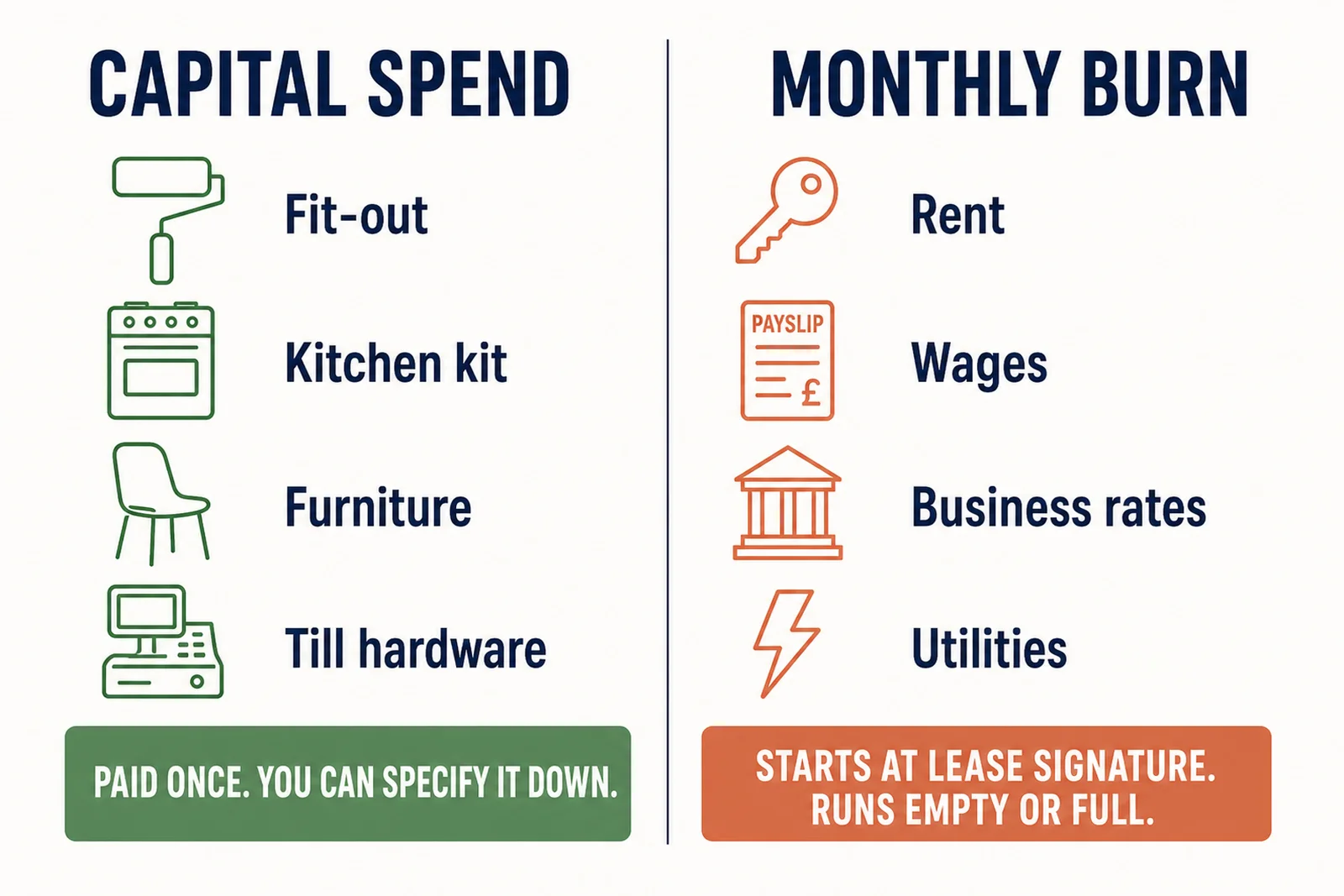
The two halves of an opening budget fail in completely different ways.
An opening budget holds two kinds of money that behave nothing alike under pressure. Separate them onto two columns first, because a blended total hides the property that decides what you can do about it: which pounds you can still change your mind about.
Capital is the half you can cut
Capital is paid once, before the doors open, and nearly all of it is negotiable. Specify a smaller extraction canopy. Buy the reconditioned combi oven. Open with thirty covers and add the mezzanine in year two. Outside the handful of items somebody else has already specified for you, nearly every line here has a cheaper version of itself, which is what makes this the column to cut when a quote comes back ugly.
Burn is the half that cuts you
Burn is rent, wages, rates, utilities and insurance. It is also the standing charge on a gas meter serving a kitchen that has not cooked anything yet. It starts at lease signature, indifferent to whether you have sold a plate. There is no reconditioned version of rent, only the number of months you can absorb it, and that number is the real budget.
When a fit-out overruns, the instinctive cuts come from the wrong column: trim the marketing, defer the second chef, delay the soft opening. Each feels prudent, and each slows the build of trade, which is the exit you are funding the reserve to reach.
Imagine two operators opening the same month with the same £120,000. One put it all into the room and has a fortnight of rent left behind it; the other kept a third back and has four months. Same budget, different business.
What can you price before you have a single quote?
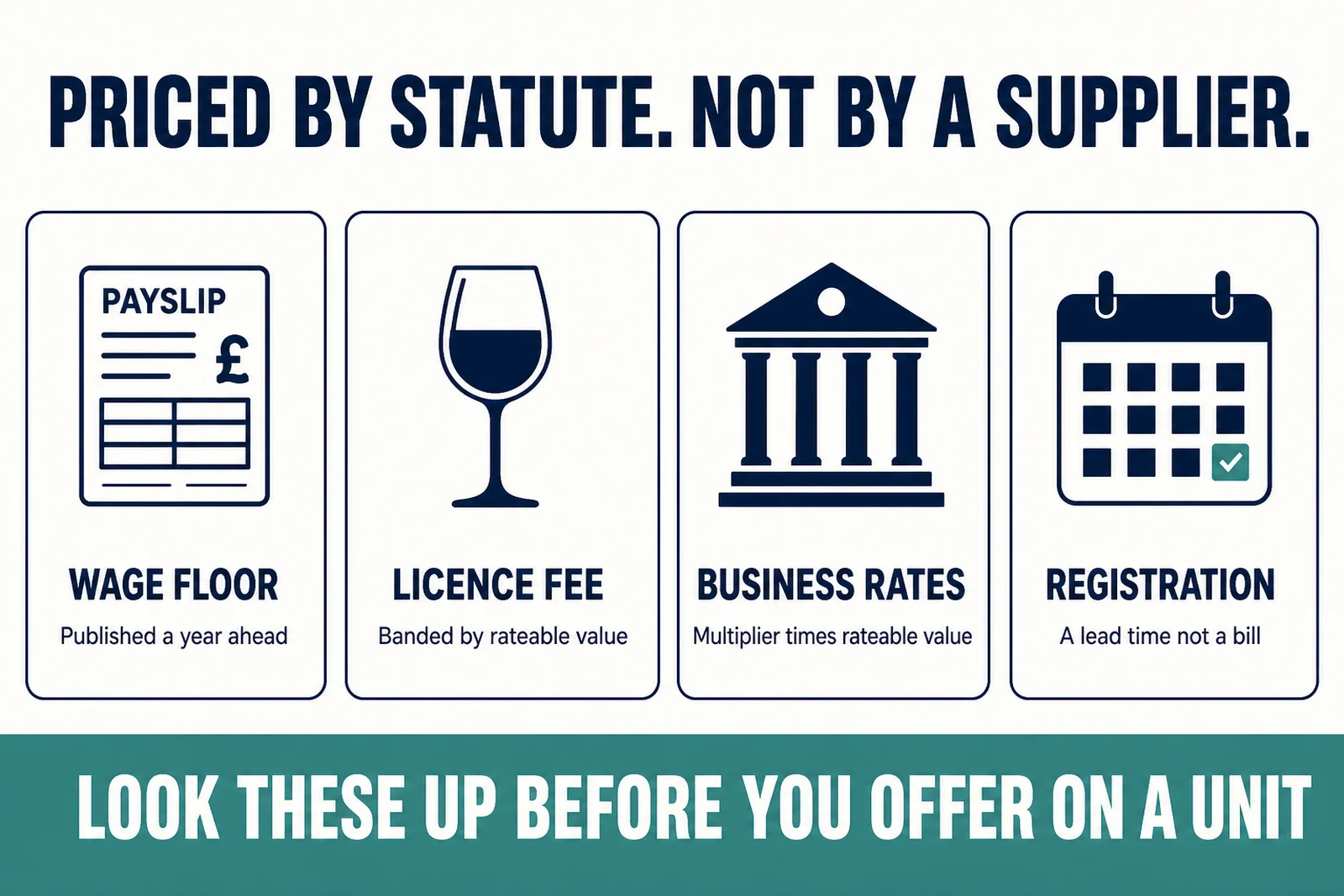
Four lines you can settle before a single supplier calls you back.
Suppliers set most of an opening budget, slowly. A useful minority is set by statute and published tables, so you can price those lines this afternoon and build the guesswork around something solid.
The wage floor is published, and it moved in April
The UK government publication on the National Minimum Wage in 2026 records that the National Living Wage rose by 4.1 per cent in April 2026 to £12.71 an hour for eligible workers aged 21 and over. That is a legal minimum, not a market rate: it sets the bottom of your rota, not its cost.
Employer National Insurance, pension contributions and holiday pay sit on top of that figure rather than inside it, so model the labour line at what leaves your bank account. The restaurant labour cost percentage guide covers how it behaves once trade starts.
The alcohol licence has a price list, not a quote
Where the concept involves alcohol, the fee is banded by the unit's non-domestic rateable value: GOV.UK's alcohol licensing fee levels set the new premises licence application fee at £100 for the lowest band and £635 for the highest, in England and Wales. Read your band off the rateable value before you offer.
Business rates follow a multiplier, not the market
A GOV.UK publication records the government's intention to introduce permanently lower business rates multipliers for retail, hospitality and leisure properties with rateable values under £500,000, from 2026-27. Business rates are devolved, so that is England's position and your nation may differ. Either way the input you need is that unit's published rateable value, not the rent the agent is quoting.
Two costs that are dates rather than pounds
Food Standards Agency guidance on GOV.UK, which covers England, Wales and Northern Ireland, states that a food business is required to register at least 28 days before trading. Put that lead time on the build programme, because it has to run alongside the fit-out rather than after it.
The Explanatory Notes to section 69 of the Deregulation Act record that it amended the Licensing Act so that a personal licence has effect indefinitely, in England and Wales. Pay once, keep it: there is no renewal to diarise or re-budget.
How do you turn that into a monthly burn?
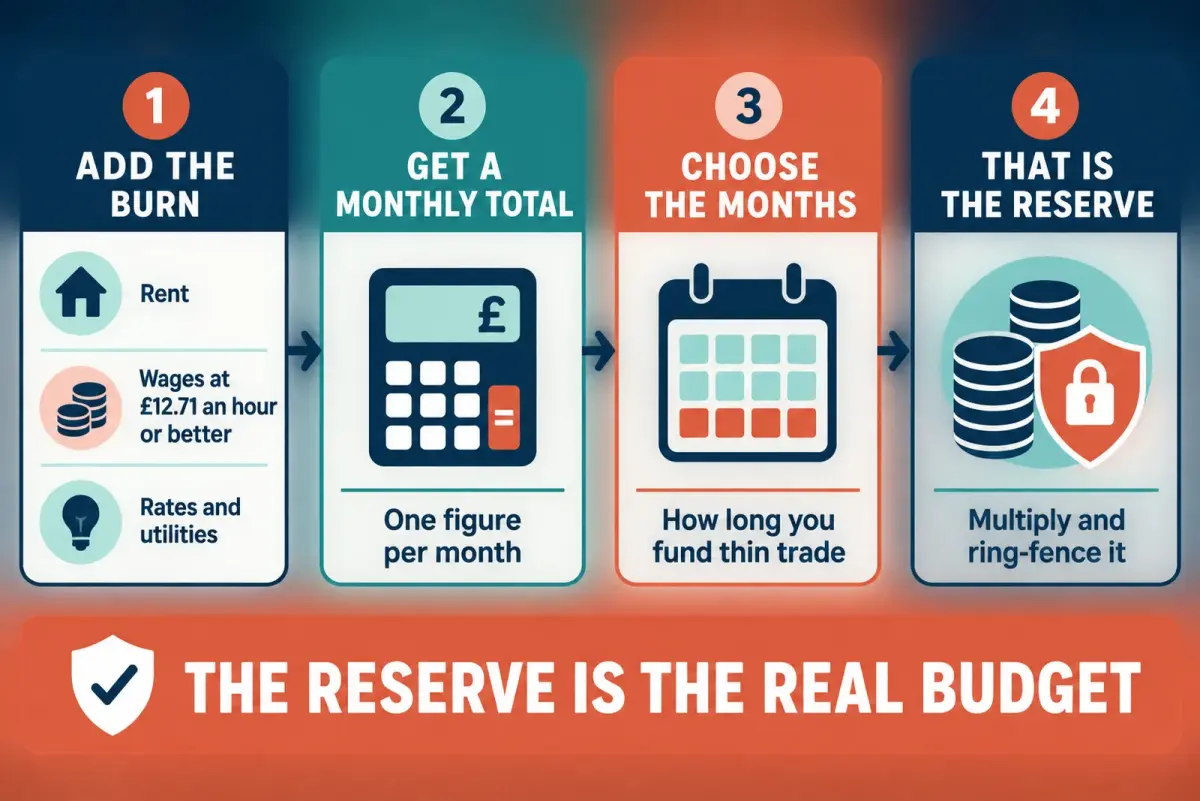
Add it up, choose the months, multiply. The answer comes out in months rather than percentages.
Setting working capital as a percentage of the capital spend measures the wrong thing. A percentage describes how big the build was, not how long you can trade quietly, which is what the reserve is there to buy. Total the burn column instead:
- Add every recurring line into one monthly figure.
- Decide how many months of thin trade you are willing to fund.
- Multiply.
That is the whole calculation, and it decides whether the concept survives that rent.
Imagine a neighbourhood restaurant. Put the rent on the sheet. Add the rota costed at the wage floor or better, then rates, utilities, insurance and the software subscriptions. Say the column comes to £21,000 a month. Four months of thin trade is £84,000, counted at the full burn because takings in those months are a bonus rather than a plan, and it has to exist before you sign rather than after the fit-out has eaten the contingency.
The arithmetic is trivial; the discipline is not. Working out your own restaurant break-even point turns the second half of that sum into a date.
What does the capital column actually buy?
Back to the column you can still argue with. Fit-out is the largest item and the most underestimated, because a shell unit rarely advertises what it is missing. Cost is driven less by design than by absence: three phase power, drainage, a route for ductwork to roof level, a floor rated for commercial loading. Picture two identical looking shells on the same parade: one already has the power and the duct route, the other has neither, and the second quote lands at twice the first. Nothing in the letting particulars tells you which one you are standing in.
Pro tip: get every capital quote twice, at the specification you want and at the one you would accept. That second set of numbers is your real contingency.
Kitchen equipment can be bought in stages and has a second-hand market, so a wrong choice is usually retrievable. Furniture is the opposite: a wobbling table gets binned in month seven whatever it cost in month one. Till hardware sits here, its subscription in the burn column, which the restaurant POS system cost guide untangles.
Is the 30/30/30 rule worth anything?
You will meet it within two searches: food, labour and overheads each taking roughly a third of revenue, leaving about a tenth as profit. We have found no published study measuring those proportions as a typical UK outcome, and being memorable with tidy arithmetic is the quality of a mnemonic, not of a finding. Its one honest use is the adding up: those buckets have to account for all of your revenue.
Imagine a projection with food at 26 per cent of revenue, labour at 25 and overheads at 24. Every third looks comfortable. What they leave is a 25 per cent margin, and that, not the thirds, is the number to defend.
Frequently Asked Questions
What are pre-opening costs for a restaurant?
Every pound spent between signing the lease and serving the first customer. Some of it you buy once: fit-out, kitchen and furniture. The rest arrives every month from lease signature whether you trade or not: rent, rates, utilities and early wages.
How much money do I need to open a restaurant in the UK?
Enough for the capital spend plus several months of running the place on almost no takings. Any total quoted without a site, a concept and a lease is guesswork, because fit-out is priced by your shell and rent by your street. The wage floor, licensing fees, rateable value and registration lead time are all published, so price those first.
What is the 30/30/30 rule for restaurants?
A rule of thumb splitting revenue into roughly equal thirds for food, labour and overheads, leaving about a tenth as profit. We have found no published study measuring it as a typical UK outcome, so use it to test whether a projection adds up, not to bless one that might.
Do I have to register my restaurant before opening?
Food Standards Agency guidance on GOV.UK, which covers England, Wales and Northern Ireland, states that a food business is required to register at least 28 days before trading. Put it on the build programme, not the to-do list.
How big should my working capital reserve be?
Count it in months of burn, not as a percentage of the capital spend. Months tell you how long you stay open while the neighbourhood works out you exist; a percentage only tells you how big the build was.
Planning the launch itself once the numbers stack up? The restaurant opening guide picks up where the budget leaves off.
Build the sheet before you sign
Key Takeaway
Two columns, drawn before you sign. That beats any national range quoted online, because the range was never about your building.
Weekly Action
- Day 1-2: draw the two columns and put every known cost on the correct side
- Day 3-4: look up the unit's rateable value, then read the licensing band and the rates position off it
- Day 5-7: total the burn column, multiply by the months of thin trade you are funding, then ring-fence the answer
- Consider the reserve untouchable from the day you count it; the point of ring-fencing it is that a visible balance is easy to raid when the ductwork quote comes back at double
Once the doors open, being findable becomes its own line of work. LocalBrandHub gives you a visibility score for how easily nearby customers can find you online, plus ready-made seasonal campaigns for the quiet spells you just budgeted for.
Carry one sentence into the lease negotiation. A fit-out that costs too much wounds you once, in the capital column. A fit-out that takes too long bleeds you every week it drags, in the burn column, and that is the failure a single number budget never sees coming.
For restaurants, salons, and local businesses
Need help with your marketing?
We help UK businesses turn social media into real results, not busywork.
Start freeSources
- GOV.UK / Food Standards Agency, Food business registration
- GOV.UK, The National Minimum Wage in 2026
- GOV.UK, Effects of the business rates retail, hospitality and leisure multipliers and high value multiplier
- GOV.UK, Alcohol licensing fee levels: main fee levels
- legislation.gov.uk, Deregulation Act Explanatory Notes, section 69
Get More Marketing Tips
Practical marketing tips for UK business owners, straight to your inbox. No spam, unsubscribe anytime.
About the Author
Local Brand Hub
Empowering UK Businesses
Local Brand Hub provides comprehensive business management tools designed specifically for UK local businesses to streamline operations, automate marketing, and grow revenue.
More articlesRelated Articles
 Business Growth
How to Write a Restaurant Business Plan: UK Lender Guide
How to write a restaurant business plan UK lenders will read: the seven sections, covers-based financial projections and real Start Up Loans cases.
 Business Growth
Restaurant Business Plan Template: Copy the UK Blocks
A restaurant business plan template you can paste and fill in, with the UK lines an American version leaves out and a source beside every number.
 Business Growth
Small Restaurant Business Plan: A Practical UK Guide
Write a small restaurant business plan using the 30/30/30/10 cost rule. Covers 7 essential sections with realistic UK startup figures.