
Step-by-step SEO for beauty salon owners who want to rank on Google. Covers Google Business Profile, keywords, reviews, and local citations.
SEO for beauty salon owners is the process of making your salon appear when potential clients search Google for treatments you offer. It covers your Google Business Profile, your website pages, client reviews, and local directory listings, all working together so the right people find you at the right time.
You offer incredible treatments. Your regulars love you. But when someone new moves to the area and searches "beauty salon near me," they find the salon down the road instead. Not because they're better, because Google knows they exist. That's what SEO fixes.
If you're thinking "SEO sounds like something I need a marketing degree for", it really isn't. Most of what works for local beauty salons is straightforward. If you can set up a social media profile, you can do this. The steps below take about 30 minutes each, and you can spread them across a month.
This guide walks you through SEO for beauty salon visibility, step by step, no jargon, no fluff. 13 min read.
What You'll Learn About SEO for Beauty Salons
- How to claim and optimise your Google Business Profile (the single biggest SEO action for most salons)
- Why each treatment needs its own page, and how to write titles Google understands
- How to get more Google reviews without being pushy
- Where to list your salon online to build local authority
- The difference between keywords, search volume, and what actually matters for a beauty salon
Step 1: Claim and Complete Your Google Business Profile
Your Google Business Profile (GBP) is typically the most important piece of SEO for beauty salon visibility. It's the listing that appears in the map results when someone searches "beauty salon near me" or "nail salon [your town]." Businesses that optimise their Google Business Profiles see 70% higher engagement than those that don't (Google, 2025).
How to claim yours:
- Go to google.com/business and search for your salon name
- If your salon appears, click "Claim this business" and follow the verification steps
- If it doesn't appear, click "Add your business" and enter your details
Once claimed, complete every field:
- Business name: your actual salon name, not stuffed with keywords
- Category: choose "Beauty Salon" as primary, then add secondary categories like "Nail Salon" or "Aesthetics Clinic"
- Opening hours: keep these accurate, including bank holidays. Google penalises businesses shown as closed when they're actually open
- Services: list every treatment with prices. Think of this as your searchable treatment menu
- Description: 750 characters to describe what you offer. Mention your town, your specialisms, and the types of clients you serve
- Photos: upload at least 10. Treatment rooms, your team, before-and-after results, the exterior of your salon
Pro Tip
According to the NHBF, most UK salon clients check Google reviews and photos before booking a first appointment (NHBF, 2025). Your GBP photos may be the first impression: make them count.
If you're only doing one thing from this entire guide, do this step. It's free, it takes 30 minutes, and it directly affects whether you appear in the Local Pack, the map results that capture 44% of all clicks on local search pages (Google, 2025).
For the full setup walkthrough, read our Google Business Profile guide for beauty salons.
Step 2: Create Individual Treatment Pages on Your Website
With your Google Business Profile sorted, the next step in SEO for beauty salon growth is your website. This is where most salon websites fall short. Instead of one generic "Services" page listing everything, each treatment deserves its own page. Why? Because Google can't rank a single page for 20 different search terms. But it can rank individual pages for specific searches.
What this looks like in practice:
A beauty salon offering lash extensions, facials, and gel nails would create:
- a page like
lash-extensions-{your-town}, with description, pricing, aftercare info, and booking link - a page like
facial-treatments-{your-town}, with treatment types, skin concern guidance, and before-and-after photos - a page like
gel-nails-{your-town}, with design options, pricing, and how to book
Each page targets a specific search query someone might type. "Lash extensions Croydon" is a real search that a real person makes, and if you have a page matching that intent, Google has a reason to show your salon.
Page title formula: [Treatment Name] in [Your Town] | [Salon Name]
For example: "Gel Nails in Brighton | Rose Beauty Studio"
The page title, or "title tag" in SEO terms, is the text that appears as the blue link in Google search results. It tells both Google and potential clients exactly what the page is about.
If you can't tell whether your website is bringing in new clients or just keeping you busy, that's usually a sign your treatment pages aren't targeting the right search terms. For more on building an effective salon site, see our salon website and SEO hub.
Step 3: Optimise Your Page Titles and Descriptions
Now that you have individual treatment pages, let's make sure Google, and potential clients, can read them properly. Every page on your website has two pieces of text that appear in Google search results: the title tag (the blue link) and the meta description (the blurb underneath it).
Title tag: this is what Google shows as the main link. Keep it under 60 characters, include your treatment name and location.
| Treatment | Title Tag Example |
|---|---|
| Lash Extensions | Lash Extensions in Brighton | Rose Beauty |
| Gel Nails | Gel Nails Brighton: Book Online | Rose Beauty |
| Facials | Facial Treatments Brighton | Rose Beauty Studio |
Meta description: the summary text below the title in search results. Think of it as a 155-character advert for that page. Include what the treatment involves and a reason to click.
Example: "Professional lash extensions in Brighton. Classic, hybrid, and volume sets from £45. Book online, evening and weekend appointments available."
Most website builders (Wix, Squarespace, WordPress) let you edit these in the page settings. You don't need any technical knowledge: just find the "SEO" or "Page settings" section.
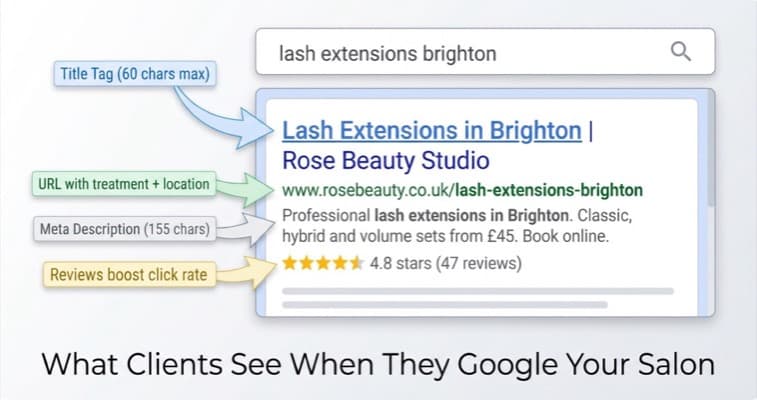
Anatomy of a Google search result: the title tag and meta description are the two elements you control directly.
Step 4: Get More Google Reviews (Without Being Pushy)
So your pages are set up and optimised. The next piece of SEO for beauty salon ranking is social proof. Reviews are one of the strongest local SEO signals. Google shows salons with more recent, positive reviews higher in local search results. But asking for reviews feels awkward when you've just spent an hour doing someone's nails.
Three approaches that work for beauty salons:
The aftercare card. Include a QR code linking directly to your Google review page on your aftercare cards. Clients scan it while their nails are drying or they're waiting for their partner. For example, a nail salon might print "Love your nails? Leave us a quick review" with the QR code on the back of every aftercare card.
The follow-up message. Send a booking confirmation that includes a review link. Most salon booking systems (Fresha, Timely, Treatwell) can automate this. The best time to ask is 2-4 hours after the appointment, when the client is still enjoying their results.
The direct ask. When a client says "I love these!" at checkout, say "That's so lovely to hear, would you mind leaving us a quick Google review? It really helps other people find us." Many people say yes when asked in person.
Respond to every review. Positive or negative. Google tracks engagement, and potential clients read your responses. A thoughtful reply to a complaint can build more trust than ten five-star reviews.
If you're reading this thinking "I barely have time to do treatments, let alone chase reviews", you're not alone. That's why automation matters. Set up the follow-up message once and it works for every appointment.
Step 5: Build Local Citations and Directory Listings
With reviews flowing in, the final building block of SEO for beauty salon visibility is making sure Google finds your salon mentioned across the web. A "citation" in SEO terms is simply a mention of your salon's name, address, and phone number on another website. The more consistent citations you have across trusted directories, the more Google trusts that your salon is real and located where you say it is.
Priority directories for UK beauty salons:
| Directory | Why It Matters |
|---|---|
| Google Business Profile | The foundation, already covered in Step 1 |
| Yell.com | UK's largest business directory |
| Treatwell | Beauty-specific booking platform |
| Fresha | Salon booking and discovery |
| Facebook Business Page | Social proof and local search |
| Bing Places | Microsoft's local listings |
| Apple Maps | iPhone default map searches |
The critical rule: consistency. Your salon name, address, and phone number (called "NAP" in SEO terms) must be identical across every listing. "Rose Beauty Studio" on Google and "Rose Beauty" on Yell confuses Google and weakens your local rankings.
For instance, a beauty studio that listed on Treatwell, Yell, and Apple Maps alongside their Google Business Profile saw their local search appearances increase noticeably within weeks. If you're only listing your salon on Instagram and expecting clients to find you through search, that rarely works for local SEO. Directories are how Google cross-references your business information and decides you're trustworthy enough to show in search results.
Step 6: Monitor What's Working
You've built the foundations. Now here's how to check they're actually working. SEO for beauty salon owners isn't a one-off task. It's an ongoing habit, like posting on social media. The difference is that SEO compounds. Every review, every directory listing, every treatment page makes the next one more effective.
Free tools to track your progress:
- Google Business Profile Insights: shows how many people found your listing, what searches they used, and how many clicked to call or get directions
- Google Search Console: shows which search terms bring people to your website and where you rank for each one (free to set up)
- Google Analytics: tracks how many visitors your website gets and which pages they view
Check these monthly. For example, a beauty salon in Leeds noticed their GBP views had doubled but website clicks stayed flat: the issue was a missing booking link on their listing. If reviews are growing but calls aren't, your listing might need better photos or an updated description.
If You Only Have 30 Minutes a Week
If you only have 30 minutes a week, do this. The reality for most independent beauty salons is that you're between a late cancellation and your next rebooking, not sat at a desk with time to spare. So start small:
- Week 1 (30 min): Claim or complete your Google Business Profile, fill in every field, upload five photos
- Week 2 (30 min): Create one treatment page on your website for your most popular service. Use the title formula from Step 2
- Week 3 (30 min): Set up automated review requests through your booking system. Print QR review cards
- Week 4 (30 min): List your salon on Yell, Treatwell, and Bing Places with identical name/address/phone
After four weeks, you've covered the SEO for beauty salon basics that most salons never get around to, and a simple local SEO checklist helps you keep them all ticking over. For example, a nail bar that followed this exact four-week plan went from invisible on Google to appearing in the Local Pack for "nail salon [their town]" within two months. From there, add one new treatment page per week and respond to every review within 48 hours.
Info
Would you book a treatment at your own salon based on what comes up when you Google your salon name? If the answer isn't an immediate yes, start with Week 1.
FAQ
What are the best SEO keywords for a beauty salon?
The best SEO keywords for a beauty salon are treatment-specific and location-based. Focus on searches your potential clients actually type: "lash extensions [your town]", "gel nails near me", "facial treatments [your area]". These are called "local intent" keywords: they include a service and a location. Tools like Google's keyword planner can show search volume, but for most independent salons, targeting your core treatments plus your town covers the high-value searches.
Is it worth paying someone to do SEO for my salon?
For most independent beauty salons, the basics covered in this guide can be done yourself. Google Business Profile setup, treatment pages, reviews, and directory listings don't require a specialist. If you're in a highly competitive area or targeting multiple locations, a local SEO specialist (typically £300-800/month in the UK) can help with technical optimisation and link building. Start with the free steps first. Many salons see meaningful improvement before needing paid help.
How long does SEO take to work for a beauty salon?
Most beauty salons see noticeable improvements in local search visibility within two to three months of consistent effort. Google Business Profile changes can show results within days. Website page rankings typically take one to three months to settle. Reviews start improving your position as soon as you accumulate them. The key is consistency: small weekly actions compound over time, just like client rebooking compounds your revenue.
What is the difference between SEO and Google Ads for salons?
SEO is free organic visibility: you optimise your website and Google Business Profile so Google shows you in search results naturally. Google Ads is paid visibility: you pay per click to appear at the top of results. For most beauty salons, SEO delivers better long-term value because the results persist after the work is done. Google Ads stop the moment you stop paying. The strongest approach is SEO as your foundation with targeted ads for seasonal promotions like prom season or Christmas party bookings.
If managing your salon's online visibility feels like one more job you don't have time for, tools like LocalBrandHub for beauty salons can handle the SEO foundations, so you can focus on the treatments your clients came for.
Key Takeaway
Key Takeaways
- Google Business Profile is often the single most impactful SEO action: claim it, complete it, keep it updated
- Each treatment needs its own website page targeting a specific local search term
- Reviews directly affect your local search ranking: automate the ask so it happens without extra effort
- Consistent name, address, and phone across all directories builds Google's trust in your salon
- SEO compounds over time: the salons on page one started their SEO months ago
- You don't need a marketing degree: 30 minutes a week, done consistently, covers the essentials
For restaurants, salons, and local businesses
Need help with your marketing?
We help UK businesses turn social media into real results, not busywork.
Start freeGet More Marketing Tips
Practical marketing tips for UK business owners, straight to your inbox. No spam, unsubscribe anytime.
About the Author
Local Brand Hub
Empowering UK Businesses
Local Brand Hub provides comprehensive business management tools designed specifically for UK local businesses to streamline operations, automate marketing, and grow revenue.
More articlesRelated Articles
 Marketing Tips
Salon Website and SEO: Complete Guide for UK Salons
How to build a salon website and SEO strategy that ranks on Google and fills your diary. Design, templates, builders, and local SEO for UK salons.
 Tutorials
Beauty Salon Google My Business: Setup Guide
Set up your beauty salon Google My Business profile in seven steps. Claim, optimise, add treatments, upload photos, and get reviews. UK beginner guide.
 Marketing Tips
Salon Website Builder: Which One Actually Takes Bookings
Which salon website builder actually takes bookings? A UK guide to Wix, Squarespace, GoDaddy and WordPress, and what the plan price leaves out.