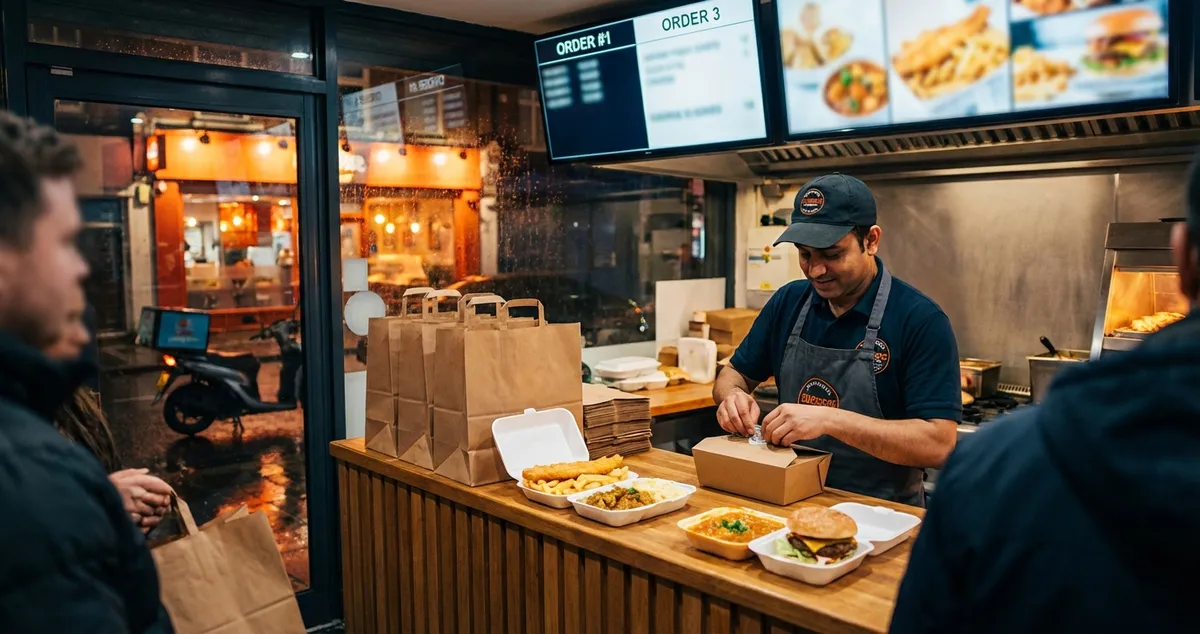
Grow your takeaway orders with the 4 P's marketing framework. Covers social media tactics, local SEO, and a weekly action plan for UK owners.
You're pulling 12-hour shifts. The food is good, customers who find you love it, but your phone stays quiet during those slow Tuesday afternoons. Meanwhile, the chain down the road always seems busy. The difference probably isn't the food. It's that they've figured out how to stay visible when you're not.
That's what takeaway marketing actually solves. Not flashy campaigns or viral videos, but consistent visibility that keeps your name in front of hungry customers at the right moment. The UK takeaway market is worth billions of pounds, and online ordering continues to grow. The question isn't whether marketing matters. It's whether you're getting your share.
Info
Related: Restaurant Marketing Strategies
What You'll Learn
- How to promote your takeaway without a big budget
- The 3-3-3 and 4 P's frameworks adapted for UK takeaways
- A 30-minute weekly marketing plan you can start today
- Practical examples from fish and chip shops, curry houses, and pizza takeaways
How to Promote a Takeaway Business
The most effective takeaway promotion combines visibility where customers already look with reasons to choose you over alternatives. Here's a practical approach that works without a marketing budget.
Start with your Google Business Profile. According to Google, 76% of people who search for something nearby visit a business within a day. Your Google listing is often the first impression. Make sure your hours are accurate, photos show your best dishes, and you respond to every review within 24 hours. Our local SEO checklist walks through every box worth ticking on your Google listing.
Build a presence on one social platform well. Don't spread yourself thin. For most UK takeaways, Instagram or Facebook works best because that's where local customers browse. A fish and chip shop in Manchester might post a simple photo of fresh battered cod on Friday afternoon, timed when people are thinking about dinner plans.
Create a reason to order direct. If you're relying entirely on delivery platforms, you're typically paying commission on every order. Offer a 10% discount for ordering through your own website or phone. The maths works out better for you even with the discount.
For instance, a takeaway running this strategy might print "Order direct and save 10%" on every receipt and bag. Many owners report seeing direct orders grow significantly within a few months of consistent promotion.
Info
What Is the 3-3-3 Rule in Marketing?
The 3-3-3 rule is a framework that divides your marketing content into three categories: one-third educational, one-third entertaining, and one-third promotional. This balance keeps your audience engaged without feeling constantly sold to.
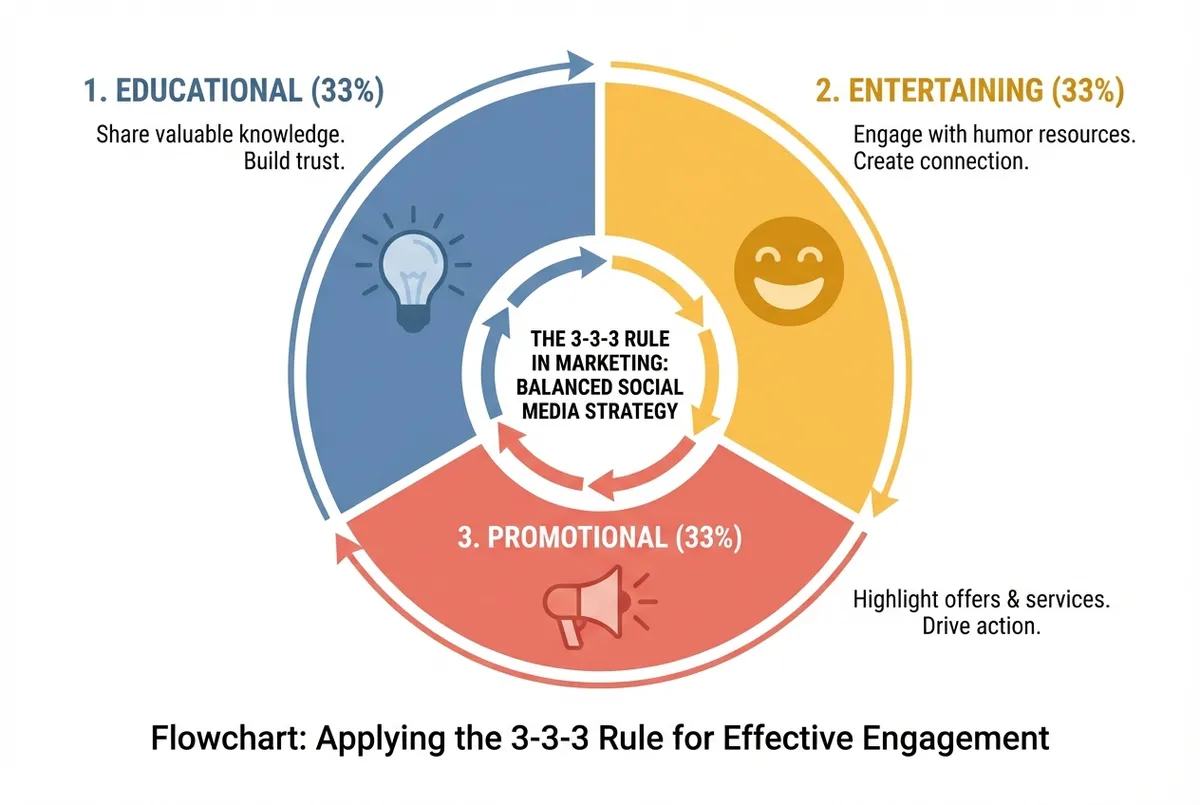
The 3-3-3 rule keeps your content balanced and engaging
For a takeaway, this might look like:
- Educational (33%): "Here's why we source our chicken from local farms" or a quick video showing proper food prep hygiene
- Entertaining (33%): Behind-the-scenes of the Saturday rush, staff taste-testing a new dish, or a time-lapse of the kitchen at peak hours
- Promotional (33%): Your weekly special, loyalty programme, or direct ordering discount
The ratio prevents the common mistake of posting only when you have something to sell. That's usually a sign your social media feels like advertising rather than a connection.
Batch Your Content
If you're thinking "I don't have time for three types of content," you're not alone. Most takeaway owners start by batch-creating content once a week. Spend an hour on Sunday taking photos and videos, then schedule them across the week.
What Are the 4 P's of Food Marketing?
The 4 P's of food marketing is a framework that covers Product, Price, Place, and Promotion. These four elements need to work together for your marketing to succeed. Here's how each applies to takeaways.
| Element | What It Means for Takeaways | Example |
|---|---|---|
| Product | Your food quality, menu design, packaging | A Chinese takeaway adding eco-friendly packaging and including chopsticks and soy sauce automatically |
| Price | Pricing strategy and perceived value | Offering meal deals that feel like savings without cutting margins significantly |
| Place | Where customers find and order from you | Your own website, Google listing, delivery apps, collection window |
| Promotion | How you communicate with potential customers | Social media, local flyers, loyalty cards, Google Ads |
Product goes beyond the food itself. It includes your packaging (does it keep food warm?), presentation, and the small touches that make customers remember you. A kebab shop that includes handwritten thank-you notes on orders often sees those shared on social media for free.
Price isn't just about being cheap. Industry research consistently shows that many UK consumers will pay more for convenience and reliability. If your delivery is faster and more reliable than competitors, you can often charge accordingly.
Place in 2026 means being everywhere your customers look. That's Google (for "takeaway near me" searches), delivery apps (for discovery), and your own ordering system (for regulars and better margins).
Promotion ties everything together. But if your product, price, and place aren't right, no amount of promotion will create repeat customers.
If you're reading this thinking "I know the theory, but when do I have time?", you're not alone. The reality for most independent takeaways is that marketing gets pushed aside when you're down two staff on a Friday night. That's why the weekly plan later in this guide focuses on consistency over perfection.
How to Promote a Fast Food Business
Fast food businesses face intense competition, which means speed and consistency in your marketing matter as much as in your kitchen. Here are tactics that work specifically for quick-service takeaways.
Leverage meal deal psychology. Bundle items together at a slight discount. A combo like "burger, chips, and drink" priced just below the individual total feels like value and encourages larger orders. Bundled offers typically increase average order value, which adds up significantly over time.
Time your social posts strategically. Post lunch specials at 10:30am when people are starting to think about food. Post dinner deals around 4pm. A pizza takeaway that shifted their posting times to these windows reported higher engagement than posting at random times.
Use local hashtags and geotags. When you post on Instagram, include your town or neighbourhood. Someone searching #SheffieldFood or #LeedsEats might discover you. This costs nothing but increases local visibility.
Offer a loyalty programme that's actually simple. Complex point systems confuse customers. "Buy 9 meals, get the 10th free" works. Physical punch cards still work for collection orders, while digital options through your website work for delivery customers.
For example, a fried chicken takeaway in Leeds running a simple stamp card saw many customers become repeat buyers within two months, compared to one-time orders before.
If you're only posting when it's quiet you'll always lose to competitors who treat marketing as part of daily operations. Ask yourself honestly: would I follow my own takeaway's social media account?
How to Promote Your Takeaway Business: A Weekly Plan
This is the section for owners who read everything above and thought "sounds good, but when do I fit this in?" Here's a minimum viable marketing plan that takes 30 minutes per week.
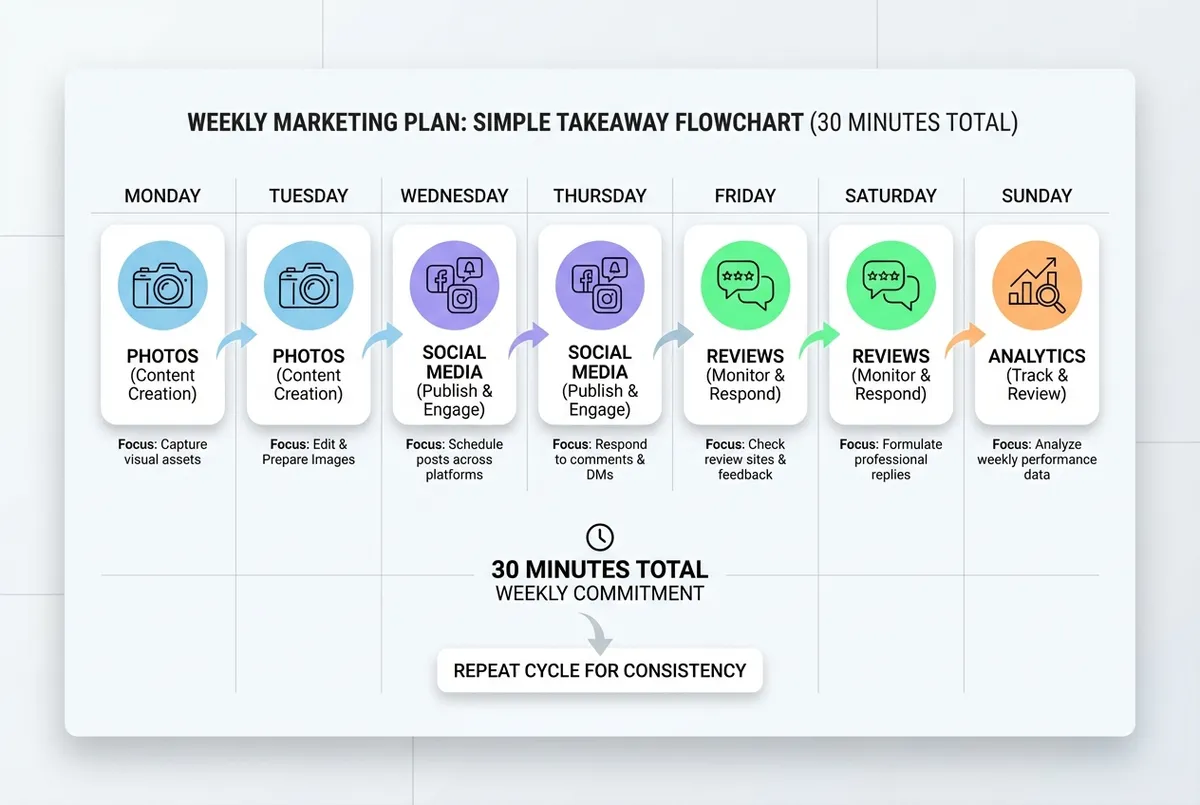
30 minutes per week is enough to build consistent visibility
If You Only Have 30 Minutes a Week
Day 1-2 (Monday/Tuesday): Take 3-5 photos of your food during prep or service (5 minutes)
Day 3-4 (Wednesday/Thursday): Post one photo to Instagram or Facebook with a simple caption about the dish (10 minutes)
Day 5-6 (Friday/Saturday): Reply to any Google reviews or social comments from the week (10 minutes)
Day 7 (Sunday): Check which post got the most engagement and note what worked (5 minutes)
That's it. This basic routine keeps you visible and builds data on what your customers respond to.
Ready to do more? Add these when you have time:
- Run a monthly Instagram giveaway ("Tag a friend who loves curry, winner gets a free meal")
- Print QR codes linking to your direct ordering page on every receipt
- Send a text or email to previous customers when you launch a new dish
The key is consistency over intensity. Posting once a week every week beats posting daily for two weeks then disappearing for a month.
This sounds great in theory. In practice, when you're exhausted after the Saturday rush, the last thing you want is another task. But here's the thing: your competitors who seem to "always be posting" aren't working harder. They're batching content creation and scheduling it in advance.
Info
Related: Restaurant Marketing - complete marketing frameworks for hospitality.
If you run a restaurant and want to see how Local Brand Hub can support your marketing, explore our restaurant marketing tools.
Key Takeaways: Takeaway Marketing
Takeaway marketing doesn't require a big budget or marketing expertise. It requires showing up consistently where your customers look and giving them reasons to choose you.
Remember these core principles:
- Your Google Business Profile is your most important free marketing tool
- The 3-3-3 rule keeps your content balanced and engaging
- The 4 P's (Product, Price, Place, Promotion) must work together
- Direct ordering saves you commission fees, so promote it
- 30 minutes per week is enough to start building visibility
The UK takeaway market is competitive, but most takeaways still don't market consistently. That's your opportunity. Start with the weekly plan above, track what works, and build from there.
Your next step: Update your Google Business Profile this week. Add 3 new photos of your best-selling dishes, verify your opening hours are correct, and respond to any unanswered reviews.
Info
Related: Restaurant Marketing - the complete hub for marketing strategies.
Get More Marketing Tips
Practical marketing tips for UK business owners, straight to your inbox. No spam, unsubscribe anytime.
About the Author
Local Brand Hub
Empowering UK Businesses
Local Brand Hub provides comprehensive business management tools designed specifically for UK local businesses to streamline operations, automate marketing, and grow revenue.
More articlesRelated Articles
 Marketing Tips
3 3 3 Rule in Marketing: Restaurant Framework Guide
Master the 3 3 3 rule in marketing for your restaurant. Focus on 3 messages, 3 audiences, and 3 channels for simpler, more effective marketing.
 Marketing Tips
7 P's of Restaurant Marketing: A Complete UK Guide
Master the 7 P's of restaurant marketing: Product, Price, Place, Promotion, People, Process, and Physical Evidence to attract more diners to your UK venue.
 Marketing Tips
12 Cafe Marketing Ideas That Actually Work in 2026
Try these 12 cafe marketing ideas used by top UK independents to grow footfall, boost repeat visits, and increase average spend.