
Master the 3 3 3 rule in marketing for your restaurant. Focus on 3 messages, 3 audiences, and 3 channels for simpler, more effective marketing.
74% of consumers use social media to decide where to eat, but you've finished a 12-hour shift, your feet hurt, and you've got nothing posted. The 3 3 3 rule in marketing offers exhausted restaurant owners a way out of this chaos: three messages, three audiences, three channels. This framework cuts through the overwhelm.
This framework forces simplicity: three key messages, three core audiences, and three marketing channels. That's it. Rather than trying to be everywhere saying everything to everyone, you focus your limited time and budget on what actually matters. This approach, rooted in cognitive psychology, helps restaurants cut through the noise and build marketing that works.
Info
Related: restaurant marketing for the complete framework and strategy guide.
The 3 3 3 rule in marketing offers a practical starting point that fits into even the busiest schedule.
What You'll Learn
- What the 3 3 3 rule is and why it works for time-strapped restaurant owners
- How to identify your three key messages, audiences, and channels
- Practical examples from real UK restaurants using this framework
- A weekly schedule that takes less than two hours to maintain
- Common mistakes that undermine your marketing efforts
What Is the 3 3 3 Rule in Marketing?
The 3 3 3 rule in marketing is a framework that simplifies marketing by limiting focus to three key messages, three target audiences, and three marketing channels. This constraint-based approach helps restaurants cut through overwhelm and build consistent, measurable marketing.
The principle is built around the idea that constraints breed clarity. Instead of spreading yourself thin across dozens of tactics, you narrow your focus to three elements in each category:
- Three key messages that communicate your core value
- Three audience segments you're specifically trying to reach
- Three marketing channels where you'll concentrate your efforts
The underlying principle comes from cognitive psychology. Our brains naturally recognise and remember patterns of three more easily than longer lists. Think about it: "location, location, location" sticks. A list of seven property buying tips doesn't.
For restaurant owners, this matters because you're competing for attention against every other message your potential customers see each day. A focused, memorable approach beats a scattered one.
For example, a fish and chip shop using this framework might focus on three messages: "Fresh fish delivered daily from Grimsby," "Family recipes since 1985," and "Queues out the door every Friday." Three audiences: local families, office workers at lunch, and Friday night takeaway customers. Three channels: Google Business Profile, Facebook, and a loyalty card scheme.
Why the 3 3 3 Rule Works for Restaurants
If you're thinking "I don't have time for another marketing framework," you're exactly who this is designed for. The 3 3 3 rule in marketing works because it acknowledges reality: you have maybe two hours a week for marketing, not twenty.
The reality for most independent restaurants is that marketing happens in the gaps between service, ordering, staffing, and everything else that keeps the doors open. The 3-3-3 rule works precisely because it acknowledges these constraints.
The Problem with Doing Everything
When you try to be on every platform, speak to every potential customer, and promote every aspect of your restaurant, three things happen:
- Your message gets diluted. You end up saying generic things that could apply to any restaurant.
- Your time gets fragmented. Twenty minutes here, fifteen minutes there, none of it building momentum.
- Your results become unmeasurable. With too many variables, you can't tell what's working.
The Power of Strategic Constraints
The 3-3-3 framework forces you to make decisions upfront. By choosing three channels instead of six, you can actually show up consistently on those channels. By defining three audience segments, you can write content that speaks directly to real people rather than a vague "everyone who might eat out."
According to marketing strategists, this approach promotes clarity, consistency, efficiency, and scalability in marketing efforts by keeping campaigns focused and manageable.
Case Example: How a Birmingham Gastropub Used the 3 3 3 Rule
A 40-cover gastropub in Birmingham was struggling with social media. The owner was posting sporadically across five platforms, creating different content for each, and seeing minimal engagement. After implementing the 3 3 3 rule in marketing, they narrowed their focus:
Their Three Messages:
- "We source all meat from farms within 25 miles"
- "Our Sunday roasts sell out by Thursday each week"
- "A proper pub with chef-quality food"
Their Three Audiences:
- Local professionals (aged 30-50) looking for quality weeknight dinners
- Families seeking Sunday lunch venues
- Couples wanting date-night atmosphere without pretension
Their Three Channels:
- Google Business Profile (for local search visibility)
- Instagram (for food photography and behind-the-scenes content)
- Email newsletter (for Sunday roast pre-booking)
Within three months, their Sunday roast bookings increased by 35%, and their Instagram engagement rate doubled. The key wasn't doing more; it was doing less, better.
Pro Tip
Related: Learn how to optimise your Google Business Profile for restaurants to capture local search traffic.
How to Apply the 3 3 3 Rule to Your Restaurant
Let's break this down into practical steps you can implement this week. The 3 3 3 rule in marketing becomes powerful when you commit to specific choices.
For instance, a Thai restaurant might spend an hour on Monday mapping out: messages about authenticity, spice customisation, and vegetarian options; audiences of spice-lovers, health-conscious diners, and local office workers; channels of Instagram, Google, and Just Eat listings. That one hour of clarity saves countless hours of scattered effort.
Step 1: Define Your Three Key Messages
Your messages aren't your menu items or your prices. They're the core reasons someone should choose your restaurant over the dozen others within walking distance.
Questions to identify your messages:
- What do loyal customers say when recommending you?
- What makes your restaurant different from your closest competitor?
- What do you want someone to remember after their first visit?
Example for a gastropub:
- "We source ingredients from farms within 30 miles"
- "Our Sunday roasts book out weeks in advance"
- "A proper pub atmosphere without the pretension"
Example for a family Italian:
- "Three generations of the same family recipes"
- "Kids eat free on Tuesdays"
- "Portions that send you home with leftovers"
Notice how specific these are. "Great food and friendly service" tells potential customers nothing. "Three generations of family recipes" paints a picture.
Step 2: Identify Your Three Audience Segments
You're not trying to reach everyone. You're trying to reach the right people consistently enough that they remember you.
Warning
Quick test: If you can describe your audience as "anyone who likes good food," you haven't defined an audience yet.
Common restaurant audience segments:
| Segment | What They Value | When They Visit |
|---|---|---|
| Local regulars | Familiarity, consistency, being recognised | Weekday evenings, weekend lunches |
| Special occasion diners | Experience, atmosphere, something memorable | Birthdays, anniversaries, celebrations |
| Weekday lunch crowd | Speed, value, convenience | Monday-Friday, 12-2pm |
| Families with children | Kid-friendly options, space, patience | Saturday lunch, early evening |
| Date night couples | Atmosphere, quality, Instagram-worthy moments | Friday-Saturday evenings |
Choose three that match your restaurant's strengths and capacity:
- A cosy 20-cover bistro probably shouldn't target families with children
- A casual lunch spot probably shouldn't chase the special occasion crowd
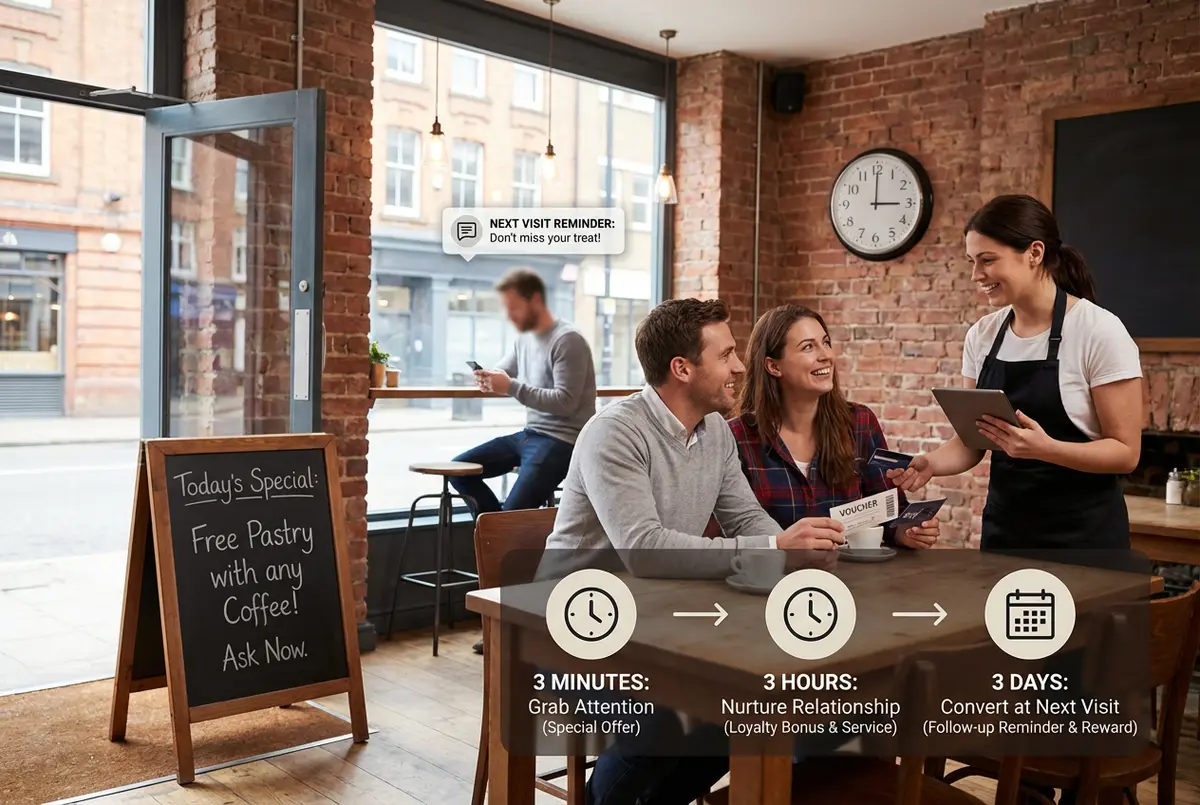
Three audience segments using the 3 3 3 rule in marketing for restaurants
Step 3: Choose Your Three Channels
This is where most restaurant owners go wrong. They try to be everywhere and end up being nowhere consistently.
Channel selection questions:
- Where do your chosen audience segments actually spend time?
- Which channels can you realistically maintain with your available time?
- Where have you seen even small results in the past?
Practical channel combinations:
- Local family restaurant: Google Business Profile + Facebook + email newsletter
- Trendy cafe targeting younger diners: Instagram + TikTok + Google Business Profile
- Fine dining establishment: Instagram + email newsletter + local partnerships
If you pick just one combination: For most UK restaurants, Google Business Profile + Instagram + email newsletter offers the best balance. Google captures people actively searching, Instagram showcases your food visually, and email lets you communicate directly with interested customers without algorithm interference.
The key insight: Google Business Profile should almost always be one of your three. It's where people search when they're actively looking for somewhere to eat. For a deeper dive into platform selection, see our guide on social media marketing for restaurants.
Budget Considerations for the 3 3 3 Rule
One advantage of the 3 3 3 rule in marketing is that it naturally controls costs. By focusing on three channels instead of six, you're not spreading your budget thin.
Typical monthly budget breakdown for a small UK restaurant:
| Channel | Cost Range | What You Get |
|---|---|---|
| Google Business Profile | £0-50 | Free listings, paid posts optional |
| Instagram/Facebook | £50-200 | Boosted posts for local reach |
| Email marketing | £15-50 | Mailchimp/Brevo for up to 2,500 subscribers |
| Total | £65-300/month | Focused presence on three channels |
Compare this to £500-1,000 monthly for scattered advertising across six platforms with diluted results.
Real example: A small Italian restaurant in Manchester started with just £100/month:
- £50 on Instagram post boosts targeting local food lovers
- £50 on Google Business Profile posts
After three months, they could trace 15% of their bookings directly to these efforts: a clear return on investment that would have been impossible to measure across six platforms.
If you can't tell whether your current marketing spend brings customers or just disappears into the void, that's usually a sign you're spread too thin. The 3 3 3 rule helps you track what's actually working.
Start Free First
Start with £0 for the first month. Use free features on all three channels to test your messages before investing in paid promotion.
The Alternative 3 3 3 Rule: Time-Based Engagement
There's a second interpretation of the 3 3 3 rule worth knowing, particularly if you're creating content:
- 3 seconds to stop the scroll and capture attention
- 3 minutes to build interest and communicate value
- 3 hours to drive action and convert
This version maps to how people actually engage with content online. Your Instagram post has about three seconds to make someone stop scrolling. Your website has about three minutes to convince them you're worth visiting. And within a few hours of seeing your content, they either take action or forget.
For restaurants, this means:
- Your photos need to grab attention instantly (no blurry, badly-lit food shots)
- Your descriptions need to communicate value quickly (what makes this dish special?)
- Your call to action needs to be obvious (book a table, order online, visit us)
For example, a burger restaurant in Leeds tested two Instagram posts: one with a dimly-lit phone photo and generic "Come try our burgers!" text, another with a professionally-lit shot and "48-hour dry-aged beef, hand-ground daily, £12." The second post got 4x more engagement. The first 3 seconds of that crispy, juicy image stopped the scroll; the next 3 minutes of reading about the sourcing built interest.
Putting the 3-3-3 Rule Into Practice
Theory is useless without implementation. Here's how to actually use this framework.
Your 3-3-3 Restaurant Marketing Template
Copy this template and fill in your own answers:
My Three Key Messages:
My Three Target Audiences:
My Three Marketing Channels:
Once you've completed this, every piece of marketing you create should:
- Reinforce at least one of your three messages
- Speak directly to at least one of your three audiences
- Appear on one of your three channels
If it doesn't meet these criteria, either adapt it or don't do it.
Weekly Marketing Checklist Using 3-3-3
| Day | Action | Channel | Message Focus |
|---|---|---|---|
| Monday | Schedule week's social content | Instagram/Facebook | Rotate through all 3 |
| Wednesday | Respond to reviews, update Google | Google Business Profile | Message 1 |
| Friday | Send email to list | Message 2 or 3 | |
| Saturday | Share behind-the-scenes content | Instagram Stories | Message 1 |
This takes less than two hours per week once you've set up your template, less still if you plan the whole week in one sitting with a social media calendar.
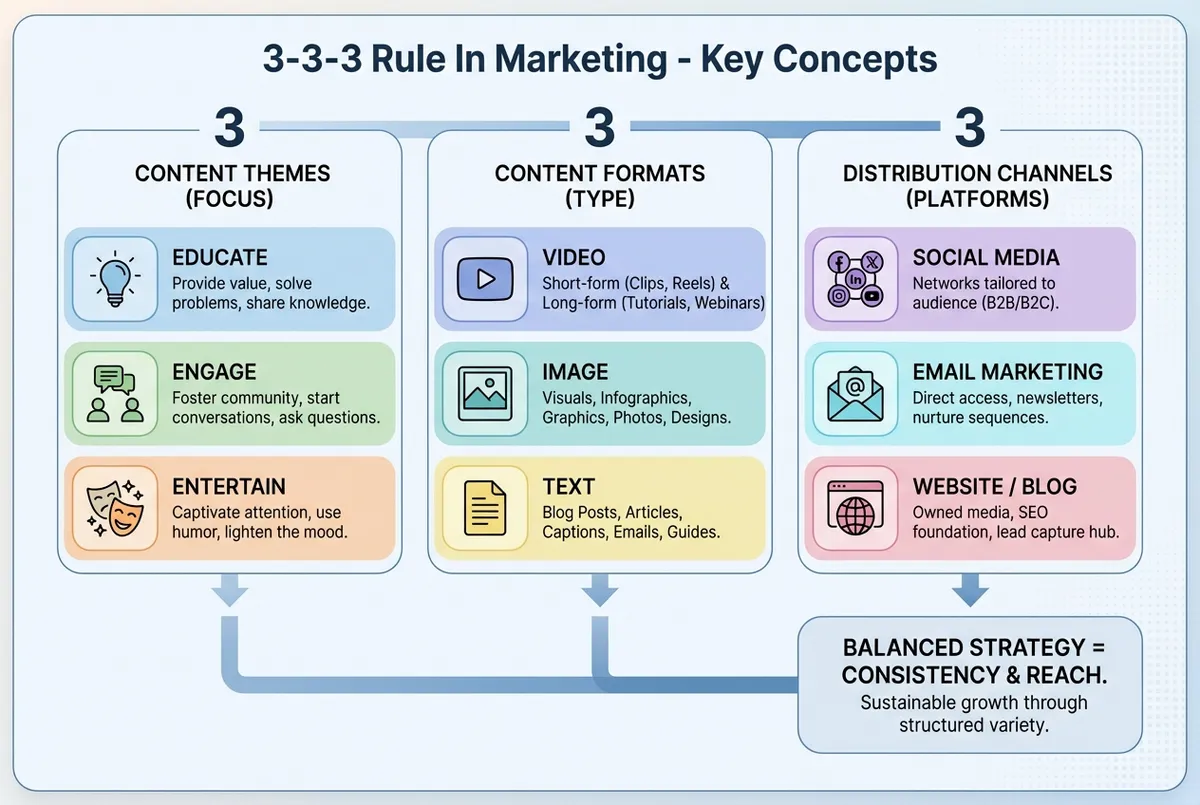
Weekly workflow implementing the 3 3 3 rule in marketing for restaurants
Common Mistakes to Avoid
Warning
If you're only checking social media when the restaurant is quiet, your marketing will always lose to competitors who treat it as part of operations, not an afterthought.
Mistake 1: Choosing channels you won't maintain
It's better to post consistently on two channels than sporadically on five. If you hate making videos, don't choose TikTok just because it's trendy.
Mistake 2: Messages that sound like everyone else
"Fresh, quality ingredients" describes nearly every restaurant. Find what's genuinely different about yours. If you can't, that's a business problem, not a marketing problem.
Mistake 3: Audiences that are too broad
"Anyone who likes good food" isn't a target audience. "Local professionals looking for a reliable weekday lunch spot within a 10-minute walk of the business park" is.
Mistake 4: Abandoning the framework too quickly
The 3 3 3 rule takes time to show results. Most marketing takes 90 days of consistent effort before you see meaningful returns. If you change strategy every fortnight, you'll never know what works.
Mistake 5: Not tracking what matters
If you can't tell whether your Instagram brings bookings or just likes, that's usually a sign your measurement isn't connected to real business outcomes. Track table bookings, not follower counts. The 3 3 3 rule in marketing only works if you measure results.
Real Example
A wine bar owner in Bristol made all five mistakes in their first year. They posted on TikTok (which they hated), used generic messages about "great atmosphere," targeted "everyone who drinks wine," changed strategies monthly, and measured success by follower growth. When they applied the 3 3 3 rule, focusing on Instagram, email, and Google with messages about natural wines and midweek deals for local professionals, bookings increased within two months.
If You Only Have 30 Minutes a Week
If you're reading this thinking "I don't have time for this," here's the absolute minimum to implement the 3 3 3 rule in marketing:
Quick Start Guide
- Day 1-2: Write down your three key messages. What do you want people to remember about your restaurant?
- Day 3-4: Define your three audiences. Who actually comes? Who do you wish came more often?
- Day 5-7: Choose your three channels. Google Business Profile plus two others you can actually maintain.
Weekly maintenance once you're set up:
| Time | Activity | Why It Matters |
|---|---|---|
| 10 min Monday | Schedule one social post | Consistency beats volume |
| 10 min Wednesday | Respond to Google reviews | Builds local SEO and trust |
| 10 min Friday | Check what performed, adjust | Learn what resonates |
That's it. No fancy campaigns, no elaborate content calendars. Just clarity about who you're talking to, what you're saying, and where you're saying it.
Self-reflection question: Would you follow your own restaurant's social media account? If the answer is "probably not," that's valuable feedback about whether your content is interesting to anyone outside your business.
Frequently Asked Questions
What is the 3 3 3 rule in marketing?
The 3 3 3 rule in marketing is a framework that simplifies your marketing by focusing on three key messages, three target audiences, and three marketing channels. Instead of trying to do everything, you concentrate your efforts where they'll have the most impact.
Does the 3 3 3 rule work for small restaurants?
Yes, especially for small restaurants. The framework is designed for businesses with limited time and budget. A small restaurant might only have two hours per week for marketing: the 3 3 3 rule ensures those two hours are spent on focused, measurable activities rather than scattered efforts.
How do I choose which three channels to focus on?
Start with Google Business Profile (essential for local search), then add one visual platform where your food can shine (usually Instagram), and one direct communication channel (email or SMS). Adjust based on where your specific audience spends time: a student-focused cafe might prioritise TikTok over email.
Can I change my three messages over time?
Yes, but not constantly. Give each set of messages at least 90 days before evaluating. Seasonal adjustments make sense (Christmas menu, summer specials), but your core brand messages should stay consistent. Changing weekly means your audience never learns what you stand for.
What's the difference between the 3 3 3 rule in marketing and the time-based version?
The standard 3 3 3 rule in marketing focuses on what you communicate (messages, audiences, channels). The time-based version (3 seconds, 3 minutes, 3 hours) focuses on how people engage with content. Both work together: use the first to plan your strategy, the second to create compelling content.
Key Takeaways: 3 3 3 Rule in Marketing
If you run a restaurant and want to see how Local Brand Hub can support your marketing, explore our restaurant marketing tools.
Key Takeaways: 3 3 3 Rule in Marketing
The 3 3 3 rule in marketing isn't about doing less. It's about doing the right things consistently.
What you've learned:
- The 3 3 3 rule means focusing on three key messages, three audience segments, and three marketing channels
- This framework works because constraints create clarity and our brains remember patterns of three
- Choosing the right three channels matters more than being on every platform
- The time-based version (3 seconds, 3 minutes, 3 hours) helps you create content that actually converts
- Consistency on three channels beats inconsistency on six
- Budget requirements are modest: £65-300/month covers most small restaurants
Your next step: Use the template above and fill in your three messages, three audiences, and three channels today. Then use it to filter every marketing decision you make for the next 90 days.
The restaurants that fill their tables aren't the ones with the biggest marketing budgets. They're the ones with the clearest message, delivered consistently to the right people in the right places. The 3 3 3 rule in marketing gives you a simple way to become one of them.
Weekly Action
This week, complete your 3 3 3 framework:
- Write your three messages (10 minutes)
- Define your three audiences (10 minutes)
- Choose your three channels (10 minutes)
Then post one piece of content on your primary channel using one of your messages, aimed at one of your audiences. That's marketing done right.
Want more restaurant marketing strategies? Read our complete restaurant marketing guide for the full framework, or explore email marketing for restaurants to maximise one of your three channels.
Get More Marketing Tips
Practical marketing tips for UK business owners, straight to your inbox. No spam, unsubscribe anytime.
About the Author
Local Brand Hub
Empowering UK Businesses
Local Brand Hub provides comprehensive business management tools designed specifically for UK local businesses to streamline operations, automate marketing, and grow revenue.
More articlesRelated Articles
 Marketing Tips
7 P's of Restaurant Marketing: A Complete UK Guide
Master the 7 P's of restaurant marketing: Product, Price, Place, Promotion, People, Process, and Physical Evidence to attract more diners to your UK venue.
 Marketing Tips
12 Cafe Marketing Ideas That Actually Work in 2026
Try these 12 cafe marketing ideas used by top UK independents to grow footfall, boost repeat visits, and increase average spend.
 Marketing Tips
Coffee Shop Marketing: Guide for Independent Cafes
Build a coffee shop marketing plan that fits around your schedule. Covers loyalty programmes, social media, and local partnerships.