
Learn how to win corporate catering clients for your restaurant with outreach, proposals, pricing tiers, and retention strategies.
Your kitchen runs a tight service five nights a week. But every morning, offices within a mile order from faceless suppliers who microwave paninis and call it a business lunch. You know you could do better. You just haven't figured out how to get in front of the people placing those orders.
The UK contract catering market is worth over £12 billion and projected to hit £18.68 billion by 2031 (Verified Market Research, 2025). Independent restaurants with the right approach are capturing a meaningful share of that growth.
What You'll Learn
- How to identify and reach corporate catering decision-makers
- What a winning catering proposal looks like
- How to structure pricing tiers that work for different budgets
- Strategies for retaining corporate clients long-term
- Common mistakes that cost restaurants corporate contracts
Why Corporate Catering Matters for Restaurants
Most restaurants operate on razor-thin margins during lunch service. A handful of walk-ins, maybe a few online orders. Meanwhile, the office park across the road feeds 200 people every day. Someone is catering that food. It should be you.
Corporate catering flips the economics of your kitchen. Instead of preparing for uncertain demand, you cook confirmed orders with fixed quantities. Waste drops. Labour is predictable. Revenue hits your account before you plate a single dish.
The sector includes roughly 3,500 catering businesses nationally (IBISWorld, 2025). That sounds like competition, but most of those are generic suppliers without a restaurant kitchen, a recognisable brand, or food worth talking about. That's your advantage.
Info
Related: Restaurant Catering Marketing, complete catering marketing guide
If you're thinking "I barely have time to run my restaurant, let alone chase corporate clients", you're not alone. The reality for most independent restaurants is that catering feels like a separate business. But it doesn't have to be. Start with one client, one lunch order per week, and scale from there.
Finding Corporate Clients
Now that you see the opportunity, let's find the clients. Where exactly are they? They're not browsing your Instagram. They're office managers, PAs, and operations leads searching "corporate catering near me" or asking colleagues who they used last time. Turning up for those local searches is exactly what local SEO tools are built for. An optimised Google Business Profile is often the difference between being found and being missed.
Where corporate catering decisions happen:
- Office managers ordering regular team lunches and meeting food
- Executive assistants booking catering for board meetings and client visits
- HR teams organising training days, away days, and onboarding lunches
- Event coordinators planning company-wide celebrations and seasonal parties
Outreach strategies that work:
- Direct email: Research businesses within your delivery radius. Send a one-page PDF menu with corporate pricing. Keep it short: three sentences and a link to your catering menu
- LinkedIn prospecting: Connect with local office managers and EAs. Share photos of your corporate platters. One post showing a boardroom spread can generate enquiries for months
- Google Business Profile: Add "corporate catering" to your services. Create a dedicated landing page optimised for "corporate catering [your area]"
- Referral incentives: Offer existing clients 10% off their next order for every referral that books
Info
Related: Restaurant Email Marketing, email outreach to corporate clients
For example, a gastropub near an industrial estate might email the ten largest offices within two miles. Attach a PDF with three menu tiers, a link to order online, and a direct mobile number. Two responses from that batch could mean £500 per week in recurring revenue.
The biggest barrier isn't competition. It's visibility. Most offices default to their existing supplier because they don't know you offer catering. That's a marketing problem, not a food problem.
If you can't tell whether your corporate outreach is landing or just being ignored, that's usually a sign you need to follow up faster. Most deals close on the second or third contact, not the first.
Writing a Winning Catering Proposal
With that outreach done, here's where restaurants lose to professional caterers: the proposal. Your food might be better, but if your proposal is a WhatsApp message saying "yeah we can do sandwiches for 20 people, about £8 a head", you've already lost.
Corporate clients need documentation. They need something to forward to their manager, attach to an expense claim, or compare against two other quotes. Give them that.
What a strong catering proposal includes:
- Company header and branding: looks professional, not a text message
- Menu options: at least two tiers with clear descriptions
- Per-head pricing: broken down so they can calculate totals instantly
- What's included: disposable plates? Cutlery? Napkins? Delivery? Setup?
- Dietary accommodations: list your standard options (vegan, GF, halal, kosher)
- Minimum order requirements: be upfront about minimums
- Lead time and ordering process: how far in advance they need to book
- Terms: payment, cancellation, and amendment policies
A well-structured catering proposal makes a strong first impression on corporate clients
A wine bar targeting law firms might create a "Working Lunch" proposal with a premium tier featuring individual bento boxes at £18 per head and a standard tier with sharing platters at £12 per head. The visual presentation of the proposal matters as much as the food itself. Corporate clients judge professionalism before they taste anything.
If you're only sending price lists without proper proposals you'll always lose to competitors who present a complete package. The proposal is your first impression. Make it count.
Info
Related: Restaurant PR, trade press coverage for B2B catering
Pricing Tiers That Work
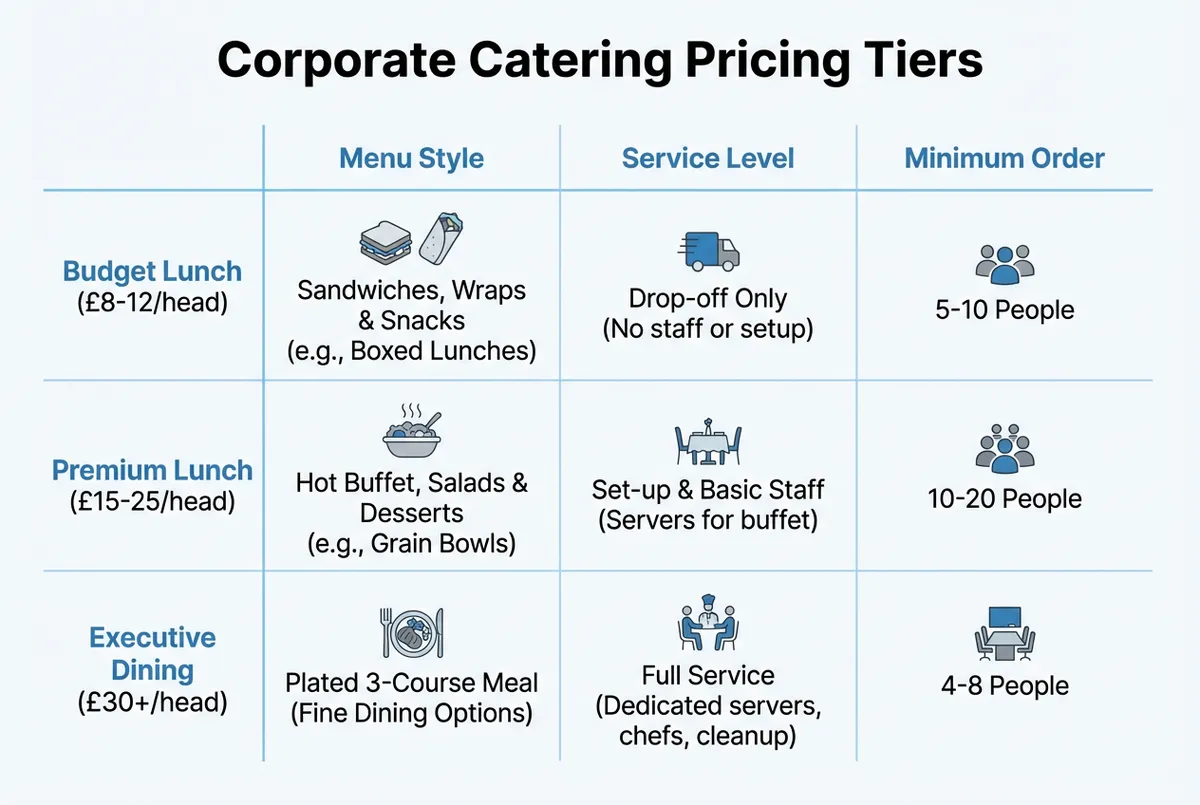
When it comes to pricing, corporate catering is different from your restaurant menu. You're selling convenience, reliability, and professionalism alongside the food. That justifies a premium.
Standard UK corporate catering price ranges:
| Tier | Price Per Head | What's Included | Best For |
|---|---|---|---|
| Budget | £8-12 | Sandwich platters, wraps, fruit, drinks | Regular team lunches |
| Premium | £15-25 | Hot mains, sides, dessert, setup | Client meetings, training days |
| Executive | £30-50+ | Bespoke menu, staffed service, drinks | Board meetings, VIP events |
Buffet catering typically ranges from £6-15 per head, while full-day conference packages start from £15 per head (Bark, 2026; British Event Catering, 2025).
Pricing principles:
- Set minimum orders: minimums prevent orders that cost more to deliver than they earn
- Include delivery in the price: separate delivery fees feel petty to corporate clients
- Offer recurring discounts: weekly standing order discounts incentivise loyalty
- Price for value, not just cost: your restaurant-quality food is still cheaper than a hotel
Don't race to the bottom. Corporate budgets for catering are healthy. They're not looking for the cheapest option. They're looking for the most reliable option that doesn't embarrass them in front of their boss.
Info
Related: Corporate Catering Services, comparing service models
Building Long-Term Client Relationships
However, landing the first order is only the hard part. Keeping them coming back is about consistency and communication.
Corporate catering clients who reorder weekly or monthly are worth exponentially more than one-off bookings. A single office ordering £200 of lunch catering every Wednesday generates over £10,000 per year. That's one client.
Retention strategies:
- Dedicated account contact: give them a direct number, not your general booking line
- Rotating menus: send a new seasonal menu every quarter so orders don't go stale
- Feedback loops: check in after the first three orders, then monthly
- Priority scheduling: regular clients get first pick of dates during busy periods
- Surprise upgrades: occasionally add a complimentary dessert platter or upgraded item
The reality for most independent restaurants is that client retention feels like extra admin on top of everything else. But a 30-second follow-up email after each delivery ("How was everything? Anything you'd change for next time?") does more for retention than any marketing campaign.
If you're only fulfilling orders without building relationships you'll always lose to competitors who make clients feel valued. Corporate clients switch suppliers over small frustrations: late deliveries, cold food, or feeling ignored.
Info
Related: Restaurant Loyalty Programme, retaining repeat corporate clients
For example, a neighbourhood Indian restaurant running a weekly corporate lunch service might assign one senior staff member as the corporate contact. That person handles orders, checks in after delivery, and sends the new menu each month. Personal service at scale.
Info
Related: Restaurant Group Dining Marketing, in-house group events
Common Mistakes to Avoid
Finally, before you dive in, learn from the mistakes other restaurants make when entering corporate catering:
- No dedicated catering menu: your restaurant menu and catering menu should be different. Corporate needs transportable food that holds well, not delicate plated dishes
- Underestimating logistics: delivery, packaging, setup, and collection all cost time and money. Price accordingly
- Slow response times: corporate clients often need quotes within hours, not days. If they email Monday morning for Wednesday lunch and you reply Thursday, someone else already has the order
- Ignoring dietary requirements: one missed allergy or dietary requirement can end a corporate relationship permanently
- No professional packaging: branded containers, proper labels, and clear allergen information signal professionalism
For example, a pizza restaurant that sends corporate orders in the same greasy takeaway boxes as Friday night deliveries loses credibility instantly. Branded containers with clear labels cost £0.50-1 more per head but signal that you take corporate work seriously.
Info
Related: Catering Corporate Lunch, daily lunch programmes
If you're thinking "this sounds like a lot of setup", it is. But the setup is front-loaded. Once your catering menu, proposal template, and delivery process are in place, each new order runs on autopilot.
Would you order from your own proposal? If the answer is "probably not," that's your starting point for improvement.
Key Takeaway
If you run a restaurant and want to see how Local Brand Hub can support your marketing, explore our restaurant marketing tools.
Key Takeaway
Corporate catering isn't about competing with big suppliers. It's about being the local option that actually tastes good.
- The UK corporate catering market is worth over £12 billion, and independent restaurants compete effectively against generic suppliers
- Finding clients requires targeted outreach: direct email, LinkedIn, and Google Business Profile work better than social media
- Professional proposals win contracts. A PDF with clear tiers, inclusions, and terms outperforms casual quotes every time
- Price for value: budget (£8-12), premium (£15-25), and executive (£30-50+) tiers capture different client needs
- Retention drives the real revenue. One weekly client generates £10,000+ per year
- Consistency, communication, and fast response times matter more than novelty
Weekly Action, if you only have 30 minutes a week, do this:
- Day 1-2: List ten businesses within your delivery radius: office parks, co-working spaces, corporate headquarters
- Day 3-4: Create a one-page catering PDF with two menu tiers and pricing
- Day 5-7: Email five of those businesses with your PDF attached and a direct phone number
Frequently Asked Questions
How do I get my first corporate catering client?
Tap your existing network first. Chat with dine-in regulars about their workplace needs. Send a one-page PDF to nearby offices with clear pricing and a direct phone number. A small first-order discount removes the risk of trying someone new. Most initial clients come from personal connections rather than cold approaches.
What profit margin should I target on corporate catering?
Aim for healthy gross margins on food, factoring in packaging and delivery. Your restaurant kitchen is already staffed and equipped, so variable costs are lower than for a standalone caterer. Drop-off orders can run at tighter margins if volume is consistent, while staffed events should command premium margins.
How far in advance do corporate clients typically order?
Established relationships run on short notice: often 24-48 hours for regular lunches. New clients and larger events typically need one to two weeks. Conferences and training days book further ahead, usually three to six weeks. Define clear deadlines in your terms, such as "orders by 3pm for next-day delivery."
Do I need separate insurance for corporate catering?
Yes. Most restaurant policies exclude off-premises food service. Speak to your insurer about adding public liability and product liability cover for off-site work. This typically costs an additional £200-500 annually on top of your existing policy.
What packaging do I need for corporate catering?
Invest in quality disposable containers with clear lids so clients can see the food. Branded stickers or labels elevate the presentation. Use separate containers for allergen-specific items, clearly labelled. Build packaging costs into your per-head pricing rather than charging separately.
For restaurants, salons, and local businesses
Need help with your marketing?
We help UK businesses turn social media into real results, not busywork.
Start freeGet More Marketing Tips
Practical marketing tips for UK business owners, straight to your inbox. No spam, unsubscribe anytime.
About the Author
Local Brand Hub
Empowering UK Businesses
Local Brand Hub provides comprehensive business management tools designed specifically for UK local businesses to streamline operations, automate marketing, and grow revenue.
More articlesRelated Articles
 Business Growth
Restaurant Operations Consultant: UK Costs and Guide
What does a restaurant operations consultant do? Covers UK pricing, real examples, a practical hiring checklist, and expected ROI for restaurant owners.
 Business Growth
How to Train Restaurant Staff: A Practical UK Guide
How to train restaurant staff effectively with proven frameworks, the 7 steps of service, and budget-friendly methods. Practical guide for UK operators.
 Business Growth
Restaurant Staff Onboarding Checklist: Complete UK Template
Use this restaurant onboarding checklist to boost new hire retention by 82%. Covers the 5 C's of onboarding, stage-by-stage process and printable template.