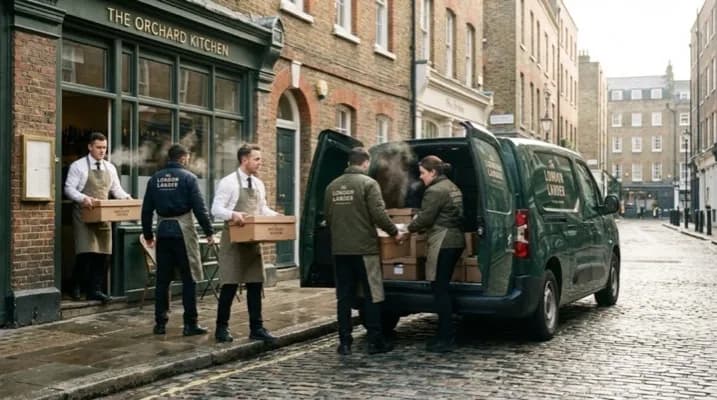
Build a profitable restaurant catering service with this UK marketing guide. Win corporate clients, set pricing, and grow revenue.
You're staring at an empty kitchen between lunch and dinner. Your team is prepped, the equipment is there, and your food is already proven. Yet the gap between "we could do catering" and actually winning paying clients is wider than most restaurant owners expect.
The UK contract catering market is valued at over £12 billion and projected to hit £18.68 billion by 2031. That growth comes from rising demand for office lunches, corporate events, and flexible dining: exactly the work a restaurant kitchen can handle alongside its existing trade.
What You'll Learn
- Why catering is one of the most accessible revenue streams for existing restaurants
- How to position your off-site food service to win corporate and private clients
- Pricing strategies that protect your margins while remaining competitive
- Marketing channels that work for off-site food services in the UK
- How to manage operations alongside your existing dine-in trade
- A 30-minute weekly plan to build your client base consistently
Why Catering Makes Sense for Restaurants
You already have the three most expensive things a catering business needs: a commercial kitchen, trained staff, and proven recipes. Most standalone caterers spend tens of thousands of pounds building what you already own.
Info
Related: Restaurant Marketing Strategies, the broader guide to promoting your restaurant across all channels
The opportunity is simple. Your kitchen has capacity between services. Your team is paid whether those hours are used or not. Off-site food service turns idle time into revenue.
Why restaurants have a natural advantage in catering:
- Existing kitchen infrastructure: no additional capital expenditure for equipment
- Proven menu and supply chain: your recipes and supplier relationships are already established
- Built-in credibility: your restaurant reputation gives corporate clients confidence
- Staff utilisation: chefs and kitchen staff can prepare orders during quiet periods
- Cross-selling opportunities: off-site clients often become dine-in customers and vice versa
The UK food service sector comprises roughly 3,500 businesses nationally. But many corporate buyers prefer ordering from a known restaurant rather than a faceless supplier. That brand trust is your competitive advantage.
If you're thinking "we don't have the capacity," you probably have more than you realise. A kitchen that serves lunch from 12 to 2pm and dinner from 6 to 10pm has roughly six hours of downtime every day. Even two orders per week during that window can generate significant additional revenue.
Positioning Your Catering Service
Now that you understand the opportunity, here's the first decision. What kind of food are you actually offering? "We do catering" is not a position. It is a vague promise. Clients won't know what to expect.
Choose Your Catering Model
| Model | Description | Price Range | Ideal For |
|---|---|---|---|
| Drop-off catering | Prepare, package, deliver; no staff on-site | £8-15 per head | Office lunches, working meetings |
| Staffed service | Deliver and provide serving staff | £15-30 per head | Board meetings, client lunches |
| Full event catering | Complete food service management | £30-60+ per head | Corporate events, private parties |
Most restaurants should begin with drop-off delivery. It needs the least investment. It uses your existing kitchen workflow. And it lets you test demand before committing to staffed events.
Info
Related: Corporate Catering Services, a detailed comparison of service models for business clients
For example, a gastropub in Manchester might start by offering a weekly office lunch delivery to businesses within two miles. The kitchen prepares food during the morning lull and packages it in branded boxes. Delivery by 11:30am. No additional staff needed. No event logistics. Just good food, packaged for a different channel.
Define Your Niche
Generic providers compete on price. Niche providers compete on expertise. Consider one area:
- Corporate daily lunches: recurring weekly orders for offices within delivery range
- Event service: weddings, parties, corporate functions
- Dietary specialist: vegan, allergen-free, or health-focused menus
- Cultural cuisine: leveraging your restaurant's specific culinary identity
Info
Related: Catering Business Ideas, ten catering concepts a restaurant can launch
Pricing That Protects Your Margins
With that positioning sorted, let's talk money. Pricing here is different from your restaurant menu. You are not charging for ambiance or the dining experience. You are charging for food, packaging, transport, and (if needed) on-site staff.
Costing Formula
Start with your food cost per portion and build up: food cost (target roughly a third of the per-head price), packaging, transport, optional on-site staff, then add your margin.
Pricing benchmarks for UK corporate food service:
| Tier | Per Head | What's Included |
|---|---|---|
| Budget lunch | £8-12 | Sandwich platters, basic salads, drinks |
| Premium lunch | £15-25 | Hot food options, premium ingredients, desserts |
| Executive dining | £30-50+ | Multi-course meals, dietary accommodations, serving staff |
Buffet options typically cost £6-15 per head, while full-day conference packages start from £15 per head.
Info
Related: Catering Corporate Lunch, detailed pricing and menu planning for daily office lunch programmes
The Minimum Order Trap
Set a minimum order value, not a minimum guest count. A minimum of £100 is more flexible than a minimum of ten people and protects you from orders that cost more to prepare and deliver than they earn.
For example, a seafood restaurant pricing drop-off lunch platters might set food cost at roughly a third of the final price, add packaging and delivery costs, and arrive at a per-head price that delivers a healthy net margin.
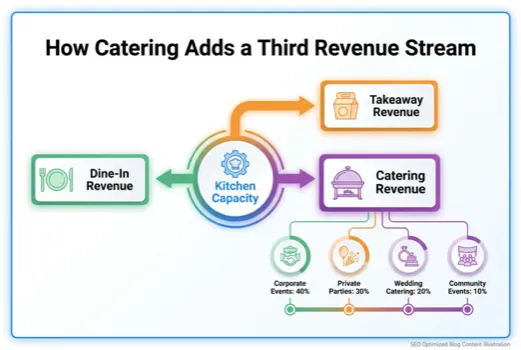
Catering adds a third revenue stream alongside dine-in and takeaway
Marketing Channels for Catering
Here's where the work really begins. Marketing your service is different from promoting your restaurant. You are selling to businesses and event planners who plan ahead. Not hungry people looking for tonight's dinner. The sales cycle is longer. The decision process is more rational. And the channels are different.
For example, a curry house near a tech park might send a monthly email with rotating lunch menus to 20 local office managers. That single channel (targeted email, no social media budget) could fill two catering slots per week within three months.
Direct Outreach
For corporate clients, direct outreach is the most effective channel. Identify businesses within your delivery radius and contact them directly.
- Office managers and PAs: the people who actually book corporate lunches
- Co-working spaces: often organise communal lunches for members
- Business parks and industrial estates: concentrated clusters of potential clients
- Local business networking groups: BNI, Chamber of Commerce, local LinkedIn groups
Info
Related: Catering for Corporate, the complete guide to winning and retaining corporate clients
Your Website
Create a dedicated page on your restaurant website for this service. This is not an afterthought buried in a menu. It should include:
- A clear menu with per-head pricing
- Minimum order requirements and delivery radius
- Sample menus for different occasions
- A simple enquiry form or direct phone number
- Testimonials from existing clients
Info
Related: Restaurant Website, building a website that converts visitors into customers
Email Marketing
Once you have regular clients, email is your most powerful retention tool. A monthly email with seasonal menu updates, special offers, and availability reminders keeps you front of mind when they need to order next.
Info
Related: Restaurant Email Marketing, building and using an email list effectively
Local SEO
Many corporate clients search online for food service providers. Optimise your Google Business Profile for relevant keywords. Create landing pages for "corporate lunch delivery [your city]." Ask happy clients to leave reviews. Keeping your Google Business Profile, listings and reviews consistent across the web is quicker with dedicated local SEO tools.
PR and Partnerships
Announce your new service through local media. A new revenue stream is a story angle for local press, especially if you can tie it to a trend like the return to office or the growth of corporate wellbeing programmes.
Info
Related: Restaurant PR, getting press coverage for your restaurant and its services
If you're only waiting for enquiries you'll always lose to competitors who actively approach corporate clients directly.
If you're thinking "this is a lot of channels to manage," start with just one. Direct outreach alone can fill your first month of orders.
Start With One Channel
The best channel is the one you will actually use consistently. A weekly email to ten offices beats a marketing plan that sits in a drawer.
Winning Corporate Clients
When it comes to reliable revenue, corporate clients are the gold standard. An office that orders lunch every Tuesday is worth more than a one-off party.
Would you hire your own restaurant to handle a client lunch? If the honest answer is "not yet," focus on these steps first.
The First Approach
Step 1: Identify 10 to 15 businesses within your delivery radius. Look for offices with 20 or more employees. They are most likely to order regular catering.
Step 2: Prepare a one-page catering menu with clear pricing. Keep it simple. Three tiers (budget, premium, executive) with two to three options at each level.
Step 3: Offer a free or discounted tasting to the office manager or PA. This is your most effective sales tool. Let the food do the talking.
Step 4: Follow up within 48 hours with a thank-you email and a simple booking process.
For example, a Vietnamese restaurant near a serviced office building might drop off a complimentary pho tasting for the office manager. Two weeks later, they have a standing Wednesday lunch order for 25 people at £11 per head: £14,300 per year from a single free tasting.
Building Recurring Orders
The real value of corporate accounts is regularity. Once you have won a client, suggest a recurring arrangement: weekly lunch deliveries, monthly meeting orders, or quarterly team events.
Info
Related: Restaurant Loyalty Programme, retention strategies that work for repeat clients
Offer incentives for commitment:
- 10% discount for weekly standing orders
- Priority booking for monthly clients during busy periods
- Seasonal menu previews exclusively for regular corporate accounts
Managing Relationships
Assign one person on your team as the dedicated contact for off-site orders. Corporate clients want consistency: the same quality, the same point of contact, the same reliability every time. That person should check in monthly, handle issues immediately, and suggest menu updates proactively.
Info
Related: How to Start a Business in Catering, the operational guide to launching your catering arm
Operations: Running Catering Alongside Dine-In
Finally, let's tackle the operational side. The biggest mistake restaurants make is treating catering as an afterthought. This is where most promising services collapse: not because the food is bad, but because the systems aren't there.
If you can't tell whether your kitchen has genuine spare capacity or just feels quiet, that's usually a sign you need to map your actual prep hours before committing to catering orders.
Scheduling
If you're reading this thinking "my schedule is already packed," most restaurant owners feel the same way. The reality for most independent restaurants is that time feels scarce until you map the actual gaps. Map your catering prep around your restaurant service times. A typical schedule:
- 7:00-10:00am: catering prep and packaging
- 10:30-11:30am: quality check and dispatch
- 12:00-2:00pm: restaurant lunch service
- 2:00-4:00pm: catering prep for evening or next-day orders
- 6:00-10:00pm: restaurant dinner service
Packaging and Transport
Invest in branded packaging from day one. Your packaging is your brand ambassador. Include your restaurant name, logo, social media handles, and a card with your menu and direct ordering details.
Info
Related: Restaurant Business Plan, planning new revenue streams within your business model
Transport requirements depend on your delivery radius and order volume. Start with your own vehicle and insulated bags. As orders grow, consider a dedicated driver during peak hours.
Pre-Launch Checklist
- Define your service model (drop-off, staffed, or full event)
- Set per-head pricing with proper cost calculation
- Create a branded one-page menu PDF
- Set up a dedicated page on your website
- Identify 10 target businesses within your delivery radius
- Prepare insulated carriers and branded packaging
Quality Control
Apply the same standards to off-site orders as you do to dine-in. Check each order before dispatch: correct items, proper packaging, allergen labels, and temperature compliance. One bad experience can lose you a corporate client permanently.
If you're only treating orders as afterthoughts you'll always lose to competitors who build proper systems around their off-site service.
Info
Related: Restaurant Group Dining Marketing, marketing in-house group events alongside off-site catering
If you run a restaurant and want to see how Local Brand Hub can support your marketing, explore our restaurant marketing tools.
Key Takeaway
Key Takeaway
Catering isn't a side hustle. It's your existing kitchen earning money during the hours it was losing it.
Here is what to act on:
- Start with drop-off catering: it requires the least additional investment and lets you test demand before scaling
- Define your niche: specialise in one area (corporate lunches, events, dietary-specific) rather than trying to cater everything
- Price to protect margins: use a costing formula that accounts for food, packaging, transport, and staff, targeting 15-25% net profit
- Market directly to businesses: direct outreach to office managers and PAs within your delivery radius is more effective than waiting for enquiries
- Build recurring revenue: weekly standing orders from corporate clients are more valuable than one-off events
- Create a dedicated catering page: your website needs clear pricing, sample menus, and a simple booking process
- Invest in branded packaging: every delivery doubles as a marketing opportunity for your restaurant
- Systemise operations: schedule catering prep around restaurant service times and apply the same quality controls to every order
Weekly Action
If you only have 30 minutes a week to build your off-site food business:
- Day 1-2: Identify three businesses within your delivery radius that could benefit from regular corporate lunch orders, note the office manager's name or email where possible
- Day 3-4: Create a simple one-page menu with three pricing tiers (budget, premium, executive) and minimum order values
- Day 5-7: Contact one business from your list with a personalised email offering a complimentary tasting for their team
This minimum viable approach builds your client base steadily. A restaurant that approaches one new business per week will have 50 prospects contacted within a year.
Frequently Asked Questions
How much can a restaurant earn from off-site food service?
Revenue varies based on your model and client base. A restaurant delivering weekly lunches to five regular clients at £200 per order generates roughly £52,000 per year. That uses kitchen capacity that would otherwise sit idle. Drop-off service typically delivers 15-25% net margins after food, packaging, and delivery costs.
Do I need additional licences for off-site food service in the UK?
If you already hold a food business registration and food hygiene certificate, you can typically offer off-site food service without additional licences. However, you may need to update your HACCP plan to cover off-site preparation and transport per Food Standards Agency guidance. For alcohol at events, check whether your premises licence covers off-site activities or apply for a Temporary Event Notice. Contact your local council's environmental health team for specifics.
What is the best way to find corporate clients for off-site food service?
The direct outreach approach is a strategy that targets office managers and PAs within your delivery radius, and it is consistently the most effective method. Start with businesses employing 20 or more people. Offer a free tasting, follow up within 48 hours, and suggest a recurring weekly arrangement. Local business networking groups and LinkedIn also work well for building corporate relationships.
How should I price my catering compared to restaurant menu prices?
Prices per head are typically lower than dine-in because you are not covering front-of-house service, ambiance, or table turnover costs. However, you need to factor in packaging, transport, and any on-site staffing costs. As a benchmark, drop-off corporate lunches typically range from £8-15 per head, staffed service from £15-30, and full event packages from £30-60 or more.
Can I run off-site food service from my existing kitchen?
Yes, and this is the primary advantage restaurants have over standalone providers. Your existing kitchen, equipment, and supply chain are already in place. The key requirement is scheduling prep around your restaurant service times, typically mornings before lunch or afternoons between services. As volume grows, you may need to adjust staffing or add dedicated prep shifts.
For restaurants, salons, and local businesses
Need help with your marketing?
We help UK businesses turn social media into real results, not busywork.
Start freeGet More Marketing Tips
Practical marketing tips for UK business owners, straight to your inbox. No spam, unsubscribe anytime.
About the Author
Local Brand Hub
Empowering UK Businesses
Local Brand Hub provides comprehensive business management tools designed specifically for UK local businesses to streamline operations, automate marketing, and grow revenue.
More articlesRelated Articles
 Tutorials
Online Gift Card Restaurant Guide: UK Setup
Learn how to sell online gift card restaurant vouchers in the UK. Compare platforms, set up your store and market digital cards year-round.
 Industry Insights
Restaurant Gift Card UK: Providers, VAT, and Rules
Compare UK restaurant gift card providers, understand Consumer Rights Act rules, VAT treatment, and expiry regulations. Setup guide for restaurants.
 Marketing Tips
Restaurant Interior Signage: Menu Boards & Upselling
Plan your restaurant interior signage strategy. Compare menu boards, wayfinding signs, hygiene displays and upselling signage with UK costs and rules.