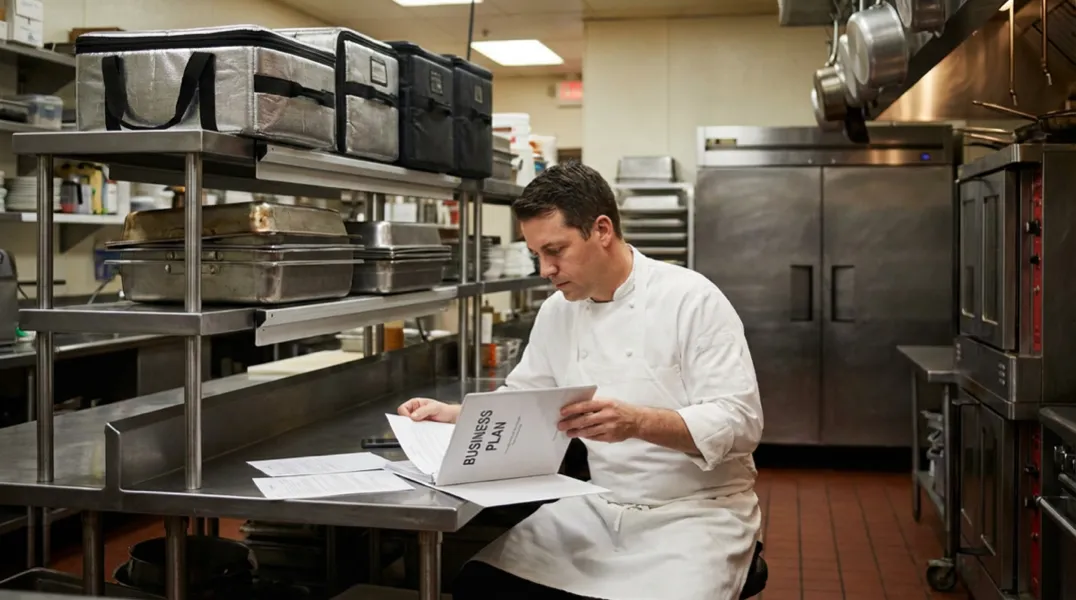
Step-by-step guide for UK restaurant owners adding catering services. Covers licences, insurance, food safety, equipment and finding your first 10 clients.
You're running a solid restaurant. The kitchen works, the recipes are proven, your team cooks under pressure. But last month a regular asked if you could cater their office party. You said yes, spent three hours Googling licensing rules, and still weren't sure if your setup was legal for off-site food service.
The UK contract catering market is worth over £12 billion and projected to reach £18.68 billion by 2031 (Verified Market Research, 2025). Restaurants are well positioned because you already have the hardest parts: a commercial kitchen, trained staff, and established suppliers.
What You'll Learn
- The 8 steps to launch catering from your existing restaurant
- Which licences and registrations you need (and which you probably already have)
- How to update your food safety management for off-site catering
- Equipment and transport requirements
- How to find your first 10 catering clients
Why Restaurants Should Add Catering
Adding off-site food service to an existing restaurant isn't starting from scratch. It extends what you already do into a new revenue channel. Your kitchen during quiet hours. Your staff during downtime. Your reputation as proof of quality.
Info
Related: Restaurant Catering Marketing, marketing your catering service
The economics make sense. Your kitchen is already equipped. Your morning prep team is already paid. Your suppliers already deliver daily. The marginal cost of producing 20 catering lunches alongside your regular prep is significantly lower than setting up a standalone catering operation.
There are roughly 3,500 businesses in this sector nationally (IBISWorld, 2025). Most are pure-play operators without restaurant kitchens. Your advantage: you can offer restaurant-quality food at competitive prices because your fixed costs are already covered.
If you're thinking "I can barely manage my restaurant, let alone a catering arm", that's exactly why you should read this before doing anything else. Launching without a plan creates chaos. Launching with the right steps creates a second revenue stream that doesn't disrupt your core business.
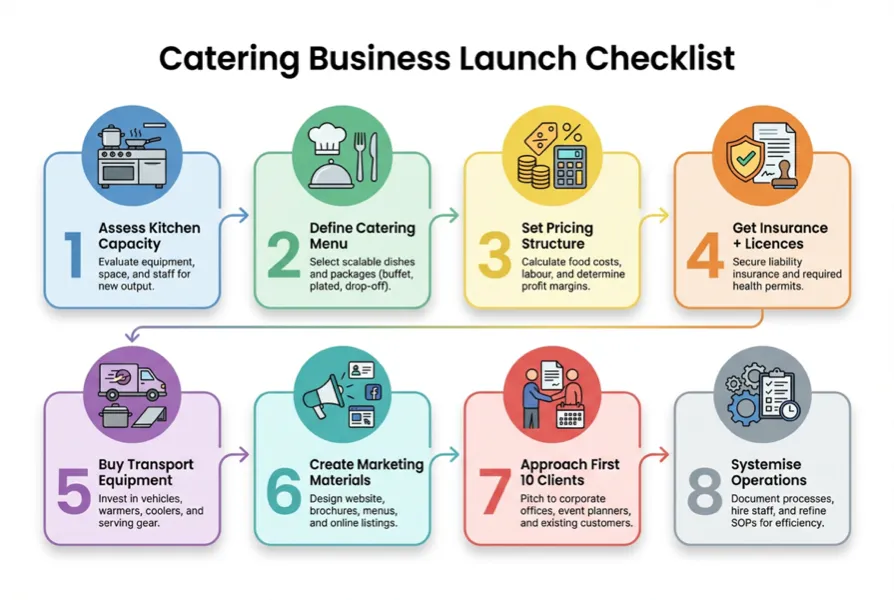
8-Step Catering Launch Checklist
Now that you see the opportunity, here is the complete checklist for adding this service. We'll cover each step in detail below.
- Step 1: Confirm licences and food business registration
- Step 2: Arrange catering-specific insurance
- Step 3: Update your HACCP plan for off-site food service
- Step 4: Source equipment and plan transport logistics
- Step 5: Develop a catering-specific menu
- Step 6: Set pricing with proper cost analysis
- Step 7: Find your first 10 clients
- Step 8: Build ordering and delivery systems
Info
Related: Restaurant Business Plan, business planning
Step 1: Licences and Registrations
First, the good news: as an existing restaurant, you already hold most of what you need.
What you likely already have:
- Food business registration: required for all food businesses and registered with your local authority
- Premises licence: covers food preparation and potentially alcohol service
- Level 2 Food Hygiene certificates: for all food handlers
What you may need to add or check:
- Updated food business registration: notify your local authority that you're adding delivery services. This is free and typically just an update to your existing registration via gov.uk
- Street trading licence: only if you'll serve food from a stall or vehicle at public events (varies by council)
- Temporary Event Notice (TEN): if serving alcohol at unlicensed venues, up to 15 per year per premises (gov.uk)
What you do NOT need:
- A separate food business registration for off-site service if you're operating from your existing registered kitchen
- Additional planning permission if your kitchen use doesn't change substantially
- A personal licence for food-only catering (only required if selling alcohol)
If you're only preparing food for delivery from your current kitchen you'll always lose time to competitors who checked their registrations first. Confirm everything with your local Environmental Health team before your first catering order. A quick phone call saves weeks of uncertainty.
Step 2: Insurance Requirements
Next, your restaurant insurance almost certainly does not cover off-premises work. This is the step most people skip, and it's the one that can cost you everything.
Essential insurance:
You need public liability (minimum £5 million), product liability (often bundled), and employers' liability (a legal requirement). If using your car for deliveries, upgrade to business vehicle insurance.
- Public liability covers injury or damage at client sites
- Product liability covers food-related claims: contamination, allergens, food poisoning
- Employers' liability is a legal requirement if staff work off-site
Contact your existing insurer first. Extending your restaurant policy to include off-site food service is typically cheaper than a separate policy. Expect to pay £200-500 per year for comprehensive cover on top of your existing insurance.
Step 3: Food Safety and HACCP Updates
Additionally, your restaurant already has a food safety management system.
For example, a curry house adding drop-off lunch deliveries would need to document how curries maintain safe temperatures during a 20-minute drive. That means logging food temps at departure and arrival, using proper insulated carriers, and keeping records for each delivery. Off-site food service introduces new risks that your current HACCP plan doesn't cover.
Key additions to your HACCP plan:
- Transport temperature control: document how you maintain safe temperatures during delivery. Hot food above 63°C, cold food below 8°C per Food Standards Agency requirements
- Time and temperature logging: record food temperatures at preparation, departure, and delivery
- Allergen management during transport: preventing cross-contamination between separately packed items
- Reheating procedures: if clients will reheat food, provide clear instructions meeting FSA guidelines
- Shelf life and labelling: all prepared food for off-site consumption must be labelled with ingredients, allergens, and use-by information
Update your HACCP plan with transport-specific hazards before your first off-site delivery.
Practical steps:
- Download your local authority's food safety guidance for caterers (free from most council websites)
- Add a "catering delivery" section to your existing HACCP documentation
- Train all staff involved in catering on the transport-specific hazards
- Invest in a digital probe thermometer and a simple logging sheet for every delivery
If you're reading this and your eyes are glazing over at "HACCP documentation", you're not alone. The reality for most restaurant owners is that HACCP updates feel bureaucratic. But your Food Hygiene Rating applies to your catering operation too. One failed inspection because your catering processes weren't documented damages your restaurant and your catering business simultaneously.
Step 4: Equipment and Transport
With that paperwork handled, let's get practical. You already have a professional kitchen. What you need is the bridge between your kitchen and the client's location.
Essential equipment:
- Insulated food carriers: hot and cold options for different menu items
- Disposable packaging: containers, lids, cutlery, napkins
- Serving equipment: chafing dishes for hot buffets, tiered stands for cold displays
- Transport crates: stackable containers for organising deliveries
- Cool bags and ice packs: for cold items, salads, and desserts
Transport: Start with your own car and proper insulated carriers. The total equipment investment is under £500. Don't buy a van until you have consistent demand: use a third-party courier for occasional orders while testing the market.
Info
Related: Catering for Corporate, your first corporate clients
Step 5: Menu Development
This is where creativity matters. Your off-site menu should not be your restaurant menu in takeaway boxes. Some dishes transport beautifully. Others fall apart in the back of a car.
Menu development principles:
- Transport-test everything: cook it, pack it, drive it 20 minutes, unpack it. Does it still look and taste good?
- Avoid dishes that deteriorate: delicate sauces, crisp coatings, elaborate plating
- Favour robust dishes: curries, tagines, rice bowls, sandwiches, platters, and build-your-own formats
- Offer three tiers: budget, standard, and premium to capture different price points
- Include clear dietary options: vegan, GF, and halal options built into every tier, not bolted on as afterthoughts
A Mediterranean restaurant might adapt their menu into catering-friendly formats: mezze platters instead of individual starters, lamb tagine in serving bowls instead of plated portions, and baklava boxes instead of dessert plates. Same quality, different presentation.
Step 6: Pricing Your Catering Service
Calculate your true cost per head before setting prices. Many restaurants undercharge for catering because they only account for food cost, not the full picture.
Full cost per head: Add food cost (£3-8), packaging, labour, delivery, and overheads to find your true cost. Then target 60-70% gross margin. If your total cost is £8 per head, price at £15-20 depending on the tier.
UK market benchmarks:
| Service Model | Price Per Head | Typical Use |
|---|---|---|
| Drop-off | £8-15 | Office lunches, team meetings |
| Staffed service | £15-30 | Client lunches, board meetings |
| Full event | £30-60+ | Corporate dinners, celebrations |
If you're thinking "those margins seem high", they reflect the convenience, reliability, and professionalism you're selling alongside the food. Corporate clients budget for catering. They're not comparing your price to cooking at home.
Step 7: Finding Your First 10 Clients
Here's the truth: your first 10 clients won't come from a website or social media campaign. They'll come from your existing network and local outreach. Turning up when nearby offices search for a caterer is where getting found in local search earns its keep alongside that legwork.
Where your first clients are:
- Your regulars: ask dine-in customers where they work and whether their office orders catering. Put a "We cater!" card in every bill folder
- Nearby offices: walk into every office within a mile. Drop off a menu and a business card. Follow up by email in three days
- Local business networks: BNI groups, chambers of commerce, business parks with communal noticeboards
- Social media, targeted: post on LinkedIn (not Instagram) about your new catering service. Tag local businesses
- Google Business Profile: add "catering" as a service immediately
Outreach sequence for cold prospects:
- Day 1: Send a brief email with your catering PDF attached
- Day 4: Follow up: "Just checking this reached you, happy to send over a sample menu"
- Day 10: Final follow-up with a specific offer: "Free trial lunch for your next team meeting"
For example, a Thai restaurant launching catering might offer 20% off the first order to the first five businesses that book. That discount costs you £30-50 per order but generates testimonials, photos, and referrals that fuel organic growth.
If you're only waiting for enquiries to come to you you'll always lose to competitors who actively reach out. Your first 10 clients require hustle. After that, referrals and repeat business do most of the work.
Info
Related: Catering Business Ideas, catering concepts to consider
Step 8: Systems and Processes
Finally, once you have clients, you need systems that prevent every order from becoming a stressful one-off.
For example, a Mediterranean restaurant running three weekly corporate deliveries might use a shared Google Sheet for orders, a template invoice in Xero, and a WhatsApp group with the kitchen team for delivery confirmations. Simple tools, reliable results.
Essential systems:
- Order form: standardised form capturing date, time, guest count, dietary requirements, delivery address, and contact number
- Menu and pricing document: a professional PDF you can email instantly
- Preparation checklist: a kitchen-side list for each order ensuring nothing is missed
- Delivery log: time prepared, time dispatched, time delivered, temperature readings
- Invoice template: professional invoice with your catering branding, payment terms, and VAT if applicable
- Feedback collection: a simple "How was everything?" email sent automatically after each delivery
These don't need to be complex. A shared Google Sheet for orders, a template invoice in your accounting software, and a WhatsApp message for delivery confirmation will handle your first 20 clients.
Build Retention Fast
After every delivery, send a one-line email: "How was everything? Anything you'd change for next time?" That 10-second habit builds retention faster than any marketing campaign.
Can you honestly say your catering process would survive if you were off sick? If the answer is no, that's your cue to document every step before scaling up.
If you run a restaurant and want to see how Local Brand Hub can support your marketing, explore our restaurant marketing tools.
Key Takeaway
Key Takeaway
Starting a catering business from a restaurant isn't about ambition. It's about using what you already have during the hours it sits idle.
If you can't tell whether your kitchen has real spare capacity or just quiet patches, that's usually a sign you need to map your actual prep schedule before committing.
- Restaurant owners already have the hardest parts: commercial kitchen, trained staff, and food suppliers
- Registration is usually a free update to your existing food business registration with your local authority
- Insurance is essential and costs £200-500 per year on top of your restaurant policy
- HACCP updates for transport and off-site service are the most important food safety step
- Start with minimal equipment (under £500) and scale up when demand justifies it
- Your first 10 clients come from local outreach, not marketing campaigns
- Price for 60-70% gross margin, benchmarking against £8-15 (drop-off) and £15-30 (staffed) per head
Weekly Action
If you only have 30 minutes a week, do this:
- Day 1-2: Phone your insurer and local Environmental Health officer to confirm what you need
- Day 3-4: Write a simple catering menu with three tiers and per-head pricing
- Day 5-7: Tell five regulars you now offer catering and ask them to pass your details to their office manager
Frequently Asked Questions
Do I need to register separately to offer catering from my restaurant?
No separate registration is required if you operate from your existing registered premises. However, you must notify your local authority that you are adding catering and delivery services. This is a free update to your food business registration via your local council or gov.uk. Do this before your first catering order.
How much does it cost to start a catering business from a restaurant?
The startup cost is surprisingly low because you already have a commercial kitchen. Budget approximately £200-500 for insulated carriers and packaging supplies, £200-500 for additional insurance, and £100-200 for marketing materials (PDF menus, business cards). Total launch cost is typically under £1,000, excluding a vehicle if needed.
Can I sell alcohol with my catering service?
If your premises licence covers off-sales, you can include bottled drinks with catering orders delivered from your restaurant. For serving alcohol at client venues, you need either a Temporary Event Notice (TEN) for each occasion or the venue must hold its own premises licence. You can apply for up to 15 TENs per year per premises.
What food hygiene rating do I need for catering?
There is no minimum legal requirement, but corporate clients check ratings. A rating of 5 (very good) is expected. For instance, a restaurant with a rating of 4 might fix minor issues (documentation gaps, labelling) before launching its catering arm. Your rating covers all food activities at your premises, including catering preparation.
How do I handle food that needs to be reheated by the client?
Provide clear written instructions with every order that requires reheating. Include the target internal temperature (75°C for reheated food per FSA guidance), recommended method (oven, microwave), and timing. Label each container with reheating instructions and a use-by time. Never rely on verbal instructions alone.
For restaurants, salons, and local businesses
Need help with your marketing?
We help UK businesses turn social media into real results, not busywork.
Start freeGet More Marketing Tips
Practical marketing tips for UK business owners, straight to your inbox. No spam, unsubscribe anytime.
About the Author
Local Brand Hub
Empowering UK Businesses
Local Brand Hub provides comprehensive business management tools designed specifically for UK local businesses to streamline operations, automate marketing, and grow revenue.
More articlesRelated Articles
 Tutorials
Online Gift Card Restaurant Guide: UK Setup
Learn how to sell online gift card restaurant vouchers in the UK. Compare platforms, set up your store and market digital cards year-round.
 Business Growth
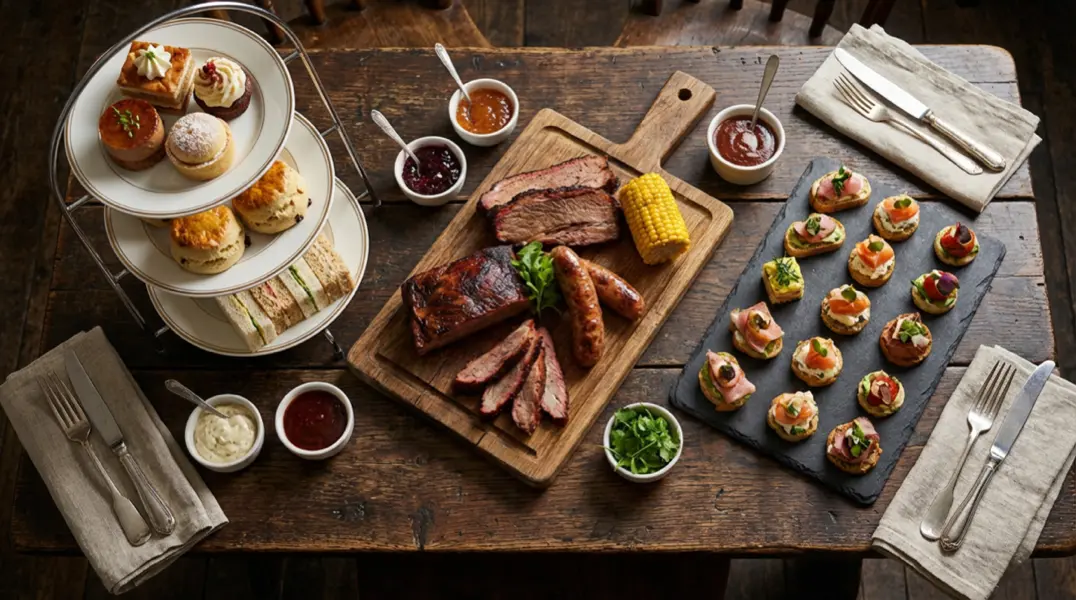
Catering Business Ideas: 12 Profitable UK Niches (2026)
Explore 12 profitable catering business ideas for UK restaurant owners. From office lunch delivery to afternoon tea and BBQ catering, find your niche.
 Industry Insights
Restaurant Gift Card UK: Providers, VAT, and Rules
Compare UK restaurant gift card providers, understand Consumer Rights Act rules, VAT treatment, and expiry regulations. Setup guide for restaurants.