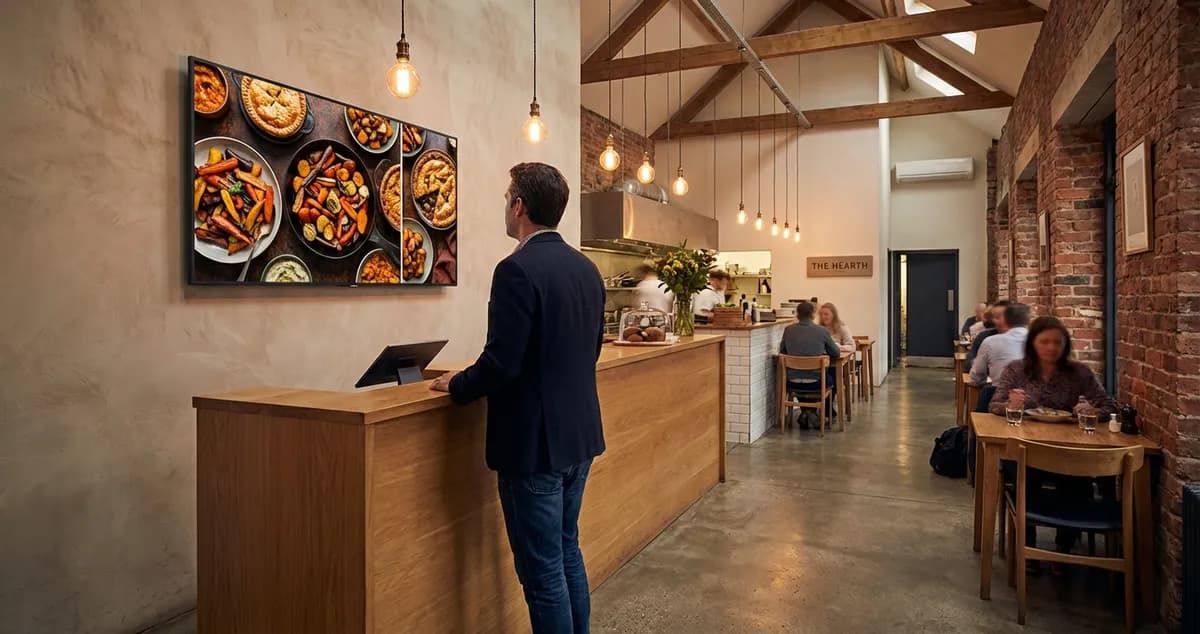
Learn how digital menu screens can boost UK restaurant sales by 3-10%. Get realistic costs from £2,000, ROI timelines, and honest UK supplier advice.
You have just finished a 12-hour shift. Your feet hurt. A customer just asked if you still do the lamb special, the one you took off six months ago. The crossed-out prices and handwritten amendments are not doing your cooking justice.
How many sales are you losing to outdated menus?
Digital menu screens are electronic displays that showcase your menu with high-resolution images, videos, and dynamic content. They update in real-time, so when your supplier runs out of sea bass, you fix it in seconds instead of grabbing a marker. For UK restaurants, these screens typically cost between £2,000 and £8,000 for a complete setup, with businesses often seeing sales increases of 3-10% after implementation.
This guide covers realistic costs, practical implementation steps, and honest advice on whether digital menu screens are right for your restaurant. Based on our experience helping UK hospitality businesses with technology decisions, we have seen what works and what fails.
What you'll learn:
- Realistic UK costs for hardware, software, and installation
- How long it takes to see a return on your investment
- Which screen size and type suits your specific setup
- Common mistakes that waste money
- A simple weekly action to evaluate if this is right for you
What Are Digital Menu Screens?
First, let us clarify exactly what we are talking about. A digital menu screen is a commercial-grade display that shows your menu electronically rather than on paper or static boards. These screens range from 32 inches to 55 inches and typically include built-in media players, content management software, and mounting hardware.
Why this matters: Unlike the TV in your living room, commercial digital menu displays are typically built for restaurant life. They handle kitchen heat, run for 16+ hours daily, and stay visible even when the sun streams through your front windows.
The technology works through a content management system that lets you upload images, schedule menu changes, and update prices from any device with internet access. For example, a fish and chip shop in Manchester uses their system to switch automatically between lunch and dinner menus, push cod when haddock runs low, and schedule bank holiday specials weeks in advance.
Info
Why UK Restaurants Are Switching to Digital Menu Screens
With that context in mind, let us look at why the shift toward digital displays in UK hospitality is accelerating. Over 85% of UK restaurant leaders planned to invest in new technology in 2025 to increase efficiency and enhance marketing (UK Restaurant Trends, 2025).
If you are thinking this sounds like something only chain restaurants can afford, you are not alone. Many independent restaurants initially share that concern. But independents often see higher proportional returns because they can act faster on the data these systems provide. Would you rather spend two hours reprinting menus or two minutes updating a screen?
The Sales Impact
Available research suggests that digital menu screens influence how customers order. Studies indicate that roughly 8 out of 10 viewers made an unplanned purchase of something promoted digitally in a restaurant setting.
Here is what available research typically shows:
- Sales increases of 3-5% when switching from static to digital displays
- Check sizes often rise by around 6% with digital menu implementation
- Promoted items can influence up to 20% of customers to change their order (Digital Signage Today, 2025)
Real example: A UK restaurant chain achieved a 6% overall sales lift, largely driven by a 9% increase in combo meal attachment rates. Their digital confirmation screen also reduced order errors by 15% (UKHospitality, 2025).
Operational Benefits
So you understand the sales potential. But what about the day-to-day headaches?
Dayparting becomes automatic. Your breakfast menu displays until 11am, then switches to lunch, then dinner. No staff member needs to remember to swap boards during the Saturday rush when you are already down two staff.
Price changes happen instantly. When your meat supplier raises prices, you adjust your screen in minutes rather than reprinting everything. Many UK restaurants spend £1,000-£1,500 annually on menu printing alone (UKHospitality, 2025).
Promotions run without extra work. Schedule your slow-day specials to appear automatically on quiet Wednesday nights, pushing high-margin items when you need the boost most.
If you are reading this thinking "I do not have time to learn new software", most systems are designed for exactly that concern. Many of the better options take about 30 minutes to learn.
Info
Related: Digital Menu Boards for Restaurants
Digital Menu Screen Costs in the UK
Understanding the benefits is one thing, but what will this actually cost? Here is the realistic breakdown for UK restaurants in 2026.
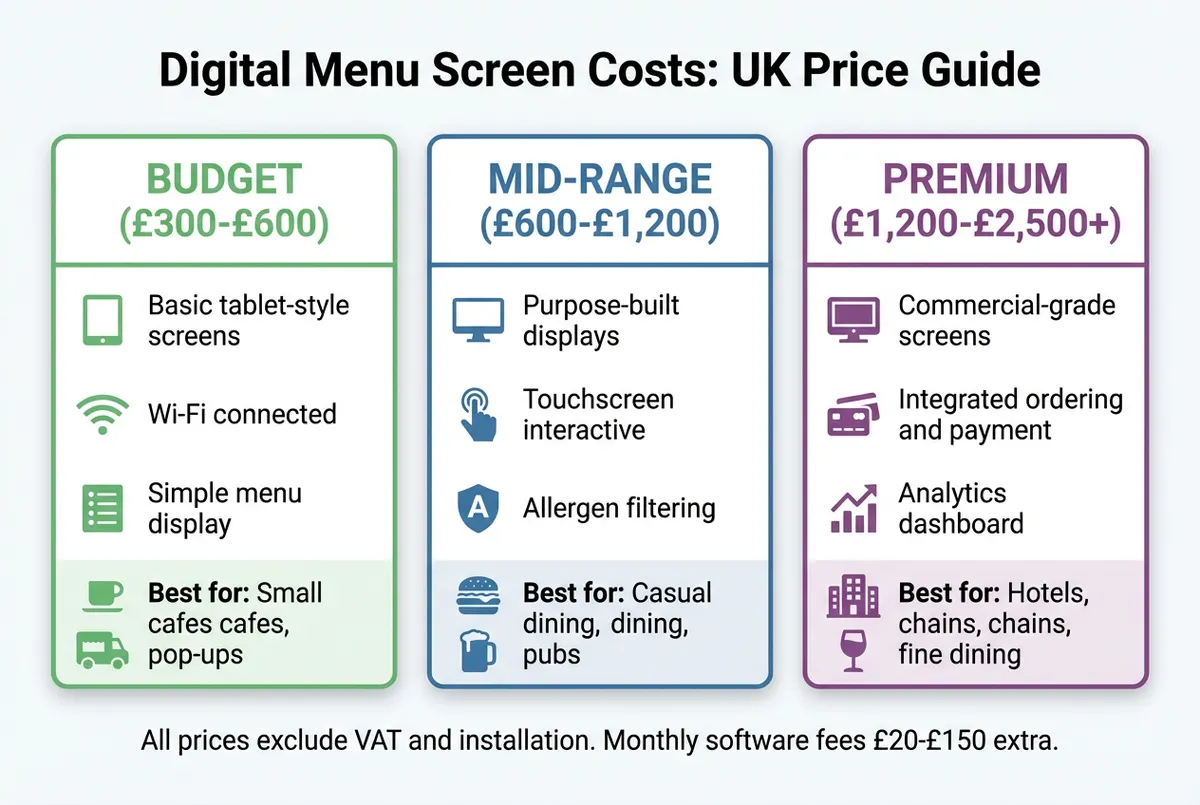
Digital menu screen cost breakdown for UK restaurants
Hardware Costs
For a complete picture, here are typical UK price ranges:
- 32-inch commercial display: £400-900 depending on quality tier
- 43-55 inch commercial display: £600-2,000+ depending on quality tier
- Media player: £100-370
- Mounting and installation: £150-700 combined
Note: These ranges reflect typical UK supplier pricing as of early 2026. Prices vary by region and specific requirements.
A complete single-screen setup typically costs between £2,000 and £4,000. Installations with 2-3 screens fall in the £4,000-£8,000 range. These are considered capital expenses for tax purposes (UK Government Business Expenses, 2025).
Software Costs
Content management software runs from £10 to £50 monthly per screen. Some UK providers to research:
- Signagelive: Approximately £17 monthly per player
- ScreenCloud Starter: Approximately £16 monthly per screen
- Embed: Approximately £10 monthly per player
For a restaurant running two screens, budget £200-600 annually for software.
Realistic ROI Timeline
Most restaurants achieve break-even within 18-24 months through increased sales and reduced printing costs.
Example calculation: A takeaway spending £100 monthly on menu printing with average weekly revenue of £8,000 installs a £3,000 digital menu system. With a conservative 3% sales lift (£240 weekly), plus £100 in printing savings, they recover their investment in under 11 months.
If you cannot tell whether your printed menu costs are significant or just background noise, that is usually a sign to start tracking them properly before making any technology decisions. The reality for most independent restaurants is that these costs often add up unnoticed until you sit down with the numbers.
Choosing the Right Digital Menu Screen
Now that you understand the costs, how do you choose the right screen? Not every digital display suits every restaurant. If you are spending more time researching than necessary, that is usually a sign you need to see a demo in person rather than read another comparison article.
Screen Size Guidelines
32-inch screens work for smaller cafes, takeaway windows, and spaces where customers view from close distances. A coffee shop in Bristol uses a single 32-inch screen behind their till and reports customers ordering more pastries since they added rotating images.
43-inch screens suit most independent restaurants with standard counter configurations. They are visible from 3-5 metres and balance cost with impact.
55-inch screens often make sense for larger QSR operations, venues with significant viewing distances, or situations where multiple screens would otherwise be needed.
For most independent UK restaurants, a 43-inch commercial LCD often offers the best combination of visibility, durability, and value.
Display Type Considerations
LED displays often offer higher brightness and better visibility in brightly lit environments, but typically cost 20-40% more than LCD equivalents. If your current menu board washes out in afternoon sun, LED is likely worth the premium.
LCD displays typically provide excellent image quality at lower cost and work well in most restaurant lighting conditions.
Features Worth Paying For
When evaluating digital menu screen providers, prioritise these capabilities:
- Dayparting: Automatic menu switching based on time of day
- Remote updates: Change content from your phone or laptop
- Multi-screen sync: Keep multiple displays synchronised
- Scheduling: Plan promotions weeks in advance
If you are only going to learn one feature, make it remote updates. This can mean the difference between fixing a price at 2am in your pyjamas versus rushing in before opening.
Want to explore other options before committing? See our complete guide to digital menu technology for a comparison of all available solutions.
Info
Related: QR Code Menus
Implementation: A Realistic Timeline
Once you have chosen your screen and supplier, what comes next? Installing digital menu screens does not require closing your restaurant for a week.
Here is a typical timeline for an independent UK restaurant:
Week 1: Planning
- Measure your space and identify power outlet locations
- Decide on screen quantity and placement
- Request quotes from 2-3 suppliers
Week 2: Content Preparation
- Photograph your best-selling dishes (or hire a food photographer for £150-300)
- Gather pricing and descriptions
- Plan your menu layout
If you are thinking "I cannot afford a photographer right now", many restaurants start with smartphone photos and upgrade later. Something is better than nothing.
Week 3: Installation
- Most single-screen installations complete in 2-4 hours
- Multi-screen setups typically take a full day
- Staff training takes 30-60 minutes
Week 4: Optimisation
- Monitor which items get attention
- Adjust promotion placement based on sales data
- Fine-tune dayparting schedules
Example: A kebab shop owner in Leeds went from initial enquiry to live screens in 18 days. The longest delay was waiting for his photographer to fit him in. Installation itself took three hours on a Monday morning before opening.
The reality is that you can typically go from decision to functioning screens in under a month. If you are reading this thinking "I barely have time to run my kitchen, let alone manage a tech project", this timeline is designed with that reality in mind.
Common Mistakes to Avoid
Before you commit, let us cover what can go wrong. These patterns emerge consistently from UK restaurant installations.
- Buying consumer-grade TVs: A £500 TV is not designed to run 16 hours daily. Expect burnout within 12 months.
- Overcrowding the screen: If you're only putting everything on one screen you'll always lose to competitors who focus on 8-12 highlighted items.
- Ignoring content updates: A digital screen showing the same image for six months loses impact. Set a monthly refresh reminder.
- Skipping professional installation: A crooked screen with visible cables undermines quality perception. Installation costs £100-500.
If you are only using your screen for a few hours daily, a consumer TV might work. But for most restaurant applications, commercial displays pay for themselves in longevity.
Info
Related: Self-Ordering Kiosk
Digital Menu Screens vs Other Options
With all that said, how do digital menu screens compare to other digital menu technology options? Here is a practical comparison.
| Factor | QR Code Menus | Digital Menu Screens | Self-Ordering Kiosks |
|---|---|---|---|
| Setup Cost | Low (under £200) | Medium (£2k-8k) | High (£4k-10k) |
| Visual Impact | Low | High | High |
| Upselling Ability | Medium | High | Very High |
| Best For | Casual dining, pubs | Counter service, takeaways | High-volume QSR |
Cost estimates are typical ranges and will vary based on specific requirements and suppliers.
For most UK restaurants doing counter service with moderate volume, digital menu screens often offer the best balance of visual impact, reasonable cost, and operational simplicity.
What to Look for in a UK Supplier
Finally, with so many options available, here is what to prioritise when choosing a digital menu screen provider.
UK-based support. When your screen fails during Friday evening service, you need someone who answers the phone in your timezone. If you have ever tried to troubleshoot tech issues while your customers queue out the door, you know this matters.
Clear warranty terms. Commercial displays should carry minimum 2-3 year warranties. Check whether this covers on-site repairs or requires you to ship equipment. Under UK consumer law, you have additional protections for business equipment purchases (UK Government Consumer Rights, 2025).
Content creation assistance. Some providers include basic content templates or design services. This can save hundreds of pounds compared to hiring a separate designer.
Scalability. If you plan to open additional locations, ensure your provider can support multi-site management from a single dashboard.
Prices from UK suppliers typically run 10-20% higher than overseas alternatives, but the support difference often justifies the cost. When your menu screen fails on a bank holiday weekend, a UK support line is worth the premium.
Key Takeaway
Key Takeaway
Digital menu screens typically cost £2,000-£8,000 for UK restaurant installations, with sales increases of 3-10% making break-even achievable within 18-24 months. For most independents, a 43-inch commercial LCD offers the best balance of visibility, durability, and value. The two most valuable software features are dayparting (automatic menu switching) and remote updates (change prices from your phone). Avoid consumer-grade TVs: they burn out within 12 months in restaurant conditions. Start with one screen in your busiest area and expand based on results.
If you run a restaurant and want to see how Local Brand Hub can support your marketing, explore our restaurant marketing tools, from menu and offers management to social media and local SEO.
This Week's Action Plan
Day 1-2: Calculate your current annual menu costs: include printing, laminating, menu board replacements, and staff time spent updating prices. This baseline helps you measure potential savings.
Day 3-4: Photograph your current menu setup from where customers stand. Look at it with fresh eyes. Does it do your food justice?
Day 5-7: Request a demo from one UK digital signage provider. Most offer virtual demonstrations that take 15-20 minutes and show how your menu would look on their system.
These steps take under an hour total and give you the data you need to make an informed decision.
For UK restaurant owners
Complement Your Digital Menu Investment
LocalBrandHub helps UK restaurants manage social media, local SEO, and marketing from one dashboard, so your digital presence matches your in-venue technology.
Start FreeGet More Marketing Tips
Practical marketing tips for UK business owners, straight to your inbox. No spam, unsubscribe anytime.
About the Author
Local Brand Hub
Empowering UK Businesses
Local Brand Hub provides comprehensive business management tools designed specifically for UK local businesses to streamline operations, automate marketing, and grow revenue.
More articlesRelated Articles
 Marketing Tips
Digital Menu Boards for Restaurants: UK Costs and Guide
Compare digital menu board costs from £499-£7,000, see 38% sales uplift stats, and learn setup requirements. UK pricing and supplier guide for restaurants.
 Marketing Tips
Digital Menu Technology: Guide for UK Restaurants
Digital menu technology boosts sales by 3-9% for UK restaurants. Compare QR codes, digital boards, screens and kiosks with costs and ROI.
 Marketing Tips
QR Code Menus: A Complete Guide for UK Restaurants
Learn how QR code menus can streamline restaurant operations, address customer concerns, and boost efficiency. Practical tips for UK owners.