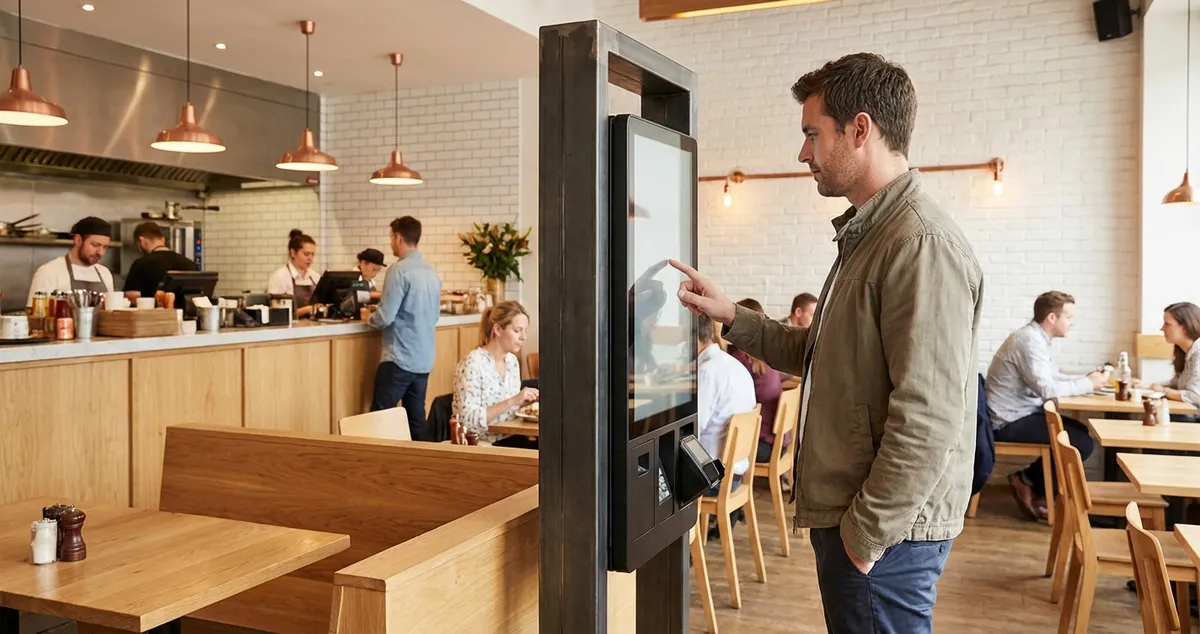
Self ordering kiosks boost UK restaurant order values by 20-30%. Hardware from £499, software fees, setup costs, and ROI payback timelines explained.
You're watching customers walk out. It's Saturday rush, you're down two staff, and the queue backs up past the door. Customers shuffle impatiently, checking their phones. Some leave without ordering. Meanwhile, the chain down the road serves twice as many covers with half the team. The difference? Self ordering kiosks.
The good news? Self-service kiosks are no longer reserved for chains with deep pockets. UK restaurants using kiosks see average order values increase by 20-30%, according to Zonal. And with hardware starting from £499, the technology has become accessible for independent operators in 2026.
This guide covers everything you need to know about implementing a self ordering kiosk in your UK restaurant, including realistic costs, ROI timelines, and whether this investment makes sense for your specific situation.
Info
What You'll Learn
- How much self ordering kiosks cost in the UK (hardware, software, and ongoing fees)
- The real ROI figures from UK restaurant operators
- Step-by-step setup considerations for independent restaurants
- Which kiosk providers may suit different restaurant types
- How kiosks integrate with your existing digital menu technology
How Much Does a Self Ordering Kiosk Cost?
A self ordering kiosk in the UK typically costs from around £500 to over £2,000 for hardware, plus monthly software fees depending on features. Total first-year investment for a single kiosk runs from around £1,000 to several thousand pounds.
For example, a fish and chip shop in Manchester installed a countertop kiosk in late 2025 for under £800 plus monthly software fees. Within three months, their average order value increased by nearly 20% because the kiosk consistently suggested adding mushy peas and a drink.
Here is the breakdown of what you are actually paying for:
Hardware Costs
Hardware costs depend on the type of kiosk you choose:
- Tablet-based systems (iPad/Android) suit small cafes and operators testing the technology
- Countertop touchscreens work well for quick service venues with limited floor space
- Floor-standing units deliver the best experience for high-volume restaurants
- Wall-mounted kiosks maximise space in takeaways and compact venues
According to Grafterr, their countertop kiosk starts at a competitive price point.
Mobile Transaction reports that simpler iPad-based setups can start from budget-friendly prices including the mount and receipt printer.
Monthly Software Fees
The hardware is only part of the equation. Software subscriptions vary by provider and features. Square's kiosk software starts from competitive monthly rates. Some providers like Kayana use subscription models that bundle hardware costs into the monthly fee.
Transaction Fees
Most kiosk providers charge card processing fees on top of monthly subscriptions. Expect standard UK card processing rates plus a small per-transaction fee.
If you are thinking about costs, you should also consider how kiosks compare to digital menu boards for restaurants, which offer different benefits at lower price points.
Info
Related: QR Code Menus, a lower-cost alternative for restaurants testing digital ordering
What Is the Cost of a Self Ordering Kiosk Machine?
Now that you understand the overall costs, let's look at what actually drives the price differences. The self ordering kiosk machine combines display hardware, payment processing, and ordering software into a single customer-facing unit. The cost varies primarily by screen size, build quality, and included peripherals.
For example, a curry house in Newcastle compared three options at different price points. They chose the mid-range countertop option because it balanced durability with their available counter space.
Price tiers at a glance:
- Entry-level: Several hundred pounds
- Mid-range: Low thousands
- Premium commercial: Considerably more
Here is what affects the price:
Screen size matters. A tablet-style kiosk costs significantly less than a large commercial touchscreen. Larger screens improve visibility but require more robust stands and higher-quality components.
Integrated peripherals add up. A basic kiosk might only include the screen and payment reader. Commercial units often include receipt printers, QR scanners, and card readers built into the housing.
Build quality determines longevity. Restaurant environments are harsh. Grease, heat, and constant use mean cheaper consumer-grade tablets may need replacing within two years. Commercial-grade units typically last five to seven years.
Budget Guidance
For a typical independent restaurant, budget in the low-to-mid thousands for a reliable mid-range unit that will handle daily service without constant maintenance issues.
How Much Does It Cost to Set Up a Kiosk?
With the machine itself sorted, what about getting it operational? Setting up a self ordering kiosk involves more than just buying the hardware. Total setup costs including installation, integration, and training typically add several hundred pounds to your initial hardware investment.
Installation Costs
Floor-standing units typically require professional installation costing a couple hundred pounds for electrical work and anchoring. Wall-mounted kiosks need mounting and cable management. Countertop units can often be self-installed.
Integration Requirements
Your kiosk needs to communicate with your existing systems. POS integration is free with some providers but can cost extra with others. Kitchen display connections are usually included in the software subscription. Menu synchronisation is critical for restaurants using QR code menus alongside kiosks.
Staff Training
Budget a few hours for initial staff training. Most providers include basic training in their setup package, but if you are introducing significant workflow changes, consider additional training time.
The real cost most owners forget: lost service time during installation. Schedule kiosk installation for your slowest day to minimise disruption.
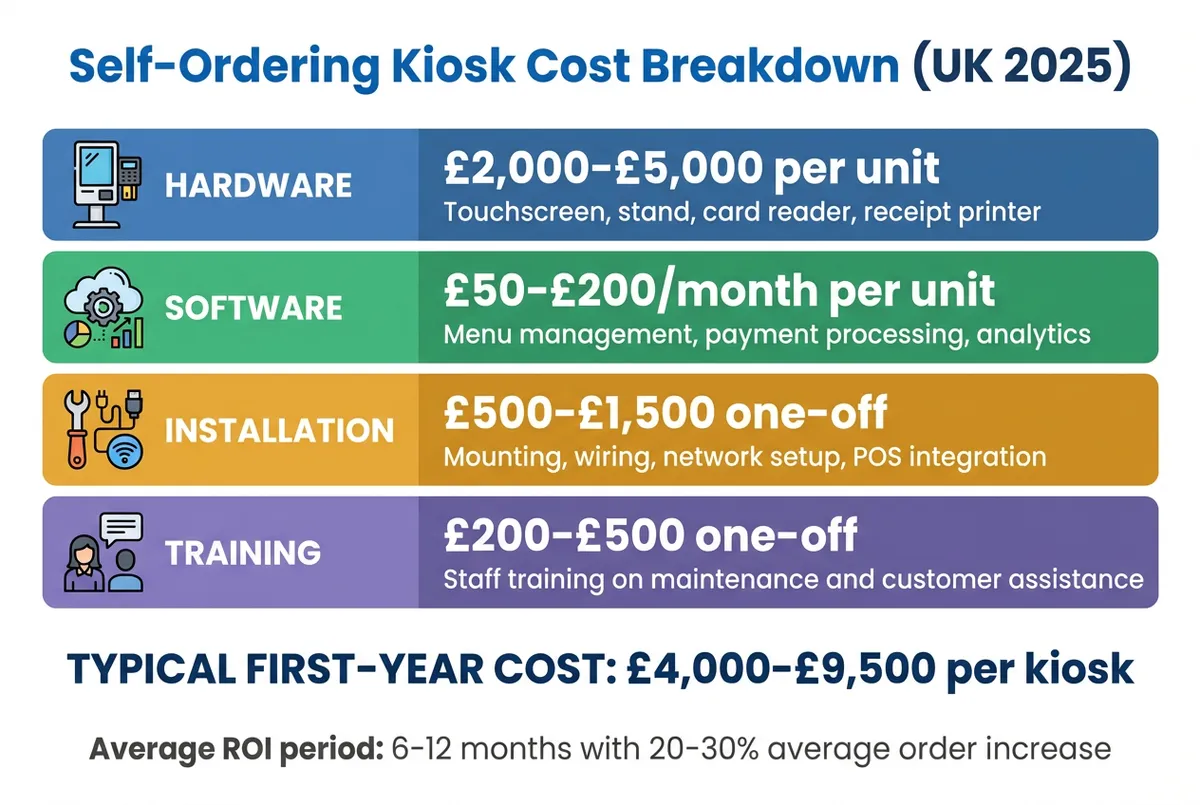
Self ordering kiosk cost breakdown for UK restaurants
How Much Do Digital Kiosks Cost Long-Term?
Digital kiosks carry ongoing costs beyond the initial purchase.
Ongoing cost categories include:
- Software subscriptions
- Payment processing fees
- Maintenance and support
Annual Cost Breakdown
Annual running costs break down into these three main categories. Budget for several hundred to over a thousand pounds annually per device depending on your transaction volume and provider tier.
The ROI Calculation
So you understand the costs. But what about returns? Restroworks research shows self ordering kiosks often increase average order values significantly. UK providers like Vita Mojo report some operators achieving notably higher transaction values.
For example, a pizza takeaway in Leeds invested in a countertop kiosk. Within a few months, their upselling consistency improved so much that the kiosk had paid for itself entirely through increased order values.
Typical ROI timeline for independent restaurants:
- Month 1-2: Initial adjustment, staff and customer learning curve
- Month 3-4: Order values start increasing, workflow stabilises
- Month 5-6: Most operators reach full payback on investment
A busy takeaway processing significant daily order volumes can see substantial monthly revenue increases when average order values rise through consistent upselling.
If you are running the numbers for your venue, remember that kiosks work best alongside other digital menu screens that reinforce your menu offerings, plus a marketing routine our all-in-one platform can run to keep customers walking in.
Info
Related: Digital Menu Screens, complement your kiosk with dynamic menu displays
The Real Benefits for UK Restaurant Owners
The cost breakdown is useful, but what does this actually mean for daily operations? Beyond the headline statistics, here is what matters when you are running a restaurant.
Key operational improvements include:
- Faster throughput during peak service
- More consistent upselling without staff fatigue
- Fewer order errors and refunds
- Greater flexibility in staff deployment
Faster Service During Peak Times
One industry analysis found kiosks cut average order processing time by nearly 40%. During your Saturday rush, that translates to serving more customers in the same window without adding staff.
For instance, a burger restaurant in Birmingham found they could serve significantly more covers during Friday evening service after installing two floor-standing kiosks near the entrance. The queue no longer backed up past the door.
More Consistent Upselling
Your best staff member might remember to suggest sides and drinks most of the time. A kiosk does it every time.
The psychological element matters too: customers often add extras when there is no perceived pressure from a person waiting for their answer.
Reduced Order Errors
Self-service technology contributes to a 99% order accuracy rate. Fewer wrong orders means less food waste, fewer refunds, and happier customers.
Labour Cost Flexibility
If you're thinking "great, I can cut staff," that's usually a sign you're approaching this wrong. That mindset often leads to poor implementation and frustrated customers.
The real benefit is redeploying existing staff. Instead of three people on tills during peak service, you might have one person assisting with kiosks while two focus on food preparation or table service.
A Word of Caution
Kiosks work brilliantly for quick service and takeaway-focused operations. For fine dining or experience-led restaurants, the human element remains crucial. Know your model before investing.
If you're only installing a kiosk because your competitors have one, you'll always lose to operators who understand why their customers want self-service in the first place.
Choosing the Right Kiosk for Your Restaurant
With the benefits clear, how do you pick the right system? Not all kiosks suit all restaurants. A busy kebab shop in East London learned this the hard way. They bought cheap tablet kiosks that cracked within weeks of heavy use. Matching hardware to your service style matters.
Here is a quick framework by restaurant type:
| Restaurant Type | Recommended Kiosk | Priority |
|---|---|---|
| Quick service/takeaways | Floor-standing or wall-mounted | Speed and durability |
| Casual dining | Countertop near entrance | Customer flow |
| Cafes/coffee shops | Tablet-based | Flexibility and cost |
| Food trucks/pop-ups | Portable tablet | Mobility |
- For quick service and takeaways: Prioritise robust build quality over aesthetics
- For casual dining: Customers can order at the kiosk then take a table number
- For cafes: A cafe in Brighton started with a tablet setup and upgraded to a countertop unit after seeing how customers responded
- For food trucks: Look for providers offering mobile-friendly solutions
UK Providers Worth Considering
| Provider | Often Suits | Key Strength |
|---|---|---|
| Grafterr | Budget-conscious operators | Low ongoing fees |
| Square | Existing Square users | Familiar interface |
| Kayana | Cash flow concerns | Subscription model |
| SumUp | Small operators testing | Easy entry point |
| Vita Mojo | Data-driven restaurants | Strong analytics |
Provider suitability varies by restaurant type and existing systems.
Before You Invest
If you cannot tell whether your current queues are costing you customers or just feel slow, that is usually a sign you need better data before investing. Track peak-time queue lengths for two weeks first.
Common Concerns Addressed
So you've got the costs and benefits. But what about the concerns keeping you from committing? Let's address the questions restaurant owners typically ask before making a final decision.
"Will customers actually use them?"
Most customers prefer self-service kiosks according to Restroworks. Post-pandemic habits shifted consumer preferences strongly toward self-service options, a trend that has accelerated through 2025 and into 2026. Younger demographics are even more comfortable with the technology.
"What about customers who struggle with technology?"
If you are thinking "my regulars will hate this," you are not alone. Always maintain a staffed ordering option. Position a team member near kiosks during initial rollout to assist customers. Most people adapt quickly once they have used the system once.
"What if it breaks during service?"
Choose providers with strong UK support. Understand the warranty terms before purchasing. Budget for a backup plan. A malfunctioning kiosk during Saturday night service will cost you more in lost orders than the maintenance premium for a responsive support package.
Ask yourself: would my customers notice if the kiosk disappeared tomorrow? If the answer is no, you probably have not integrated it properly into your service flow yet.
Frequently Asked Questions
How much does a self ordering kiosk cost in the UK?
A self ordering kiosk in the UK typically costs from several hundred pounds for hardware, plus monthly software fees. Total first-year investment runs from around £1,000 to several thousand pounds.
Are self ordering kiosks worth it for small restaurants?
For quick service restaurants processing high order volumes, kiosks typically pay for themselves within a few months through increased average order values. For fine dining, the investment may not be appropriate.
How long does it take to install a self ordering kiosk?
Countertop units can be self-installed in hours. Floor-standing units require professional installation taking a day, plus staff training.
Do self ordering kiosks replace staff?
Kiosks complement rather than replace staff. Most successful implementations redeploy team members to food preparation, table service, or customer assistance rather than reducing headcount.
Which kiosk providers suit UK restaurants?
Provider choice depends on your existing systems. For instance, a tapas bar in Bristol already using Square POS found the Square kiosk integrated seamlessly with their existing setup. Grafterr typically offers lower ongoing fees for budget-conscious operators starting their digital journey.
What happens if my kiosk goes offline during service?
Most modern kiosks store orders locally and sync when connectivity returns. However, you should always maintain a backup ordering method. A pie and mash shop in Southwark keeps a tablet behind the counter as their fallback option.
Can I rent a self ordering kiosk instead of buying?
Some providers offer rental or lease options that spread costs over time. Kayana and similar subscription-based providers bundle hardware into monthly payments, making trial periods more accessible.
Key Takeaway
Key Takeaway
Self ordering kiosks boost UK restaurant order values by 20-30% through consistent upselling, with hardware starting from £499 and most operators reaching full payback within 5-6 months. The technology suits quick service, takeaways, and casual dining best, not fine dining. For most independents, start with a single countertop kiosk, track the impact for two months, then scale based on results. Always maintain a staffed ordering option alongside kiosks, and choose a UK-based provider with responsive support for when things go wrong during service.
If you run a restaurant and want to see how Local Brand Hub can support your marketing, explore our restaurant marketing tools.
This Week's Action Plan
Monday-Tuesday: Request pricing from Grafterr, Square, and one other provider.
Wednesday: Calculate your average order value from the past month.
Thursday: Measure queue times during your busiest hour.
Friday: Compare provider features against your POS system requirements.
Weekend: Decide whether a trial makes financial sense for your venue.
If the numbers work, budget for a single kiosk trial before committing to multiple units. Test during a two-week period that includes both quiet and busy service days.
For UK restaurant owners
Build Your Restaurant's Digital Strategy
LocalBrandHub helps UK restaurants manage social media, local SEO, and marketing from one dashboard, complementing your self-service technology investment.
Start FreeGet More Marketing Tips
Practical marketing tips for UK business owners, straight to your inbox. No spam, unsubscribe anytime.
About the Author
Local Brand Hub
Empowering UK Businesses
Local Brand Hub provides comprehensive business management tools designed specifically for UK local businesses to streamline operations, automate marketing, and grow revenue.
More articlesRelated Articles
 Marketing Tips
Digital Menu Boards for Restaurants: UK Costs and Guide
Compare digital menu board costs from £499-£7,000, see 38% sales uplift stats, and learn setup requirements. UK pricing and supplier guide for restaurants.
 Marketing Tips
Digital Menu Screens: A Practical Guide for UK Restaurants
Learn how digital menu screens can boost UK restaurant sales by 3-10%. Get realistic costs from £2,000, ROI timelines, and honest UK supplier advice.
 Marketing Tips
Digital Menu Technology: Guide for UK Restaurants
Digital menu technology boosts sales by 3-9% for UK restaurants. Compare QR codes, digital boards, screens and kiosks with costs and ROI.