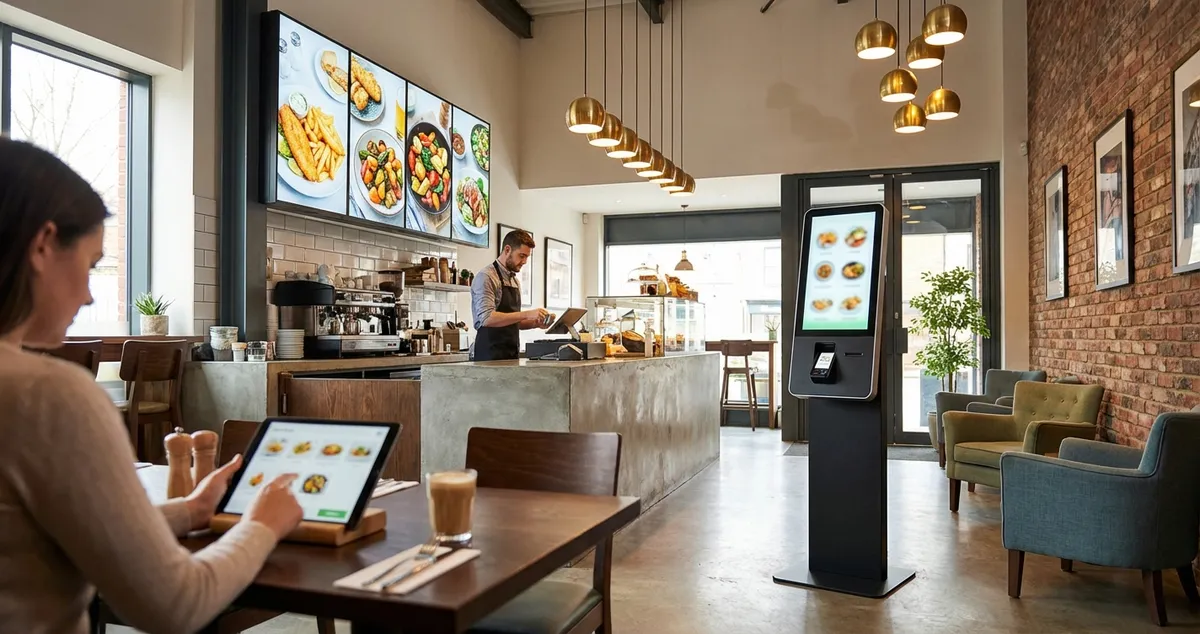
Digital menu technology boosts sales by 3-9% for UK restaurants. Compare QR codes, digital boards, screens and kiosks with costs and ROI.
It is 6pm on a Friday. Your restaurant is filling up. A customer points at the menu asking about the sea bass special. The problem? You sold out two hours ago. Nobody updated the board. Now your server is apologising while tables back up.
If you are thinking "that sounds like my restaurant last week", you are not alone. The reality for most independent restaurant owners is that menu management becomes an afterthought. You are down two staff. The Saturday rush is about to hit. Who has time to update menus?
Digital menu technology solves this exact problem. UK restaurants using digital menus report sales increases of 3-9%. Most see break-even within 9 months (Restaurant Finance Monitor, 2025). But with options ranging from £12-per-month QR codes to £5,000 kiosks, choosing the right solution matters.
What You'll Learn
- The four main types of digital menu technology and when to use each
- Realistic costs in GBP for UK restaurants of various sizes
- How to calculate your potential ROI before committing
- A practical framework for choosing the right technology
What Is Digital Menu Technology?
First, let's define what we mean. Digital menu technology is a framework that replaces printed menus with electronic displays. The technology ranges from simple QR codes linking to your menu on phones to interactive screens enabling payment at the table.
For instance, a busy gastropub might use QR codes at each table. Customers browse and order drinks without waiting for staff. Meanwhile, a fast-food chain might install digital boards behind the counter that switch from breakfast to lunch at 11am automatically.
The core benefit is flexibility. Your supplier runs out of sea bass? Update in seconds. Want to push a special during the quiet 3pm lull? Highlight it instantly. No reprinting needed.
Research from the Polytechnic of Milan found that 72% of customers see digital menus as more professional, according to UKHospitality industry research. This perception often leads to increased repeat bookings. That perception matters when you compete for customers with dozens of options nearby.
Here is the key insight that vendors will not tell you: digital menus do not make bad food taste better, but they do make good food easier to sell.
Info
Related: Digital Menu Boards for Restaurants
The Four Types of Digital Menu Technology
Now that you understand the basics, let us examine the four main options. Each suits different operations. Understanding these distinctions helps you avoid wasting money on features you may not use.

The four main types of digital menu technology compared
Digital Menu Boards
Fixed screens mounted on walls or behind counters. Typically used in quick-service restaurants and takeaways. These boards display your menu in high resolution with motion graphics and daypart scheduling.
Suits: Fast food, takeaways, coffee shops, counter-service
Key benefits:
- Influence customers to change their purchase towards promoted items
- Update prices instantly across multiple locations
- Schedule menus for breakfast, lunch, and dinner automatically
A UK chicken franchise achieved significantly fewer menu errors within six months of implementation (Restaurant Technology Magazine, 2025). For a coffee shop, this means switching from pastries to sandwiches at 11am without staff lifting a finger.
Info
Related: Digital Menu Boards for Restaurants
QR Code Menus
Moving to the most accessible option, QR codes let customers scan with their smartphone. They view your menu on their own device. This offers the lowest barrier to entry. Some solutions start from just £12 per month.
Ideal for: Casual dining, pubs, cafes, low-cost digital solution
Key benefits:
- No hardware investment beyond printed QR codes
- Customers browse, order, and pay from phones
- Saves significantly on menu printing costs
QR ordering has grown substantially in recent years. Major chains including Nando's and Pizza Hut adopted this across UK locations. A neighbourhood pub might use QR codes for table orders during busy periods. This frees bar staff for service.
Info
Related: QR Code Menus
Digital Menu Screens
For restaurants where menu experience matters, interactive screens at tables let customers browse with photos, videos, and detailed descriptions. They go beyond passive display. Diners filter by dietary requirements and view allergen information.
Great fit for: Mid-range casual dining, family restaurants, visual presentation
Key benefits:
- Photos and videos showcase dishes at their best
- Dietary filtering helps customers find options quickly
- Fast loading leads to high completion rates
If you're thinking "my customers prefer traditional menus", the reality is most diners appreciate options. Studies show customers ordering via digital interfaces add extras like desserts more often. A family restaurant might use tablet menus so parents find child-friendly options fast while viewing appealing photos.
Info
Related: Digital Menu Screens
Self-Ordering Kiosks
Finally, for high-volume operations, freestanding touchscreen terminals work well. Customers browse the full menu, customise orders, and pay. No staff needed. These kiosks manage queues during peak times effectively.
Recommended for: Quick-service, food courts, high-volume venues, staffing challenges
Key benefits:
- Reduce queue times during busy periods
- Consistent upselling on most orders
- Free up staff for food prep and service
With 74% of consumers open to automation when venues are understaffed, kiosks address a real pain point. If you can't tell whether your queue is costing you customers or just making them wait, that's usually a sign you need better data. A burger restaurant might place two kiosks near the entrance. Customers often skip the counter queue during lunch rush.
Info
Related: Self-Ordering Kiosk
Comparing Costs and ROI
Now that you understand the technology options, let's talk money. Here is what UK restaurants typically spend on each type.
Note: Costs vary by provider. These figures represent typical ranges for UK independents in 2025-2026.
| Technology | Typical Setup Cost | Monthly Cost | Ideal ROI Scenario |
|---|---|---|---|
| QR Code Menus | £0-200 | £10-50 | Low volume, frequent changes |
| Digital Menu Boards | £800-3,000 per screen | £20-100 | High-traffic counter service |
| Digital Menu Screens | £400-1,500 per tablet | £30-80 | Table service, high tickets |
| Self-Ordering Kiosks | £2,000-5,000 per unit | £50-150 | High volume, peak times |
Most restaurants achieve break-even within 9 months. This comes from increased sales and reduced operational costs combined.
Hidden Print Costs
If you cannot calculate your annual menu printing costs in five minutes, you are likely spending more than you realise. Hidden costs include rush reprints, seasonal updates, and damaged menu replacements.
Which Digital Menu Technology Should You Choose?
With that cost picture clear, here's the practical decision framework. If you are reading this after a 12-hour shift thinking "I do not have time for this", here is a practical framework.
Start with QR codes if:
- You want to test digital menus cheaply
- Your menu changes frequently
- Customers are comfortable with smartphone ordering
- You are a pub, cafe, or casual restaurant
For example, The Crown and Anchor in Bristol started at £15 per month. They saw 12% fewer order errors in the first month.
Invest in digital boards if:
- You have counter-service
- You run promotions regularly
- You need consistent menus across locations
- You are a takeaway or coffee shop
If you're only updating boards when forced you'll always lose to competitors using real-time promotions.
Consider digital screens if:
- Visual presentation matters to your experience
- You want to upsell through imagery
- Your menu includes many dietary options
- You are mid-range or family-focused
Choose self-ordering kiosks if:
- You have predictable peak times with queuing
- Staff costs are a significant concern
- Your menu suits customisation
- You are quick-service or fast casual
For most UK independents, QR codes often offer the best starting point. Low cost. Fast implementation.
The real secret is starting somewhere. Any digital menu is better than an outdated printed one.
If You Only Have 30 Minutes a Week
The reality is you cannot dedicate hours to research. Here is a structured approach that fits a busy week.
Your Quick-Start Checklist:
- Calculate annual menu printing costs (Day 1-2)
- Observe your busiest service and note bottlenecks (Day 3-4)
- Request demos from two providers (Day 5-7)
For instance, a cafe owner might discover £400 annually on menu printing. Plus £200 on rush reprints when prices change. That £600 baseline makes a £30-per-month solution an easy decision.
Ask yourself: would I follow my own restaurant on social media based on its menu presentation? That question often clarifies which solution fits.
If you cannot tell whether your menu drives sales or just fills space, that's usually a sign your presentation needs attention.
Key Trends for 2025-2026
Here is what UK restaurant owners should watch as digital menu technology evolves.
AI-powered personalisation: Menus that adapt to preferences, time of day, and inventory. 41% of UK restaurants plan AI investment for efficiency (UK Restaurant Survey, 2025).
NFC integration: By 2026, NFC may handle 50% of contactless transactions. Tap-to-order features become increasingly relevant.
Sustainability messaging: Digital menus highlight locally sourced ingredients. This appeals to environmentally conscious diners.
Menu diversification: 48% of UK leaders intend to grow menu offerings in 2025. Flexible digital solutions become more valuable.
Key Takeaway
Key Takeaway
Digital menu technology typically delivers 3-9% sales increases for UK restaurants, with 72% of customers perceiving digital menus as more professional. QR codes offer the lowest entry point from £12 per month, ideal for pubs, cafes, and casual restaurants. Digital boards suit high-volume counter service. Self-ordering kiosks reduce queues and free up staff. Most restaurants see break-even within 9 months. For most UK independents, start with QR codes and scale up as you see results.
If you run a restaurant and want to see how Local Brand Hub can support your marketing, explore our restaurant marketing tools and keep your menu and offers organised in one place.
This Week's Action Plan
Day 1-2: Calculate your annual menu printing costs: include rush reprints, seasonal updates, and damaged menu replacements.
Day 3-4: Observe one peak service and write down three specific pain points you notice around menu presentation and ordering.
Day 5-7: Request demos from two digital menu providers that match your restaurant type.
These data points will guide your decision about which digital menu technology fits your restaurant.
For UK restaurant owners
Boost Your Restaurant's Digital Presence
LocalBrandHub helps restaurant owners manage social media, local SEO, and digital marketing from one simple dashboard, complementing your menu technology investment.
Start FreeGet More Marketing Tips
Practical marketing tips for UK business owners, straight to your inbox. No spam, unsubscribe anytime.
About the Author
Local Brand Hub
Empowering UK Businesses
Local Brand Hub provides comprehensive business management tools designed specifically for UK local businesses to streamline operations, automate marketing, and grow revenue.
More articlesRelated Articles
 Marketing Tips
Digital Menu Boards for Restaurants: UK Costs and Guide
Compare digital menu board costs from £499-£7,000, see 38% sales uplift stats, and learn setup requirements. UK pricing and supplier guide for restaurants.
 Marketing Tips
Digital Menu Screens: A Practical Guide for UK Restaurants
Learn how digital menu screens can boost UK restaurant sales by 3-10%. Get realistic costs from £2,000, ROI timelines, and honest UK supplier advice.
 Marketing Tips
QR Code Menus: A Complete Guide for UK Restaurants
Learn how QR code menus can streamline restaurant operations, address customer concerns, and boost efficiency. Practical tips for UK owners.