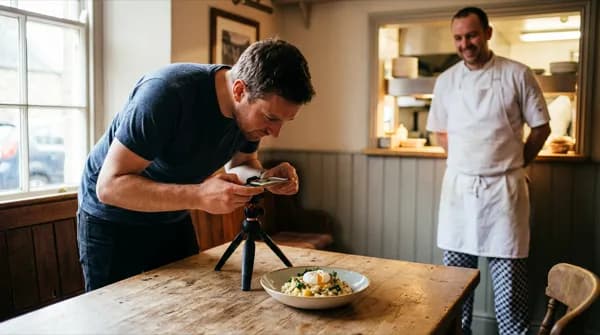
Step-by-step food blogger outreach guide for UK restaurants. Find, pitch, and host bloggers with the 50-15-8 funnel and email templates.
You're scrolling Instagram and a competitor three streets away has a stunning review from a local food blogger. The photos are professional, the caption is glowing, and the comments are full of people tagging friends. You have no idea how they managed it. They did not get lucky. They reached out first.
According to Edelman's Trust Barometer (2025), the majority of consumers trust what influencers and content creators say about brands more than what brands say about themselves. For restaurants, that trust translates directly into bookings.
Info
Related: Restaurant PR, complete guide to restaurant PR
What You'll Learn
- How to find food bloggers in your area using UK-specific platforms
- The 50-15-8 outreach funnel that turns research into restaurant reviews
- How to write a pitch email that food bloggers actually reply to
- What to do (and not do) when hosting a blogger for a tasting
- UK etiquette around gifted meals, disclosure, and expectations
Why Food Blogger Outreach Works for UK Restaurants
First, let's be clear about why food blogger outreach deserves your time. A review from a trusted local food blogger feels like a recommendation from a friend, not a marketing message. That distinction matters when someone is choosing where to eat on a Saturday night.
According to Influencer Marketing Hub (2025), micro-influencers (1,000 to 50,000 followers) deliver the highest engagement rates. For restaurants, micro-influencers are often local food bloggers: the people whose audiences live within driving distance of your venue.
Info
Related: Restaurant Influencer Marketing, paid influencer partnerships
Here is what makes blogger outreach different:
- Long-lasting content. A blog post stays discoverable for months, unlike a paid ad that disappears when your budget runs out.
- SEO value. A backlink from a well-established food blog tells Google your restaurant is legitimate.
- Social proof. Future diners searching your restaurant name will find third-party reviews, and they trust those more than your own marketing.
The reality for most independent restaurants is that blogger outreach feels intimidating because it involves reaching out to strangers. But bloggers are actively looking for content to create. You are not bothering them. You are giving them something to write about.
Finding the Right Food Bloggers in Your Area
Now that you understand why food blogger outreach works, here's how to find the right people. Follower count is a poor measure of value. A blogger with 3,000 highly engaged local followers will generate more bookings than one with 100,000 followers scattered across three countries.
Where to find UK food bloggers:
| Platform | How to Search | What to Look For |
|---|---|---|
| Hashtags: #[yourcity]food, #[yourcity]eats | Local followers, genuine comments | |
| "[your city] food blog" | Active blog (posted in last 3 months) | |
| TikTok | Location-tagged food content | Video quality, local audience |
| Directories | Foodies100, Feedspot UK food blogs | Rankings, update frequency |
Focus on local engagement
A curry house in Leeds should search #leedsfood and #leedsfoodie on Instagram. Sort by recent posts to find active bloggers. Look at comments: genuine engagement from local accounts matters far more than a high follower count.
If you're thinking "I don't have time to scroll through hundreds of profiles," that is exactly what the funnel in the next section solves.
The 50-15-8 Food Blogger Outreach Funnel
With that list of bloggers in hand, here's the system that turns research into results. Effective food blogger outreach is a numbers game with a structure. You cannot pitch one blogger and hope for the best. The 50-15-8 funnel gives you a structured approach that works consistently.
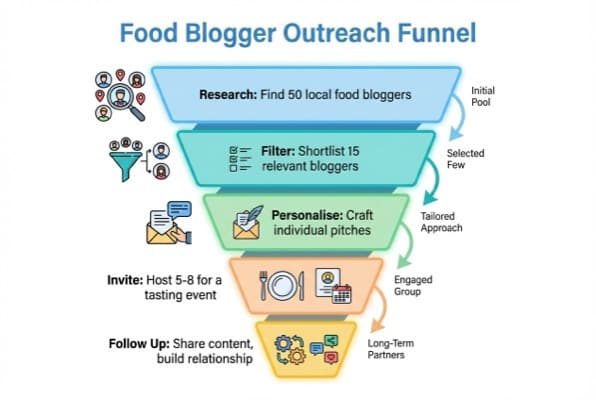
The 50-15-8 funnel: research 50, filter to 15, host 5-8.
Stage 1: Research 50 Bloggers
Build a spreadsheet of 50 food bloggers in your area. For each, note: name, handles, follower count, engagement rate, content type, last post date, and contact method. Skip anyone inactive for 3+ months.
Stage 2: Filter to 15 Strong Matches
Filter to 15 bloggers who fit your restaurant based on: location match (local audience), style match (their tone suits your venue), recent activity, and genuine engagement from real local accounts.
Stage 3: Personalise Pitches to 15
Write individual pitches to all 15. Not a template blast: personalised emails that reference their recent content.
Stage 4: Invite 5-8 for Tastings
From the responses, invite five to eight bloggers for a complimentary tasting. Some will not reply. Some will decline. Five to eight confirmed visits from 15 pitches is a strong conversion rate.
Example in action
A Thai restaurant in Birmingham might research 50 food bloggers, filter to 15 who regularly review Asian restaurants in the West Midlands, pitch all 15 with personalised emails referencing their recent Thai food content, and confirm six tastings over the next two months.
If you're only sending copy-paste DMs to random food accounts you'll always lose to competitors who take the time to personalise.
If you can't tell whether a blogger brings genuine local engagement or just inflated numbers, that's usually a sign you need to look at comments rather than follower counts. Ask yourself: would their audience actually visit my restaurant?
Info
Related: Restaurant Social Media Marketing, social amplification
Writing a Pitch That Food Bloggers Reply To
Next, let's tackle the part where most food blogger outreach fails: the pitch. According to BuzzStream (2024), outreach emails with relevant, contextual personalisation get higher reply rates than emails sent from a template alone.
Pitch template (customise every field):
Subject: [Their Name]: would love to host you at [Restaurant Name]
Hi [Name],
Your recent post about [specific post] really resonated, especially your point about [specific detail].
I'm [your name], owner/chef at [Restaurant Name] in [area]. We [one sentence about your concept].
I think your readers would enjoy our [specific dish or experience] because [reason linked to their content]. I'd love to invite you for a complimentary tasting for two.
No obligations and no expectations for coverage. If you're interested, I'm happy to work around your schedule.
Best, [Your name] [Phone number]
What makes this work
The pitch references their actual content, explains why their audience would care, applies no pressure for coverage, and includes a phone number for a personal touch.
Hosting and Follow-Up
Finally, the blogger said yes. Now what? The tasting experience determines whether you get a glowing review, a lukewarm mention, or nothing at all.
Info
Related: How to Get Press Coverage for Your Restaurant, broader press coverage tactics
Before the visit:
- Confirm the date, time, and number of guests (usually the blogger plus one)
- Brief your front-of-house team: excellent but natural service, not over-the-top attention
- Serve dishes as they would normally appear: bloggers can spot a specially plated "press version"
During the visit:
- Greet them personally, then step back and let them enjoy the meal
- Do not ask them to photograph specific dishes or angles
Setting the scene
A gastropub might seat the blogger at a quiet corner table where natural light works well for photography, serve the standard menu rather than a special "press version," and have the chef stop by briefly to explain the sourcing behind the signature dish.
The most important rule: treat them like a valued guest, not a marketing tool. If you are genuine and the food is good, the review will reflect that. If you are pushy and transactional, word gets around fast.
If you're reading this after a blogger visit that went awkwardly, you are not alone. It gets easier, and the content they produce is worth the initial discomfort.
After the Visit
Within 48 hours: Send a brief thank-you. Don't ask about their review timeline or whether they plan to post, because that pressure undermines the relationship you just built.
When they post: Share their content on your own channels (our social post generator helps you turn a review into on-brand posts fast), and engage with comments on their post. This amplification shows you value their work beyond the free meal.
Ongoing: Keep them on a list of contacts. When you launch a new menu or host an event, send a personal message. According to Later (2025), the majority of micro-influencers prefer long-term brand relationships over one-off collaborations.
UK disclosure rules
Under ASA guidelines, bloggers must disclose gifted meals with tags like #ad or #gifted. Do not ask them to hide the disclosure. Transparency builds trust.
If you run a restaurant and want to see how Local Brand Hub can support your marketing, explore our restaurant marketing tools.
Key Takeaway
Key Takeaway
- Use the 50-15-8 funnel: research 50, filter to 15, pitch all 15, host 5-8
- Personalise every pitch by referencing the blogger's recent content
- Host bloggers like valued guests, not marketing assets: no pressure for coverage
- Follow up within 48 hours and amplify their content when they post
- Build ongoing relationships for repeated mentions, not just one-off reviews
Food blogger outreach is not about getting free advertising. It is about earning a recommendation from someone your future customers already trust. That distinction changes how you approach every interaction.
Weekly Action
If you only have 30 minutes a week, do this:
- Day 1-2: Search three hashtags on Instagram for food bloggers in your city and add ten to a spreadsheet with name, handle, follower count, and engagement notes
- Day 3-4: Review your list and draft one personalised pitch email referencing the blogger's recent content
- Day 5-7: Send the pitch and engage with two food bloggers' posts by leaving genuine, thoughtful comments on their latest content
For restaurants, salons, and local businesses
Need help with your marketing?
We help UK businesses turn social media into real results, not busywork.
Start freeFrequently Asked Questions
How much does food blogger outreach cost?
The primary cost is a complimentary meal for the blogger and one guest: typically £50 to £150 per visit depending on your menu prices. There is no fee for editorial coverage from genuine food bloggers. If someone requests payment for a review, that is paid influencer marketing, not blogger outreach.
Should I invite food bloggers or wait for them to find me?
Reach out proactively. Most food bloggers have long lists of restaurants to visit, and yours is competing for limited slots. A personalised invitation puts you at the front of that queue. Active outreach produces results in weeks rather than months.
What if a food blogger writes a negative review?
Respond professionally and briefly. Do not argue with their opinion. If the criticism is valid, fix the issue and consider inviting them back in a few months. Most bloggers respect a restaurant that takes feedback seriously.
How many food bloggers should I work with per year?
Aim for six to twelve visits per year, roughly one per month. Time visits around menu launches and seasonal changes for maximum relevance.
Get More Marketing Tips
Practical marketing tips for UK business owners, straight to your inbox. No spam, unsubscribe anytime.
About the Author
Local Brand Hub
Empowering UK Businesses
Local Brand Hub provides comprehensive business management tools designed specifically for UK local businesses to streamline operations, automate marketing, and grow revenue.
More articlesRelated Articles
 Marketing Tips
Content Marketing for Restaurants: A Practical Guide
Master content marketing for restaurants using the 5 C's framework and the 30/30/30 rule. Actionable ideas that bring more diners through your door weekly.
 Marketing Tips
Restaurant Blog Ideas Only Your Kitchen Could Write
Restaurant blog ideas a rival two streets away could not copy: the test that kills weak topics, where the material sits, and a twenty minute method.
 Marketing Tips
Restaurant Content Calendar: A Free UK Template for 2026
A restaurant content calendar that survives service. Copy the seven column UK template, plan what you shoot before what you say, and start this week.